
The effect of screencast feedback on the performance of the IELTS essay writing component among pre-service teachers of English: An intervention study in Chile
Official IELTS research report on IELTS Test - Writing; Impact and Washback - Improvement in test scores; Impact and Washback - Stakeholder attitudes; Impact and Washback - Test preparation; Impact and Washback - Use of test scores; Technology, published in 2022.
Abstract
This study explores the effect of screencast feedback on EFL pre-service teachers’ IELTS essay skills and examines their perceptions of this type of feedback.
This is a two university action research study with the main aim of examining the effect of screencast feedback provision on pre-service teachers’ IELTS essay writing component.
The study followed an action research design that consisted of four written tasks based on the IELTS essay writing component. The study also aimed at identifying students’ perceptions of the provision of screencast feedback on writing.
The results showed a statistically significant improvement regarding the four IELTS writing components: Task response, Coherence and cohesion, Lexical resource, and Grammatical range and accuracy. Participants were able to connect ideas better, made use of a wide range of vocabulary, and used more complex sentence structures. Regarding participants’ perception, it could be noted that they showed a positive perception towards screencast feedback in terms of comprehension, organisation, elaboration of ideas and structural issues.
Finally, it was also observed that most participants preferred screencast feedback over written comments.
1 Introduction
Writing in a second language is considered a very difficult process (Mubarak, 2017; Wanja, 2016; Warschauer, 2010). To this end, it is very important that the support given to students through the provision of feedback strategies is effective. Feedback is defined by Hattie & Timperley (2007, cited in Yang, et al. 2021, p. 611) “as information given by an agent regarding aspects of one’s performance or understanding”. In this context, during the production of a piece of text students face different types of language problems: poor vocabulary, difficulties with grammar, organisation of ideas, sentence structure, among others. In order to deal with these issues, language teachers have to provide different types of feedback. One common issue during this process is to define the appropriate feedback for writing: focused, unfocused, metalinguistic, non-metalinguistic, according to the learners’ needs. Apart from choosing the right type of feedback, the manner in which the said feedback is delivered to students is an equally important decision teachers face every day in their classrooms.
Since the 1990s, the modality in which the different types of feedback (paper-based, oral, audiotaped, digitally written, digital audio or screencast) can be provided efficiently and effectively has been gaining increasing attention from researchers worldwide. In past years, written comments were the most traditional way of feedback provision. However, thanks to the advances in technology, now feedback can be provided not only through written comments but also by creating recordings using audio and video. In this context, screencast feedback (SCF) allows “EFL teachers to provide constructive feedback by recording the computer screen as the teacher comments on student work, usually by adding writing, drawings and voiceover” (Bakla, 2018, p. 319). In this sense, the feedback given to writing becomes a process in which different elements are combined that may favour different learning preferences. Thus, the aim of this action research project is to investigate the effect of screencast feedback on the performance of the IELTS essay writing component among Chilean pre-service teachers of English.
2 Literature review
This section defines and describes key concepts of the writing skill, feedback strategies and modes of feedback. It gives a detailed description of screencast feedback, the focus of this study, and shows an overview of previous research-related studies.
2.1 Writing in a second language
Writing in a second language is considered a very difficult process (Klimova, 2014). This is due to the fact that the development of this skill involves different phases (drafting, revising, editing and proofreading a text) before accomplishing a final version (Abas & Aziz, 2016; Harmer, 2004; Hayes & Flowers, 1987). During these phases, the teacher has to focus on different aspects of a text that include: organisation of ideas, vocabulary, coherence and cohesion, grammar structures, punctuation, among others. Some of these aspects require more revision than others and this will depend on each learner’s skills.
The revision process involves the provision of feedback, a strategy that plays a very important role during error correction. Nevertheless, it is also very important to consider the type of feedback given on learners’ writing and the mode or modality as well. Regarding the types of feedback strategies, the feedback can be positive and negative (also called corrective feedback). In the case of written corrective feedback, according to Ellis’s (2009) taxonomy, feedback can be implicit/explicit, direct/indirect, focused/unfocused, metalinguistic, non-metalinguistic.
Studies related to the most appropriate feedback are not conclusive; in fact, research has not identified the best type of feedback yet because its effect may depend on different factors: depths of understanding, learning preferences, task type, among others (Lipnevich & Panavero, 2021).
As to the modes of feedback provision, at present, technological tools have allowed the use of different modes that are identified as audio and audio/video. Each of these modes of feedback is supposed to have advantages and disadvantages. However, screencast feedback (audio/video), the focus of this study, “has widely become an alternative to traditional written corrective feedback” (Pachuashvili, 2021, p. 68), as it combines different modes of feedback provision.
2.2 Screencast feedback
Carr & Ly (2009) define screencasting as a method of capturing actions performed on a computer; this includes mouse movements and clicks on web browser links, in the form of video. The video can then be attached in the email, a web link or be uploaded to a cloud. In the field of education, screencast is used to provide information, tell a story, introduce concepts and provide feedback. The duration of a screencast can vary, from a few minutes to 15 or 20 minutes. This depends on learners. However, the shorter the screencast is, the better, because “longer screen streams can be boring and counterproductive” (Harper et al. 2015, p.13).
2.3 Benefits of using screencast feedback on writing
A key benefit of screencast feedback is that this tool combines the two main senses for learning: visual and auditory (Mayer & Moreno, 2003). While providing screencast feedback, it is possible to use underlining, colouring, bolding, boxing and other similar highlighting strategies. This is particularly important with respect to providing clearer feedback because vague feedback is commonly cited as a source of confusion among learners. However, screencast feedback allows teachers to get engaged in a kind of dialogue with the student, thereby promoting comprehension and engagement (Cranny, 2016).
Screencasts provide learners with certain level of flexibility in receiving feedback. They can watch the video as many times as they wish and use the pause and rewind functions whenever they need them (Cranny, 2016; Lee, 2017). This could be highly beneficial for learners’ writing performance. While watching the videos, learners could take notes or directly transfer what they have learned from the screencast feedback to the written work to correct it. This makes video feedback a practical tool that could help improve the quality of EFL writing. Individualisation, in the form of pausing, fast forwarding, and rewinding and re-watching could improve the quality of communication by boosting learners’ comprehension. Another benefit of screencast feedback is that it allows flexibility and accessibility. Learners can have access to the screencast videos using computers or mobile devices anywhere and anytime as long as they have access to internet connection (Cranny, 2016). Such an advantage also allows them to practice their writing skills even in an out-of-the-classroom setting or in a distance learning modality.
Additionally, the use of screencast could bring about some affective benefits as well. For instance, screencast feedback provides a clear and organised view of the aspects of writing to be improved, and as a result, learners do not get overwhelmed with coloured scribbles that are dispersed around traditional written corrective feedback. In fact, coloured scribbles are considered as a sign of failure by learners. They could cause learners to feel that they might not be able to write a good paragraph or essay. Therefore, experienced teachers know that writing lots of comments on student assignments might not be very useful and counter-productive on some occasions.
As learners do not see the audio comments on the writing, they do not get discouraged or demotivated when getting screencast feedback. In contrast, if teachers ask their learners to give feedback to each other and upload the resulting screencast on YouTube or similar social media platforms, they might feel that what they express in writing or orally really matters because they are using the language more authentically. Although screencast feedback significantly reduces the time spent for writing comments, it is not possible to say that this mode of feedback is a real time-saver. This is because the teacher has to allocate some time uploading the videos on the internet and sharing them with students. Moreover, in some studies, participants reported some technology-related problems such as difficulty in uploading and downloading the screencast (Ali, 2016).
Furthermore, current research suggests that SCF increases the social presence of the teacher (Harper et al., 2015). This is true of audio feedback as well (Ice, Reagan, Perry, & Wells, 2007), but not of written feedback (WF). As Chang et al. (2017) note, audiovisual feedback, promotes proximity between teachers and students, so it could help improve the quality of student writing. For instance, according to the participants in Ducate & Arnold’s (2012) study, the teacher was considered more caring when using SCF (cited in Elola & Oskoz, 2016). Moreover, while screencast help increase social presence, they decrease possible pressure caused by face-to-face conferences (Lee, 2017). Such feelings are critical, as they could help establish rapport. As with SCF, learners who received audio feedback (AF) in several studies also reported that the teacher cared for them and attached importance to their work (Cavanaugh & Song, 2014; Ice et al., 2007; Sipple, 2007). In a more recent study, Ali (2016) worked with 63 mixed-level students to compare WF and SCF and obtained findings in favour of the latter. The participants thought that SCF was “personal, specific, supportive, multimodal, constructive, and engaging” (p. 131).
Research suggests that SCF could guide learners better in drafting their essays. The quality of communication gets higher in screencast feedback due to the rapport established. In this respect, as Gormely & McDermott (2011) found, screencast could be engaging and motivating for students, and an efficient way of providing formative feedback to L2 students (Cranny, 2016). Written feedback is often limited, but while producing a screencast, the teacher could provide detailed and comprehensible audio feedback with visual support. It is possible to focus on both macro and micro level issues by providing detailed feedback.
As to students’ perception of screencast feedback, a number of studies show that there is a positive perception (Ali, 2016; Moore & Filling, 2012; Morris & Chikwa, 2014; Orlando, 2016; West & Turner, 2016). For example, Harper et al. (2015) affirm that students feel closer to the teacher through an audio and visual tool. In addition, they also view feedback as more personal and supportive. Gormely & McDermott (2011) also declare that students find screencast feedback more engaging and motivating. In other studies, carried out by West & Turner (2016) and Whitehurst (2014), learners declared that they preferred screencast feedback due to the fact that it was easier to understand it. Likewise, Merry and Orsmond (2008) stated that learners regarded audio and visual feedback as more meaningful because it helped them understand the teacher’s comments better.
3 Methodology
3.1 Research questions
The research investigates screencast feedback, focusing on two research questions.
- What is the effect of screencast feedback on the English performance of pre-service teachers in the essay writing component of IELTS?
- What are the pre-service teachers’ perceptions of screencast feedback?
Providing answers to these questions will be of assistance for teachers, students and researchers to reflect on screencast feedback and to consider using it in their classroom practices.
3.2 Research design
This study follows an action research design, and uses a small sample of 4th and 5th-year EFL pre-service teachers. It seeks to modify and improve essay writing teaching practices through a screencast-based intervention. Figure 1 portrays the different stages of action research, which will be described below:
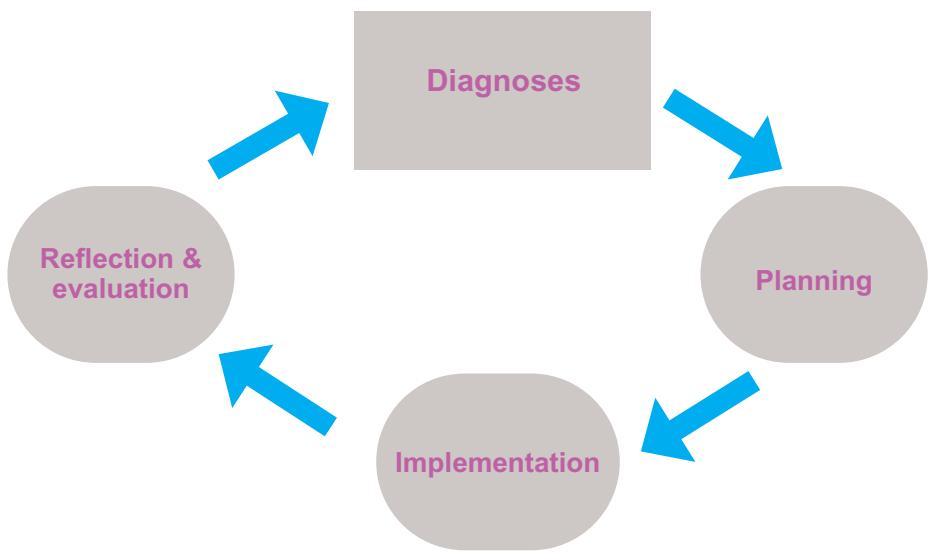
Figure 1: Stages of action research, based on Pérez Serrano (1998), Teppa (2006) and Suárez Pozos (2002).
3.2.1 Diagnosis
As shown in Figure 1, during the first part of this action research, a problem was identified during the diagnosis stage. It is well known that writing in a second language is one of the most difficult language abilities because it implies the management of different competencies, such as organisation of ideas, the use of a wide range of vocabulary, coherence and cohesion, grammar, among many others (Anderson & Cuesta, 2019; Del Pilar, Castelló Badía & Badía Gargante, 2016).
The development of this competence is even harder when writing an academic essay in English, and especially in a context in which English is not spoken. As to the essay writing component of IELTS, the time limit is another factor that counts. Writing under time pressure makes students feel more anxious and this factor usually has a negative effect on their performance. This is the case of pre-service teachers of English from two universities in the south of Chile.
According to the national standards for EFL teacher education pre-service teachers of English have to show their English proficiency through an international exam like IELTS, when they are in their fourth or fifth year of teacher preparation. To achieve this goal, pre-service teachers need to spend many hours of their curriculum to master the four language skills proficiently. However, there are many factors that interfere in this preparation process. One of them is the large number of students per class. This factor prevents teacher educators from providing quality and frequent feedback as it is an exhausting task. Consequently, pre-service teachers’ results in IELTS are not that satisfactory, since the writing component is the one in which they usually score the lowest.
The arguments given in the previous paragraph highlight the urgent need for more effective methods for the development of IELTS essay writing skills among Chilean pre-service teachers of English.
3.2.2 Planning
After the identification of the research problem, an action plan was defined and it consisted of a series of strategies used when providing screencast feedback. The action plan is explained in detail below, in the procedure section (Screencast feedback protocol, Section 3.4).
3.2.3 Implementation
The intervention lasted 24 weeks. During the study implementation, each participant wrote four argumentative essays. As it can be observed in Figure 2, after the pre-writing phase (examples of essays, layout, brainstorming of ideas), each student wrote a draft in a Microsoft Word document. Then, participants had to send the draft to the teacher, who provided screencast feedback through the screencast-o-matic application (https://screencast-o-matic.com). After this, participants went through and revised the feedback given via screencast and worked on a new piece of text. The idea of applying the feedback in the following writing piece was to observe if participants were able to process, retain and use this new information in a different piece of writing. Besides, current studies in the field of writing refer not only to feedback strategies but also to the concept of ‘feedforward’, understood as “the willingness to act on the information received and use it to modify a new text” (Álvarez & Difabio de Anglat, 2018, p. 10). In this way, participants’ writing performance can be observed in a new learning context.

Figure 2: Writing process for the IELTS essay writing component
After each essay writing assignment, participants were given screencast feedback on a weekly basis (see Figure 3). Participants were not asked to rewrite the text, instead they were instructed to apply their new writing knowledge and competencies in the next writing task.

Figure 3: Implementation of the screencast feedback methodology
3.2.4 Reflection and evaluation
After the provision of each screencast feedback, there was a period of analysis, reflection and evaluation in order to observe the learners’ progress.
During this period, it was observed that learners made different types of decisions. For example, some of them did not make the same type of mistake again. In this respect, the type of mistake that was not usually repeated was the one that had to with the essay format.
Some participants who received their first screencast feedback did not make the same mistake in writing task 2. However, it could be perceived that they were not able to retain and apply the feedback provided and, as a result, they made the same type of mistake in writing task 3. When this was the case, the feedback was reinforced. This situation usually happened with grammatical errors, which seemed to be the most difficult to internalise.
There were a few participants who did not show a better performance in the subsequent writing. The conclusion is that these students probably did not pay much attention to the screencast feedback. It could also be assumed that these participants watched the video just once.
Depending on the results, the screencast feedback given to the next piece of writing was always reinforced or modified.
3.3 Participants
The participants were fourth and fifth year pre-service teachers of English from two Chilean universities, who were completing their language development courses to reach a C1 (7.0-8.0 IELTS band score) English level, according to the Common European Framework of Reference for Languages (CEFR) and meet one of the standards of the Chilean Ministry of Education for teachers of English. The participants of the intervention were 30 EFL teacher candidates, of whom 70% were female and 26.7% male. As shown in Table 1, the 30 participants were teacher candidates from two universities whose curriculum plan each lasted five years and aimed at developing an advanced English level and sound pedagogical skills. Twenty (66.7%) participants were from university 1, while ten (33.3%) were from university 2.
Table 1: Participants’ distribution according to gender and university
| N | % | ||
|---|---|---|---|
| Gender | Female | 21 | 70% |
| Gender | Male | 8 | 26,75 |
| Gender | Non binary | 1 | 3,3% |
| Institution | One | 20 | 66,7% |
| Institution | Two | 10 | 33,3 % |
3.4 Procedure
The provision of screencast feedback follows the phases of the writing process: planning, editing and revising. The feedback used was made up of positive and corrective comments. The protocol used during the provision of feedback followed the recommendations given by Whitehurst (2014), who states that teachers should give feedback in different ways to meet students’ learning preferences. Based on this, the following steps were taken for providing screencast feedback (see Appendix 3).
- The teacher explained the task and provided guidelines.
- Each participant wrote his/her essay in a Microsoft Word document.
- Participants turned in their assignment.
- The teacher started revising the text and provided screencast feedback using the software, Screen O’matic (https://screencast-o-matic.com). During this phase, the teacher followed a protocol that included some recommendations given by Whitehurst (2014) for screencast feedback (see Figure 4 below).
Furthermore, during the video recording process, the teacher had the camera on while giving feedback (see Appendix 1). This means participants could see the teacher’s facial expressions during feedback provision. Additionally, the teacher used corrective and positive feedback and different types of strategies (positive/corrective) and elements (highlighting links to websites for further practice), to attract participants’ attention on errors, as illustrated in Figure 4.

Figure 4: Teacher’s strategies to promote error correction, taken from Whitehurst (2014)
As portrayed in Figure 4, the teacher followed specific steps, adapted from Whitehurst (2014) to orient participants towards error correction, including:
- Greeting (the teacher called students by name).
- The teacher provided global comments on strong and weak points.
- The teacher provided corrective and positive feedback.
- The teacher also highlighted ideas, underlined words and inserted links for further practice.
- The teacher ended the video talking to the student and inviting him/her to make the corresponding corrections.
- The teacher sent the video for students’ correction.
- Students watched the video as many times as they considered it as convenient.
- Students wrote a new essay and the process was repeated.
3.5 Data collection techniques
This study employed quantitative and qualitative techniques to gather the participants’ data, including four IELTS essay writing tasks, the IELTS writing rubric, a multimodal survey (see Appendix 1) and the researchers’ notes.
3.5.1 IELTS essay writing tasks
For each of the argumentative essays (see Appendix 2), participants had to write a text consisting of an introduction, body paragraphs and a conclusion. After each essay task, participants received screencast feedback. Essays one and four were considered as the pre-intervention test and the post-intervention test, respectively. The choice of topics participants had to write their essays were selected from past IELTS essay exams and are described as follows:
-
Essay 01 topic: A foreign language should be learned as soon as children start school. To what extent do you agree or disagree with this opinion? Give reasons for your answer and include any relevant examples from your own knowledge or experience. Write at least 250 words.
-
Essay 02 topic: Education should be accessible to people of all economic backgrounds. All levels of education, from primary school to tertiary education, should be free. To what extent do you agree with this opinion? Write at least 250 words.
-
Essay 03 topic: Some people believe that children should not be given homework every day, while others believe that they must get homework every day in order to be successful at school. Discuss both sides and give your opinion. Write at least 250 words.
-
Essay 04 topic: The role of education is to prepare children for the modern world. Schools should cut art and music out of the curriculum so that children can focus on useful subjects such as information technology. To what extent do you agree? Write at least 250 words.
3.5.2 IELTS writing component rubric
The IELTS writing rubric was employed to assess each one of the essay tasks. It had four different criteria: Task response, Coherence and cohesion, Lexical resources and Grammatical range and accuracy.
3.5.3 Multi-modal feedback survey
This instrument designed by Vincelette & Bostic (2013), explored pre-service teachers’ perceptions of screencast feedback, and consisted of 19 Likert scale items. These items were organised into the following four dimensions.
- Attending and engagement: it measured participants’ attentiveness and engagement (3 items).
- Incorporation of revision: it explored participants’ ability to incorporate the revisions suggested (5 items).
- Feedback quality/quantity: it examined participants’ perceptions of the feedback quality and quantity (6 items).
- Preference: it looked into participants’ preferences for using this type of feedback as opposed to the more traditional written comments given by instructors (5 items).
Additionally, the survey (see Appendix 3) included the following qualitative item:
- How did you use the screencast feedback provided to improve your next argumentative essay?
3.5.4 Researchers’ notes
Informal descriptions of observed or unexpected events were collected along the intervention by the two researchers to constantly reflect on what was being done. The notes were registered in a Word file and were compared throughout the research process. These research notes were used to register participants’ reactions or decision-making in a subsequent piece of writing, after the screencast feedback was provided. These notes were also very effective to contextualise and give sense to some of the findings.
3.6 Data analysis techniques
As a starting point, data analysis should always match the research questions. Action research can benefit from varied approaches to disciplined inquiry that includes both qualitative and quantitative approaches. The idea is to think carefully of the methods that should be used to gain reliable data. In most cases, descriptive statistics will suffice for the analysis of action research data. However, inferential statistics may be required if it is necessary to compare groups or measure relationships between variables (Creswell, 2005). In fact, typical inferential statistics is not common in action research, but this does not mean it is forbidden as long as it is used to answer the research questions.
Action research allows for the use of all types of data collected through the use of a wide variety of techniques. It is important to collect multiple measures on a variable of interest in a given study that can allow researchers to triangulate the collected data, integrating or relating multiple sources of data to establish their quality and accuracy. In this sense, inferential statistics provide additional information for the data analysis, particularly if one is looking at how a group changes over time or writing improves as an intervention sequence is being implemented (Mertler, 2009).
For research question one, descriptive (means and standard deviations) and inferential (ANOVA) statistics are employed and complemented by qualitative extracts from participants’ essay tasks. Research question two utilises descriptive and inferential statistics (means, standard deviations, correlations, t-tests) and thematic analysis is also employed. This qualitative analysis was recursive and dynamic, and it became more intensive as the study progressed. Once qualitative data from the question How did you use the screencast feedback provided to improve your next argumentative essay? was transcribed, these steps were followed:
- Data was coded using numbers and phrases to assign an attribute. Open coding was used for short segments of data.
- The short segments and codes that seemed to go together were grouped (axial coding).
- Then recurring regularities or patterns were sought to continue the process of data sorting. They became the themes, which captured the patterns. The names for themes came from a combination of participants’ exact words and literature on the topic. Theme construction was based on the following principles from Merriam & Tisdell (2016) and Flick (2018): responsive to the research question; exhaustive; mutually exclusive; sensitising; and conceptually congruent.
- Using the constant comparative method, the list of themes was revised and combined again into fewer more comprehensive themes and subthemes, which offered rich detail.
- Once the list of themes and subthemes was refined, a frequency count was done for the subthemes and relevant data extracts were employed to illustrate each subtheme. The themes, subthemes, frequency count and data extracts were organised into tables.
- To visualise word frequencies in participants’ responses, the web application TagCrowd was used. It allowed the creation of word clouds which helped to summarise and communicate ideas in a single glance.
- To ensure that results were consistent and dependable, investigator triangulation was employed. Two different researchers analysed the data and compared their findings. There were at least four different online sessions between researchers until they felt that findings were saturated, and no new information surfaced.
4 Findings
This section presents the findings of the intervention that examined the effect of screencast feedback on a group of 30 pre-service teachers’ performance through four IELTS essay writing tasks. The essays were assessed according to the four criteria from the band descriptors of the IELTS writing task, namely, Task response, Coherence and cohesion, Lexical resource, and Grammatical range and accuracy.
The Findings section has been organised into two parts according to the two research questions. In the first research question, four one-way ANOVA (Field, 1998, 2009; Howell, 2006; Rosenthal et al., 2000) measurements were carried out to identify statistically significant differences in the means of each assessment criterion in the four essay writing tasks. Post-hoc tests helped determine the essay writing tasks in which the statistical difference was found. Additionally, extracts of the participants’ essays per each criterion were compared to complement the quantitative analysis from a qualitative perspective.
4.1 RQ1: What is the effect of screencast feedback on the English performance of pre-service teachers in the essay writing component of IELTS?
4.1.1 Assessment criterion 01: Task response
A one-way within-subjects analysis of variance (ANOVA) was conducted to explore the variation of the scores of the Task response criterion (factor 1) among the four essay writing tasks. Results indicated that the difference found had a significant effect , as shown in Table 2. Therefore, since the effect of factor 1 was significant, the difference of the means in the essay writing tasks was also statistically significant.
Table 2: Tests of within-subjects effects for Task response criterion
| Source | Type III Sum of Squares | Df | Mean Square | F | Sig. | |
|---|---|---|---|---|---|---|
| Factor1: Task response | Sphericity Assumed | 23.200 | 3 | 7.733 | 4.332 | 0.007 |
| Factor1: Task response | Greenhouse-Geisser | 23.200 | 2.373 | 9.775 | 4.332 | 0.012 |
| Factor1: Task response | Huynh-Fieldt | 23.200 | 2.599 | 8.927 | 4.332 | 0.010 |
| Factor1: Task response | Lower-bound | 23.200 | 1.000 | 23.200 | 4.332 | 0.046 |
| Error(factor1) | Sphericity Assumed | 155.300 | 87 | 1.785 | ||
| Error(factor1) | Greenhouse-Geisser | 155.300 | 68.829 | 2.256 | ||
| Error(factor1) | Huynh-Fieldt | 155.300 | 75.371 | 2.060 | ||
| Error(factor1) | Lower-bound | 155.300 | 29.000 | 5.355 |
a. Computer using alpha = .05
Having determined the significant difference of the participants’ Task response scores, a post-hoc test using the Bonferroni adjustment was used to specifically identify the essay writing tasks in which this difference was found, as shown in Table 3.
Table 3: Descriptive statistics and Bonferroni post hoc test for Task response criterion
| Mean | Std. Deviation | N | Bonferroni sig.* | |
|---|---|---|---|---|
| Task response 1 (1) | 5.13 | 1.795 | 30 | 4 (0.043) |
| Task response 2 (2) | 5.27 | 1.721 | 30 | 4 (0.014) |
| Task response 3 (3) | 5.47 | 1.634 | 30 | 4 (0.031) |
| Task response 4 (4) | 6.27 | 1.552 | 30 | 1.2.3 (0.063. 0.014. 0.031) |
*. The mean difference is significant at the .05 level.
In particular, the post-hoc test results revealed that pre-service teachers’ Task response scores were significantly different between:
- essay writing task 1 and 4 (Task response criterion mean score in writing task 1=5.13; Task response criterion mean score in writing task 4=6.27; p=0.043)
- essay writing task 2 and 4 (Task response criterion mean score in writing task 2=5.27; Task response criterion mean score in writing task 4=6.27; p=0.014)
- essay writing task 3 and 4 (Task response criterion mean score in writing task 3=5.47; Task response criterion mean score in writing task 4=6.27; p=0.031).
Furthermore, the significant differences identified in the participants’ scores are consistent with the estimated marginal means, that is to say, the average values of the Task response criterion across the four different essay writing tasks, as illustrated in Figure 5.

Figure 5: Estimated marginal means of Task response criterion
Hence, the estimated marginal means indicated that pre-service teachers’ Task response scores increased progressively throughout the four writing tasks and reached their highest average in the final writing task.
In addition, the steady increase in the pre-service teachers’ Task response criterion scores matched with the participants’ writing improvements from a qualitative stance. Table 4 shows extracts of the participants’ progression on how they stated their position and approached the first and fourth essay writing tasks.
Table 4: Participants’ essay extracts for the Task response criterion
| Participants | Essay writing task 01 | Essay writing task 04 |
|---|---|---|
| Participant 2 | As a foreign language, English has turned into one of the most important tools in this globalized world. Parents are more and more interested in their children learn another language given the several advantages it has for their development. For that reason, learning English as a foreign language at an early age, especially as soon as children start school, is seen as an advantage in terms of ease for acquiring new sounds, sociability, and better prospects for the child in future. | What would be of human lives if music and art did not exist? Perhaps, people would be living in a sad and tedious world. Art and music are disciplines present in the Chilean curriculum given their numerous benefits for student in the academic aspect, as well as in the socioemotional one. Therefore, art and music should be permanently included in the Chilean national curriculum. |
| Participant 18 | Learning a second language should be learned as earlier as possible when we are children. Even if over the year it has been argued that there is no connection with the time we learn, there are several reasons that can help to believe the contrary. First, if we learn a second language when we are young, our way of thinking can be expanded, also as we have more time to learn we can become more confident and knowledgeable about it when we are older and last the learning process is faster at early stages of our lives which can give us a more flexible understanding of the language. | To conclude, art and music should not be excluded from the Chilean curriculum because it would cause negative effects on students, compromising their performance, depriving their time of artistic space and enclosing students’ intelligences to linguistic and analytical. All these reasons led to the result that these subjects are beneficial for students and should continue being incorporated in the actual curriculum. |
| Participant 10 | I agree with this statement for several reasons. Firstly, as everything in life, we should not postpone objectives that we have, regarding our human development because if we try to accomplish them, these will be harder as we decided to wait for a long time to begin. | The removal of certain subjects from the curriculum to promote the learning of other subjects that are considered more relevant has always been under discussion. However, students should be trained and should have contact with all the areas of knowledge, so they can know what it feels like to learn more disciplines. For that reason, I disagree with the idea of removing certain subjects, for example, music or arts in favour of others because of the following reasons. Firstly, all subjects should be treated equally as they are all disciplines that contribute to our society. Without music or acting, for instance, there would be no musicians or artists who could deliver entertainment content to their audiences. |
| Participant 9 | Have you ever wondered when it is the appropriate time to learn a foreign language? It is well-known that the brain’s capacity to learn something new declines with age. Therefore, there are two critical reasons why a foreign language should be learned as soon as children start school. | Education plays a vital role in the development not only of a country but also of an individual. It is claimed that Art and Music should be removed from the curriculum so that children can focus on crucial topics. Although some people believe that it would help students, I am against that false argument. First, art and music subjects provide students with a well-rounded education. Getting the proper instruction is vital to life achievement as well as nutrition is vital to the human body. |
Hence, throughout the completion of the different writing tasks, pre-service teachers became more skilled at stating their points and their opinions clearly and supporting them accordingly. This qualitative improvement is also supported by the increase of the participants’ Task response scores from a quantitative view.
4.1.2 Assessment criterion 02: Coherence and cohesion
Regarding Coherence and cohesion scores (factor 1), the results of the one-way within-subjects ANOVA indicated that there was a significant effect of this criterion in the essay writing tasks [; ], as shown in Table 5. Since the effect of this factor was significant, the difference in the participants’ Coherence and cohesion scores in the essay writing tasks was statistically significant as well.
Table 5: Tests of within-subjects Effects for Coherence and cohesion criterion
| Source | Type III Sum of Squares | Df | Mean Square | F | Sig. | |
|---|---|---|---|---|---|---|
| Factor1: Coherence and cohesion | Sphericity Assumed | 32.533 | 3 | 10.844 | 6.646 | 0.000 |
| Factor1: Coherence and cohesion | Greenhouse-Geisser | 32.533 | 2.555 | 12.736 | 6.646 | 0.001 |
| Factor1: Coherence and cohesion | Huynh-Fieldt | 32.533 | 2.822 | 11.527 | 6.646 | 0.001 |
| Factor1: Coherence and cohesion | Lower-bound | 32.533 | 1.000 | 32.533 | 6.646 | 0.015 |
| Error(factor1) | Sphericity Assumed | 141.967 | 87 | 1.632 | ||
| Error(factor1) | Greenhouse-Geisser | 141.967 | 74.081 | 1.916 | ||
| Error(factor1) | Huynh-Fieldt | 141.967 | 81.845 | 1.735 | ||
| Error(factor1) | Lower-bound | 141.967 | 29.000 | 4.895 |
a. Computerusingalpha = .05
The results of the post-hoc test, which used the Bonferroni adjustment, revealed the specific essay writing tasks in which the Coherence and cohesion scores were significantly different as illustrated in Table 6
Table 6: Descriptive statistics of the Bonferroni post hoc test for the Coherence and cohesion criterion
| Mean | Std. Deviation | N | Bonferroni sig. | |
|---|---|---|---|---|
| Coherence and cohesion 1 (1) | 5.13 | 1.756 | 30 | 4 (0.011) |
| Coherence and cohesion 2 (2) | 5.27 | 1.741 | 30 | 4 (0.001) |
| Coherence and cohesion 3 (3) | 5.53 | 1.613 | 30 | 4(0.012) |
| Coherence and cohesion 4 (4) | 6.47 | 1.479 | 30 | 1.2.3 (0.011;0.001; 0.012) |
Thus, significant differences were observed between:
- essay writing task 1 and 4 (Coherence and cohesion criterion mean score in writing task 1=5.13; Coherence and cohesion criterion mean score in writing task 4=6.47; p=0.011)
- essay writing task 2 and 4 (Coherence and cohesion criterion mean score in writing task 2=5.27; Coherence and cohesion criterion mean score in writing task 4=6.47; p=0.001)
- essay writing tasks 3 and 4 (Coherence and cohesion criterion mean score in writing task 3=5.53; Coherence and cohesion criterion mean score in writing task 4=6.47; p=0.012).
These significant differences agreed with the calculation of the estimated marginal means of the Coherence and cohesion criterion displayed in Figure 6.
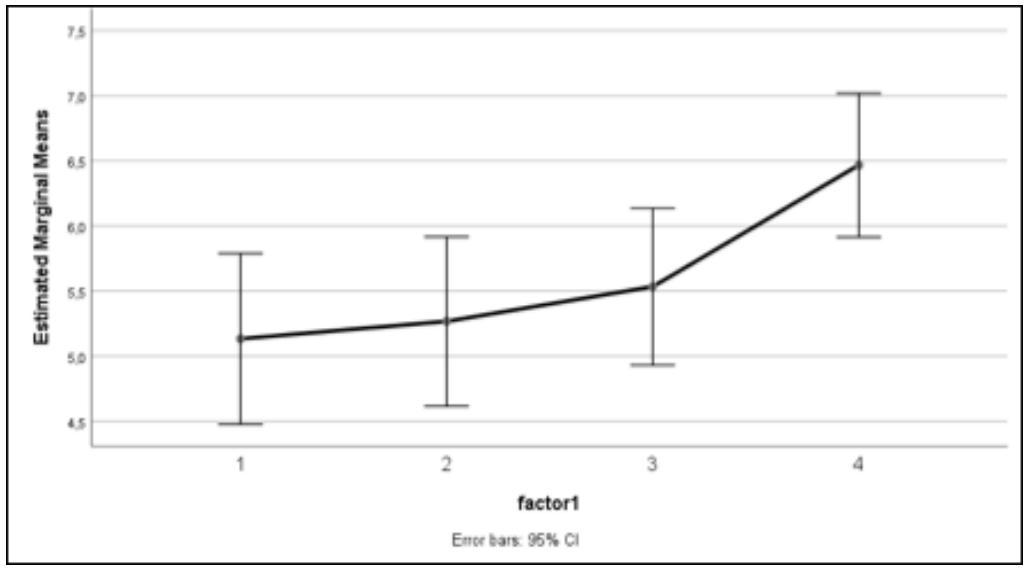
Figure 6: Estimated marginal means of Coherence and cohesion criterion
The estimated marginal means provided insight into the Coherence and cohesion scores in regard to every essay writing task, indicating a clear progression, especially in the fourth essay writing task, where participants’ averages were the highest. Moreover, the significant difference evidenced in the pre-service teachers’ scores can also be analysed from a qualitative perspective by contrasting extracts of the participants’ first and last essay writing tasks, regarding Coherence and cohesion. Table 7 provides examples of the improvement of the participants’ essays in terms of coherence and cohesion.
Table 7: Pre-service teachers’ writing comparison regarding coherence and cohesion
| Participants | Essay writing task 01 | Essay writing task 04 |
|---|---|---|
| Participant 4 | Secondly, it is crucial to receive a lot of input in order to acquire a second language (Krashen, 1982). Currently in our country the hours per week destined to studying an L2 are not enough to provide students with the necessary input. In the same way, not every family is prepared or willing to do it on their own. Considering this, there should be adjustments made in the first place so students can really learn, otherwise, the acquisition process would not be as effective as it should. | Similarly, children need to be exposed to a variety of disciplines to develop properly. Restricting children’s areas of study would limit their vision of themselves, as well as their concept of life. In other words, the absence of art and music would negatively impact their analytical skills, social skills, emotional intelligence, etc. In addition to this, school would not be a realistic representation of the world. Overall, the arts are versatile and contribute to our lives from different angles. |
| Participant 19 | Firstly, as we are surrounded by languages of the world since our very beginnings, the earlier we start, the earlier we will be able to interact effectively with a new language. Besides, children’s plasticity towards learning new things makes the task easier. When children start school, their brains are in a language development process that is still fresh and in progress, facilitating, in that way, their learning of a foreign language. | First, the preparation of students for the modern world needs art and music as much as information technology. The three subjects fill us with knowledge. Apart from content, they grant us the opportunity to develop skills that I believe, all are important in one’s development as a human being. The list can go long with creativity, originality, problem-solving, organization, resourcefulness, analytical and critical thinking, and so forth. Such skills serve in both creative and logical thinking, both essential parts of human growth. |
| Participant 20 | Taking into consideration that children’s characteristics are curiosity, creativity, willingness to discover new things, and more, it is possible to say that the first stage in human life is the most accurate to learn a foreign language. The most suitable place to develop those skills is the school for the youngest students. | Similarly, arts and music help students develop their memory and creativity. If we think about singing, dancing, or painting, they may seem quite simple actions, but instead, they are important to develop memory and creativity. |
| Participant 6 | To sum up, I have discussed two essential reasons that support that a foreign language can be learned at any time, not necessarily at a young age. The first one demonstrates the clarification of the myth that there is not an “ideal time” to learn a new language, and the latter indicates the necessity of meta-awareness when learning such language. | To summarize, art and music are considered paramount subjects that should be taken into consideration in order to have a balanced curriculum. These contents have a great impact on the students’ progress since they promote cognitive and motor skills as well as decrease stress levels. |
Thus, the pre-service teachers’ significant differences found in the Coherence and cohesion scores were reflected by the participants’ enhancement in their ability to elaborate more cohesive ideas, use discourse markers appropriately, and sequence information logically.
4.1.3 Assessment criterion 03: Lexical resource
To examine the variation of the Lexical resource scores (factor 1) among the four essay writing tasks, a one-way within-subjects ANOVA was performed. Results indicated that the Lexical resource scores presented a significant effect in the different essay writing tasks [; ], as illustrated in Table 8. As a result, participants’ Lexical resource scores were statistically significant.
Table 8: Tests of within-subjects effects for the Lexical resource criterion
| Source | Type III Sum of Squares | Df | Mean Square | F | Sig. | |
|---|---|---|---|---|---|---|
| Factor1: Lexical resource | Sphericity Assumed | 33.825 | 3 | 11.275 | 8.648 | 0.000 |
| Factor1: Lexical resource | Greenhouse-Geisser | 33.825 | 2.686 | 12.592 | 8.648 | 0.000 |
| Factor1: Lexical resource | Huynh-Fieldt | 33.825 | 2.987 | 11.326 | 8.648 | 0.000 |
| Factor1: Lexical resource | Lower-bound | 33.825 | 1.000 | 33.825 | 8.648 | 0.006 |
| Error(factor1) | Sphericity Assumed | 113.425 | 87 | 1.304 | ||
| Error(factor1) | Greenhouse-Geisser | 113.425 | 77.902 | 1.456 | ||
| Error(factor1) | Huynh-Fieldt | 113.425 | 86.611 | 1.310 | ||
| Error(factor1) | Lower-bound | 113.425 | 29.000 | 3.911 |
a. Computerusingalpha = .05
Results of post-hoc test, which used the Bonferroni adjustment, identified the essay writing tasks in which the pre-service teachers’ scores in the Lexical resource criterion were statistically significant, as shown in Table 9.
Table 9: Descriptive Statistics and Bonferroni post hoc test for the Lexical resource criterion
| Mean | Std. Deviation | N | Bonferroni sig. | |
|---|---|---|---|---|
| Lexical resource 1 | 5.03 | 1.497 | 30 | 4 (0.003) |
| Lexical resource 2 | 5.03 | 1.542 | 30 | 4 (0.000) |
| Lexical resource 3 | 5.50 | 1.358 | 30 | 4 (0.028) |
| Lexical resource 4 | 6.33 | 1.470 | 30 | 1.2.3 (0.003; 0.000; 0.028) |
Similar to the first two assessment criteria analysis, significant differences were observed between:
- essay writing tasks 1 and 4 (Lexical resource criterion mean score in writing task 1=5.03; Lexical resource criterion mean score in writing task 4=6.33; p=0.003)
- essay writing task 2 and 4 (Lexical resource criterion mean score in writing task 2=5.03; Lexical resource criterion mean score in writing task 4=6.33; p=0.000)
- essay writing task 3 and 4 (Lexical resource criterion mean score in writing task 3=5.50; Lexical resource criterion mean score in writing task 4=6.33; p=0.028).
In addition, estimated marginal means were calculated to analyse the changes of the Lexicon resource scores across the four essay writing tasks, as presented in Figure 7.

Figure 7: Estimated marginal means of the Lexical resource criterion
As depicted in Figure 7, the Lexical resource scores did not present any changes between the first and second essay writing tasks. However, a sharp increase in the mean scores took place in the third and fourth essay writing tasks. Furthermore, from a qualitative point of view, participants managed to enhance their use of lexical resource, mirroring the significant differences observed in their scores across the different essay writing tasks. Table 10 shows a comparison of participants’ writing extracts between essay writing tasks 01 and 04.
Table 10: Pre-service teachers’ writing comparison regarding Lexical resource
| Participants | Essay writing task 01 | Essay writing task 04 |
|---|---|---|
| Participant 17 | Therefore, I strongly believe that a foreign language should be learned at primary school due to positive benefits and the benefits for children’s future. | To begin with, most students are unmotivated trying to face subjects such as math and science. They are overburdened with academic tasks, assignments, and pressure. |
| Participant 3 | An example can be seen with children in preschool, where they are taught a second language without the pressure of scholar achievement…; hence, using this cerebral condition to ease learning makes a lot of sense. | When referring to preparing children for the world, it is not constrained to the technical abilities and knowledge. Effective communication, goal setting, group management, team-work, and problem-solving are crucial within any working environment. |
| Participant 12 | Therefore, the use of motherese in babies when acquiring a mother and a foreign language makes the process easier and helpful…To conclude, the acquisition of a language is not easy, especially when we are talking about the acquisition of a foreign language. | On the other hand, teaching information technology and science at schools develops critical thinking and problem-solving skills. Currently, our society is becoming more dependent on technologies. Consequently, schools must foster students to think about the future using science. By the same token, science and information technology promote critical thinking because aspects such as “problems in the society” and “future events” must be analyzed to create new tools and equipment for the future. |
| Participant 11 | Secondly, bilingual children will have the opportunity of communicating with different cultures. As children will know another language, they will have access to different resources. They can see information from other perspectives, speak to people from around the world, and meet new cultures. I saw that children from the practicum were already watching videos from English YouTubers, and they loved them | Firstly, a variety of subjects provides students with the opportunity to have balance in their study hours, improving their well-being. Students face high pressure during school years, dealing with excessive homework and a limited amount of time for themselves. Artistic subjects such as music and arts provide students time for self-expression and liberation. Furthermore, dealing with too much stress affects their performance. To cut subjects that help them regulate emotions would not improve their performance in others that are considered more significant. |
In sum, pre-service teachers managed to make better use of lexical resource, especially in their fourth essay writing task. Participants were able to formulate more sophisticated structures using a wide range of vocabulary, which is supported by the significant differences found in the statistical analysis.
4.1.4 Assessment criterion 04: Grammatical range and accuracy
In terms of Grammatical range and accuracy scores (factor 1), a one-way within subjects ANOVA was used to explore the variation of the participants’ means. Results suggested that Grammatical range and accuracy scores presented a significant effect in the essay writing tasks [; ], as illustrated in Table 11. As a result, the difference of the means in the essay writing tasks was considered statistically significant.
Table 11: Tests of within-subjects Effects for the Grammatical range and accuracy criterion
| Source | Type III Sum of Squares | Df | Mean Square | F | Sig. | |
|---|---|---|---|---|---|---|
| Factor1: Grammatical range and accuracy | Sphericity Assumed | 29.800 | 3 | 9.933 | 8.845 | 0.000 |
| Factor1: Grammatical range and accuracy | Greenhouse-Geisser | 29.800 | 2.652 | 11.235 | 8.845 | 0.000 |
| Factor1: Grammatical range and accuracy | Huynh-Fieldt | 29.800 | 2.944 | 10.122 | 8.845 | 0.000 |
| Factor1: Grammatical range and accuracy | Lower-bound | 29.800 | 1.000 | 29.800 | 8.845 | 0.006 |
| Error(factor1) | Sphericity Assumed | 97.700 | 87 | 1.123 | ||
| Error(factor1) | Greenhouse-Geisser | 97.700 | 76.919 | 1.270 | ||
| Error(factor1) | Huynh-Fieldt | 97.700 | 85.381 | 1.144 | ||
| Error(factor1) | Lower-bound | 97.700 | 29.000 | 3.369 |
a. Computerusingalpha = .05
Moreover, the post-hoc test, which used the Bonferroni adjustment, revealed the specific essay writing tasks in which the Grammatical range and accuracy scores were significantly different, as depicted in Table 12.
Table 12: Descriptive statistics and Bonferroni post hoc test for the Grammatical range and accuracy criterion
| Mean | Std. Deviation | N | Bonferroni sig. | |
|---|---|---|---|---|
| Grammatical range and accuracy 1 | 4.77 | 1.455 | 30 | 4 (0.004) |
| Grammatical range and accuracy 2 | 4.80 | 1.518 | 30 | 4 (0.001) |
| Grammatical range and accuracy 3 | 5.10 | 1.373 | 30 | 4 (0.005) |
| Grammatical range and accuracy 4 | 6.00 | 1.554 | 30 | 1.2.3 (0.004; 0.001; 0.005) |
Following the pattern observed in the other three assessment criteria, significant differences were identified between:
- essay writing task 1 and 4 (Grammatical range and accuracy criterion mean score in writing task 1= 4.77; Grammatical range and accuracy criterion mean score in writing task 4= 6.00; p=0.004)
- essay writing task 2 and 4 (Grammatical range and accuracy criterion mean score in writing task 2= 4.80; Grammatical range and accuracy criterion mean score in writing task 4= 6.00; p=0.001)
- essay writing tasks 3 and 4 (Grammatical range and accuracy criterion mean score in writing task 3=5.10; Grammatical range and accuracy criterion mean score in writing task 4=6.00; p=0.005).
Additionally, to analyse the changes of the Grammatical range and accuracy scores throughout the different essay writing tasks, estimated marginal values were calculated, as displayed in Figure 8.

Figure 8: Estimated marginal means of grammatical range and accuracy criterion
The estimated marginal mean values indicated a very slight increase between the first and second writing tasks, with a steady rise in the scores during the third and fourth essay writing tasks. This scenario follows a familiar pattern with the other criteria (Task response, Coherence and cohesion, and Lexical resource), in which the participants’ mean scores either remain the same or improve a little at the beginning, having their highest overall values in the last essay writing task.
Furthermore, a parallel can be drawn by comparing the participants’ scores and the quality of their use of grammar and accuracy from a qualitative stance. As pre-service teachers’ scores increased in the fourth essay writing task, so did their skills to formulate more complex and accurate grammatical constructions. Table 13 portrays samples of the participants’ initial and final essay writing tasks, where a clear progression is presented in terms of grammatical range and accuracy.
Table 13: Pre-service teachers’ writing comparison regarding grammatical range and accuracy
| Participants | Essay writing task 01 | Essay writing task 04 |
|---|---|---|
| Participant 1 | …thus, they can acquire or learn a language with ease at an early age… Second, it opens an infinite doors. | As it is crucial, some people believe that in schools children should be taught useful subjects only, for example, information technology, and remove other subjects such as art and music. |
| Participant 8 | Learn a foreign language at an early age is significantly beneficial…Nowadays, globalization helps us to know different cultures around the world and knowing a foreign language might provide a better communication. | Education is fundamental for children and has a duty to prepare them for the modern world… Firstly, arts and music help students to cope with the academic pressure of other subjects. |
| Participant 7 | There may be many answers, but the truth is that the youngest, the best. Brain plasticity is more active in the early years. The ability of the brain to reorganized information and create new neural pathways is known as neuroplasticity. | Have you ever considered the importance of having different subjects at school? The role of the school is to prepare children for life and every subject is constantly contributing to develop different skills among students. Unfortunately, in recent years, some topics have been sidelined from the schools such as arts or history. |
| Participant 5 | Nowadays, learning and mastering a second language is an ability valued by many, especially when applying for a job or a scholarship abroad. For this reason, it is fundamental that children start from a young the process of learning a second language. In Chile students start having the English course in the first grade, right after they graduate from kindergarten, hence, they have better chances of learning English as they are exposed from a young age to the language. Therefore, learning a foreign language, as the case of English, should start as soon as children start their educational path. | Second, it rests in every student to decide whether they want to cut art and music from the curriculum, as they are the ones who will be having the lessons. Additionally, for some students, the opportunity of choosing for themselves is fundamental, particularly if it has to do with something that will directly affect them, moreover, compared to other subjects as biology or chemistry, arts and music have more freedom regarding the method of evaluation, students can take a break from rigids evaluations associated to the previously mentioned subjects. |
In conclusion, pre-service teachers succeeded in improving the quality of their essay writing skills, particularly in essay writing task 4. On the one hand, from a quantitative perspective, participants’ mean scores per each IELTS writing task criterion presented statistically significant differences. Those differences were consistent with the participants’ improvement made across the writing tasks, particularly contrasting their initial three writing tasks with the final one. On the other hand, from a qualitative point of view, these criteria are evidenced in the analysis of the pre-service teachers’ essay extracts. Participants managed to respond to the tasks accordingly, offered logical and well-sequenced ideas, used a wide range of vocabulary, and formulated complex grammatical constructions.
4.2 RQ2: What are pre-service teachers’ perceptions of screencast feedback?
The second research question is initially addressed from a quantitative perspective through descriptive and correlational statistics, and then, from a qualitative stance through thematic analysis and word frequency analysis. To begin with, the results of the multi-modal feedback survey (Vincelette& Bostic, 2013) are presented. This survey aimed to analyse the participants’ perceptions of screencast based on four main constructs: attending and engagement; incorporation of revision; feedback quality and quantity; and preference. Reliability analysis indicated that all the constructs had, to a certain extent, acceptable or good Cronbach’s alpha coefficients except for attending and engagement, which presented a low coefficient (.596), as depicted in Table 14.
Table 14: Reliability analysis of constructs
| Construct | Cronbach’s Alpha | N° of items |
|---|---|---|
| Attending and engagement | .596 | 3 |
| Incorporation of revision | .827 | 5 |
| Feedback quality and quantity | .790 | 6 |
| Preference | .736 | 5 |
As shown in Table 15, from a total of 30 participants who responded the survey, 21 were female (70%), 8 were male (26.7%) and 1 participant was non-binary (3.3%). Additionally, 20 of them belonged to university 1 (66.7%), and 10 to university 2 (33.3%).
Table 15: Participants’ distribution according to gender and university
| N | % | ||
|---|---|---|---|
| Gender | Female | 21 | 70.0% |
| Gender | Male | 8 | 26.7% |
| Gender | Non-binary | 1 | 3.3% |
| Institution | One | 20 | 66.7% |
| Institution | Two | 10 | 33.3% |
4.2.1 Attending and engagement
The attending and engagement construct examined participants’ attentiveness when receiving screencast feedback. As illustrated in Table 16, the perception of screencast as a tool to help their revision process (statement 2) presented a high level of agreement since it received the highest mean score (3.90), and the lowest standard deviation in this construct. Based on this, it could be assumed that participants’ answers did not differ much from one another, as they presented a low level of variation (0.305).
Table 16: Descriptive statistics of pre-service teachers’ attending and engagement construct
| Statements | N | Mean | Std. Deviation |
|---|---|---|---|
| 1. Compared to more traditional feedback, I think that I paid more attention to my instructor’s comments with screencast. | 30 | 3.80 | 0.407 |
| 2. Compared to more traditional feedback, I think that screencast helped me better understand how to go about revising my writing. | 30 | 3.90 | 0.305 |
| 3. Compared to more traditional feedback, I think that screencast made me a better writer. | 33 | 3.33 | 0.736 |
Scale of agreement: 1) strongly disagree 2) disagree 3) agree 4) strongly agree
However, the statement with the lowest mean score and highest standard deviation had to do with the participants’ perception of the screencast’s contribution in becoming better writers (statement 3), in comparison with traditional feedback. This result showed pre-service teachers slightly agreed on the perceived importance of screencast feedback to develop their skills as proficient writers, and as a result, participants’ answers presented a little more variation (0.736).
4.2.2 Incorporation of revision
Regarding the incorporation of revision construct, understood as the participants’ ability to incorporate the revisions suggested, participants agreed the most about the importance of the screencast feedback to understand problems related to language mechanics and usage (statement 8). As portrayed in Table 17, this statement presented the highest mean score and a low standard deviation; hence, pre-service teachers’ answers seemed to converge on this perceived view.
Table 17: Descriptive statistics of pre-service teachers’ incorporation of revision construct
| Statements | N | Mean | SD |
|---|---|---|---|
| 5. I gained a better understanding of how to organise my writing due to the feedback received through screencast. | 30 | 3.60 | 0.675 |
| 6. I was able to create better arguments due to the feedback received through screencast. | 30 | 3.40 | 0.498 |
| 7. I was able to elaborate better due to the feedback received through screencast. | 30 | 3.57 | 0.504 |
| 8. I gained a better understanding of my issues with mechanics and usage due to the feedback received through screencast. | 30 | 3.73 | 0.521 |
| 9. I gained a better understanding of how to structure my essays due to the feedback received through screencast. | 30 | 3.70 | 0.466 |
Scale of agreement: 1) strongly disagree 2) disagree 3) agree 4) strongly agree
In contrast, statement 6 presented the lowest mean score (3.40) and it involved the perception of improvement in argumentation thanks to screencast feedback. This statement also presented a low standard deviation (0.498), which means that participants’ agreed with this perceived view in general, though not strongly, and that the pre-service teachers’ answers were varied but to a minor extent.
4.2.3 Feedback quality and quantity
The feedback quality and quantity construct explored the participants’ perceptions about the level of excellence and amount of screencast feedback through videos received. As Table 18 illustrates, in terms of quality, pre-service teachers acknowledged that screencast feedback allowed them to understand writing feedback better (statement 11), and additionally, to clarify what needed to be improved (statement 12). These two statements shared the same highest mean score and a low level of variation. Thus, the participants’ answers seemed to be analogous.
Table 18: Descriptive statistics of pre-service teachers’ feedback quality and quantity construct
| Statements | N | Mean | SD |
|---|---|---|---|
| 10. When compared to other writing activities, I think I received more feedback on my writing in this activity due to screencast. | 30 | 3.47 | 0.819 |
| 11. When compared to other writing activities, I think that I better understood the feedback on my writing due to screencast. | 30 | 3.73 | 0.785 |
| 12. When compared to other writing activities, the comments I received helped me understand what I needed to do to improve my writing due to screencast. | 30 | 3.73 | 0.450 |
| 13. When compared to other writing activities, I received feedback that helped me understand how to revise my papers beyond just issues with mechanics and usage. | 30 | 3.53 | 0.571 |
| 14. When compared to other writing activities, I believe the feedback on screencast helped me become a better writer. | 30 | 3.57 | 0.504 |
| 15. When compared to other writing activities, I believe the feedback on screencast helped me write better papers. | 30 | 3.53 | 0.629 |
Scale of agreement: 1) strongly disagree 2) disagree 3) agree 4) strongly agree
On the contrary, regarding quantity, pre-service teachers agreed the least on receiving more feedback through screencast than in comparison with other writing activities (statement 10). This perceived view presented the lowest mean score and the highest level of standard deviation, which reflected that the participants’ answers tended to differ a bit more.
4.2.4 Preference
The last construct, preference, highlighted the participants’ preferences for using screencast type of feedback as opposed to the more traditional written comments given by instructors. Table 19 portrays that pre-service teachers highly agreed in preferring screencast feedback over traditional written comments for assistance in structural issues in their essays (statement 19). This statement had the highest mean score in this construct (3.77), and the lowest standard deviation, therefore, participants’ answers seemed not to differ much from one another.
Table 19: Descriptive statistics of pre-service teachers’ preference construct
| Statements | N | Mean | SD |
|---|---|---|---|
| 16. I would prefer to receive feedback on screencast, as opposed to traditional written comments, to help me deal with mechanics and usage issues. | 30 | 3.53 | 0.681 |
| 17. I would prefer to receive feedback on screencast, as opposed to traditional written comments, to help me deal with organisational issues (sequence, description, cause and effect, compare and contrast, and problem and solution). | 30 | 3.67 | 0.479 |
| 18. I would prefer to receive feedback on screencast, as opposed to traditional written comments, to help me deal with issues pertaining to elaboration. | 30 | 3.73 | 0.521 |
| 19. I would prefer to receive feedback on screencast, as opposed to traditional written comments, to help me deal with structural issues (introduction, body and conclusion). | 30 | 3.77 | 0.430 |
| 20. I would recommend that other writing instructors use screencast, as opposed to traditional written comments in their classes. | 30 | 3.73 | 0.450 |
Scale of agreement: 1) strongly disagree 2) disagree 3) agree 4) strongly agree
On the contrary, regarding assistance in language mechanics and usage, pre-service teachers’ preference for screencast feedback over traditional written comments (statement 16) presented the lowest mean score (3.53) and the highest standard deviation (0.681) in this construct. As a result, participants seemingly agreed up to a point on this preference, though their answers were more varied.
In general, descriptive statistics indicated that pre-service teachers’ views presented a relatively high level of agreement within the four constructs, especially in attending and engagement (mean score= 3.72), and preference (mean score= 3.69). This is evidenced in the highest mean scores observed in these two constructs, as illustrated in Table 20.
Table 20: Descriptive statistics of pre-service teachers’ constructs
| N | Minimum | Maximum | Mean | Standard deviation | |
|---|---|---|---|---|---|
| Attending and engagement | 30 | 2.67 | 4.00 | 3.72 | 0.32 |
| Incorporation of revision | 30 | 2.80 | 4.00 | 3.60 | 0.41 |
| Feedback quality and quantity | 30 | 2.33 | 4.00 | 3.59 | 0.45 |
| Preference | 30 | 3.00 | 4.00 | 3.69 | 0.36 |
Scale of agreement: 1) strongly disagree 2) disagree 3) agree 4) strongly agree
In particular, the two highest statement mean scores were found in the attending and engagement construct and were related to the participants understanding better how to revise their writing (statement 2, mean score=3.90) and being more attentive to instructors’ comment through screencast (statement 1, mean score =3,80). Additionally, the third highest statement mean score was observed in the preference construct, in which pre-service teachers favoured screencast feedback over traditional written comments to improve essay layout issues (statement 19, mean score=3.77). Conversely, the construct with the lowest mean score was related to the feedback quality and quantity construct (mean score =3.50). However, the statement with the lowest mean score was found in the attending and engagement construct and it involved the participants’ perception of becoming better writers because of the screencast feedback, in comparison to traditional feedback (statement 3, mean score= 3.33). Nevertheless, it is relevant to highlight that all four constructs’ mean scores were higher than 3.5. Furthermore, all the statements’ mean scores were above 3 points. Therefore, pre-service teachers’ perceptions were certainly positive towards the screencast feedback provided.
4.2.5 Correlations of constructs according to participants’ gender and higher education institution
Through the statistical analysis of the different constructs, it was possible to identify positive and significant correlations among them as depicted in Table 21.
Table 21: Correlations of pre-service teachers’ constructs
| Constructs | Attending/ engagement | Incorporation of revision | Feedback quality/quantity | Preference | |
|---|---|---|---|---|---|
| Attending and engagement | Pearson Correlation | 1 | .592** | .562** | .460* |
| Attending and engagement | Sig. (2-tailed) | 0.039 | 0.005 | 0.014 | |
| Incorporation of revision | Pearson Correlation | .592** | 1 | .726** | .469** |
| Incorporation of revision | Sig. (2-tailed) | 0.039 | 0.000 | 0.009 | |
| Feedback quality and quantity | Pearson Correlation | .562** | .726** | 1 | .578** |
| Feedback quality and quantity | Sig. (2-tailed) | 0.005 | 0.000 | 0.001 | |
| Preference | Pearson Correlation | .460* | .469** | .578** | 1 |
| Preference | Sig. (2-tailed) | 0.014 | 0.009 | 0.001 |
*. Correlation is significant at the 0.05 level (2-tailed). **. Correlation is significant at the 0.01 level (2-tailed).
Specifically, the three most significant correlations were found between the incorporation of revision and feedback quality and quantity (.726), the incorporation of revision and attending and engagement (.592) and preference and feedback quality and quantity (.578). From these results, it could be implied that the integration of the feedback provided through the screencast videos was positively related to the quality and quantity of their essay content, and that this significant incorporation of revision was also connected to the increasing engagement and active participation of the pre-service teachers in the essay writing process. Moreover, the participants’ preference for using screencast feedback over traditional writing comments may have been directly related to the quality and quantity of the information delivered through the screencast videos.
Furthermore, slight descriptive differences in the means of the constructs were observed, based on the participants’ gender and higher education institution. Nevertheless, none of them was statistically significant, as illustrated in Table 22 and Table 23.
Table 22: Descriptive statistics of pre-service teachers according to gender
| Constructs | Female Frequency | Female Mean | Female SD | Male Frequency | Male Mean | Male SD | T-test sig. |
|---|---|---|---|---|---|---|---|
| Attending and engagement | 21 | 3.35 | 0.34 | 8 | 3.31 | 0.26 | .808 |
| Incorporation of revision | 21 | 3.59 | 0.43 | 8 | 3.70 | 0.35 | .525 |
| Feedback quality and quantity | 21 | 3.60 | 0.43 | 8 | 3.58 | 0.55 | .919 |
| Preference | 21 | 3.72 | 0.35 | 8 | 3.63 | 0.42 | .566 |
*Non-binary gender was not considered because it was only one case (Attending/engagement mean=3.75; incorporation of revision mean=3.00; Feedback quality/quantity mean=3.50; Preference mean=3.40)
Regarding gender, the highest mean score by female pre-service teachers is related to the preference construct (mean score=3.72), while for male pre-service teachers is observed in the incorporation of revision construct (mean score=3.70).
Table 23: Descriptive statistics of pre-service teachers according to higher education institution
| Constructs | University 1 Frequency | University 1 Mean | University 1 SD | University 2 Frequency | University 2 Mean | University 2 SD | T-test sig. |
|---|---|---|---|---|---|---|---|
| Attending and engagement | 20 | 3.31 | 0.32 | 10 | 3.43 | 0.31 | .372 |
| Incorporation of revision | 20 | 3.63 | 0.39 | 10 | 3.54 | 0.47 | .583 |
| Feedback quality and quantity | 20 | 3.55 | 0.51 | 10 | 3.68 | 0.29 | .452 |
| Preference | 20 | 3.73 | 0.35 | 10 | 3.60 | 0.40 | .364 |
Considering the participants’ academic background, participants who studied at University 1 presented their highest mean score (3.73) in the preference construct, whereas participants from University 2 obtained their highest mean score (3.68) in the feedback quality and quantity construct.
4.2.6 Correlations between survey constructs and IELTS assessment criteria
The different constructs described earlier were analysed in relation to the four IELTS writing task assessment criteria, and the following correlations at 0.05 levels were found:
- incorporation of revision and Task response 3: (rs = .434, p=0.05)
- incorporation of revision and Coherence and cohesion 3: (rs = .369, p=0.05)
- incorporation of revision and Lexical resource 3: (rs = .362, p=0.05)
- incorporation of revision and Coherence and cohesion 4: (rs = .425, p=0.05).
All of the four correlations identified were positive and significant, which may indicate that the importance pre-service teachers placed on incorporating the screencast revisions into their successive essays positively affected the manner in which participants responded to the essay writing tasks, and might help to explain their improvement in elaborating coherent and cohesive ideas, the expansion in their range of vocabulary, and the formulation of more accurate and complex grammar constructions. Furthermore, the strongest correlation observed was between the incorporation of revision construct and the task response criterion, specifically during the third essay writing task, as displayed in the correlation matrix in Table 24.
Table 24: Correlation between constructs and Task response scores
| Attending & engagement | Incorporation of revision | Feedback quality & quantity | Preference | Task response 1 | Task response 2 | Task response 3 | Task response 1 | |
|---|---|---|---|---|---|---|---|---|
| Attending & engagement | 1 | ,592* | ,495** | ,444* | -0,168 | 0,123 | 0,188 | 0,182 |
| Incorporation of revision | ,592* | 1 | ,726** | ,469** | -0,029 | 0,059 | ,434* | 0,344 |
| Feedback quality & quantity | ,562** | ,726** | 1 | ,578** | 0,033 | -0,026 | 0,191 | 0,182 |
| Preference | ,460* | ,469** | ,578** | 1 | -0,245 | -0,018 | 0,152 | 0,127 |
| Task response 1 | -0,168 | -0,029 | 0,033 | -0,245 | 1 | ,395* | 0,124 | 0,086 |
| Task response 2 | 0,123 | 0,059 | -0,026 | -0,018 | ,395* | 1 | ,481** | ,502** |
| Task response 3 | 0,188 | ,434* | 0,191 | 0,152 | 0,124 | ,481** | 1 | ,588** |
| Task response 4 | 0,182 | 0,344 | 0,182 | 0,127 | 0,086 | ,502** | ,588** | 1 |
*. Correlation is significant at the 0.05 level (2-tailed). **. Correlation is significant at the 0.01 level (2-tailed).
As a result, this significant correlation found at essay writing task 3 could imply that pre-service teachers had started developing their essay writing skills further by the time they completed the first two writing tasks and managed to incorporate the screencast feedback in their essays accordingly, which allowed them to become more responsive to the third writing task.
4.2.7 Thematic analysis
The following section examines pre-service teachers’ self-perceived qualitative views of screencast feedback on essay writing. Participants responded to the following question:
- How did you use the screencast feedback provided to improve your next argumentative essay?
Participants’ responses were classified and synthesised through thematic analysis, as shown in Table 25 and Table 26. Two major themes emerged from the participants’ responses: participants’ study strategies using screencast feedback; and benefits of screencast feedback.
Table 25: Theme one: Participants’ study strategies using screencast feedback
| Theme | Subtheme | Frequency | Extracts |
|---|---|---|---|
| Participants’ study strategies using screencast feedback | Re-watching screencast feedback videos | 9 | Before writing the next essays, I watched the screencast feedback once or twice so as to know my weaknesses in writing. (Participant 8) I used the screencast feedback as a guidance. I watched it twice. (Participant 13) I watched the video recording several times, as I was writing the essay. (Participant 14) First of all, I watched it more than twice so that I would really understand what I had to improve. (Participant 28) |
| Participants’ study strategies using screencast feedback | Following the teacher’s advice | 9 | Moreover, I paid more attention to the highlighted details the feedback addressed, as the teacher made comments and suggestions to overcome those issues next time. (Participant 4) While writing the essays, I watched the feedback in order to make sure I was doing well and follow the advice given by the teacher. (Participant 8) I took into consideration all the details and comments provided by the professor. (Participant 17) I used my feedback following the suggested steps and changes that my teacher made in the Screencast. (Participant 26) |
| Participants’ study strategies using screencast feedback | Taking notes | 8 | I took notes on the screencast feedback, which helped me to organize and improve the following essays. (Participant 4) While I was watching the screencast feedback, I took some notes that would help me to remember (Participant 15) I made notes using the feedback to internalize the correct structure and keep the tips and my essays as references for future work. (Participant 20) I checked and took notes on the organization of the essay and what each of the parts of the essay had to contain. (Participant 21) |
| Participants’ study strategies using screencast feedback | Analysing weaknesses | 5 | I used the feedback to improve the organization of the essays that I made later because I checked the weaknesses that I had previously to improve them in the next essays. (Participant 3) Before writing the next essays, I watched the screencast feedback once or twice so as to know my weaknesses in writing. (Participant 8) I paid attention to the mistakes detected in the piece of writing in order to not repeat them. (Participant 11) I notice my mistakes and I was able how to solve them. (Participant 12) |
The study strategies of the first theme (see Table 25) referred to specific actions in which pre-service teachers used screencast feedback to improve their essays. Four subthemes emerged from this category, namely, taking notes, re-watching screencast feedback videos, following the teacher’s advice, and analysing weaknesses. Based on response frequency, pre-service teachers placed great emphasis on re-watching the screencast feedback videos (F=9) as many times as needed in order to internalise their content effectively and improve their essay writing skills. The same importance is given to following the teacher’s advice (F=9). Participants trusted that such assistance would be a meaningful contribution to their learning as they frequently expressed to have taken notes (F=8) from the videos. Last but not least, the analysis of their weaknesses (F=5) was another relevant subtheme, which prevented participants from making common mistakes in later essay writing tasks and it was supported by re-watching the screencast feedback videos and following the teacher’s advice.
Table 26 below highlights the second theme and its subthemes.
Table 26: Theme two: Benefits of screencast feedback
| Theme | Subtheme | Frequency | Extracts |
|---|---|---|---|
| Benefits of screencast feedback | Essay organisation and layout | 6 | I used it to improve the structure and how the parts of the essay are developed: introduction, development and conclusion. (Participant 3) The screencast feedback helped me especially with the structure of the essay, seeing everything in the video was quite useful for the other essays. (Participant 2) Also, I saw that I improved in the structure of the essays in general. (Participant 29) I understood better the organization of an introduction. (Participant 19) |
| Friendly, clear, and personalised feedback | 6 | … and with the explanation of my teacher, everything was clearer than with a written feedback. (Participant 14) It made me realize common mistakes that I made in my writing and since the feedback is more personalized I was able to correct them. (Participant 18) I think that the screencast feedback provides a more friendly perspective than the traditional feedback, so I could improve as well my perspective and predisposition to improve my mistakes when writing essays. (Participant 22) Well, I felt quite comfortable having this kind of feedback; I think it is more personalized. (Participant 29) | |
| Language awareness | 4 | It made me realize common mistakes that I made on my writing and since the feedback is more personalised I was able to correct them. (Participant 18) It helped me to understand what I did wrong and how to correct it. (Participant 23) My first argumentative essay had many problems that I overlooked, but screencast feedback was especially effective in helping me to be aware of these problems. (Participant 27) Actually, I went back to it in the processing of every next task that I was assigned. It helped me build my learning upon my errors and hopefully, with having them fresh in my mind, not committing them again, remembering the structure, and adding what I needed to add. (Participant 30) | |
| Permanent resource of reference | 3 | It was really useful. You can access to your feedback not only once, and I think that is an advantage. (Participant 7) …in case I forgot something, the screencast was able to be seen again. (Participant 12) I watched the video recording several times, as I was writing the essay, this way the feedback could be given at any moment during the process of writing. (Participant 14) |
In Table 26, pre-service teachers’ perceived benefits of screencast feedback derived into several subthemes. The most frequent were related to essay organisation and layout, screencast as a permanent resource of reference, language awareness, and friendly, clear, and personalised feedback. Participants agreed that screencast feedback (F=6) provided clear explanations and described it as friendly and more comfortable in comparison to traditional written feedback. Likewise, another common perceived benefit was essay organisation and layout (F=6).
Pre-service teachers remarked that screencast feedback had been useful as it supported the improvement of the text layout in the following essay writing tasks. Although to a minor extent, pre-service teachers also acknowledged that screencast feedback contributed to their language awareness (F=4) because it helped them realise their writing errors and provided useful guidance on how to correct them. This would become instrumental in the participants’ writing improvement shown in the subsequent writing tasks, especially in the last essay. Lastly, participants agreed on the benefit of screencast feedback as a permanent resource of reference (F=3), to which they could resort to as many times as needed to support their writing skills development throughout the successive essay writing tasks.
Additionally, the website, https://tagcrowd.com, was employed to provide an alternative insight into the pre-service teachers’ overall perceptions about screencast feedback through a word cloud, as portrayed in Figure 9.
Figure 9 revealed that the most frequent words in pre-service teachers’ responses were feedback (F=29), essays (F=23), writing (F=18) and improve (F=17). As a result, it could be inferred that participants perceived that the feedback provided through screencast videos played a major role in improving their essays, which reflected and evidenced their improvement in essay writing skills. In addition, Figures 10 and 11 specifically illustrate the word frequency of participants’ responses regarding screencast feedback study strategies (theme one) and screencast feedback benefits (theme two).

Figure 9: Word frequency of participants’ answers to question: How did you use the screencast feedback provided to improve your next argumentative essay?

Figure 10: Word frequency of theme one: Participants’ study strategies using screencast feedback
The visual representation of theme one depicted in Figure 10 highlighted frequent words such as writing (F=15), feedback (F=14), essays (F=14), watched (F=12) and teacher (9), which supported the frequent subthemes of watching the screencast videos and following the teacher’s recommendations as the main strategies in which pre-service teachers used the screencast feedback. Figure 11 illustrates the participants’ perceived benefits of screencast feedback.

Figure 11: Word frequency of theme two: Benefits of screencast feedback
The word cloud representation of theme two appeared to display words with a lower frequency in comparison to the visual depiction of theme one. Nevertheless, the highest frequency words were feedback (F=15), essay (F=11), helped (F=8), improve (F=8), structure (F=6) and writing (F=6). Therefore, it could be inferred that pre-service teachers considered screencast feedback as a relevant tool to improve the structure of their essays, even though the low word frequency might hint towards some variation among the participants’ perceptions.
Finally, participants’ responses to the question, How did you use the screencast feedback provided to improve your next argumentative essay? were studied through thematic analysis and word frequency by means of a word cloud visual representation. The most frequent subthemes that emerged were related to participants’ strategies using screencast feedback such as watching the videos again to understand their message better and following the teacher’s advice. Additionally, subthemes related to the perceived benefit of screencast feedback were also identified, the most frequent being the assistance provided in improving essay layout and organisation, and the friendly and personalised feedback that pre-service teachers were able to rely on.
5 Discussion
The following section will provide answers to the two research questions of this study. Main findings will be discussed with the results of similar research.
5.1 RQ1: What is the effect of screencast feedback on the English performance of pre-service teachers in the essay writing component of IELTS?
Based on the results obtained, pre-service teachers, after receiving successive screencast feedback (four video files), managed to improve their essay writing skills regarding the four IELTS writing components: Task response, Coherence and cohesion, Lexical resource, and Grammatical range and accuracy. This improvement was statistically significant according to the four one-way ANOVA tests that were carried out. Furthermore, such a significant difference was found in essay writing task 1, 2, and 3 in relation to essay writing task 4. Participants gradually started to respond to the writing tasks more efficiently, elaborated more logical and cohesive ideas, resorted to more varied lexical choices, and used more complex grammatical constructions.
Several studies on screencast feedback and writing skills have presented related findings. For instance, Ali (2016) explored the effect of screencast video feedback on university freshmen’s writing. While the control group received written feedback only, the experimental group was given screencast video feedback for higher order concerns of writing (content, organisation and structure) and written feedback for lower order concerns (accuracy). Post-test results revealed a statistically significant difference in the mean scores of the experimental group, which surpassed the scores of the control group regarding higher order writing concerns and overall writing skills. Hence, in Ali’s (2016) research, participants presented a significant improvement in the writing concerns that were addressed through screencast video feedback (content, organisation and structure), and not by written feedback (accuracy). Likewise, in the present study, pre-service teachers enhanced their writing skills by receiving screencast feedback and refining their essay writing, not only in terms of organisation and layout, but also in aspects considering coherence, cohesion, grammar, and vocabulary range. This claim is supported by participants who commented that screencast feedback allowed them to understand the organisation and layout of an essay better, while at the same time, being able to identify writing mistakes involving accuracy, such as the use of specific lexical items.
Soltanpour & Valizadeh (2018) investigated the effect of individualised technology-mediated feedback (ITMF) on argumentative essay writing of Iranian EFL learners. Findings indicated that participants who received ITMF through video feedback and a follow-up classroom discussion, presented a significant difference in the overall quality of their argumentative essays, in comparison with participants who were only given common written corrective feedback (CWCF). Additionally, delayed post-tests were run to determine if the difference between ITMF and CWCF varied over time.
The difference between the groups remained statistically significant and ITMF was superior in terms of the overall quality of argumentative essays. However, no statistically significant difference was found in the long term by comparing the post-test and the delayed post-test. The common ground between Soltanpour and Valizadeh’s (2018) research and the present study is that the participants exposed to video feedback certainly improved their essay writing skills. In contrast, these two studies differ in that the present research on screencast feedback did not use CWCF and did not run delayed post-tests to measure statistically significant differences in the long term, which could be considered as strong contenders for complementing this study.
Based on the results above, it can be inferred that screencast feedback can be very beneficial to treat learners’ error on writing. These benefits may have different explanations. Firstly, as Mayer and Moreno (2003) affirm “a key benefit of screencast feedback is that it combines the two main senses for learning: visual and auditory. Thus, it can facilitate learning” (p. 2,913). It can be deduced then, that this technique may have a positive impact on students with different learning styles due to the fact that the visual and auditory input may make the feedback more comprehensible and learners can probably retain the feedback for a longer period of time.
When compared with written comments, the most traditional way of feedback provision, it can be stated that the screencast feedback may attract the attention of a greater number of students in a classroom. The use of only written comments sometimes interferes with learners’ comprehension. In this respect, it is very common to see learners who do not understand the written feedback given by the teacher, especially those who struggle with the learning of a second language. Apart from written comments, some researchers (Bitchener & Knoch, 2010; Lee, 2017; Seror, 2012) assert that the use of a correction code, for example, sometimes confuses students. Thus, it can be inferred that those students who do not understand the teacher’s written comments or the symbols used for correction, can comprehend better when there is an audio and visual stimulus. They may remember the information better when an image or the teacher’s voice come to their mind. Furthermore, some students become overwhelmed with too many written comments. As such, Ali (2016) claims that writing lots of comments on student work might be useless or counter-productive.
Secondly, screencast feedback offers learners different possibilities. For example, it allows learners to watch the video recording as many times as they wish. The option of pausing, forwarding, rewinding and re-watching gives learners more chances to understand the feedback and the nature of their errors. In addition, students work at their own pace without the pressure of the teacher, a problem that usually affects potentially shy students and those who suffer from anxiety. Screencast feedback can also help students to understand the teacher’s comments better. They can focus their attention on aspects that are hard to understand and by repeating the screencast video, learners can probably improve their comprehension of errors and how to deal with them. According to Bakla (2018), “while watching the videos, learners can take down notes or directly transfer what they have learned from feedback to the written work. This makes video feedback a practical tool that could help improve the quality of EFL writing” (p. 324). In other words, screencast feedback gives learners the chance to spend more time comprehending and reflecting on the feedback. This is a very important factor to take into consideration, especially in the field of grammar. Learners usually struggle with the comprehension of specific features of the second language, especially when L1 and L2 differ greatly. To this end, learners require more than normal time to process feedback. In these circumstances, Seliem and Ahmed (2009) affirm that when learners receive frequent feedback, they tend to show more commitment to the task. They probably feel more engaged and motivated when receiving more support during the writing of a text. It can be stated then that the time of exposure to feedback can be considered a determining element for writing development.
Thirdly, based on the positive results on each rubric criterion used to assess writing, it can be inferred that screencast feedback may be beneficial to treat different types of errors in writing. The participants showed a significant improvement in each of the performance criteria: task response, coherence and cohesion, lexical resource and grammatical range and accuracy. In this sense, screencast feedback can be beneficial to treat not only macro-level errors (content, organisation of ideas, coherence, etc.) but also micro-level ones (grammar, punctuation, spelling, etc.). This means screencast feedback can probably assist students better during the process of writing a piece of text. According to different researchers (Moore & Filling, 2012; Orlando, 2016; Vincelette & Bostic, 2013; Silva, 2012), screencast seems to offer in-depth explanations. This possibility of in-depth explanations may allow the treatment of different types of errors in writing effectively. To exemplify, most students have difficulties processing grammar; thus, they require a better explanation of rules and, if necessary, some examples. Bakla (2017) also supports the idea that screencast allows more detailed and comprehensible input through audio and visual support. In this context, screencast feedback not only facilitates the provision of detailed feedback but can also provide different types of examples, underline and highlight mistakes, and refer students to specific links so that they can have further practice. While other types of feedback provision also allow detailed feedback, the interactive elements used during screencast feedback make the process more motivating and enjoyable.
Another key factor that can be considered an advantage of screencast feedback, when compared to other modes of feedback, is “the social presence of the teacher”. The student can listen to the teacher’s voice and see their face. Even though there is no interaction, in comparison to written comments, learners can feel the teacher’s presence more closely. This could have an impact on students’ motivation and performance. According to Changet al. (2017), “this can promote proximity between the teacher and student, so it could help improve the quality of student writing” (p. 109). This proximity between the teacher and the student may constitute an important benefit for teaching and learning in virtual environments. It is clear that not all students enjoy working in an environment without the teacher’s presence, especially in the context of feedback. Technology cannot replace humans; However, it can facilitate communication, interaction and teacher-student relationship. As Bakla (2018) says, “although screencast feedback is not as communicative as writing conferences, it could be a good strategy in crowded classes in which one-to-one writing conferences may not be an option” (p. 328).
Nevertheless, it is important to acknowledge that a specific feedback technique may not always work in every teaching context. For instance, Bakla (2020) assessed three online feedback modes (written, audio, and screencast feedback) to support intermediate learners’ writing through different essay writing and revision tasks. Results showed that the participants who received audio feedback presented the highest number of correct revisions in the essay writing task, while the participants who received screencast obtained the lowest correction scores. Also, no significant differences were found among the three online feedback modes in the essay revision task, and consequently, no feedback method was found to be more efficient than the others in improving the participants’ global revision scores. In the light of this finding, integrating different feedback modes might offer better insight for learners (Cunningham, 2015).
5.2 RQ2: What are pre-service teachers’ perceptions of screencast feedback?
In terms of participants’ perceptions, a number of studies show that there is a positive perception towards screencast feedback (Ali, 2016; Moore & Filling, 2012; Morris & Chikwa, 2014; Orlando, 2016; West & Turner, 2016). As to learners’ perceptions in the present study, it could be observed that they viewed screencast feedback as an important tool to organise writing better, elaborate ideas and arguments, and understand better grammar-related problems.
When they were asked to compare screencast feedback with other types of writing, the results demonstrated that students perceived more advantages in terms of feedback amount, comprehension and the quality of their writing. This means screencast was viewed as a tool that allowed the provision of more feedback. It made feedback more comprehensible and helped students to improve their writing. This result is consistent with other related studies (Alharbi, 2021; Ali, 2016; Merry & Orsmond, 2008) where students viewed audio and visual feedback as more meaningful due to the fact that it helped them better understand the teacher’s comments.
The results of the questionnaire also showed that most students would prefer screencast feedback over written comments in order to deal with different types of errors: mechanics, usage, organisation and elaboration of ideas and layout. This result is consistent with various studies that have reported that students perceive audio and audio-visual feedback to be of better quality than written feedback (Alharbi, 2021). Compared to written comments, it can be inferred that students better understand the teacher feedback on each type of error.
These favourable perceptions concur and contrast with findings of similar studies on screencast feedback. For instance, research on the writing of freshmen students (Ali, 2016) revealed that participants perceived screencast feedback as positive because it was clear, personal, engaging, and specific. This finding is analogous to the pre-service teachers’ perceptions identified in this study, which portrayed screencast feedback as friendly, clear, and personalised. Participants’ comments supported this view, describing screencast feedback as concise, promoting a better predisposition towards improving writing mistakes and supporting oral language and learners’ customisation.
Similarly, Bush (2020) explored the reactions of freshmen students from an advanced writing class, regarding screencast feedback. Participants completed three high-stakes essay assignments and received written correction feedback for the first essay and a combination of written and oral comments through screencast for the remaining assignments. Results indicated that participants perceived screencast feedback as more pleasant and effective than written corrective feedback itself. However, this screencast technique was not found to be more effective by teachers, despite students’ favourable appreciation of it. Participants from the present research study seemed to be of the same mind as they expressed their preference for screencast feedback over traditional written feedback methods. This perceived view is evidenced from a statistically significant point of view since the constructs with higher mean scores were attending and engagement (3.72), and preference (3.69). Further, Bush’s (2020) research contemplated the provision of written corrective feedback in the first essay assignment, and a mixture of written and oral comments through screencast feedback in the last two. In contrast, this current research employed only screencast feedback throughout the completion of four essay writing tasks, which may have enhanced the participants’ familiarity and insights of the feedback technique.
By the same token, Inan-Karaual and Seker (2021) explored self-regulated learning (SRL) writing strategies through screencast feedback on higher education learners. Through a semi-structured interview, it was found that participants’ opinion of screencast feedback, as well as SRL training, were quite positive. Frequent comments elicited described screencast feedback as “more intimate”, “easier”, “clearer” and more “motivating”. This finding resonates with this current research in terms of the pre-service teachers’ perceived view of screencast feedback as “friendly, clear and personalised” given that this type of feedback fostered learners’ individualised support, oral language and clarity of explanations. Additionally, it was reported that screencast feedback had supported enhancement in predisposition to improve writing mistakes, though this perceived view presented a very low frequency. Another common ground identified was the participants’ preference for feedback modality. Inan-Karaual and Seker (2021) found that participants regarded screencast feedback videos as more beneficial than just receiving written feedback, an opinion shared by the vast majority of pre-service teachers of this present study. However, higher education learners in Inan-Karaual and Seker’s (2021) research stated their preference for face-to-face feedback as the best and preferred mode of receiving feedback, whenever possible. This is an aspect worthy of consideration, as the present research did not cover it. Another point of divergence is that Inan-Karaual and Seker (2021) focused on exploring SRL writing strategies and used screencast feedback as a means of communication with the participants, whereas in the current study, screencast feedback is both the main strategy being examined and a means of communication with pre-service teachers.
The technological advantages of screencast feedback are more relevant than ever before, considering the global pandemic crisis and the viable solution offered by distance learning. Cunningham (2019) investigated the efficacy of screencast feedback and text feedback on learners of an intermediate ESL writing course. Findings revealed the participants’ preference for screencast feedback over text feedback, due to ease of use, clarity, and efficiency. In addition, participants who worked with screencast feedback remained in the target language, and these learners did not need to ask clarification questions, as opposed to participants who received text feedback. Also, the creation of video feedback took less time than text feedback, which saved 33% of time. When comparing Cunningham’s (2019) findings with our research, the views of pre-service teachers were similar in how screencast feedback was considered useful and beneficial in the development of essay writing skills, and in how participants regarded screencast feedback as friendly, clear, and personalised. However, Cunningham’s (2019) study examined several technical aspects worthy of consideration in future research, such as feasibility by comparing the length of time to create screencast feedback and text feedback files, participants’ use of clarification questions, and whether or not the participants remained using the target language.
Teachers’ views on how and what type of feedback is usually provided to their students are always a welcome contribution to improve classroom practice. Zubaidi (2021) offers a well-grounded stance on how EFL lecturers perceived screencast feedback in L2 writing. Results indicated that most lecturers’ perception of screencast feedback was positive. While some EFL teacher participants resorted to screencast feedback only, others used a combination of screencast feedback and written feedback. Only one case was reported in which only written feedback was used. Despite the positive perception of screencast feedback, the EFL lecturers’ opinions were also varied. For some participants, screencast feedback and written feedback were seen as complementary, whereas in another view, written feedback was preferable because it provided richer information, it was organised according to the essay structure, and it prevented repetitive comments. In terms of feedback practices, EFL teacher participants stated that they provided comprehensive feedback in all aspects of writing, though the content of writing was prioritised as it was the main assessment criterion of the courses they taught. The main contrast with this current research is that Zubaidi’s (2021) study
is teacher-oriented, while the present work examines pre-service teachers’ perspectives (student-oriented). Another relevant difference is that the EFL lecturers emphasised the content of writing, while pre-service teachers of this research project highlighted the enhanced understanding of the organisation and layout of an essay as one of the major benefits of screencast. Nonetheless, both studies converge in the positive perception of screencast feedback, its several benefits, and preference, from either in-service teachers or pre-service teachers’ point of view.
6 Conclusion
This final section of the report will provide a summary of the main findings according to the two research questions and will include some teaching implications based on the results. The limitations of this study will be discussed and some suggestions for further research will be addressed. It is very important to remember that this investigation was a small-scale action research study with 30 participants only which made use of quantitative and qualitative techniques to understand and reflect on the research problem, and help participants improve their essay writing skills. Therefore, findings can not be generalised to other research contexts, but results, discussion and conclusions can be used as input for reflecting, planning and executing other similar studies.
All things considered, different conclusions can be drawn. One conclusion is that the effect of screencast feedback on pre-service teachers’ writing performance was positive and significantly supported the development of the participants’ essay writing skills according to the four IELTS Writing components. Such an improvement was also in agreement with the findings of similar studies that sought to explore the effect of screencast feedback on learners’ writing. Nonetheless, it is in the teachers’ best interest to carefully investigate, try and adapt the feedback mode that benefits their learners’ writing the most.
A second conclusion has to do with the type of research carried out. As our study followed an action research design, the writing tasks were repeated until the problems detected in writing, were, somehow, overcome. As teachers, it is important to understand that errors cannot be treated only on one occasion. Learners need multiple opportunities to be conscious of their errors and to work on them. Feedback provision has to be frequent and clear. Thereby, it is essential to look for new techniques to deliver feedback that can be meaningful for students. Furthermore, feedback cannot only be of one kind. Both positive and corrective feedback are essential to support learners in their process of writing. In this respect, screencast feedback meets this purpose due to the fact that a protocol which combines positive and written comments is followed.
A third conclusion is that it was possible to establish which writing components were affected by the exposure to screencast feedback and whether or not the improvement in that specific component was significant, rather than a general analysis of the essay writing. Furthermore, to complement the analysis, the writing components were examined in relation to other constructs (attending/engagement, incorporation of revision, feedback quality/quantity and preference) and positive and significant correlations were found. Therefore, this study strongly suggests conducting qualitative research on the effect of screencast feedback on specific writing components to support and promote learners’ writing skills.
Finally, thinking of further studies, another research aspect that could be explored is a detailed analysis of specific elements of writing that are improved through screencast feedback. It would also be interesting to continue research on comparing different modes of feedback provision: written comments, audio feedback and screencast feedback. While there is some research on the topic, studies are not conclusive yet.
While some studies have certainly examined participants’ perceptions of screencast feedback (Bush, 2020), and others have delved into the contrast of screencast feedback and other feedback modes (Soltanpour & Valizadeh, 2018; Bakla, 2020, Cunningham, 2015) and the general improvement in the participants’ writing (Ali, 2016), examination of linguistic components of writing and how they are affected by screencast feedback still have a lot to offer to the ELT field.
6.1 Pedagogical implications
Considering the positive impact of screencast feedback on learners’ writing skills and the participants’ perceptions, this study recommends that this feedback technique be integrated more often in everyday classroom practice due to several reasons. On the one hand, from the teacher’s perspective, in some cases, recording a screencast video might take less time than elaborating written feedback. Moreover, in the case of large classes, teaching could be facilitated to a great extent if screencast feedback was provided to students working in pairs or in groups. However, the teacher is required to be familiar with video recording technology, which may pose a problem for teachers who may not be acquainted with it yet. Nevertheless, there is a variety of digital tools that can assist teachers in this process. For instance, Screencast-o-matic is an app that allows screen and webcam recordings simultaneously on PC. Likewise, Showme is a free iPad tool that is used to record voice and graphics, while Lensoo Create is an Android tool that supports whiteboard screencasting. Therefore, teachers can use any of these tools to create screencast feedback videos depending on the platform they are using.
From the learner’s point of view, screencast feedback presents various benefits. Learners perceive screencast feedback as clearer, personal, engaging and specific (Ali, 2016). In addition, this kind of feedback is considered more pleasant and effective than written corrective feedback (Bush, 2020). Despite these perceived views, one of the disadvantages of screencast feedback is that learners, after watching the video files, have no immediate means to ask questions or respond to the teacher, unlike face-to-face feedback in the classroom. A potential solution could be in using an online educational platform such as Microsoft Teams, as a means not only to upload and download the screencast feedback videos but also to stay in touch online with the teacher through instant messaging. This way, learners can send their questions and comments about the video files received, in real time. If these types of platforms are not accessible, the teacher could still address the learners’ feedback concerns straight away in the following session either individually or through class discussion.
Furthermore, teachers could combine different modes of feedback (Cunningham, 2015), according to the needs of their classes. Audio feedback, written corrective feedback, and screencast feedback could be used from time to time, depending on the skill to be practiced, and the length, and complexity of the task learners will engage in. For instance, audio feedback could be used for formative assessment for short oral reports, whereas written corrective feedback might be applied in reading comprehension exercises, and screencast feedback, in more complex assignments such as projects, formal presentations and academic writing.
6.2 Limitations and further research
As expected, our study did have some setbacks due to the COVID-19 pandemic during 2021. The provision of screencast feedback was greatly dependent on internet connectivity, which affected the upload, reception and download of the video files. Participants who lived in countryside areas with limited internet access were affected the most. Another relevant drawback experienced was a decrease in the number of participants. Some pre-service teachers could no longer participate in the research due to poor connectivity issues, lockdown restrictions and because their availability to participate became more limited as they started to work in part-time jobs to provide for their families. It was also an issue that some participants caught COVID while they were taking part in this research, which also affected their time and work availability.
Fortunately, these shortcomings were eventually overcome, and this study was completed. However, many aspects of screencast feedback remain to be explored. Teachers could contribute to the ELT field by investigating the effects of screencast feedback on other types of written discourse, apart from argumentative, such as descriptive, narrative and persuasive discourse. Additionally, other types of written texts could be included in screencast feedback research for example, tales, short stories, resumés and reviews.
Furthermore, screencast feedback could be studied in relation to how it affects the different language skills, for instance, by comparing its impact on learners’ speaking, reading, or listening. Another compelling topic to be considered is how screencast feedback supports students’ communicative competence when fulfilling integrated skill tasks, either the ones designed by the teacher for general communication settings, or in the case of advanced learners and pre-service teachers of English, integrated tasks such as the ones used in different international examinations.
Finally, screencast feedback is a powerful tool in the teacher’s arsenal, one that can make an important difference in how learners perceive and understand feedback. Such understanding is vital to facilitate and support learners’ language skill development and to ignite and foster their engagement in learning a foreign language.
References
- Abas, I., & Aziz, N. (2016). Classification of L2 writing process and writing strategies. International Seminar on Generating Knowledge through Research, vol 1, pp 367-380
- Ali, A. (2016). ‘Effectiveness of using screencast feedback on EFL students’ writing and perception’, English Language Teaching, vol 9, pp 106-121
- Alharbi, M. (2021). Impact of teacher written vs. audio feedback on EFL undergraduates’ writing. Cypriot Journal of Educational Sciences, vol 16, pp 1141-1153
- Álvarez, G., & Difabio de Anglat, H. (2018). Retroalimentación docente y aprendizaje en talleres virtuales de escritura de tesis. Apertura. Revista de Innovación Educativa, vol 10, pp 8-23
- Anderson, C., & Cuesta, L. (2019). Beliefs and practices concerning academic writing among postgraduate language-teacher trainees. Ikala, vol 24, pp 1-22
- Bakla, A. (2017). Interactive videos in foreign language instruction: A new gadget in your toolbox, Mersin University Journal of the Faculty of Education, vol 13, pp 124-137
- Bakla, A. (2018). Learner-generated materials in a flipped pronunciation class: A sequential explanatory mixed-methods study, Computers & Education, vol 125, pp 14-38
- Bakla, A. (2020). A mixed-methods study of feedback modes in EFL writing, Language Learning & Technology, vol 24, pp 107-128
- Bitchener, J., & Knoch, U. (2010). The contribution of written corrective feedback to language development: a ten month investigation, Applied Linguistics, vol 31, pp 193-214
- Bush, J. (2020). Using screencasting to give feedback for academic writing, Innovation in Language Learning and Teaching, vol 15, pp 473-486
- Cavanaugh, A., & Song, L. (2014). Audio feedback versus written feedback: Instructors’ and students’ perspectives, MERLOT Journal of Online Learning and Teaching, vol 10, pp 122-138
- Carr, A., & Ly, P. (2009). More than words: screencasting as a reference tool, Reference Services Review, vol 37, pp 408-420
- Chang, C., Cunningham, K., Satar, H., & Strobl, C. (2017). Electronic feedback on second language writing: A retrospective and prospective essay on multimodality, Writing & Pedagogy, vol 9, pp 405-428
- Cranny, D. (2016). Screencasting, a tool to facilitate engagement with formative feedback?, AISHE-J: The All Ireland Journal of Teaching & Learning in Higher Education, vol 8, pp 2,911-2,927
- Creswell, J. (2005). Educational research: Planning, conducting, and evaluating quantitative and qualitative approaches to research, NJ: Merrill/Pearson Education, Upper Saddle River
- Cunningham, J. (2019). Composition students’ opinions of and attention to instructor feedback, Journal of Response to Writing, vol 5, pp 4-38
- Cunningham, K. (2019). Student perceptions and use of technology-mediated text and screencast feedback in ESL writing, Computers and Composition, vol 52, pp 222-241
- Del Pilar, G. C., Castelló Badia, M., & Badia Garganté, A. (2016). Faculty feelings as writers: Relationship with writing genres, perceived competences, and values associated to writing. Higher Education, vol 71, pp 719-734
- Ducate, L., & Arnold, N. (2012). Computer-mediated feedback: Effectiveness and student perceptions of screen-casting software versus the comment function. In G. Kessler, A. Oskoz & I. Elolal (Eds.), Technology across writing contexts and tasks, vol. 10, pp 31-56
- Ellis, R. (2009). A typology of written corrective feedback types, ELT Journal, vol 63, pp 97-107
- Elola, I., & Oskoz, A. (2016). Supporting second language writing using multimodal feedback, Foreign Language Annals, vol 49, pp 58-74
- Field, A. (1998). A bluffer’s guide to sphericity. Newsletter of the Mathematical, Statistical and Computing section of the British Psychological Society, vol 6, pp 13-22
- Field, A. (2009). Discovering statistics using SPSS Sage Publications Inc, Thousand Oaks, CA
- Gormley, K., & McDermott, P. (2011). Teachers’ use of technology in elementary reading lessons, Reading Psychology, vol 37, pp 121-146
- Harmer, J. (2004). How to teach writing. Essex: Longman
- Hayes, J. R., & Flower, L. (1987). On the structure of the writing process. Topics in language disorders, vol 7, pp 19-30.
- Flick, U. (2018). An introduction to qualitative research. Sage, Los Angeles
- Harper, F, Green, H, & Fernandez-Toro, M. (2015). Using screencasts in the teaching of modern languages: Investigating the use of Jing® in feedback on written assignments, The Language Learning Journal, vol 43, pp 1-18
- Howell, D. (2006). Statistical methods for psychology. Thomson, Belmont, CA
- Ice, P., Reagan, C., Perry, P., & Wells, J. (2007). Using asynchronous audio feedback to enhance teaching presence and students’ sense of community, Journal of Asynchronous Learning Networks, vol 11, pp 3-25
- Inan-Karagul, B., & Seker, M. (2021). Improving language learners’ use of self-regulated writing strategies through Screencast feedback, SAGE Open, vol 11, pp 1-14
- Klimova, B. (2014). Constraints and difficulties in the process of writing acquisition. Procedia - Social and Behavioral Sciences, vol 122, pp. 433-437
- Lee, I. (2017). Classroom writing assessment and feedback in L2 school contexts. Springer Nature Singapore, Singapore
- Lipnevich, A. A., & Panadero, E. (2021). A review of feedback models and theories: descriptions, definitions, and conclusions, Front. Educ, vol 6, pp 1-29
- Mangan, S. S. (1988). Grammar and the ACTFL oral proficiency interview: discussion and data, Modern Language Journal, vol 72, pp 266-76
- Mayer, R., & Moreno, R. (2003). Nine ways to reduce cognitive load in multimedia learning, Educational Psychologist, vol 38, pp 43-52
- Merriam, S., & Tisdell, E. (2016). Qualitative research. A guide to design and implementation. Jossey-Bass, San Francisco
- Merry, S., & Orsmond, P. (2008). Students’ attitudes to and usage of academic feedback provided via audio files, Bioscience Education, vol 1, pp 1-11
- Mertler, C. (2009). Action research: teachers as researchers in the classroom. Sage, Los Angeles
- Moore, N., & Filling, M. (2012). iFeedback: using video technology for improving student writing, Journal of College Literacy & Learning, vol 38, pp 3-14
- Morris, C., & Chikwa, G. (2014). Screencasts: How effective are they and how do students engage with them?, SAGE journals, vol 15, pp 25-37
- Mubarak, A. (2017). An investigation of academic writing problems level faced by undergraduate students at Al Imam Al Mahdi University - Sudan, English Review: Journal of English Education, vol 5, pp 175-188
- Orlando, J. (2016). A comparison of text, voice, and screencasting feedback to online students, American Journal of Distance Education, vol 30, pp 156-166
- Pachuashvili, N. (2021). Screencast video feedback and its implication on English as a foreign language (EFL) writing, European Scientific Journal, ESJ, vol 17, pp 66-80.
- Pérez Serrano, G. (1998). Investigación qualitativa. Retos e interrogantes, La Muralla, Madrid
- Rosenthal, R., Rosnow, R., & Rubin, D. (2000). Contrasts and effect sizes in behavioural research: a correlational approach, Cambridge University Press, Cambridge
- Seliem, S., & Ahmed, A. (2009). Missing: Electronic feedback in Egyptian EFL essay writing classes. In CDELT 29th Conference, Conference Occasional Papers, Faculty of Education, Ain-Shams University, Egypt
- Seror, J. (2012). Show me! Enhanced feedback through screencasting technology, TESL Canada Journal, vol 30, pp 104-116
- Skehan, P. (1998). A cognitive approach to language learning, Oxford University Press, Oxford
- Silva, M. (2012). Camtasia in the classroom: Student attitudes and preferences for video commentary or Microsoft Word comments during the revision process, Computers and Composition, vol 29, pp 1-22
- Sipple, S. (2007). Ideas in practice: Developmental writers’ attitudes toward audio and written feedback, Journal of Developmental Education, vol 30, pp 22-31
- Soltanpour, F., & Valizadeh, M. (2018). The effect of individualized technology-mediated feedback on EFL learners’ argumentative essays, International Journal of Applied Linguistics & English Literature, vol 7, pp125-136
- Suárez Pazos, M. (2002). Algunas reflexiones sobre la investigación-acción colaboradora en la educación, Revista Electrónica de Enseñanza de las Ciencias, vol 1, pp 1-17
- Teppa, S. (2006). Investigación acción participativa en la praxis pedagógica diaria, UPEL-IPB, Barquisimeto
- Vincelette, E., & Bostic, T. (2013). Show and tell: Student and instructor perceptions of screencast assessment, Assessing Writing, vol 18, pp 257-277
- Wanja, M. (2016). Challenges faced by undergraduate students in academic writing: A case of Kenyan students, African Multidisciplinary Journal of Research, vol 1, pp 1-25
- Warschauer, M. (2010). Invited commentary: New tools for teaching writing, Language Learning & Technology, vol 14, pp 3-8
- West, R., & Turner, L. (2016). IPC, Cengage Learning, Boston
- Whitehurst, J. (2014). Screencast feedback for clear and effective revisions of high-stakes process assignments. Retrieved from http://www.ncte.org/cccc/owi-open-resource/screencast-feedback
- Yang, M., Mak, P., & Yuan, R. (2021). Feedback experience of online learning during the COVID-19 pandemic, Voices from pre-service English language teachers, Asia-Pacific Edu Res, vol 30, 611-620
- Zubaidi, N. (2021). EFL lecturers’ perception and practice of screencast feedback, JEELS, vol 8, pp 1-25
Appendix 1: Screencast videos screenshots


Appendix 2: Sample essays
Task 4
You should spend about 40 minutes on this task.
Write an argumentative essay about the following topic:
The role of education is to prepare children for the modern world.
Schools should cut art and music out of the curriculum so that children can focus on useful subjects such as information technology. To what extent do you agree?
School’s curriculum: What is relevant?
Education has an undisputable vital role in society. Throughout the years, a debate within the educational community has been present. Some people consider artistic subjects as of minor relevance, proposing to remove them from the curriculum, whilst others reject this view. Schools should impart the necessary subjects to address students’ needs, interests, and well-being.
Firstly, a variety of subjects provides students with the opportunity to have balance in their study hours, improving their well-being. Students face high pressure during school years, dealing with excessive homework and a limited amount of time for themselves. Artistic subjects such as music and arts provide students time for self-expression and liberation. Furthermore, dealing with too much stress affects their performance. To cut subjects that help them regulate emotions would not improve their performance in others that are considered more significant, but decrease it because of high pressure, stress, and demotivation. Therefore, children and adolescents require time to explore more areas of interest and learn through them.
Secondly, society should acknowledge the relevance of artistic subjects. Some people consider that these do not contribute to society. However, arts and music are part of the culture, entertainment, well-being, and happiness. In addition, jobs in these areas seem more important than ever nowadays because of the lockdowns. The pandemic demonstrated the importance arts and music have in people’s mental health, contributing to better well-being. Students need the approach to these areas, learn their significance, have the opportunity to explore it first-hand and take it as part of self-discovery.
To sum up, schools should cover students’ needs, interests, and well-being. A variety of subjects in the curriculum provide balance and improve students’ well-being. Moreover, artistic subjects require to be acknowledged since they highly impact people’s mental health. Schools need to provide the tools for students to explore and appreciate diverse areas; is not that the purpose of education?
Task 4
You should spend about 40 minutes on this task.
Write an argumentative essay about the following topic:
The role of education is to prepare children for the modern world. Schools should cut art and music out of the curriculum so that children can focus on useful subjects such as information technology. To what extent do you agree?
Some people believe that the role of education is to serve as a life laboratory.
A laboratory in which they learn and acquire competences that will allow students to make a living in the future, but also a space in which they can socialize with other, reflect, and express their individuality. And I could not agree more. In consequence, I disagree with the idea of schools cutting art and music out of the curriculum in favour of working world related subjects.
In the first place, increasing the amount of hours to teach rather technical subjects just for economic purposes can lead to frustration in students. I would like to clarify that I am not against the education on newer technologies. However, as I see it, it can become a problem if these new subjects highlight their usefulness through their capacity of preparing increasingly competent workers and just that. In the highly competitive world we live in, this approach could exacerbate feelings of uselessness and frustration in those individual that do not success in the acquisition of the needed knowledge.
Likewise, the teaching of specific skills or contents can lead to an incomplete comprehension of the world. By favouring certain subjects because of their economic potential, and discarding other precisely for their lack of monetary prospects, students will acquire isolated and specific knowledge with blunt limits. This already happens, inspired in great part by the ideas of positivism, and it is something that will hardly change if schools do not integrate interdisciplinary approaches in the classroom, even if they do not match thoroughly the needs of the industry.
In conclusion, schools should not cut subjects out the curriculum just to add industry or business-related classes. This may lead to mental health issues in generations that are already under the pressure of a highly competitive system, but also accentuate a utilitarian vision of education, discarding aspects such as art or music.
Appendix 3: Multimodal feedback survey

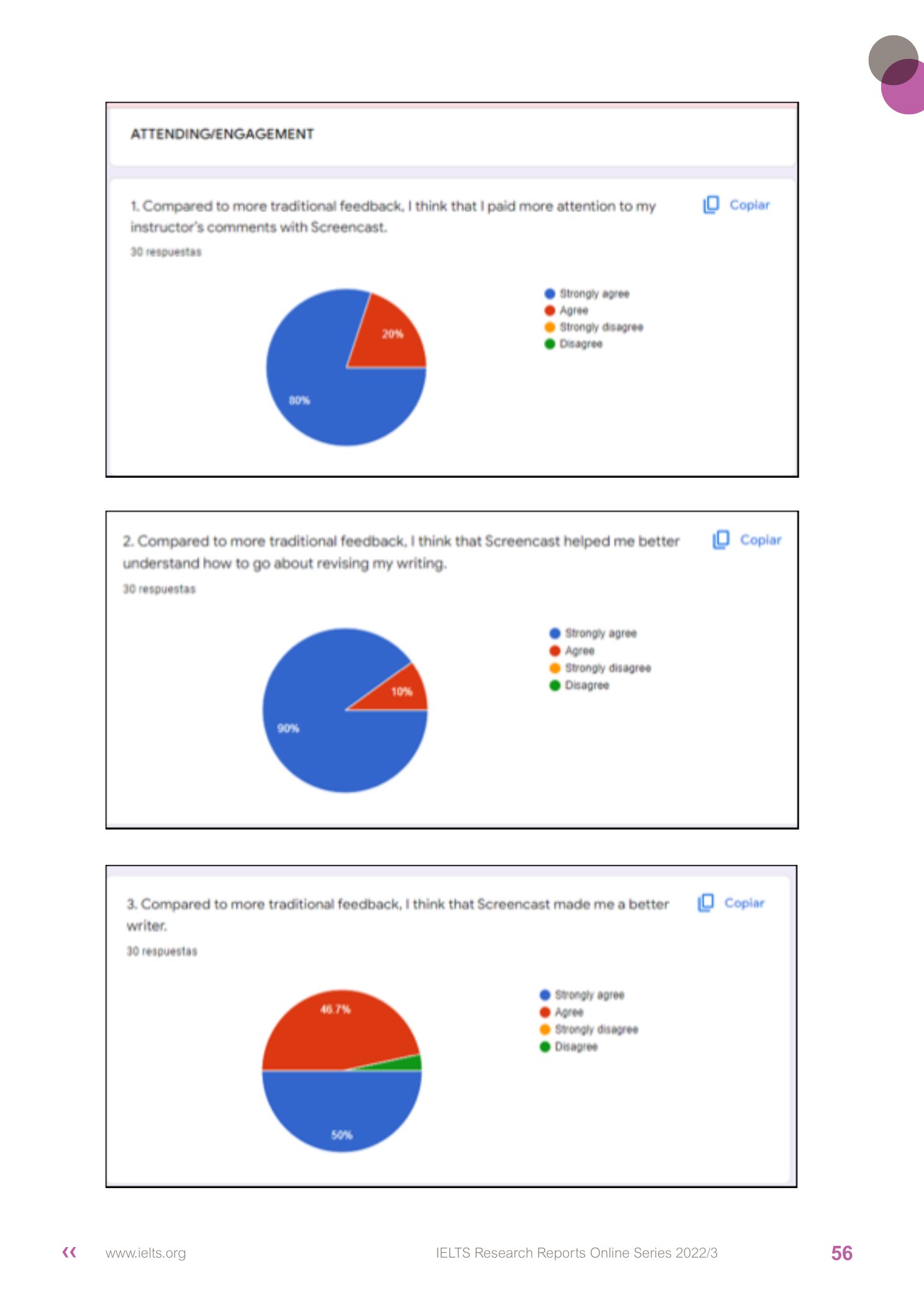


Appendix 3 open responses
Using the screencast feedback from your first argumentative essay, describe how you used it to improve the next pieces of writing.
Response count: 30 respuestas.
-
My first argumentative essay had many problems that I overlooked, but screentcast feedback was specially effective in helping me to be aware of these problems. First, I paid attention to visual elements used by the teacher to highlight which and where were the mistakes; for example, using different colours to identify the type of error made. And then, I listened to the teacher comments or explanations. The repetition of these oral comments played a huge role in improving my second argumentative essay as I could repeat what the teacher said, mainly because I didn’t get it the first time.
-
I listened carefully to every advice the teacher gave me to improve my writing. For example I tend to use “we” or some informal words and thanks to the teacher I realized that. It is worth saying that screencast feedback is really helpful in my opinion because it is way better when someone explains what you need to do instead of just writing it.
-
The experience was very organic, even though it was through a screen. The professional gave the appropriate amount of information as I assumed that he prepared what to say, something that would be different during a real time meeting/call. I wrote down a small list of “DOs and DON’Ts” that I tried to follow during the following tasks, together with the supporting material that the professional sent me.
-
Even if in terms of content I still got some mistakes, the screencast feedback helped me specially with the structure of the essay, seeing everything in the video was quite useful for the other essays. Also, it was good when you showed the recommendations or other pages with information in the same video.
-
Actually, I went back to it in the processing of every next task that I was assigned. It helped me build my learning upon my errors and hopefully, with having them fresh in my mind, not committing them again, remembering the structure, and adding what I needed to add.
-
I used the screencast feedback as a guidance. I watched it twice. The first time was to pay attention to general ideas and notice how was my performance on average. The second time was to pay attention to details and take into consideration my points of improvements.
-
Before writing the next essays I watched the screencast feedback once or twice so as to know my weaknesses in writing. While writing the essays, I watched the feedback in order to make sure I was doing well and follow the advice given by the teacher.
-
It helped me more to realize what I was doing wrong. I would watch the screencast feedback, take notes of what I did wrong and then would go to YouTube to search how to improve my piece of writing, maybe structure or vocabulary, then watch the screencast again to see if a forget something and finally I would start writing with the video open and changing what I did wrong before.
-
I wrote down my mistakes and tried not to make them again.
-
I watched the video recording several times, as I was writing the essay, this way the feedback could be given at any moment during the process of writing, and with the explanation of my teacher, everything was clearer than with a written feedback.
-
I’ve been able to rewatch the screencast feedback from previous essays focusing on what could have been improved as well as what was right.
-
I used the feedback to improve the organization of the essays that I made later because I checked the weaknesses that I had previously to improved it in the next essays. Also, I used it to improve the structure and how the parts of the essay are developed (introduction, development and conclusion). Besides that, the feedback also helped me better use specific words and vocabulary in the essays.
-
I tried to include as much as I could but what i tried the most was the supporting ideas, at least two examples for each idea that has to be developed
-
I took notes on the screencast feedback, which helped me to organize and improve the following essays. More specifically, it helped me to improve the essay’s structure and grammatical errors. Moreover, I paid more attention to the highlighted details the feedback addressed, as the teacher made comments and suggestions to overcome those issues next time.
-
I considered the comments of my teacher and in other piece of writing I tried not to make the same mistakes.
-
It made me realized common mistakes that i Made on My writing and since the feedback is more personalized i was able to correct them.
-
I paid attention to the mistakes detected in the piece of writing in order to not repeat them next time and also studied the attached material as to include their concepts in my next works.
-
I watched the video twice or more and I took notes, then I would study and write according to the notes and the screencast feedback.
-
The first feedback I received was focused on the structure of an essay. While I was watching the screencast feedback, I took some notes that would help me to remember. Then I used the essays’ structure recommended to do the following writings.
-
First of all, I watched it more than twice so that I would really understand what I had to improve. Then, whenever I needed to check if my piece of writing followed the required structure I watched the video again to make sure I did not made the same mistakes.
-
I checked and took notes on the organization of the essay and what each of the parts of the essay had to contain.
-
I notice my mistakes and I was able how to solve them, in case I forgot something, the screen cast was able to be seen again.
-
I made notes using the feedback to internalise the correct structure and keep the tips and my essays as references for future work.
-
It helped me to understand what I did wrong and how to corrected. Many times written feedback is confusing, however, this opportunity give me a better notion of my mistakes.
-
I mainly used the screencast feedback as a guide to improve my previous mistakes. In the first essay, I just had my previous knowledge and what I remembered to write the essay, but in the following ones, I could pay attention to the details highlighted in the feedback. I think that the screencast feedback provides a more friendly perspective than the traditional feedback, so I could improve as well my perspective and predisposition to improve my mistakes when writing essays.
-
I used my feedback following the suggested steps and changes that my teacher made in the Screencast.
-
I understood better the organization of an introduction.
-
Well, I felt quite comfortable having this kind of feedback; I think it is more personalized. Besides, it helped me to feel a little more self-confident, because the mistakes I made were silly, considering the 40 minutes to complete the task. Also, I saw that I improved in the structure of the essays in general.
-
It was really useful. You can access to your feedback not only once, and I think that is an advantage. From the beginning to the end I guess I improved a lot. I considered it a good technique. Also, the time to prepared was really enough, i don’t feel pressure just writing in two hours
-
I took into consideration all the details and comments provided by the professor. I think I understood better how to improve my pieces of writing since the Screecast feedback was more elaborate and concise than traditional feedback due to the body language.
Author biodata
Mabel Oritz
Mabel Ortiz graduated from Universidad de Concepción as an EFL teacher. She holds an MA in ICT from Universidad de la Frontera and a PhD in Linguistics from Universidad de Concepción. At present, she works at Universidad Católica de la Santísima Concepción, Chile. Her research interests are the use of technology in language learning and written corrective feedback strategies. Mabel has taught postgraduate courses and has supervised undergraduate and postgraduate thesis projects. She has been the lead researcher and co-researcher in different research projects in the field of English language teaching and learning. She has also published several papers in national and international journals.
Claudio Diaz
Claudio Díaz Larenas graduated from Universidad de Concepción as an EFL teacher. He holds an MA in Linguistics and a PhD in Education from Universidad de Concepción, Chile. At present, he works at Universidad de Concepcion. He teaches undergraduate and postgraduate courses, and guides thesis projects. His research interests are teacher cognition and language assessment. Claudio has conducted national and international research projects in the field of English language teaching, learning and assessment. He has also published numerous papers in national and international journals.