
Benchmarking English standards across professions and professional university degrees
Official IELTS research report on Impact and Washback - Use of test scores; Test comparisons, published in 2024.
Abstract
This study reports benchmarking practices, and examines the scoring and equating practices across different language tests (IELTS, TOEFL, PTE, C1A, OET, and DET), for the purposes of professional registration and entry into university study leading to professional registration.
The study focuses on six linguistically demanding professional areas: education, law, medicine, nursing, psychology, and social work, in the six English-medium countries of Australia, Canada, Ireland, New Zealand, United Kingdom, and United States of America.
Through the collection of minimum English proficiency scores and score equivalence practices on the most used international language tests, it can be observed how stakeholders apply these tests and, through their equation score, how they perceive tests to be related. The data also compares the acceptable minimum standards of test-developers, professional organisations, and university degrees in professional areas.
1 Introduction
English proficiency tests are powerful because they play a pivotal role in enabling major life events to occur, such as migration to another country, professional registration, university entry, educational placement, and more. English proficiency tests are used by stakeholders for gate-keeping purposes, preventing people who do not meet standards from gaining access, and ensuring those who pass have the set of communication skills required for future purposes. Sometimes the future context may be private study, where the consequences of insufficient language skills may largely affect only the individual and their social network. Sometimes the future context may involve providing a service to the public, where others are relying on good communication in order for the service to be carried out. This service may involve life-and-death situations.
This project focuses on six major English-medium countries, which are also popular migration and study destinations: Australia, Canada, Ireland, New Zealand, United Kingdom (UK), and the United States of America (USA). It examines the English proficiency requirements for professional university degree entry and professional registration in the linguistically demanding areas of medicine, nursing, psychology, social work, law, and education.
The project examines the scoring and equivalence setting practices, through which stakeholder perceptions can be observed regarding standardised tests such as IELTS, TOEFL, PTE, C1A, OET, and DET. Both the professional registration requirements and the professional university degree admission requirements will be internationally benchmarked. Through benchmarking, the project also ascertains what level of agreement exists between stakeholder decisions about the minimum standards and equivalent scores they accept between proficiency tests.
The point must be made that real equivalence that is based upon linguistic evidence is not the main focus of this project. The focus is on how the tests are used by stakeholders, and how they vary in choice of scores, tests, and equivalence in applied use. This ‘perceived’ equivalence is not necessarily a product of either test-developer recommendations nor formal equivalence studies.
Misalignment between stakeholders’ accepted minimum scores and equation scores poses a threat to test face validity and value. Thus, another outcome of the project, beyond benchmarking the range of proficiency scores chosen, is to establish test score equating practices which show how competitor test scores are perceived to be positioned against each other, and highlight where discrepancies between stakeholder minimum score standards exist. The project also identifies possible influences on standard setting, such as professional registration requirements, university course accreditation by professional bodies, university rank, and country-based norms.
As noted in the Preface, this report is intended to engage stakeholders in thinking about equivalence and its implications. The work is undertaken in Australia where IELTS is the only high-stakes English language test mentioned in Australian legislation (and in this study is found to be the most widely accepted test among both institutions and professions in the six countries). Therefore, IELTS is foregrounded here as the benchmark test in this report.
2 English proficiency tests
This study examines the most common international English proficiency tests used among the professions and universities. These include the International English Language Testing System - Academic (IELTS), Occupational English Test (OET), and Cambridge 1 Advanced (C1A, formerly its equivalent was Cambridge Academic English, known as CAE) which all have roots in University of Cambridge Local Examinations Syndicate (established 1858) and the first Cambridge English Exam (established 1913). The Pearson Test of English - Academic (PTE) is part of the Pearson PLC group and the University of London Schools Examination Board’s PTE General (established 1982). The Test of English as a Foreign Language iBT (TOEFL) and online version come from the founding organisation Modern Language Association (established 1883). Finally, the Duolingo English Test (DET) is from Duolingo Inc (established 2011). A full explanation of the different formats of each test can be found in the Appendix 1.
Table 1 provides an overview of each test included in the study. Except for OET, these proficiency tests tend to be primarily designed for English assessment of international students for academic purposes, and thereafter extended for use in professional and migration domains.
Table 1: English proficiency test establishment and goals
| Test name | Year of origin | Location | Main uses |
|---|---|---|---|
| International English Language Testing System - Academic (IELTS) | 1989 | UK/Australia | Academic and professional settings; study abroad, immigration, professional registration. |
| Occupational English Test (OET) | 1989 | UK/Australia | Tailored for healthcare professionals seeking to work or study in English-speaking environments. |
| Cambridge English: Advanced (C1A) | 1991 | UK | Academic and professional settings; study abroad, immigration, professional registration. |
| Pearson Test of English Academic (PTE) | 2009 | UK | Academic and professional settings; study abroad, immigration, professional registration. |
| Test of English as a Foreign Language - iBT (TOEFL) | 1964 | USA | Academic and professional settings; study abroad, immigration, professional registration. |
| Duolingo English Test (DET) | 2016 | USA | Flexible option for academic and student visa applications; accessible online testing. |
Table 2: Comparative chart of time required to take each English proficiency test in minutes
| Test | Maximum test time | Listening | Reading | Writing | Speaking | Minimum result time |
|---|---|---|---|---|---|---|
| IELTS | 144 min | 30 min | 60 min | 60 min | 11-14 min | >3 days |
| TOEFL | 116 min | 36 min | 35 min | 29 min | 16 min | >4 days |
| PTE | 140 min | 30-43 min | 29-30 min | 54-67 min combined | >2 hours | |
| C1A | 243 min | 40 min | 90 min | 90 min | 15-23 min | >2 weeks |
| OET | 170 min | 45 min | 60 min | 45 min | 20 min | >10 days |
| DET | 60 min | 45 min combined | 10 min combined | >12 hours |
Table 3 details the content of each test. IELTS, TOEFL, and OET use a combination of human raters and computer scoring. PTE and DET are assessed by computer scoring alone (i.e., speech and writing are not assessed by human raters). C1A is assessed by human raters alone.
Table 3: Comparative chart of questions and number of tasks in each English proficiency test
| Test | Listening | Reading | Writing | Speaking | Human raters |
|---|---|---|---|---|---|
| IELTS | 40 questions | 40 questions | 2 tasks | 3 tasks | Yes |
| TOEFL | 28 questions | 20 questions | 2 tasks | 4 tasks | Yes |
| PTE | 12-20 questions | 13-18 questions | 28-36 questions | No | |
| C1A | 30 questions | 56 questions | 2 tasks | 4 tasks | Yes |
| OET | 42 questions | 42 questions | 1 task | 2 tasks | Yes |
| DET | No fixed number (adaptive) | No fixed number (adaptive) | No |
Score equivalence refers to the process of comparing and aligning scores from different language testing systems to establish an equivalent interpretation of language proficiency levels. Each testing system (i.e., IELTS, TOEFL, PTE, C1A, OET, and DET above) has unique scoring, assessment methods, and focal areas of English usage (i.e., the function or reason that drove the test to be created). Stakeholders (such as educational institutions, governments, and professional bodies) rely on equivalence tables to reconcile scores across different language testing systems that may be used (even if the test was not designed for the context they work within). Such tables are based on both expert opinion and empirical studies, and are intended to align score ranges for practical purposes like university admissions or visa applications.
The equivalence of the most commonly used scores for university and professional standard setting is presented in Table 4, indexed against IELTS half-band scores, and is derived from the fuller table in Appendix 2 which compiles the information about score equivalence across test-developer websites (Cambridge Language Assessment 2019; Duolingo 2023, ETS 2023 b; OET 2018; Pearson 2022).
Table 4: Test scores equivalences, as established in linguistic research and by test makers
| IELTS | 5.5 | 6.0 | 6.5 | 7.0 | 7.5 | 8.0 |
|---|---|---|---|---|---|---|
| TOEFL | 46-59 | 60-78 | 79-93 | 94-101 | 102-109 | 110-114 |
| PTE | 36-45 | 46-55 | 56-65 | 66-75 | 76-83 | 84-88 |
| C1A | 162-168 | 169-175 | 176-179 | 180-190 | 191-210 | N/A |
| OET | 200-240 | 250-290 | 300-340 | 350-390 | 400-440 | 450-500 |
| DET | 95-100 | 105-115 | 120-125 | 130-135 | 140-145 | 150-155 |
3 Stakeholder test score setting and score equating
It has been established in the literature that stakeholders may not have high levels of test literacy (Hyatt & Brooks 2009; Murray et al. 2011; O’Loughlin 2012; Lam et al. 2021). Given the range of possible international and local English proficiency tests available to stakeholders, it is common to encounter variation between institutions and professions about what tests are accepted and what minimum scores are set. Stakeholders may not follow the score recommended by IELTS for linguistically demanding courses (Müller 2015), and by proxy, the linguistic requirements for later professional practice (Müller 2016). Similar disagreement has been found between professional bodies for registration requirements. For example, in a study of nursing registration standards by Müller (2016), there was variation of requirements between local jurisdictions, especially in Canada and the USA, despite the existence of a national body who advised on what scores to use (albeit without the power to mandate).
There are already indications that variation in the equivalence scores on different tests will be found among universities. An example can be drawn from one university who sets a score of IELTS 7.5 as being ‘equivalent’ to TOEFL 82, but in other universities, it may be TOEFL 100 or 110 (see University of Western Australia, University of Waterloo, and University of Cambridge). This pattern of variation between stakeholder perceptions of equivalence is seen for other language tests, so an IELTS 7.5 is perceived as ‘equivalent’ to PTE 51, 70, and 76 (see University of Tasmania, Cornell University, and University of Sydney). Test developers recommend an IELTS 7.5 as equivalent to TOEFL 102-109 and PTE 76-83.
This project allows us to fully benchmark and understand stakeholder test-score setting and test-score equivalence, and this can be compared to the recommendations of test developers. A benefit of this project is to also ascertain the relationship between professional university degree entry requirements to their partner professional registration requirements. This research builds upon the work by Merrifield (2016) who examined the use of IELTS by professional associations in the United Kingdom, Canada, Australia, and New Zealand, and extracted minimum score data as part of that project. This study is different because it adds the USA and Ireland, and focuses on the linguistically demanding professions of education, law, medicine, nursing, psychology, and social work, all of which require considerable spontaneous verbal skills which rapidly switch between general English and domain-specific language, in addition to informal and formal registers.
This project has four main research questions.
- What are the minimum English proficiency scores set by stakeholders for linguistically demanding professions and professional degrees?
- How are English proficiency scores equated (perceived equivalence) across tests (IELTS, TOEFL, PTE, C1A, OET, and DET) by professional bodies and universities?
- To what degree do scoring practices vary from test-developer recommendations?
- Are there any differentiating or predictable patterns seen between countries, professional bodies, and universities?
4 Methods
4.1 Variables
4.1.1 Tests
This study examines the most common international English proficiency tests used among the professions and universities: International English Language Testing System - Academic (IELTS); Occupational English Test (OET); Cambridge 1 Advanced (C1A, formerly CAE); Pearson Test of English - Academic (PTE); Test of English as a Foreign Language iBT (TOEFL); and Duolingo English Test (DET). Thus, six main tests were included in the study for benchmarking.
The project did not look at national tests (e.g., CELBAN, CanTEST, NZCEL) because these have limited circulation. The project examined the most popular internationally available and used tests among the selected groups of this study. It did not collect data on other proficiency measures such as grade results from previous English-medium education, English College graduation, foundation courses, and preparation courses (e.g., IB English, GCSE, AICE). The use of non-standardised methods of establishing English proficiency, and equating these to tests, is not dealt with here. Finally, CEFR was not included because it is not an English proficiency test: it is a framework used to describe activities and competencies across languages.
4.1.2 Countries
This project focused on the six major English-speaking countries subject to high volumes of international students and migration: Australia, Canada, Ireland, New Zealand, UK, and USA. Given that each country has major administrative divisions or ‘jurisdictions’ in which professional bodies operate, the search involved 77 countries, territories, states, or provinces, etc., at the jurisdictional level.
4.1.3 Professions
This project examined the six professional areas of education, law, medicine, nursing, psychology, and social work. These were chosen because they are common linguistically demanding professions with regulatory governance. For the professional bodies, data was recorded at state level in federated systems for Australia, Canada, and USA. Ireland, New Zealand, and the UK were treated as single jurisdictions. This is because professions may be regulated by a local or national body, so with 77 jurisdictions being investigated, 462 data sources were searched. The minimum English proficiency standard for registration was recorded.
4.1.4 Universities
Universities listed in the Times Higher Education Top 1000 rankings in the nominated countries of the study were included. A total of 330 universities were eligible for investigation. In the six designated professional areas, 1,986 professional degree entry standards were searched.
A professional degree was selected for investigation if it lead to professional registration. A professional degree may be undergraduate and/or postgraduate, and while a degree is often not the only step to most professionals, an undergraduate bachelor is usually sufficient to gain basic registration, except for medicine and psychology. There may be additional placement or internship component of up to two years which could be a part of the degree or undertaken after the main coursework has been completed.
Table 5: Degrees searched in the dataset (the minimal qualification leading to professional registration)
| Degree to Registration | AUSTRALIA | NEW ZEALAND | UK | IRELAND | CANADA | USA |
|---|---|---|---|---|---|---|
| EDUCATION:‘Primary school teacher’‘Elementary school teacher’ | Bachelor of Education (Primary) | Bachelor of Education (Teaching) | Bachelor of Education | Bachelor of Education | Bachelor of Education | Bachelor’s degree in education |
| LAW:‘Barrister’‘Litigator/Trial lawyer’ | Bachelor of Law or Juris Doctor | Bachelor of Law | Bachelor of Law | Bachelor of Law | Bachelor of Law or Juris Doctor | Juris Doctor |
| MEDICINE:‘General practitioner’‘Family physician’‘Family doctor’‘Primary care physician’ | Bachelor of Medicine or Bachelor of Surgery or Doctor of Medicine | Bachelor of Medicine or Bachelor of Surgery | Bachelor of Medicine or Bachelor of Surgery or Bachelor of Medical Sciences | Bachelor of Medicine or Bachelor of Surgery | Doctor of Medicine | Doctor of Medicine |
| NURSING:‘Registered nurse’ | Bachelor of Nursing | Bachelor of Nursing | Bachelor of Nursing | Bachelor of Nursing | Bachelor of Nursing or Bachelor of Science in Nursing | Bachelor of Science in Nursing or Associate Degree in Nursing |
| PSYCHOLOGY:‘Registered psychologist’ | Bachelor of Psychology | Bachelor of Psychology | Bachelor of Psychology | Bachelor of Psychology | Master of Psychology or Doctor of Psychology | PhD in Psychology or Doctor of Psychology |
| SOCIAL WORK:‘Social worker’ | Bachelor of Social Work | Bachelor of Social Work | Bachelor of Social Work | Bachelor of Social Work | Bachelor of Social Work | Bachelor of Social Work |
4.2 Procedure
4.2.1 Data collection
This was a desktop study which collected data from the websites and documentation of professional bodies (July-August 2023) and universities (March-June 2023). Data was collected on the English proficiency tests accepted and the minimum English proficiency scores required.
Professional registration English proficiency data was gathered from publicly available professional registration websites and official policy documents. If this information could not be located on the website or in the documentation, professional organisations were directly emailed for English proficiency information.
The Times Higher Education Top 1000 universities list was downloaded and searched. The universities in target countries were located in this list and retained. Six professional areas for each university were created, ready for data population.
University-based English proficiency data was gathered from the publicly available university website and official documents. When the preferred type of degree (see Table 5) was not listed by the university, a related or equally recognised degree at the same level and reaching the same outcomes was searched. When there was no equivalent degree offered for that professional area, then no data was recorded against that degree. When an entry test score was not located for a specific degree or faculty, but the degree was available, the minimum English proficiency test score set for general university entry at that degree level was recorded. Details about the professional classification and relevant degree leading to professional registration in each area can be found in Appendix 3.
In cases where only sub-test scores could be located, an aggregate overall score was calculated in these cases and recorded in the dataset. Overall scores were sometimes given with minimum sub-test scores, and again, only the overall score was retained in this study. There was some variation on whether multiple sittings were allowed, but not considered an issue for inclusion. If a letter grade was provided (specifically found in OET or C1A), the lowest minimum equivalent numerical score was retained.
In situations where a test was nominated as accepted, but no specific minimum entry score was given for that test, a code for ‘not specified’ was recorded. If a test type was explicitly stated as not accepted, a code for ‘unaccepted test’ was recorded.
After data collection, the proportions of the dataset for each variable was verified and found to be mostly balanced, with the exception of professions having substantial missing data in the USA. The proportions and distributions can be viewed in Appendix 4.
Brief notes and observations were made next to dataset entries as required, particularly if patterns were being observed, such as the use of a particular test being conditionally accepted.
4.3 Data analysis
Data was analysed in Microsoft Excel v2311 and SPSS v28. Descriptive statistical analysis was conducted on the test scores and how these are distributed according to country, test, university rank, and profession. Descriptive statistics included counts, percentages, averages (both mean and median, with checks made for any disparity that needed attention), ranges, notable high/low score distributions, and distribution graphs. Non-parametric testing was conducted, such as Spearman correlations, as per test assumptions being met.
5 Results
5.1 Country-based averages and ranges
Looking at the test scores in different countries, it can be asked if there is effect of location rather than professional area on scores. Tables 6 and 7 show the distribution of required test scores according to country, first for professional standards and then for university standards.
Table 6: All professions - averages and ranges by each country
| Country | IELTS | TOEFL | PTE | C1A | OET |
|---|---|---|---|---|---|
| Australia | 7.2 (7.0-7.5) | 95 (94-99) | 65 (65) | - | 350 (350) |
| Canada | 7.2 (6.0-7.5) | 95 (94-99) | 65 (65) | - | 350 (350) |
| Ireland | 7.0 (7.0) | - | - | 180 (180) | 350 (350) |
| New Zealand | 7.2 (7.0-7.5) | 98 (98) | 65 (65) | 180 (180) | 350 (350) |
| UK | 7.1 (6.5-7.5) | 100 (100) | 73 (73) | 180 (180) | 350 (350) |
| USA | 6.6 (6.5-8.0) | 83 (72-92) | 55 (55) | 172 (160-176) | 313 (300-350) |
| All countries | 7.0 (6.0-8.0) | 95 (72-100) | 65 (55-73) | 178 (160-180) | 344 (300-350) |
Across all professions, there are blank cells for a few tests, indicating that these tests were not universally recognised as acceptable by some countries in any of their professions. This was the case for TOEFL, PTE, and C1A. Most countries recorded a weighted average across all professions at IELTS 7.0-7.2, with the USA notably lower at IELTS 6.6. The largest variations in range occurred in the USA (IELTS 6.5-8.0) and Canada (6.0-7.5). Note that the IELTS recommendation is 7.5 for linguistically demanding situations.
If we examine the university averages and ranges across countries, in Table 7, it immediately becomes apparent that there are lower standards for university degrees than those set for professional registration.
Table 7: All professional degrees - university averages and ranges by each country
| Country | IELTS | TOEFL | PTE | C1A | DET |
|---|---|---|---|---|---|
| Australia | 6.9 (6.0-8.0) | 90 (60-109) | 64 (50-78) | 179 (152-186) | 115 (115) |
| Canada | 6.7 (6.5-8.0) | 90 (79-108) | 62 (58-76) | 182 (175-200) | 117 (105-145) |
| Ireland | 6.5 (6.5) | 89 (79-92) | 62 (58-63) | 177 (175-180) | 117 (110-120) |
| New Zealand | 6.5 (6.0-7.5) | 87 (80-100) | 55 (46-65) | 174 (169-185) | 105 (105-105) |
| UK | 6.6 (5.5-7.5) | 88 (60-110) | 63 (48-80) | 178 (160-200) | 118 (80-140) |
| USA | 6.5 (5.5-8.0) | 82 (61-114) | 56 (44-90) | 180 (152-200) | 110 (85-160) |
| All countries | 6.6 (5.5-8.0) | 88 (60-114) | 60 (44-90) | 178 (152-200) | 114 (80-160) |
The mean university IELTS score across all countries is IELTS 6.6, lower in Ireland, New Zealand, and the USA at IELTS 6.5, and higher in Canada at IELTS 6.7 and in Australia at IELTS 6.9. The UK sits in the middle at 6.6. The range of entry scores across all countries is IELTS 5.5-8.0, where the UK is responsible for the lowest scores, and Ireland has the least variation, only accepting IELTS 6.5 despite greater variability for other tests. Again, note that IELTS 7.5 is a recommendation for entry into linguistically demanding education.
5.1.1 Profession-based averages and ranges
The international profession-based test score averages and ranges is given in Table 8. In some cases, there are blank cells where no professional organisation in any country has nominated a particular test, and therefore there is no score available.
Table 8: Profession-based averages and ranges across countries
| Professional Registration | IELTS | TOEFL | PTE | C1A | OET |
|---|---|---|---|---|---|
| Education | 7.1 (6.0-7.5) | 91 (72-103) | 65 (65) | 170 (160-180) | - |
| Law | 7.2 (7.0-7.5) | 99 (99) | 73 (73) | - | - |
| Medicine | 7.1 (6.5-7.5) | 91 (79-96) | 65 (65) | 180 (180) | 347 (300-350) |
| Nursing | 6.7 (6.5-7.5) | 85 (79-94) | 59 (55-65) | 175 (175-176) | 333 (300-350) |
| Psychology | 7.1 (7.0-8.0) | 95 (80-100) | 65 (65) | - | - |
| Social work | 7.0 (7.0) | 92 (92) | - | 180 (180) | - |
| All professions | 7.0 (6.0-8.0) | 92 (72-103) | 65 (55-73) | 176 (160-180) | 340 (300-350) |
5.1.2 University-based averages and ranges
The international university-based test score averages and ranges, by professional degree, is given in Table 9.
Table 9: University-based averages and ranges across countries
| University Degree | IELTS | TOEFL | PTE | C1A | DET |
|---|---|---|---|---|---|
| Education | 6.6 (5.0-8.0) | 87 (60-110) | 60 (44-80) | 178 (160-200) | 113 (80-140) |
| Law | 6.5 (5.5-8.0) | 86 (60-114) | 59 (44-90) | 176 (152-193) | 115 (80-135) |
| Medicine | 6.7 (6.0-8.0) | 89 (61-110) | 62 (53-80) | 180 (158-200) | 116 (90-145) |
| Nursing | 6.7 (5.5-7.5) | 89 (60-110) | 61 (44-79) | 178 (160-200) | 117 (95-130) |
| Psychology | 6.7 (6.0-8.0) | 90 (60-110) | 62 (51-80) | 180 (158-200) | 117 (85-160) |
| Social work | 6.6 (5.5-7.5) | 86 (60-110) | 59 (44-79) | 177 (160-200) | 115 (80-140) |
| All universities | 6.6 (5.0-8.0) | 88 (60-114) | 60 (44-90) | 178 (152-200) | 114 (80-160) |
It is noted that in the above tables, there is minor variation in the total mean score values for country versus professional areas for C1A, OET, and DET due to the use of weighted means. This does not affect the analysis.
5.1.3 Test score equivalence
In the following sections, the IELTS test scores will act as the reference point for understanding score variability across tests, as seen in the equivalence scores set by professions and universities. The work is undertaken in Australia where IELTS is the only high-stakes English language test mentioned in Australian legislation. It is also the most common test for the dataset across the countries. Therefore, IELTS is foregrounded here as the benchmark test.
The top line in each graph represents the range of equivalent scores on each test, as recommended by test developers, so no mean score is appropriate. For the graphing of the tests, a single point with no line represents no variation in what is perceived as the equivalent score. A wide line indicates great variation on what a score is considered to be comparable in another test.
5.1.3.1 IELTS-TOEFL equivalence found in the data
The following graph presents the range of TOEFL scores considered equivalent to each IELTS half-band score (Figure 1). IELTS and TOEFL dominate the dataset in terms of acceptance and recognition, are the longest established tests, in addition to being similar in terms of purpose and structure.

Figure 1: TOEFL equivalence scores set for each IELTS half band
Overall, it is immediately noticeable that the score ranges do not match the test-developers’ recommendations represented in black. At lower English proficiency, universities and professions set higher TOEFL scores than IELTS equivalents. This trend reverses at the higher English proficiency levels. The closest alignments occur at the IELTS 6.5-7.0 scores. These are also the most common score categories in terms of frequency.
The problem here is equating scores from TOEFL back to IELTS scores. Consider the situation where a TOEFL score of 86 is indexed - depending on what university is using it, it may be equivalent to anywhere between IELTS 5.5-7.5. This is also found for the professions, where a TOEFL score of 96 may be equivalent to IELTS 6.0-7.5 depending on which professional body being referenced. A contradiction occurs for TOEFL scores set by professional bodies at IELTS 7.0 being higher than the TOEFL scores needed to equate to IELTS 7.5.
5.1.3.2 IELTS-PTE equivalence found in the data
The range of PTE scores considered equivalent to each IELTS half-band score is shown in Figure 2. While PTE is popular among universities (albeit also the second most likely to be explicitly prohibited by universities after DET), PTE is rarer among professions (and the unified mean/range values are a result of this scarcity, in addition to two-thirds of PTE values generated by professional bodies following the recommendations of a single Australian national regulator).

Figure 2: PTE scores set for each IELTS half band
As with TOEFL equivalents, the black line indicates the test-developers’ advice about what range of PTE scores equates to each IELTS half band. Once again, it is noticeable that university score ranges do not stay within the test-developers’ recommendations. At the IELTS 6.5-7.0 levels, we see the greatest range in possible equivalent PTE scores, which was not the case for TOEFL which stabilised somewhat in this area. Among the professional bodies, the PTE equivalence scores were consistently below that recommended, and slightly lower than the mean scores of universities, which means it is easier to get registered as a professional than it is to commence university study when it comes to PTE scoring. Finally, as seen for TOEFL, the problem of equating PTE scores back to IELTS scores is also present, where a PTE score of 65 can fall anywhere between IELTS 6.0-7.5 in the university sector.
5.1.3.3 IELTS-C1A equivalence found in the data
The range of C1A scores considered equivalent to each IELTS half-band score is shown in Figure 3. The observation counts for C1A are significantly fewer than the number of observations available for IELTS, TOEFL, and PTE, particularly from professional bodies.

Figure 3: C1A equivalence scores set for each IELTS half band
Again, the graph shows that universities do not stay within the recommended ranges given by test developers, but this time the professional bodies come close to it.
Universities, on the other hand, show an equivalence range that is quite wide. If a C1A score of between 185-200 was used as a referral point, any score between IELTS 6.0-8.0 would allow entry. As such, there is almost no discriminatory power evident here.
The mean values, however, are much closer to that recommended by test developers.
5.1.3.4 IELTS-OET equivalence found in the data
The range of OET scores considered equivalent to each IELTS half-band score is shown in Figure 4. There were more OET observations in the dataset than PTE observations in the area of professional registration. OET is reported only for the professions in this report since it is rarely found among university entry requirements.
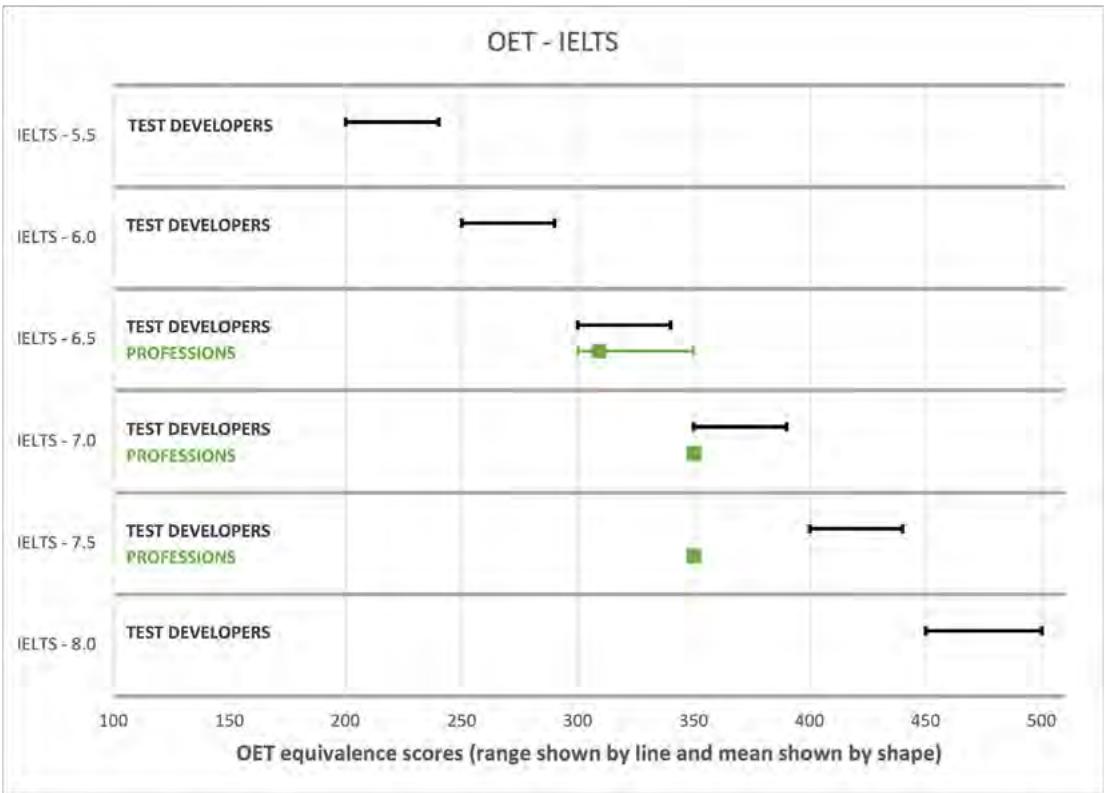
Figure 4: OET equivalence scores set for each IELTS band
The OET scores set by professional bodies do not go above 350. The values between test developers and the professions match more closely here than for other tests, but not at the highest levels. The professions, for both OET and TOEFL, as seen in an earlier figure, raise the IELTS scores without raising the equivalence scores.
5.1.3.5 IELTS-DET equivalence found in the data
The range of DET scores considered equivalent to each IELTS half-band score is shown in Figure 5. While DET is used by many universities, it is also the most likely to be prohibited. DET is not accepted by any profession. Figure 5 demonstrates visually the instability of the DET equation scores set by stakeholders.

Figure 5: DET equivalence scores set for each IELTS half band
As with previous tests, it is challenging to use a DET score as a reference point to locate an equivalent IELTS score. A DET score of 120 is equivalent to IELTS 6.0-7.5, depending on which university scores are referred to. Also, comparing the test-developer ranges to the DET ranges, it is clear that universities set DET scores that are much lower in every IELTS band score, and the mean scores fall entirely out of the range of test-developer recommendations.
5.1.4 Correlations between perceived score equivalence versus test-developer score ranges
The graphs above show how the test scores are equated in practice. To understand statistically how well stakeholder scores related to the score ranges recommended by test developers, the scores on different tests were converted into categorical variables according to the values given in Table 4. Thus, a TOEFL score range of 79-93 was recoded as a single categorical variable which had an equivalent of IELTS 6.5 (this is the equivalence set by the TOEFL test developers). The university dataset was large enough to run Spearman rho correlations, and since the professional dataset was much smaller, Kendal’s tau was also used.
As explained earlier, we would expect the test scores circulating among universities to fall within the recommended ranges of equivalent scores put forward by the test developers, and perfect correlations should be the result. However, as we have already seen in the figures above, a perfect correlation does not seem to happen in practice. Table 10 shows the correlations.
Table 10: Correlations between perceived test equivalence to test-developer recommended score equivalence
| Test compared to IELTS | Universities - Spearman rho | N | Professions - Kendall’s tau | N |
|---|---|---|---|---|
| TOEFL | .796 | 1087 | .747 | 75 |
| PTE | .626 | 805 | 1.0 | 36 |
| C1A | .657 | 525 | .882 | 7 |
| OET | n/a | n/a | .765 | 44 |
| DET | .654 | 455 | n/a | n/a |
As can be seen from Table 10, the perceived equivalence of scores across tests among universities are best for TOEFL and lowest for PTE. The professional bodies had larger correlations which indicates a better alignment with test-developer recommendations.
5.2 Factors influencing score
5.2.1 Proportion of international students, university ranking, and English proficiency test scores
It is possible that factors such as proportion of international students and university rankings might have affected score setting. A Spearman correlation of 0.42 (p<.001, n=1411) was found between university rank and international student proportion. This means that higher international student proportions were significantly related to higher university ranking, with the boxplots indicating this trend being particularly clear for those universities ranked in the top 400 in the world. Following this, a Spearman correlation of 0.37 (p<.001, n=1248) was found between university rank and IELTS requirement, and a Spearman correlation of 0.30 (p<.001, n=1248) between international student proportion and IELTS entry requirements. These significant results mean that the higher the international student proportions and university ranking, the higher the IELTS requirements tend to be as well.
5.2.2 Explicitly disallowed tests
While IELTS, TOEFL, and PTE were well accepted, and OET in its own healthcare domain, there were instances where some tests were stated explicitly as not accepted, as can be seen in Tables 11 and 12. This is different from being silent on whether a test was accepted or not, since an explicit statement of exclusion was located for this data.
Table 11: Tests explicitly not accepted by professional regulatory bodies, by jurisdiction
| COUNTRY | IELTS | TOEFL | PTE | C1A | OET | DET |
|---|---|---|---|---|---|---|
| Australia (in social work) | - | 8 | 8 | 8 | 8 | 8 |
| Canada (in education and nursing) | - | 1 | 3 | 3 | 3 | 3 |
| Ireland | - | - | - | - | - | - |
| New Zealand(in medicine and psychology) | - | 2 | 1 | 1 | 1 | 1 |
| UK | - | - | - | - | - | - |
| USA (in education) | - | - | 3 | 3 | 3 | 3 |
| TOTAL | 0 | 11 | 15 | 15 | 15 | 15 |
Table 12: Tests explicitly not accepted by universities, by jurisdiction
| COUNTRY | IELTS | TOEFL | PTE | C1A | OET | DET |
|---|---|---|---|---|---|---|
| Australia | - | 6 | 5 | - | 1 | 4 |
| Canada | - | 1 | 1 | - | 1 | - |
| New Zealand | - | - | - | - | - | 5 |
| UK | - | - | 2 | - | 4 | 9 |
| USA | 3 | 1 | 6 | 3 | 6 | 13 |
| TOTAL | 3 | 8 | 14 | 3 | 12 | 31 |
There are also some cases where tests were explicitly accepted, but without a minimum score stated. This sometimes occurred in both professions and universities. Among universities, Australia had two cases of naming a test without a score for TOEFL, PTE, and C1A, and one for OET, but Canada only had one instance, with one region accepting TOEFL but with no score. UK universities had seven instances of PTE, three of C1A, and one of DET where no scores were nominated. It was more common in the USA to accept a test without giving a score: 13 for IELTS, 17 for TOEFL, two for PTE, and six instances for DET.
6. Discussion
This project had four research questions regarding score setting practices, as follows.
- What are the minimum English proficiency scores set by stakeholders for linguistically demanding professions and professional degrees?
- How are English proficiency scores equated (perceived equivalence) across tests (IELTS, TOEFL, PTE, C1A, OET, and DET) by professional bodies and universities?
- To what degree do scoring practices vary from test-developer recommendations?
- Are there any differentiating or predictable patterns seen between countries, professional bodies, and universities?
Essentially, the aim was to establish how similar or different scores were for linguistically demanding professions and their degree areas, whether stakeholders set the same equivalence scores across tests, if these practices varied from the recommendations of test developers, and if there were any discernible patterns across these variables.
In relation to research question 1 regarding minimum English proficiency scores, there was a variation found between the professional areas, the university degree areas, and between professional registration standards and entry into the degree leading to that professional area. Averaged across profession registration standards, an IELTS 7.0 was found, with averages of nursing lowest (IELTS 6.7) and law highest (IELTS 7.2), which is a large variation. In terms of range, the lowest entry scores were found in education (starting at IELTS 6.0), while the highest entry scores were found in psychology (IELTS 8.0). For TOEFL, the average was TOEFL 92, with both the lowest and highest scores found in education (TOEFL 72-103). PTE had an average of PTE 65, with professions often settling on that score, and the lowest scores found in nursing (PTE 55) and the highest in law (PTE 73). OET was more uniform in its range of scores being between OET 300-350 (essentially one grade step for the letter-based grades), but medicine with a higher mean than nursing (OET 347 versus 333). There were very low counts of C1A scores, and none for DET.
Across the university sector, the averages were lower than that of their target profession. Across professional degrees, an average of IELTS 6.6 was found, with law averaging lowest (IELTS 6.5) and medicine, nursing, and psychology highest (IELTS 6.7). This is not a large variation. In terms of range, the lowest entry scores were found again in education (starting at IELTS 5.0) and the highest entry scores were shared among education, law, medicine, and psychology (IELTS 8.0). For TOEFL, the average was 88, with all but medicine sharing the lowest score (TOEFL 60), and highest scores found in law (TOEFL 114). There was a mean score of PTE 60 with all universities averaging within two points, and for range, the lowest scores were found in education, law, nursing, and social work (PTE 44) and the highest in law (PTE 90). For C1A, the mean score was 178, with professions averaging around two points of this, and for range, law had the lowest score (C1A 152) and all others shared the highest score (C1A 200). DET 114 was the average score for this test, with all universities averaging within two points, but in terms of range, education, law, and social work shared the lowest starting score (DET 80) and psychology the highest score (DET 160). There were very low counts for OET so it was excluded early from the analysis.
At this point, it is worth considering research question 3 about whether these test scores match the recommendations given by test developers. For IELTS, the recommendation for commencing a linguistically demanding academic course is an IELTS 7.5 score, which is deemed ‘acceptable’ English proficiency, and IELTS 7.0 deemed as ‘probably acceptable’ (IELTS 2024). No profession averaged IELTS 7.5, but they did average between 7.0-7.2 (except nursing). The range was from a low of IELTS 5.5, usually reserved for those entering an English language college for intensive English study, to a high of IELTS 8.0, which may have been unnecessarily high, given that the test measures English proficiency for academic study, not advanced applications of the language in educational, legal, health, and social work settings. For universities, none reached an average of IELTS 7.0, so most had an average score which would be deemed as ‘English study needed’. The range of scores among universities mirrored the range found in the professions, with extreme lows (IELTS 5.5), with perhaps some setting scores that were unnecessarily high (IELTS 8.0), going well beyond the recommendation of IELTS 7.0-7.5 as (probably) acceptable.
It is an interesting finding to the first question that universities were admitting students into degree pathways with a score lower than that required for professional registration, given that there is often a clinical or practical component in the coursework that requires supervised practice on the public. Through course accreditation, professional registration bodies have some power over the standards that universities set.
So if professional degree entry is consistently set at lower standards than that of professional registration, i.e., as was seen in nursing in Australia, and the university course is accredited by the national body, then the professional body can require a higher English proficiency score for commencing students as part of accreditation.
Putting clinical or practical readiness aside, the question can be raised about how students are expected to improve their English skills in time to be work-ready (at least in the countries in this study). Studies have shown that international students do not necessarily increase their IELTS score by more than a 0.5 band over an entire degree (O’Loughlin & Arkoudis 2005), with between 35%-63% remaining at the same level or worsening over their degree (O’Loughlin & Arkoudis 2005; Craven 2012). This can occur despite language and learning support services being available throughout these students’ degrees.
Research question 2 asks about score equivalence practices regarding what test score equals a score on a different test. In the Results section, IELTS was used as the anchor score and equivalent test scores were graphed to show averages and ranges. The results gave a reasonable picture of the equivalent test score distributions, by test developer, profession, and university. It was found that there were increasingly lowered equivalence test scores against the incremental increases in IELTS, so that the alternative test would require a lower score than the higher IELTS scores would indicate. Working backwards, if the other test was used as the anchor score, it was not possible to distinguish what the equivalent anchor IELTS score might have been. It was not possible to reliably equate a TOEFL, PTE, C1A, OET, or DET score reliably back to a single equivalent IELTS score. Consider the situation where a TOEFL score of 86 is the anchor - the stakeholder equivalent is set anywhere between IELTS 5.5-7.5. These scores do not discriminate between lower intermediate and advanced users. A PTE score of 65 may be deemed equivalent to somewhere around an IELTS 6.0-7.5, a C1A score of 185-200 may be deemed equivalent to somewhere around an IELTS 6.0-8.0, and a DET score of 120 may be deemed equivalent to somewhere around IELTS 6.0-7.5, again depending on which university table is consulted. These are large differences in possible IELTS scores. The professions also have this problem, where a TOEFL score of 96 may be equivalent to IELTS 6.0-7.5, depending on which professional body is referenced to.
It is expected that equivalence scores will be functional. People regularly use equivalence tables and expect equation values to be reliable and consistent, so if one value is known, the other can be calculated, both ways. For example, it is common to convert Fahrenheit to Celsius (and vice versa), miles or knots to kilometres, pounds to kilos, country shoe and clothing sizes, etc. As a working example, a recipe that instructs a cake to be cooked at 180 degrees Celsius is commonly understood to be about 360 degrees Fahrenheit in an older oven, and the Fahrenheit score can be converted back again to Celsius. Some leeway is expected for the context, such as cooking conditions, oven idiosyncrasies, heat leak, etc. However, the person is unlikely to use a 300- or 450-degree Fahrenheit setting, because this is too far out of range. In this study, this latter situation is occurring for score setting standards.
Research question 3 asked how much stakeholder scores vary from the levels recommended by test developers. This has already been partially addressed in the discussions of research questions 1 and 2. The means for professional areas show that ‘probably acceptable’ IELTS 7.0 is usually met, rather than the ‘acceptable’ IELTS 7.5. However, the range for professions indicates that a range of scores below ‘probably acceptable’ have also been used.
The correlations between different test scores as seen among the score equivalence practices further reveal the departure from test-developer recommendations. The nonparametric correlation in this study are a measure of relative change, where it measures how closely one score increases to the other test score increase. When test-developer advice is followed, the correlations would be 1.0, because although the correlation tests used in this study are not linear, they still reliably show agreement between the setting of scores between different tests, as decided by how stakeholders set their equivalence scores. Values below this quantify the level of departure from the test-developer equivalence recommendations. The professions had correlations of .747 to 1.0 (the only 1.0 was for OET). This means there was a 0% to 25% difference (i.e. a mismatch) found among the professions’ equation practices. Nonetheless, the professions had tighter equating practices than universities where there was a much lower relationship between the scores deemed ‘equivalent’ between tests, correlations ranging between .626 and .796. At best, there was a 20% to 37% difference, or mismatch, evident in university score equation practices. It is puzzling that standardised tests, valued for their impartial third-party assessment, are used in such an unstandardised manner by stakeholders.
It is worth considering the mixed messages that differing equivalence scores across tests and institutions sends to international students and education agents. Poor equivalence affects candidates with borderline proficiency, because people can simply locate an easier option via a poorly set equivalence score on another test without needing to improve their underlying English skills. Furthermore, poor test score equivalency means that some tests will appear better to take than others. Test developers have the opportunity to lead on this issue and raise this problem with stakeholders and regulatory bodies. Arguably, a lack of consistency harms the credibility of the entry pathway and regulatory practices of stakeholders at a systems level. The arbitrariness is a sign of poor regulation and encourages both gaming of the system and a reduction of faith in university-related processes.
Research question 4 asked about differences in patterns for countries, professional bodies, and universities. This has partially been answered in the discussion of the first three questions, but more discussion can be made about the relationship for country and university ranking. While university ranking is known to attract international students, test scores also play a role in attracting international students, and minimum standards might be adjusted to meet recruitment targets (Lam et al. 2021). These variables were tested, with a significant correlation of 0.42 being found for university rank and international student proportion, and this trend was particularly clear for those universities ranked in the top 400 in the world. Building on this, a significant correlation of 0.37 was also found between university rank and IELTS requirement, which counteracts the argument that lower scores were set to achieve higher international student numbers. Indeed, a significant correlation of 0.30 was found between international student proportion and IELTS entry requirements. These significant results mean that the higher the international student proportions and the higher the university ranking (most clearly seen for the top 400 universities), the higher the IELTS requirements tended to be as well.
There were differences found by country and score setting for universities, with the weighted average across all countries being IELTS 6.6. The highest university test score averages were found for Australia (IELTS 6.9, range 6.0-8.0) and Canada (IELTS 6.7, range IELTS 6.5-8.0), the two federated countries positioned in the middle of the dataset in terms of number of universities/data points collected. The UK was positioned at the average for all countries at IELTS 6.6 (range IELTS 5.5-7.5). The USA had the lowest professional requirements (IELTS 6.5, range IELTS 5.5-8.0), alongside Ireland (mean and range IELTS 6.5) and New Zealand (IELTS 6.5, range 6.0-7.5).
Australia stood out with the highest university entry requirements, with Canada next, and the other countries not differing much from the average found for the sector. The top position remains the same for Australian professional requirements, joined by New Zealand (that had been among the lowest university entry scores), both averaging IELTS 7.2 (range 7.0-7.5), which also matches the test-developer recommendations of IELTS 7.5 as ‘acceptable’ and IELTS 7.0 as ‘probably acceptable’. The UK followed with the next highest professional mean score of IELTS 7.1 (range IELTS 6.5-7.5). The average professional requirement in Ireland (mean and range IELTS 7.0) and Canada (IELTS 7.0, range IELTS 6.5-7.5) was also the average found across professions across all countries. Finally, the USA was significantly lower than the average for professions at IELTS 6.6 (range 6.5-8.0). The countries, except for the USA, of this study did not differ greatly in their professional registration standards. Australia and New Zealand had marginally higher standards, and the USA had notably lower standards than the others.
The role of centralised political regulation may have influenced score setting. Given the USA’s lowest scores and least unity in score setting, it can be speculated that an aversion to centralised regulation, with minimal consumer and public protections, and a neoliberal free market approach to public life (Gaffiney 2015) could have an effect. The USA and Canada were the most difficult countries to collect data from because their regulations mainly sit at the state level, and any national standard may be taken as merely a starting point. In the USA, it is possible that each state may have had a standard that we were not able to ascertain online or through direct email contact. It was quite common to find no minimum English language requirements specified, possibly because there may be a national ‘hurdle’ test of skills. Compare this to the centralised professional registration of Australia, which although neoliberal in orientation, has substantial public welfare and public protections in place. Ireland, New Zealand, and the UK have single professional regulatory bodies, and Australia has a single regulatory body for all but education and law. IELTS has an opportunity to comprehensively engage with professional bodies to help them review score setting and equating practices, both for professional registration and for their approvals of university course accreditation applications.
At this point, the question might arise of why it is important to have unified standards. As referred to previously, language proficiency tests could be used for gate-keeping at major points in people’s lives. A good standard of English is often regarded as a key component to both academic and employment success. Should having standards be applauded rather than being seen as a barrier? To set a score too low may have consequences, because it can mislead individuals into believing they have the right skillsets to complete their study or to safely practice as professionals. It may impact negatively on the consumer when standards are not met. When the consumer is a student, being allowed to enter study too soon and without sufficient linguistic competence may result in academic underperformance. In the case of international students coming from low socio-economic backgrounds, where financial support from family or a community enables entry into university, academic underperformance may mean having to repeat subjects or leaving study with no qualifications gained. This impacts both the student and their family or sponsors. Given the clear rise of academic integrity problems, contract cheating, and use of artificial intelligence for assessments at universities, setting low or poorly discriminating English proficiency scores establishes an environment where students may pursue such solutions. It is surprising that stronger reaction has not been observed around the poor equivalence practice. Is it fair for students to assume they have sufficient English to undertake their degree if they pass the English proficiency entry requirement? When scores are inappropriately set, students can be misled into believing they are ready. Recall the earlier point made that between 35%-63% of students either worsen in their English or remain at the same level over the course of their degree (O’Loughlin & Arkoudis 2005; Craven 2012). There is a distinct possibility that they will not improve their English skills while studying in the destination country.
The second response concerns public safety. Patients in life-threatening situations require healthcare professionals who can communicate well with each other to respond to emergencies, and similarly when medications and treatments are involved. Health professionals work in teams, and communication is rapid with specialised vocabulary and jargon on top of standard English skills. The same situation can be seen in lower-stakes situations. There may not be the urgency of a life-threatening situation, but poor communication skills discourage students in educational settings. In legal settings, a poorly communicated argument can negatively affect the outcomes for a defendant. There are consequences for miscommunication, and it seems that stakeholders concentrate on levels of attainment rather than on levels of error involved at different test scores, and other similar limiting factors (also observed in Lam et al., 2021). All test providers can take some remedial steps to focus on errors that remain at each band, and on other tests. Rather than a score being an end goal, it could be seen as a bare minimum standard, a starting point, to manage risk. In the future, with the decline in births and ageing populations in certain countries, skilled migration may be increasingly relied upon to meet national requirements, so having reliable language proficiency test scores become more important.
This leads to a consideration of trust and messaging around proficiency standards. What happens when the test scores vary so significantly that they lose credibility? How can people entering English-medium countries have confidence in the public systems they are presented with if these are not administrated transparently and consistently? Can a person pay for a different test to get what they want? The implicit message becomes that by seeking alternatives, one can find an option that meets their desired outcome, suggesting that threshold scores can be strategically manipulated and standards are merely formalities to be circumvented. Democratic societies rely on trust, and when stakeholders fail to reliably use independent validated language proficiency tests, especially for significant life-changing events such as university entry or professional registration, then social order may be undermined and distrust may be fostered.
To help stakeholders, the problem of scale could be addressed by test developers. Stakeholders need to switch between test score scales, but it has been found that stakeholders struggle with test numbers (Lam et al. 2021). It is possible that issues of scale and increments are poorly understood by stakeholders, given the inconsistencies found for score setting and score equating in this study. Different scales and increments may be a barrier: TOEFL ranges 0-120 and PTE ranges 10-90 (both in 1-point increments); OET ranges 0-500 (10-point increments); DET ranges 10-160 (5-point increments). However, IELTS clearly differs from these with its range of 0-9 in 0.5 increments. A 0.5 increase is not even a whole number, and stakeholders may naively apply their existing understanding of the natural numbering system to this scale measure. A suggested response for IELTS, that better conveys the differences between half bands and full bands, would be to simply add a multiplier of 10 (or perhaps 100) to the base band score. This would immediately give the impression of a larger score that is meaningfully different, like the 0-500 of OET, and abandon the 0.5 increment system to follow the 10-point increments found in OET. On another note, the C1A range of 142-159 in 1-point increments is likely to also be problematic, due to its odd range and lack of a natural zero.
Finally, a question should be raised about the respect shown for the evidence base, the test-developers’ expertise, and the linguistics profession itself. While universities produced these linguistic professionals in the first place, it is also universities that were found to be least likely to follow professional recommendations for equivalence score setting, both in terms of range of possible scores (universities also had test scores which lacked alignment with professional accreditation too). Professional bodies loosely adhered to recommendations too.
These language tests, and professional linguistic recommendations, are made in good conscience and based upon evidence. Linguistics is a professional area specialising in language structure, learning, and use, and it is reasonable to expect that the test developers would ideally know what language scores are required and how they roughly equate scores on different tests. There is an opportunity for IELTS to lead the way, by linking with other test providers to provide a united front on what test scores to use and how to equate scores on different tests, and to produce the same equivalence table which would be displayed on each test-developer’s website. The equivalence could be jointly reviewed annually to ensure agreement between tests is met.
7. Further research
There is work that could be done to understand the issues raised in this study. Focusing on the users of tests, more work is needed to establish the effect of test score variations on student perceptions of the standards and tests used. What effect does the variations in scoring and equating have on their perceptions of fair process, language standards, different tests, and other related factors? Further research also needs to be conducted on English proficiency gains among those seeking work in the destination country, but who commenced university with a lower score than required for professional registration. The need to improve is a powerful motivator, and currently the evidence suggests that many students are unlikely to achieve better language proficiency.
Focusing on stakeholders, more knowledge is needed about how test scale/increments affect stakeholder decision-making for test score setting and equating. Is there some level of naive understanding of the counting system transferring across, or is it that enrolment targets pressure stakeholders to minimise the differences they understand to exist between levels of a test? Research can be also be conducted on the latent potential for professional organisations to influence university test score setting and equating practices through external course accreditation.
At the country level, a deeper investigation could be made on whether the influence of country regulatory orientations (e.g., federal versus state) and stance on consumer protections affected test score setting and equating practices. It is also possible to investigate the relationship between the levels of multiculturalism, multilingualism, and international student ratios of a country on test score setting. It is possible that greater experience with the positive and negative aspects of communicating with people across different levels of ability may affect score setting.
8 Conclusion
This project has examined English language proficiency test score-setting and score-equating practices, and through these, the study also establishes the perceptions of stakeholders about these different tests and how they relate to each other. While there are publicly available tables made by the test developers and evidence available in the literature that clearly indicate appropriate test score setting and test score equating, this advice has either been loosely followed or even ignored. Professions averaged test score setting practices at a level of ‘probably acceptable’ English, even though a higher score at an ‘acceptable’ level was possible. Individual professional organisations sometimes set scores below ‘probably acceptable’. Universities often set lower than recommended, at the level of ‘English study needed’, and every professional degree area averaged below ‘probably acceptable’.
In terms of test score equivalence, professional organisations set test equivalence scores which were closer to the test-developer recommendations, and only for OET were the two matched. There was a greater mismatch between university-issued test equivalence scores and those recommended by test developers. This mismatch meant that scores could not be equated back, i.e., when using an alternative test score as the first score, a number of possible IELTS scores could be selected.
Overall, equating practices collapsed when IELTS 7.5 scores and higher were involved, for both professions and universities. This study found that there was some relationship between higher university rank and higher English language proficiency requirements, and this was also found when there were higher international student ratios.
This conclusion closes with a call for the standardisation of equivalence scores as a point of urgent need. Test developers could be encouraged to create a single equivalence table of their tests as an important exercise to improve trust and reliability of language proficiency testing.
References
- Association of Social Workers in Northern Canada. (No date). Who we are, Association of Social Workers in Northern Canada. Available at: https://www.socialworknorth.ca/ (Accessed: 06 September 2023).
- Australian Association of Social Workers. (2023). Membership, Australian Association of Social Workers. Available at: https://www.aasw.asn.au/membership/member-benefits/ (Accessed: 06 September 2023).
- Bar of Ireland. (2022). Becoming a barrister, Law Library. Available at: https://www.lawlibrary.ie/join-us/becoming-a-barrister/ (Accessed: 21 September 2023).
- Become. (2023). Law Schools & Careers: How to become a lawyer, LearnHowToBecome.org. Available at: https://www.learnhowtobecome.org/lawyer/ (Accessed: 02 September 2023).
- Bézy, M., and Settles, B. (2015). The Duolingo English Test and East Africa: Preliminary linking results with IELTS & CEFR, https://englishtest.duolingo.com/research/publications. Available at: https://s3.amazonaws.com/duolingo-papers/reports/DRR-15-01.pdf (Accessed: 02 February 2024).
- Brenzel, J., and Settles, B. (2017). The Duolingo English Test - Design, Validity, and Value. Available at: https://s3.amazonaws.com/duolingo-papers/other/DET_ShortPaper.pdf (Accessed: 02 February 2024).
- British Council. (2023 a). IELTS scoring in detail. Available at: https://ielts.org/organisations/ielts-for-organisations/ielts-scoring-in-detail (Accessed: 18 January 2024).
- British Council. (2023 b). How to become a nurse in Canada with IELTS. Available at: https://takeielts.britishcouncil.org/blog/become-a-nurse-in-canada (Accessed: 08 September 2023).
- Cambridge Language Assessment. (2019). Comparing scores to IELTS B2 First and C1 Advanced. Available at: https://www.cambridgeenglish.org/Images/461626-cambridge-english-qualifications-comparing-scores-to-ielts.pdf (Accessed: 24 January 2024).
- Cambridge University Press & Assessment. (2024). C1 Advanced exam format, Cambridge English. Available at: https://www.cambridgeenglish.org/exams-and-tests/advanced/exam-format/ (Accessed: 24 January 2024).
- Cambridge Education Group. (2023). How and why to become a family doctor in Ireland. iheed Health Training Limited. Available at: https://www.iheed.org/latest/blog/becoming-a-general-practitioner-in-ireland (Accessed: 21 September 2023).
- Canadian Psychological Association. (2023). Becoming a psychologist. Available at: https://cpa.ca/students/career/becomingapsychologist/ (Accessed: 05 September 2023).
- Clesham, R., and Hughes, S. (2020). 2020 Concordance Report PTE Academic and IELTS Academic. Available at: https://assets.ctfassets.net/yqwtwibiobs4/1hXHbkTLYCJly7JryACWjK/5a20dbe26d8ca2c36a3b0dd5a32868d7/2021_PTEA_2020_PTE_IELTS_Concordance_White_Paper.pdf (Accessed: 28 February 2024).
- College of Law New Zealand, The. (2021). Becoming a lawyer. Available at: https://www.collaw.ac.nz/your-career/becoming-a-lawyer (Accessed: 02 September 2023).
- College of Law, Australia. (2022). Becoming a lawyer. Available at: https://www.collaw.edu.au/your-career/becoming-a-lawyer (Accessed: 02 September 2023).
- College of Physicians and Surgeons of Ontario. (2023). Registration and new members, CPSO. Available at: https://www.cpso.on.ca/en/Physicians/Registration (Accessed: 03 September 2023).
- Coru, Regulating Health & Social Care Professionals Ireland. (No date). Social Workers - approved qualifications. Available at: https://coru.ie/health-and-social-care-professionals/education/approved-qualifications/social-workers/ (Accessed: 21 September 2023).
- Council of Europe. (2001). Common European framework of reference for languages: Learning, teaching, assessment (CEFR). Available at: https://www.coe.int/en/web/common-european-framework-reference-languages/ (Accessed: 24 January 2024).
- Craven, E. (2012). The quest for IELTS band 7.0: Investigating English language proficiency development of international students at an Australian university, IELTS Research Reports, Vol 13. IDP: IELTS Australia and British Council. Available at: https://www.ielts.org/for-researchers/research-reports/volume-13-report-2 (Accessed: 29 February 2024).
- Cushing, S.T., and Ren, H. (2022). Comparison of IELTS Academic and Duolingo English Test, IELTS Partnership Research Papers: Studies in Test Comparability Series, 1. IELTS Partners: British Council, Cambridge Assessment English and IDP: IELTS Australia. Available at: https://s3.eu-west-2.amazonaws.com/ielts-web-static/production/Research/comparison-of-ielts-academic-and-duolingo-english-test-cushing-et-al-2022.pdf.
- Department for Education, UK. (No date). What qualifications do I need to be a teacher? Available at: https://getintoteaching.education.gov.uk/is-teaching-right-for-me/qualifications-you-need-to-teach (Accessed: 06 September 2023).
- Department of Home Affairs, Australia. (2023). Work restrictions for student visa holders, Immigration and citizenship. Available at: https://immi.homeaffairs.gov.au/visas/getting-a-visa/visa-listing/student-500/temporary-relaxation-of-working-hours-for-student-visa-holders (Accessed: 28 February 2024).
- Duolingo. (2023). Understanding scores, Duolingo English Test. Available at: https://englishtest.duolingo.com/scores (Accessed: 02 February 2024).
- ETS. (2023 a). TOEFL iBT Test Writing Section, ETS. Available at: https://www.ets.org/toefl/test-takers/ibt/about/content/writing.html (Accessed: 23 January 2024).
- ETS. (2023b). Comparing TOEFL iBT Scores. Available at: https://www.ets.org/toefl/score-users/ibt/compare-scores.html (Accessed: 18 January 2024).
- Gaffiney, A. (2015). The neoliberal turn in American Health Care, International Journal of Health Services. Available at: https://pubmed.ncbi.nlm.nih.gov/26460446/ (Accessed: 27 February 2024).
- Green, A. (2017). Linking tests of English for academic purposes to the CEFR: The score user’s perspective, Language Assessment Quarterly, 15(1), pp. 59-74. doi:10.1080/15434303.2017.1350685.
- Gu, L. et al. (2023). Maintaining score quality on the enhanced TOEFL IBT test - ETS, Research Memorandum ETS RM-23-05. Available at: https://www.ets.org/Media/Research/pdf/RM-23-05.pdf (Accessed: 24 January 2024).
- Health & Care Professions Council, UK. (2023). Certificate of English language proficiency. Available at: https://www.hcpc-uk.org/registration/getting-on-the-register/international-applications/documents/certificate-of-english-language-proficiency/ (Accessed: 05 September 2023).
- Hyatt, D., and Brooks, G. (2009). Investigating stakeholders’ perceptions of IELTS as an entry requirement for higher education in the UK, IELTS Research Reports, Vol 10. IDP: IELTS Australia and British Council. Available at: www.ielts.org/pdf/Vol10_Report1.pdf
- IELTS. (2022). Comparing IELTS and CEFR, International English Language Testing System, www.ielts.org/-/media/us-files/comparing-ielts-andcefr.ashx
- Irish College General Practitioners. (No date). The Training Path. Available at: https://www.icgp.ie/go/become_a_gp/the_training_path (Accessed: 21 September 2023).
- Job Bank. (2023). Primary School Teacher in Canada, Job requirements. Available at: https://www.jobbank.gc.ca/marketreport/requirements/4714/ca;jsessionid=44F425BBA616B9148CAA77F55364958C.jobsearch74 (Accessed: 06 September 2023).
- LaFair, G.T., and Settles, B. (2019). Duolingo English Test: Technical Manual. Available at: https://s3.amazonaws.com/duolingo-papers/other/Duolingo%20English%20Test%20-%20Technical%20Manual%202019.pdf
- Lam, D., Green, A., Murray, N., and Gayton, A. (2021). How are IELTS scores set and used for university admissions selection, IELTS Research Reports Online Series, 3. IELTS Partners: British Council, Cambridge Assessment English and IDP: IELTS Australia. Available at: www.ielts.org/for-researchers/research-reports/online-series-2021-3
- Legal Services Council, Australia. (2015). Uniform principles for assessing overseas qualifications. Available at: https://legalservicescouncil.org.au/documents/uniform-principles-for-assessing-qualifications-of-overseas-applicants-for-admissions-to-the-australian-legal-profession.pdf (Accessed: 02 September 2023).
- Medical Board of California. (2023). Licensing. Available at: https://www.mbc.ca.gov/Licensing/ (Accessed: 03 September 2023).
- Medical Council of Canada. (2023). Application for medical registration. Available at: https://www.mcc.ca/services/application-for-medical-registration/
- (Accessed: 03 September 2023).
- Medical Council of New Zealand. (2019). Registration, Medical Council of New Zealand. Available at: https://www.mcnz.org.nz/registration/ (Accessed: 03 September 2023).
- Merrifield, G. (2016). An impact study into the use of IELTS by professional associations in the UK, Canada, Australia, New Zealand, 2014 to 2015, IELTS Research Reports, Vol 7. IELTS Australia, Canberra and British Council, London. Available at: www.ielts.org/for-researchers/research-reports/ielts_online_rr_2016-7
- Müller, A. (2015). The differences in error rate and type between IELTS writing bands and their impact on academic workload, Higher Education Research & Development, 34(6). Available at: https://doi.org/10.1080/07294360.2015.1024627
- Müller, A. (2016) Language proficiency and nursing registration, International Journal of Nursing Studies, 54. Available at: https://doi.org/10.1016/j.ijnurstu.2015.01.007
- Müller, A., and Han, W. (2022). IELTS Writing band scores 5.5-7.5: Grammatical error rates, stakeholder perceptions, and risk, IELTS Research Reports Online, No. 1/2022. IELTS Partners: British Council, Cambridge Assessment English and IDP: IELTS Australia. Available at: https://ielts.org/researchers/our-research/research-reports/ielts-writing-band-scores-5-5-7-5-grammatical-error-rates-stakeholder-perceptions-and-risk
- Murray, J., Cross, J., and Cruikshank, K. (2011). Stakeholder perceptions of IELTS as a gateway to the professional workplace, IELTS Research Reports Online Series, No. 1/2014. IDP: IELTS Australia Available at: www.ielts.org/for-researchers/research-reports/online-series-2014-1
- National Careers Service, UK. (No date). Barrister, Explore careers, National Careers Service. Available at: https://nationalcareers.service.gov.uk/job-profiles/barrister (Accessed: 02 September 2023).
- National Committee on Accreditation (NCA), Canada. (2023). NCA policies, Federation of Law Societies of Canada. Available at: https://nca.legal/resources/nca-policies-and-guidelines/ (Accessed: 02 September 2023).
- National Conference of Bar Examiners, America. (2023). Foreign Legal Education, Comprehensive Guide to Bar Admission Requirements. Available at: https://reports.ncbex.org/comp-guide/charts/chart-4/ (Accessed: 02 September 2023).
- New York State Education Department. (2023). License requirements for physicians, NYS Medicine: License Requirements. Available at: https://www.op.nysed.gov/professions/physicians/license-requirements (Accessed: 03 September 2023).
- New Zealand Council of Legal Education. (2023). Assessment of Overseas Law Qualifications. Available at: https://nzcle.org.nz/overseas_qualifications.html (Accessed: 02 September 2023).
- New Zealand Psychologists Board. (2022). Registration information. Available at: https://psychologistsboard.org.nz/looking-to-register/registration-information/ (Accessed: 05 September 2023).
- Nursing and Midwifery Board of Australia. (2023). Examination, Nursing and Midwifery Board of Australia. Available at: https://www.nursingmidwiferyboard.gov.au/Accreditation/IQNM/Examination.aspx (Accessed: 08 September 2023).
- Nursing and Midwifery Board of Ireland. (2022). Registration Process for Students and Graduates who qualified in Ireland. Available at: https://www.nmbi.ie/Registration/Qualified-in-Ireland (Accessed: 21 September 2023).
- Nursing and Midwifery Council, UK. (2022). Register as a nurse or midwife if you trained outside the UK. Available at: https://www.nmc.org.uk/registration/joining-the-register/register-nurse-midwife/trained-outside-uk/ (Accessed: 08 September 2023).
- Nursing Council of New Zealand, Inc. (No date). Kua Rēhita Hei tapuhi, Register as a nurse. Available at: https://www.nursingcouncil.org.nz/NCNZ/nursing-section/Register_as_a_nurse.aspx (Accessed: 08 September 2023).
- O’Loughlin, K. (2012). Developing the assessment literacy of IELTS Test users in higher education, IELTS Research Reports, Vol 13. IDP: IELTS Australia and British Council. Available at: https://ielts.org/researchers/our-research/research-reports/developing-the-assessment-literacy-of-ielts-test-users-in-higher-education
- O’Loughlin, K., and Arkoudis. (2005). Investigating IELTS exit score gains in higher education, IELTS Research Reports, Vol 10. IELTS Australia Pty Limited and British Council. Available at: https://ielts.org/researchers/our-research/research-reports/investigating-ielts-exit-score-gains-in-higher-education
- OET. (2018). Factsheet Information for OET candidates. Available at: https://prod-wp-content.occupationalenglishtest.org/resources/uploads/2018/12/10124926/OET-candidate-fact-sheet.pdf (Accessed: 24 January 2024).
- Ontario College of Social Workers and Social Service Workers. (2023). Learn about registering with the OCSWSSW. Available at: https://www.ocswssw.org/applicants/ (Accessed: 06 September 2023).
- Open Universities Australia. (2023). How to become a primary school teacher, Career paths. Available at: https://www.open.edu.au/advice/careers/education-teaching/primary-school-teacher (Accessed: 06 September 2023).
- Pearson. (2022). Scoring and score comparison: Pearson PTE, PTE English Language Tests. Available at: https://www.pearsonpte.com/research/scoring (Accessed: 29 February 2024).
- Pearson PTE. (2024). Guide to scoring: Pearson PTE, PTE English Language Tests. Available at: https://www.pearsonpte.com/scoring (Accessed: 18 January 2024).
- Pill, J. (2015). Drawing on indigenous criteria for more authentic assessment in a specific-purpose language test: Health professionals interacting with patients, Language Testing, 33(2), pp. 175-193. doi:10.1177/0265532215607400.
- Psychological Society of Ireland. (2023). Frequently asked questions. Available at: https://www.psychologicalsociety.ie/footer/Frequently-Asked-Questions
- (Accessed: 21 September 2023).
- Psychology Board of Australia. (2023). English language skills registration standard FAQ. Available at: https://www.psychologyboard.gov.au/standards-and-guidelines/faq/english-language-skills.aspx (Accessed: 05 September 2023).
- Roever, C., and Ikeda, N. (2021). What scores from monologic speaking tests can(not) tell us about interactional competence, Language Testing, 39(1), pp. 7-29. doi:10.1177/02655322211003332.
- Slippery Rock University. (2018). Social Work Licensure Requirements by State, USA. Available at: https://www.sru.edu/Documents/academics/online-learning/Social%20Work%20Licensure%20Requirements%20by%20State.pdf (Accessed: 06 September 2023).
- Social Work England. (2023). Register Guide. Available at: https://www.socialworkengland.org.uk/registration/register-guide/ (Accessed: 06 September 2023).
- Social Workers Registration Board New Zealand. (2023). Registration: Social Workers Registration Board. Available at: https://swrb.govt.nz/registration/ (Accessed: 06 September 2023).
- Spinks, H. (2016). Overseas students: Immigration policy changes 1997-2015, Parliament of Australia. Available at: https://www.aph.gov.au/About_Parliament/Parliamentary_Departments/Parliamentary_Library/pubs/rp/rp1516/OverseasStudents (Accessed: 28 February 2024).
- Teaching Council of Aotearoa New Zealand. (2023). Current ITE programmes leading to teacher registration. Available at: https://teachingcouncil.nz/professional-practice/ite-providers/current-ite-programmes/ (Accessed: 06 September 2023).
- The Bar Standards Board, UK. (2023). The Bar Qualification Manual. Available at: https://www.barstandardsboard.org.uk/training-qualification/bar-qualification-manual-new.html (Accessed: 02 September 2023).
- The General Medical Council, UK. (2023). Registration and licensing. Available at: https://www.gmc-uk.org/registration-and-licensing (Accessed: 03 September 2023).
- The New Zealand Law Society. (2020). Starting practice as a barrister: New Zealand Law Society: Te kāhui ture O Aotearoa. Available at: https://www.lawsociety.org.nz/professional-practice/legal-practice/starting-practice-as-a-barrister/(Accessed: 03 September 2023).
- The Teaching Council, Ireland. (No date). Primary Teaching. Available at: https://www.teachingcouncil.ie/how-to-become-a-teacher/primary/ (Accessed: 21 September 2023).
- The United States Medical Licensing Examination. (2023). United States Medical Licensing Examination. Available at: https://www.usmle.org/ (Accessed: 03 September 2023).
- US Bureau of Labor Statistics. (2022 a). How to Become a Kindergarten or Elementary School Teacher. Available at: https://www.bls.gov/ooh/education-training-and-library/kindergarten-and-elementary-school-teachers.htm#tab-4 (Accessed: 06 September 2023).
- US Bureau of Labor Statistics. (2022 b). How to Become a Psychologist: Occupational Outlook Handbook. Available at: https://www.bls.gov/ooh/life-physical-and-social-science/psychologists.htm#tab-4 (Accessed: 05 September 2023).
- US Bureau of Labor Statistics. (2022 c). Social Workers: Occupational Outlook Handbook. Available at: https://www.bls.gov/ooh/community-and-social-service/social-workers.htm#tab-4 (Accessed: 06 September 2023).
- US Bureau of Labor Statistics. (2023 a). Lawyers: Occupational Outlook Handbook. Available at: https://www.bls.gov/ooh/legal/lawyers.htm#tab-4 (Accessed: 02 September 2023).
- US Bureau of Labor Statistics. (2023 b). Registered nurses: Occupational Outlook Handbook. Available at: https://www.bls.gov/ooh/healthcare/registered-nurses.htm#tab-4 (Accessed: 08 September 2023).
- UK NARIC. (2019). Relating the Occupational English test (OET) to the CEFR, Academic Research. Available at: https://prod-wp-content.occupationalenglishtest.org/resources/uploads/2019/07/28135938/OET-CEFR-benchmarking.pdf (Accessed: 26 February 2024).
- University of Toronto. (2023). So, you want to become a lawyer, University of Toronto Faculty of Law. Available at: https://www.law.utoronto.ca/getstarted (Accessed: 02 September 2023).
- Vaughan, J.M. (2023). DHS Reports Record Number of Overstays in 2022, Centre for Immigration Studies. Available at: https://cis.org/Vaughan/DHS-Reports-Record-Number-Overstays-2022 (Accessed 25 March 2024).
- Victorian Bar (Australia). (2019). Becoming a barrister. Available at: https://www.vicbar.com.au/public/about/becoming-barrister (Accessed: 03 September 2023).
Appendix 1: Language test design and scoring
International English Language Testing System Academic (IELTS Academic)
Provenance: The IELTS Academic is jointly managed by the British Council, IDP: IELTS Australia, and Cambridge Assessment English.
Purpose: The Academic version of IELTS assesses an individual’s ability to understand and use English in academic and professional contexts.
Components:
- Listening (30 minutes): Involves various formats such as conversations and monologues in academic settings. It tests candidates’ ability to understand main ideas, detailed information, and opinions in English speech.
- Reading (60 minutes): Presents academic materials to evaluate candidates’ reading comprehension and ability to understand arguments and discussions within an academic context.
- Writing (60 minutes): Consists of two tasks. Task 1 involves summarising or explaining information presented in a graph, table, chart, or diagram. Task 2 requires writing an essay in response to an argument or problem. This subtest assesses the ability to organise ideas, use evidence, and apply language skills in academic writing.
- Speaking (11-14 minutes): Conducted in a face-to-face interview format. This component evaluates spoken English skills through a structured three-part session that includes an interview, a short speech on a given topic, and a discussion. It assesses fluency, accuracy, and the ability to communicate effectively in English.
Scoring system: The IELTS Academic score range between 0-9.0 in 0.5 (half band) increments, with an overall score and subtest scores. Each subtest contributes equally, approximately 25%, to the overall band score. A score of 0 indicates the test was not taken.
Time: The total duration of the IELTS Academic test is approximately 144 minutes.
Test of English as a Foreign Language Internet-based Test (TOEFL iBT)
Provenance: The TOEFL iBT is managed by the Educational Testing Service (ETS), which also produces other institutional tests like TOEIC.
Purpose: TOEFL iBT is a public computer-based test focusing on assessing academic English proficiency.
Components:
- Listening (36 minutes): Features lectures and discussions to assess comprehension skills.
- Reading (35 minutes): Consists of 3-4 academic text passages with related questions, focusing on reading comprehension.
- Writing (29 minutes): Divided into two tasks:
- Integrated Writing Task: Requires reading an article, listening to a lecture, and writing a response that synthesises information from both sources (ETS 2023 a).
- Independent Writing Task: Involves writing an essay based on personal experience or opinion, focusing on the ability to generate and organise ideas cohesively and coherently (ETS 2023 a).
- Speaking (16 minutes): Involves speaking into a microphone to a computer interface, contrasting with IELTS’s live oral examination with a human examiner (British Council 2023 a; ETS 2023 a).
Scoring system: The TOEFL iBT score ranges from 0 to 120 in 1-point increments, with overall score and subtest scores. Writing tasks are graded based on organisation, grammar, vocabulary, and the accuracy and completeness of the content (British Council 2023 a; ETS 2023 a).
Time: As of July 2023, the total testing time has been reduced to less than 2 hours, making it 30 minutes shorter than IELTS (Gu et al. 2023). This change involved shortening the reading and writing subtests, resulting in 40-50% fewer questions compared to IELTS.
Pearson Test of English Academic (PTE Academic)
Provenance: The PTE Academic is managed by Pearson Plc.
Purpose: The PTE Academic assesses English language proficiency, focusing on an integrated use of language skills in academic settings.
Components:
- Listening (30-43 minutes): Consists of audio and video clips that play automatically, requiring candidates to provide answers as they listen.
- Reading (29-30 minutes): Includes different question types, such as multiple choice and fill in the blanks, with some questions integrated into the Writing score.
- Writing and Speaking (54-67 minutes): These subtests are integrated and together account for about 50% of the total score. They assess the ability to use language skills cohesively and coherently (British Council 2023 a; Pearson PTE 2024).
Scoring system: The PTE Academic score ranges 0-90 in 1-point increments, with an overall score and subtest scores. The test includes six enabling skills (grammar, oral fluency, pronunciation, spelling, vocabulary, written discourse) and four communicative/language skills (listening, reading, writing, and speaking). Unlike IELTS and TOEFL, the overall test score is not a direct average of performance on four discrete communicative skill tests but instead uses an integrative scoring methodology.
Time: The total exam time is 140 minutes.
Cambridge English: Advanced and C1 Advanced (C1A/CAE) 1
Provenance: C1 Advanced (C1A), formerly known as Cambridge English: Advanced (CAE), is part of the Cambridge Assessment English suite, founded by the University of Cambridge. It provides comprehensive English language assessments from beginners (A1) to masters (C2).
Purpose: C1 Advanced is designed to evaluate a high level of academic English language skills, filling the gap between B2 First and C2 Proficiency qualifications.
Components:
- Listening (40 minutes): Consists of four parts with various spoken materials such as interviews and lectures. It tests candidates’ understanding of main ideas, details, and opinions in spoken English, simulating real-life listening situations.
- Reading and Use of English (90 minutes): Assesses reading comprehension and language proficiency through eight varied tasks, including multiple-choice, gapped text, and word formation. This subtest evaluates understanding of complex texts and grammar skills.
- Writing (90 minutes): Comprises two parts, involving writing an essay and a choice of text types like a letter/email, proposal, report, or review. The assessment focuses on content, communicative achievement, organisation, and language use within a 220-260-word limit for each part.
- Speaking (15 minutes): Conducted in pairs (or groups of three), includes an interview, a collaborative task, an individual long turn, and a discussion. This subtest assesses effective communication in face-to-face scenarios, focusing on fluency, spontaneity, and pronunciation (Cambridge University Press & Assessment 2024).
Scoring system: The C1A score ranges from 142-159 (but extends to 180) in 1-point increments, with overall score and subtest scores. These values align with the Common European Framework of Reference for Languages (CEFR), which uses an identical scale (Council of Europe 2001). C1A also offers numerical values for scoring.
Time: The total test duration is approximately four hours, which is significantly longer than other testing systems discussed.
Occupational English Test (OET)
Provenance: The OET is owned by Cambridge Boxhill Language Assessment Unit Trust.
Purpose: The OET is an advanced English proficiency examination specifically designed for healthcare professionals across 12 healthcare professions, including dentistry, dietetics, medicine, nursing, occupational therapy, optometry, pharmacy, physiotherapy, podiatry, radiography, speech pathology, and veterinary science. It tests English language skills in a healthcare context to assess how effectively practitioners can communicate in their professional environment.
Components:
- Listening (45 minutes): Composed of dialogues and presentations related to healthcare topics. It assesses candidates’ ability to understand spoken English in real-life healthcare situations.
- Reading (60 minutes): Requires skimming and scanning skills through brief health-related texts, using comprehensive and inferential reading skills with more complex passages.
- Writing (45 minutes): Involves writing a letter, often a referral or discharge letter, based on case notes. The assessment criteria include purpose, content,
- There was an issue found during data collection surrounding the version of the test that the score refers to. The raw data from universities’ websites for this project sometimes listed a letter or a score without the particular Cambridge test being named. In some instances only a letter grade was provided, for example a ‘Grade C’ requirement for C1A exams, without clarifying the exact test score, and this could lead to confusion. There is an array of Cambridge English assessments and several other tests (such as ‘B2 First’ or English First) use a ‘Grade C’ within their grading system too which are not equivalent across their tests (i.e., letter grades not indexed to other Cambridge tests nor to CEFR’s A1-C2 framework). What apparently looks like the same score represents a different kind of language proficiency level in different tests. It is important to cite the specific test name for the grade given, and this is not the case for all stakeholders.
conciseness and clarity, professional genre and style, organisation and layout, and general language. These criteria ensure candidates can communicate effectively and appropriately in a professional healthcare setting.
- Speaking (20 minutes): Candidates participate in profession-specific role-play scenarios, simulating real-life workplaces. The evaluation criteria include intelligibility, fluency, appropriateness of language, and clinical communication skills.
Scoring system: The OET assigns letter grades from A to E and, since 2018, has included numerical scores in a range of 0-500 in 10-point increments, with overall score and subtest scores.
Time: The total test time is 170 minutes, making it the second longest exam after C1 Advanced (C1A).
Duolingo English Test (DET)
Provenance: The DET is owned by Duolingo Inc and is a relatively new entrant in the field of English language proficiency assessment.
Purpose: The DET is designed to assess English language proficiency using adaptive question sequences, making it more personalised by adjusting the difficulty of questions based on the candidate’s performance.
Components:
- Adaptive Test (45 minutes): Assesses English proficiency through various question types presented in a random order. This includes interactive reading and listening, dictation, and C-test questions.
- Speaking and Writing Subtest (10 minutes): Includes tasks such as extended writing and speaking, and picture description. The test utilises artificial intelligence for both administering and scoring responses (Duolingo, 2021).
Scoring system: The DET score range is from 10-160 in 5-point increments, reflecting abilities in comprehension, literacy, production, and conversation, with overall score and subtest scores.
Time: The total test duration is approximately 60 minutes, which is much shorter than other English tests currently available.
Appendix 2: English proficiency test score equivalences
This table documents the full range of score equivalence compiled from across test-developer websites (Cambridge Language Assessment 2019; Duolingo 2023, ETS 2023 b; OET 2018; Pearson 2022). The grey shading indicates heritage or alternative reference scores.
| TEST | EQUIVALENT SCORE RANGES FOR EACH IELTS SUB-BAND | ||||||||||
|---|---|---|---|---|---|---|---|---|---|---|---|
| IELTS | 0-4 | 4.5 | 5 | 5.5 | 6 | 6.5 | 7 | 7.5 | 8 | 8.5 | 9 |
| TOEFL | 0-31 | 32-34 | 35-45 | 46-59 | 60-78 | 79-93 | 94-101 | 102-109 | 110-114 | 115-117 | 118-120 |
| PTE updated | 10-22 | 23-28 | 29-35 | 36-45 | 46-55 | 56-65 | 66-75 | 76-83 | 84-88 | 89-90 | N/A |
| PTE original | 10-29 | 30-35 | 36-41 | 42-49 | 50-57 | 58-64 | 65-72 | 73-78 | 79-82 | 83-85 | 86-90 |
| C1A | 154-161 | 162-168 | 169-175 | 176-179 | 180-190 | 191-210 | |||||
| OET numerical | 0-190 | 200-240 | 250-290 | 300-340 | 350-390 | 400-440 | 450-500 | ||||
| OET alphabetical | E - D | C | C+ | B | A | ||||||
| DET updated | 10-60 | 65-75 | 80-90 | 95-100 | 105-115 | 120-125 | 130-135 | 140-145 | 150-155 | 160 | |
| DET original | 10-60 | 65-70 | 75-80 | 85-90 | 95-100 | 105-110 | 115-120 | 125-130 | 135-140 | 145-150 | |
| CEFR | A1-B1 | B2 | C1 | C2 |
The score equivalences come from each base test’s equivalence table in relation to the IELTS score they listed. The tests themselves largely agree with each other about what scores equate to other tests, and if there was any difference (usually small), the base test issuing the equivalence scores was given preference. The CEFR framework scores are given for reference only. 2 Equivalence tables should be used cautiously and consider the potential for measurement error and differences in test constructs.
- Figures for PTE are reported for before and after their update. For OET, there are letter and number equivalents, where the C+ category was introduced in 2017, and the numerical values were commenced in September 2018 (UK NARIC 2019). The DET scores changed unannounced somewhere between June-August 2022, so both DET scores before (as sourced from Cushing and Ren 2022) and after 2022 are presented.
Appendix 3: Professional registration and the degree pathway leading to it
A description is given of the minimum university qualification that leads to professional registration, including any relevant processes, procedures, and step. Each of the professional areas will examined in turn alphabetically, and the common target professional category identified for that discipline. It is logical to discuss countries by geographical region, so the sequencing will move from Australia and New Zealand to the UK and Ireland, and then to Canada and the USA. The following descriptions of professional registration are intended to provide a general overview and may not encompass every detail or variation. The duration of degrees and internships discussed can range from 1 to 5 years, depending on the program, country, and profession.
Education - Professional Registration
This project focused on a primary or elementary school teacher qualification as a common educational degree leading to professional registration.
An Australian primary school teacher typically needs a Bachelor of Education (Primary) or a bachelor’s degree in a related field followed by a Master of Teaching (Primary). These programs usually incorporate both coursework and practical teaching placements. After graduation, registration with the state or territory teaching board is also necessary. Registration requirements vary but typically involve successfully completing a period of supervised teaching (Open Universities Australia 2023). In New Zealand, aspiring primary school teachers need to complete a Bachelor of Education (Teaching) or a Graduate Diploma in Teaching (Primary) including both theoretical instruction and practical experience (Teaching Council of Aotearoa New Zealand 2023).
The most common route in the UK is to complete a Bachelor of Education (BEd) or a bachelor’s degree in another subject followed by a Postgraduate Certificate in Education (PGCE). Professional skills tests must also be passed. Upon completing educational training, completion of a period of Initial Teacher Training (ITT) is required to gain Qualified Teacher Status (QTS), essential for teaching in state schools in England and Wales (Get Into Teaching, n.d.). However, not all teachers in the UK are mandated to have QTS for teaching positions. While QTS is a statutory requirement for teaching in maintained schools in England and Wales, academies and free schools in England are afforded greater flexibility in employing teachers without QTS. It is noteworthy that Welsh QTS differs from English QTS; the latter, which includes English language requirements, is automatically recognised in Wales. Alternatively, applicants can directly apply for Welsh QTS, which does not stipulate English language requirements. In Scotland, the requirement is registration with the General Teaching Council for Scotland (GTCS), serving a similar purpose as QTS, while in Northern Ireland, teachers must be registered with the General Teaching Council for Northern Ireland (GTCNI), with no specific mention of English language requirements. In Ireland, either a bachelor’s degree in education or a postgraduate Professional Master of Education (PME) allows qualification as a primary school teacher. Subsequent to this academic achievement, registration with the Teaching Council of Ireland is secured (The Teaching Council n.d.).
The educational requirements to become a primary school teacher in Canada can vary by province or territory. Generally, a bachelor’s degree followed by a Bachelor of Education (BEd) is required. Some universities offer concurrent programs that allow completion of both degrees in a shorter time frame. After finishing education, certification by the educational authority in the province or territory where teaching is planned is necessary. This often includes passing certain exams and a period of supervised teaching (Job Bank 2023).
In the USA, requirements vary by state but generally include completing a bachelor’s degree in Education or in a specific subject with a teacher preparation program. A series of certification exams, which differ from state to state, must also be passed. After this, application for a teaching license in the intended state of work is required. Some states also require a master’s degree after a certain number of years of teaching (US Bureau of Labor Statistics 2022 a).
In terms of language proficiency prerequisites, English language examinations are typically only obligatory for applicants who pursued their education in a language other than English. All the Commonwealth countries, with the exception of a few Canadian states and territories, have established English language prerequisites. Even in instances where these states do not explicitly mandate English language examination, they typically anticipate candidates to possess fluency in English. In contrast, teacher registration authorities in the USA, with the exception of a couple of states, do not impose English language proficiency requirements. However, the numerous certification examinations integral to the registration process render it highly improbable for applicants with subpar English language skills to successfully navigate these assessments.
Law - Professional Registration
This project focused on the professional category of barrister for this project. Barrister was chosen because of the difficulty of aligning similar professional categories across countries for other types of legal practitioners, such as solicitors, barristers, or attorneys. Generally speaking, barristers have stricter regulation and centralised control compared to solicitors in many English-speaking countries. Barristers are specialised advocates who provide legal representation in court. Their role often requires passing a standardised bar examination that assesses legal knowledge and courtroom skills. This exam ensures that barristers possess the necessary expertise to argue cases effectively. Due to their courtroom responsibilities, barristers are held to a high standard of English language skills, as they need to persuasively present arguments in court. This proficiency is crucial for their role in advocating on behalf of clients. In contrast, solicitors handle legal matters outside the courtroom, such as providing advice and drafting documents. While there are professional requirements for solicitors, they may vary more widely between jurisdictions, states, and territories. This distinction in regulation stems from the specific demands of barristers’ courtroom advocacy, which necessitates rigorous training and language proficiency.
In Australia, the path to becoming a barrister involves obtaining an LLB (Bachelor of Laws) or JD (Juris Doctor), followed by the completion of a Practical Legal Training (PLT) course. After this, aspiring barristers must be admitted as a lawyer by the relevant state’s Supreme Court and then complete a Bar Exam and a period of ‘reading’ under a mentor. Licensure and practice guidelines are governed by state-based Bar Associations, such as the New South Wales Bar Association or the Victorian Bar (College of Law 2022; Victorian Bar 2019).
In New Zealand, after obtaining an LLB and completing a Professional Legal Studies course, admission to the roll of Barristers and Solicitors of the High Court of New Zealand is required. Subsequently, a move to specialise as a barrister typically involves a period of practice as a solicitor. Regulation is overseen by the New Zealand Law Society and the New Zealand Bar Association (College of Law 2021; The New Zealand Law Society 2020).
In the United Kingdom, the pathway involves completing either an undergraduate law degree (LLB) or a Graduate Diploma in Law (GDL) for those with a non-law undergraduate degree. Aspiring barristers must then complete the Bar Professional Training Course (BPTC) and a pupillage (a period of practical training). Licensure is overseen by the Bar Standards Board (National Careers Service n.d.).
In Ireland, individuals typically acquire an undergraduate law degree or a postgraduate conversion course as a foundational step towards barristership. Subsequently, the Entrance Examination of the Honourable Society of King’s Inns is undertaken and passed. Following this, enrolment in the Barrister-at-Law degree program at the King’s Inns is essential. After their call to the Bar, a period known as ‘devilling’ is completed. Upon fulfilling these prerequisites, the individual is qualified to practice as a barrister (Bar of Ireland 2022).
In Canada, after an LLB or JD and articling (a period of practical training), passing the bar exam administered by the provincial or territorial law society where practice is planned is required. The Federation of Law Societies of Canada oversees this at the national level, but each province or territory has its own law society that administers the bar exams and grants licensure (University of Toronto 2023).
In the USA, after completing a JD, candidates must pass the Bar Examination in the state where they intend to practice. The American Bar Association provides general guidelines, but each state’s bar association is responsible for licensure and regulations. Admission to a JD program requires a pre-existing undergraduate degree in any discipline. Interestingly, the most common undergraduate fields among applicants include English, political science, economics, business, philosophy, and journalism (Become 2023; US Bureau of Labor Statistics 2023 a).
In Australia and New Zealand, English language proficiency only applies to lawyers with overseas qualifications (Legal Services Council 2015; New Zealand Council of Legal Education 2023). In the United Kingdom, an English proficiency test is mandated only if the educational institution cannot vouch for the applicant’s language competence vis-à-vis the Bar’s standards (The Bar Standards Board 2023). Similarly, in Canada, domestic law graduates are generally exempt from submitting English language proficiency certificates for legal practice (National Committee on Accreditation 2023). In the USA, while there is no formal English language requirement for barristers, some states restrict bar admission for graduates of foreign law schools (National Conference of Bar Examiners 2023).
Overall, English language proficiency examinations do not constitute a critical determinant for barrister candidacy in the countries evaluated in this study. A plausible explanation for this observation is that all aspiring barristers must successfully complete a bar examination, which intrinsically demands a high level of proficiency in the English language. Additionally, most jurisdictions stipulate a period of practical training prior to the bar examination, during which candidates with insufficient language skills are likely to be identified and advised by mentors and potential referees.
Medicine - Professional Registration
This project focused on the professional category of general practitioners, also known as physicians, primary care physicians, or family doctors/physicians. General practitioners are the type of medical practitioner most likely to have first contact or regular contact with their patients, and act as a point of referral to specialists.
In Australia, medical licensure is overseen by the Medical Board of Australia and the Australian Health Practitioner Regulation Agency (AHPRA). After completing an accredited Bachelor of Medicine, Bachelor of Surgery (MBBS) or Doctor of Medicine (MD) and an internship, graduates must apply for General Registration with AHPRA to practice medicine independently. In New Zealand, licensure is administered by the Medical Council of New Zealand. Following the completion of an accredited Bachelor of Medicine or Bachelor of Surgery (MBBS), and an internship, physicians must apply for registration in a general or vocational scope of practice (Medical Council of New Zealand 2019).
In the United Kingdom, the General Medical Council (GMC) is responsible for the licensure of medical doctors. After obtaining an accredited Bachelor of Medicine, Bachelor of Surgery (MBBS) or Bachelor of Medical Sciences (BMedSci) and completing a Foundation Program, doctors must register with the GMC to practise (The General Medical Council 2023). In Ireland, the pathway to becoming a General Practitioner (GP) commences with a bachelor’s degree in medicine or Bachelor of Surgery (MBBS/MBChB) program, followed by an internship. The subsequent step involves completing the structured General Practice Training Program. Upon its completion, eligibility for membership within the Irish College of General Practitioners (ICGP) is achieved, enabling practice as a GP (Cambridge Education Group 2023; Irish College General Practitioners n.d.).
In Canada, medical licensure is the jurisdiction of provincial and territorial medical regulatory authorities, such as the College of Physicians and Surgeons of Ontario (College of Physicians and Surgeons of Ontario 2023). A Doctor of Medicine (MD) degree, successful completion of the Medical Council of Canada Qualifying Examination (MCCQE), and a period of residency are essential for licensure (Medical Council of Canada 2023). In the USA, each state has its own medical board responsible for licensure, such as the California Medical Board or the New York State Board for Medicine (Medical Board of California 2023; New York State Education Department 2023). Candidates must pass the United States Medical Licensing Examination (USMLE) and complete a residency program to be eligible for state licensure after obtaining a Doctor of Medicine (MD) (The United States Medical Licensing Examination 2023). In each of these countries, details about medical licensure can generally be found on the websites of the respective national or state governing bodies. These are valuable resources for anyone pursuing a medical career, as they provide guidelines, registration forms, and essential information for medical practitioners.
In both Australia and New Zealand, the linguistic prerequisites for medical practitioners are notably stringent, mirroring the high standards of medical education and practice in these nations. Similarly, the United Kingdom, and the majority of Canadian provinces maintain rigorous English language requirements for physicians. In contrast, the USA does not universally mandate explicit language criteria for medical licensure. However, in the states of Maryland, Michigan, and Ohio, specific language requirements do exist. Furthermore, the necessity for candidates to successfully pass the United States Medical Licensing Examination (USMLE) effectively serves as an implicit language requirement. The USMLE assesses not only medical knowledge and skills but also necessitates a high level of proficiency in English, thereby indirectly enforcing a language standard for medical professionals.
Nursing - Professional Registration
This project focused on registered nurses (RN) which is a standardised category of nursing internationally. Other types of nurse may arise from varying non-university pathways, such as an enrolled nurse, licensed practical nurse, nurse aid. Registered nurses can gain higher degree qualifications to specialise further, such as a Nurse Practitioner or Diabetes Nurse, based upon a bachelors degree. The pathway to becoming a registered nurse exhibits variations across nations, encompassing distinct educational, examination, and registration requirements.
In Australia, becoming a registered nurse involves the completion of a Bachelor of Nursing program. Upon obtaining their degree, graduates must undergo registration with the Nursing and Midwifery Board of Australia (NMBA) through the Australian Health Practitioner Regulation Agency (AHPRA). Overseas qualified applicants may be required to pass additional examinations to demonstrate equivalence to Australian standards (Nursing and Midwifery Board of Australia 2023). In New Zealand, the primary educational prerequisite is the completion of a Bachelor of Nursing program from a recognised institution. Subsequent to their studies, graduates must apply to the Nursing Council of New Zealand for professional registration. To attain full registered nurse status, they must successfully pass the state final examination, which is akin to the NCLEX-RN (National Council Licensure Examination for Registered Nurses) which is a standardised exam that evaluates the competency of nursing graduates to ensure they are prepared for safe and effective entry-level nursing practice (Nursing Council of New Zealand, n.d.).
In the United Kingdom, the standard entry-level qualification is a Bachelor of Nursing program. While some institutions still offer the Diploma in Higher Education Nursing, it is gradually being phased out. Following their academic achievements, graduates are obliged to register with the Nursing and Midwifery Council (NMC). For those trained outside the United Kingdom, there is often an additional requirement to pass the Test of Competence to secure their registration (Nursing and Midwifery Council 2022). To qualify as a registered nurse in Ireland, one completes a bachelor’s degree in nursing from a recognised institution. Post-graduation, registration with the Nursing and Midwifery Board of Ireland is required (Nursing and Midwifery Board of Ireland 2022).
Canada’s nursing education is characterised by a Bachelor of Science in Nursing (BScN) or a Bachelor of Nursing (BN). Upon graduation, individuals must register with the nursing regulatory body of the province or territory where they intend to practise. To demonstrate their competence, candidates must successfully pass the NCLEX-RN examination (British Council 2023 b). In the USA, there exist two primary pathways for nursing education: an associate degree in nursing (ADN) and a Bachelor of Science in Nursing (BSN). Following the completion of their chosen program, graduates must submit applications to their state’s Board of Nursing to sit for the NCLEX-RN. Passing this examination is a mandatory requirement for practising as a registered nurse in all states (US Bureau of Labor Statistics 2023 b).
In terms of English language proficiency, it can be asserted that nursing is subject to rigorous regulation across all examined nations. Australia sets the highest standards, closely followed by New Zealand, the United Kingdom, and Canada. In contrast to other professions analysed, nearly all USA states require proof of English language proficiency from nurses seeking registration. Additionally, there are minor discrepancies regarding the accepted language exams in the USA. For instance, in the state of Michigan, the Occupational English Test (OET) is not accepted for medical doctors but is an option for registered nurses. However, in Alabama, OET is accepted for medical doctors but not for registered nurses.
Psychology - Professional Registration
This project focuses on registered psychologists. A registered psychologist is a professional who has completed a recognised education and training program in psychology and has obtained the necessary licensure or registration from the relevant regulatory authority. Registered psychologists possess in-depth knowledge of psychological theories, research methodologies, and therapeutic techniques, allowing them to assess, diagnose, and treat a wide range of psychological issues. In contrast to non-registered psychologists and counsellors, registered psychologists undergo a rigorous assessment process to ensure their competence and adherence to ethical standards. This distinction reflects the higher level of education and training that registered psychologists have undergone, enabling them to provide a broader scope of psychological services and interventions to individuals, couples, families, and groups. Generally speaking, a registered psychologist is a professional who has completed a university degree and has obtained either a post-graduate university degree or completed an equivalent of supervised practical training.
Both in Australia and in New Zealand, the registration of psychologists is governed by national agencies or Psychology Boards (New Zealand Psychologists Board 2022; Psychology Board of Australia 2023). In Australia, after completing a university degree in psychology, followed by either a post-graduate university degree or an equivalent of supervised practical training, aspiring psychologists engage in supervised practice, followed by assessments of competence, ethical judgment, and professional conduct, leading to registration with the Psychology Board of Australia. Similarly, in New Zealand, after completing the necessary education, a process of supervised practice and assessment by the New Zealand Psychologists Board is required for registration.
In the United Kingdom, the Health and Care Professions Council oversees all applicants (Health & Care Professions Council 2023). After completing a university degree in psychology and a Health and Care Professions Council (HCPC) approved training program, aspiring psychologists must engage in supervised practice and assessments, leading to registration with the HCPC. In Ireland, a foundational bachelor’s degree in psychology is acquired, followed by a requisite postgraduate degree in the field. Depending on one’s professional inclination, further specialisation may be pursued. While not mandatory, registration with the Psychological Society of Ireland (PSI) is often recommended (Psychological Society of Ireland 2023), and it is the least regulated of all countries of this study.
Contrary to Australia, New Zealand, and the UK, in Canada and in the USA, psychologist registration is governed at state or territory levels by separate boards. In Canada, in order to register as a psychologist, either a master’s or a doctoral degree is needed (Canadian Psychological Association 2023). In Canada, after obtaining either a master’s or a doctoral degree in psychology, there are provincial and territorial licensing bodies that establish specific requirements, with most regions demanding supervised practice and successful completion of exams (Canadian Psychological Association 2023). Interestingly, in the USA, most psychologists need a doctoral degree to practise. This could be a PhD in psychology or a Doctor of Psychology (PsyD) degree. After obtaining the necessary doctoral degree, supervised experience and successful completion of the Examination for Professional Practice in Psychology (EPPP) are required for licensure, with specific state variations (US Bureau of Labor Statistics 2022 b).
Finally, becoming a registered or licensed psychologist involves steps beyond the academic qualifications, and these requirements can vary by country.
Social Work - Professional Registration
This project focuses on the general category of registered social worker, also called a licensed social worker or simply a social worker.
In Australia, completing a Bachelor of Social Work degree, a program combining academic coursework with field education placements, is generally required to become a social worker. Graduation allows for the option of accreditation through the Australian Association of Social Workers. Although not mandatory for practice, it is usually required by most employers, especially in public health (Australian Association of Social Workers 2023). In New Zealand, a bachelor’s degree in social work is typically the minimum requirement for entry into the field. After completing studies, registration with the Social Workers Registration Board is necessary to legally practise as a social worker. Registration generally includes a character and criminal record check and may require completion of a competence assessment (Social Workers Registration Board New Zealand 2023).
In the United Kingdom, becoming a social worker requires either an undergraduate degree in social work or a postgraduate degree if the first degree is in another subject. After completing the educational requirements, registration with one of the UK’s regulatory bodies for social workers, such as Social Work England or its equivalents in Scotland, Wales, and Northern Ireland, is necessary (Social Work England 2023). To practise social work in Ireland, a bachelor’s degree in the discipline from a recognised institution is essential. Upon graduation, registration with CORU, the Health and Social Care Professionals Council, is obtained (Coru n.d.).
In Canada, the minimum educational requirement to become a social worker varies by province, but is generally a Bachelor of Social Work. Some provinces, like Ontario, also require registration or licensure, which often involves passing an exam and fulfilling a number of supervised practice hours. Additional education, such as a Master of Social Work, may be required for certain positions (Ontario College of Social Workers and Social Service Workers 2023). Some provinces like Yukon and Nunavut do not require any form of registration for social workers (Association of Social Workers in Northern Canada n.d.). In the USA, educational requirements for social workers also vary by state and the type of social work to be performed. A Bachelor of Social Work is typically the minimum requirement, but many positions, especially in clinical settings, require a Master of Social Work. Licensure is generally required and often involves passing a series of exams and fulfilling supervised work requirements (US Bureau of Labor Statistics 2022 c).
Regarding English language proficiency prerequisites, Australia, New Zealand, and the UK possess centralised regulatory bodies. While membership is not obligatory in Australia, it is frequently mandated by third-party entities. These regulatory bodies stipulate the submission of evidence for English language proficiency, particularly for applicants with foreign qualifications or those unable to demonstrate a sufficient duration of education in an English-speaking environment. Conversely, in Canada, only a select number of provinces necessitate proof of English language proficiency. In the USA, Wisconsin stands as an exception, requiring either a TOEFL (not iBT) score or “an equivalent score on a comparable examination” for applicants whose education was not conducted in English (Slippery Rock University 2018). Although other states do not mandate a formal English language assessment, licensure through various state boards frequently entails the successful completion of board-administered examinations (Slippery Rock University 2018).
Appendix 4: Dataset counts and proportions
Note: Minor discrepancies in the percentages in these tables are due to the rounding of decimal points.
Proportion of scores expected by country and jurisdiction
This project focused on the six major English-speaking countries of Australia, Canada, Ireland, New Zealand, UK, and USA, with 77 jurisdictions of county, territory, state, province, etc. This table shows the proportions of each country’s contribution to the dataset.
| Country | Jurisdictions | % |
|---|---|---|
| Australia | 8 | 11% |
| Canada | 13 | 18% |
| Ireland | 1 | 1% |
| New Zealand | 1 | 1% |
| UK | 4 | 1% |
| USA | 50 | 68% |
| Totals | 77 | 100% |
Counts and proportions of profession-derived scores sampled by language test
The tests used by professional bodies were IELTS, TOEFL, PTE, C1A, and OET. Absent was DET.
| Test | Profession-based scores | % |
|---|---|---|
| IELTS | 153 | 47% |
| TOEFL | 86 | 26% |
| PTE | 36 | 11% |
| C1A | 8 | 2% |
| OET | 44 | 13% |
| Total | 327 | 100% |
Counts and proportions of profession-derived scores sampled
| Professional area | Datapoints gathered | Proportion of all data |
|---|---|---|
| Education registration | 30 | 9% |
| Law registration | 31 | 9% |
| Medicine registration | 64 | 20% |
| Nursing registration | 142 | 43% |
| Psychology registration | 42 | 13% |
| Social work registration | 18 | 6% |
| Totals | 327 | 100% |
Counts of profession-derived scores sampled by country and language test
| Country | IELTS n= | TOEFL n= | PTE n= | C1A n= | OET n= | DET n= |
|---|---|---|---|---|---|---|
| Australia | 48 | 29 | 24 | 0 | 16 | 0 |
| Canada | 44 | 9 | 0 | 0 | 5 | 0 |
| Ireland | 4 | 0 | 0 | 2 | 2 | 0 |
| New Zealand | 6 | 1 | 1 | 1 | 2 | 0 |
| UK | 18 | 4 | 2 | 1 | 8 | 0 |
| USA | 34 | 44 | 10 | 4 | 12 | 0 |
| All countries | 154 | 87 | 37 | 8 | 45 | 0 |
Counts of proportions of university-derived scores sampled by country
The tests accepted by universities were IELTS, TOEFL, PTE, C1A, DET, and OET. Notably OET was in such small numbers that it was not deemed widespread enough to include in the main report analysis, but is included here for transparency.
| Country | Universities | % |
|---|---|---|
| Australia | 37 | 11% |
| Canada | 27 | 8% |
| Ireland | 7 | 2% |
| New Zealand | 8 | 2% |
| UK | 95 | 29% |
| USA | 156 | 47% |
| Total | 330 | 100% |
Counts and proportions of university-derived scores sampled by language test
| Test | University-based scores | % |
|---|---|---|
| IELTS | 1,248 | 30% |
| TOEFL | 1,121 | 27% |
| PTE | 811 | 19% |
| C1A | 528 | 13% |
| DET | 460 | 11% |
| OET | 29 | 1% |
| Total | 4,197 | 100% |
Counts of university scores sampled by country and language test
| Country | Total n= | IELTS n= | TOEFL n= | PTE n= | C1A n= | DET n= | OET n= |
|---|---|---|---|---|---|---|---|
| Australia | 544 | 175 | 132 | 131 | 77 | 5 | 24 |
| Canada | 421 | 106 | 105 | 79 | 68 | 63 | 0 |
| Ireland | 120 | 26 | 25 | 25 | 19 | 25 | 0 |
| New Zealand | 106 | 31 | 27 | 24 | 23 | 1 | 0 |
| UK | 1,338 | 411 | 312 | 304 | 252 | 54 | 5 |
| USA | 1,668 | 499 | 520 | 248 | 89 | 312 | 0 |
| All Countries | 4,197 | 1,248 | 1,121 | 811 | 528 | 460 | 29 |
Counts and proportions of university-derived scores sampled by professional degree
| Professional degree | Test scores gathered | % |
|---|---|---|
| Education degree | 835 | 20% |
| Law degree | 787 | 19% |
| Medicine degree | 473 | 11% |
| Nursing degree | 695 | 17% |
| Psychology degree | 872 | 21% |
| Social work degree | 535 | 13% |
| Totals | 4,197 | 100% |
Author biodata
Dr Amanda Müller is an Associate Professor at Flinders University. She has a BA in psychology and English, Graduate Certificates in Higher Education and TESOL, a MA in Public Health, and a PhD was in corpus linguistics examining non-standard and standard variants of Scottish and English grammar, punctuation, spelling, and vocabulary. She has taught nursing communication for large numbers of international nursing students.
Amanda has completed numerous research studies which involve the language testing of international students, and examined the topics of IELTS, treatment of error, and linguistic fluency. She has also authored several articles in this area, some which have appeared in journals such as International Journal of Nursing Studies, International Journal of Bilingual Education and Bilingualism, and English for Specific Purposes. More generally, Amanda has a published 75 articles, books, and chapters, across the areas of international student education, applied linguistics, nursing, midwifery, and health.
Andrew Brenner is a registered nurse (with credentially), a nursing academic and currently pursuing a PhD at Flinders University. He has a Bachelor of Honours in both TESOL and Communication, and had been a TESOL teacher for many years. Andrew has extensive clinical and teaching experience, and his work includes improving communication in healthcare settings. He has prepared and taught numerous language test preparation courses, and has acted as an interlocuter within the Occupational English Test.