
Survey of Receiving Institutions' Use and Attitude to IELTS
Official IELTS research report on Impact and Washback - Stakeholder attitudes, published in 1999.
Abstract
Since its launch in December 1989, IELTS has established a significant profile in Australia while still facing opposition in some circles and competition from other tests which eat into its potential candidature. Many universities run their own English tests for entry into programs possibly as an incentive to lure students to their university. Other institutions may use IELTS but with little understanding of what an IELTS score actually signifies and what level of predictive validity it offers.
This research project was conceived and designed to investigate some major issues relating to tertiary level English language testing generally and ascertain the attitude of the end users of these tests, ie the universities and TAFE colleges, in an attempt to piece together an overall picture of test usage. It was decided to target the institutions both at the Admissions level and also within individual faculties on a one to one basis, in particular those accepting large numbers of overseas NESB students, to ascertain views on the test. It was felt that opinions should be sought on a range of issues, from the product itself (ie the level of English competence that an organisation can expect from a student offering an IELTS score) to matters relating to test administration (eg the positive aspects and/or shortcomings of IELTS in terms of speed of results and cost to candidates).
The overall objectives of the research were:
- to establish which institutions are using IELTS as their main instrument of assessment of English proficiency for incoming NESB students
- to establish to what extent IELTS is serving the needs of these receiving institutions
- to establish what other language proficiency tests are being used for assessment of English proficiency
The research also posed the question as to whether Australia needs the variety of tests, which are currently being used/offered by institutions, and what effect this diverse choice may be having on overall educational standards across the Australian education sector.
1.0 Background to Research Project
It was felt by the Research Team that while IELTS is growing fast in Australia and other IELTS Australia centres, it still faces opposition in some circles and competition from other tests which eat into its potential candidature. Many universities run their own English tests for entry into programs possibly as an incentive to lure students to their university. Other institutions may use IELTS but with little understanding of what an IELTS score actually signifies and what level of predictive validity it offers.
The project was therefore conceived and designed to investigate some major issues relating to tertiary level English language testing generally and ascertain the attitude of the end users of these tests, ie the universities and TAFE colleges, in an attempt to piece together an overall picture of test usage. It was decided to target the institutions both at the Admissions level and also within individual faculties on a one to one basis, in particular those accepting large numbers of overseas NESB students, to ascertain views on the test. It was felt that opinions should be sought on a range of issues from the product itself (ie the level of English competence that an organisation can expect from a student offering an IELTS score) to matters relating to test administration (eg the positive aspects and/or shortcomings of IELTS in terms of speed of results and cost to candidates). The overall objectives therefore were:
- to establish which institutions are using IELTS as their main instrument of assessment of English proficiency for incoming NESB students.
- to establish to what extent IELTS is serving the needs of these receiving institutions, with the objective of increasing the cohort and reducing the reliance on the competition.
- to establish what other language proficiency tests are being used for assessment of English proficiency
2.0 Methodology
The research was carried out on a two-tier basis. A questionnaire was designed (see Appendix 5.1) and trialled on a small sample of universities to refine the instrument. Prior to despatching the questionnaires, personal contact was made with each institution by telephone to ascertain to whom they should be sent and all universities and TAFE colleges received a copy. Some anecdotal evidence of usage was gathered during this initial contact stage. When all questionnaires were received (100% response), the information was collated and forms the body of this report. An interim paper was delivered at the ELICOS Conference in Sydney in September 1996 where the findings were discussed.
The second stage of the project has involved personal interviews with a number of academic staff to find out how academics feel about the level of English of their NESB students and what, if any, changes they would like to see in the area of gatekeeping arrangements.
3.0 The Survey
3.1 English Proficiency Tests accepted by Australian Universities and Colleges
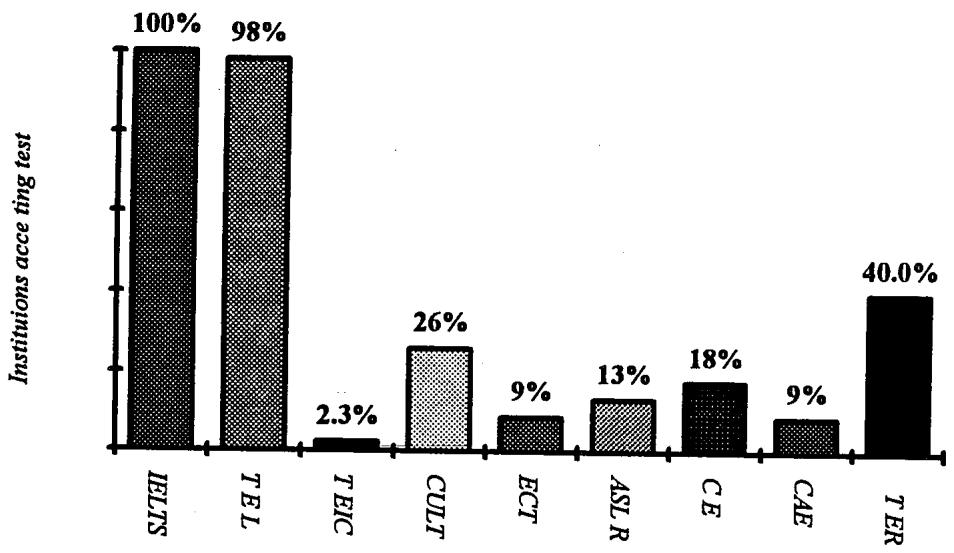
The first probe on the questionnaire was set out to establish which tests the universities and colleges accept for entry into their formal courses. Each university/college was asked to nominate a list of tests that included IELTS, TOEFL, TOEIC, CULT, ECT, ASLPR, CPE, CAE and other 1. The collated results of the response to this question are shown in graph format below:
| *OTHER | ELS 109 | BEST test | UEEC test | ECU test |
|---|---|---|---|---|
| *OTHER | RMIT - CELL Advanced English Certificate | Hong Kong “O” Level | ||
| *OTHER | Western Australia TAFE/ASLPR test | “O” Levels | ||
| *OTHER | Certificate in English for TAFE | Michigan test |
Graph 1 English tests accepted by institutions
| IELTS | = | International English Language Testing System |
|---|---|---|
| TOEFL | = | Test of English as a Foreign Language (Educational Testing Service) |
| CULT | = | Combined Universities Language Test |
| ECT | = | English Competency Test |
| ASLPR | = | Australian Second Language Proficiency Ratings |
| CPE | = | Certificate of Proficiency in English (University of Cambridge Local Examinations Syndicate) |
| CAE | = | Certificate of Advanced English (University of Cambridge Local Examinations Syndicate) |
Perhaps the most significant factor to emerge from this probe was the fact that both IELTS and TOEFL have the highest acceptance by the universities/colleges although it is interesting to note that there was one state in which the TAFE sector did not accept TOEFL (South Australia). The Combined Universities Language Test (CULT) which is run by the Institute of Languages, University of New South Wales was accepted by 35% of the institutions which is significant, although further analysis showed that these institutions are all in New South Wales/ACT which would indicate that the test results are not recognised in the other states.
The TOEIC test (Test of English for International Communication) is recognised by one university (University of Tasmania). The TOEIC is owned and administered by Educational Testing Service (ETS) and is a test really aimed at the corporate market, as its name would suggest. At the present point in time, the test does not have a significant profile in Australia and is delivered in Brisbane by Achievers International College for a fee of $110.00 per student. In Sydney, the test cost $200 and is delivered by Sydney Student Service who has detailed in their brochure that the University of Technology, Sydney is the test centre. (This has caused some confusion as students have contacted the IELTS test centre at International Programs, UTS requesting information on the test). Apparently, ETS have recently appointed Frontier Learning Corporation 2, an Adelaide based organisation to promote the test in Australia. The organisation is currently in the process of setting up its test delivery infrastructure and is considering involving the Australian Council for Educational Research in the delivery of the test Australia wide, beginning December 1996. The test itself is a 75 minute test, with a 45 minute listening test followed by a 30 minute reading test.
The ECT test (English Competency Test) was devised by the Centre for English as a Second Language and measurement specialists at the University of Western Australia with a grant from the Western Australia Education Department. The University of Western Australia maintains that a pass in the test satisfies the English requirement for entrance into all universities and TAFE colleges in Western Australia. At the present point in time, the ECT tests approximately 1,000 students a year and costs $70.00 to sit. It is sometimes run off shore in countries such as Malaysia.
CAE and CPE are conducted twice a year worldwide, and delivered in Australia through the offices of the Local Secretary, University of Cambridge Local Examinations Syndicate and cost $215 and $220 respectively. Australian universities have accepted the CPE as an English language qualification for quite some time in Australia as it has quite a high international profile. CAE is also recognised by some universities.
The ASLPR (Australian Second Language Proficiency Rating) appears to have a higher profile in Queensland than any other state and this is perhaps to be expected given that it was developed in Queensland.
It was to be expected that there would a range of “other” tests acceptable to the institutions and it is interesting to note the range of different tests or assessment procedures nominated by different institutions.
Under the “OTHER” heading in the graph are:
| Test or procedure | Description |
|---|---|
| ELS109 | In-term assessment procedure designed and implemented by ELS Language Centre, Charles Sturt University for entry into their courses - for further details refer page 123. |
| BEST test | Test procedure developed by Bond University English Language Institute for entry into its formal courses - for more information on test refer page 122. |
| UEEC | In-term assessment procedure designed and implemented by English for Academic Purposes unit of Institute of Languages, University for New South Wales. Procedure was intended only for entry into UNSW formal courses although it has been suggested that other universities have in the past accepted it for entry into postgraduate courses - for more information on this test refer page 124. |
| RMIT - CELL Advanced English Certificate | In-term assessment procedure designed and implemented by Centre for English Language Learning, RMIT - for more information on test refer page 124. |
| Hong Kong “0” level | O level examination specifically designed and delivered for the Hong Kong candidature |
| ECU test | Edith Cowan University English Entry test designed for entry into their formal courses |
3.2 English Proficiency Test Usage Ranking
The second probe on the questionnaire was designed to complement the information garnered by the first probe in that the first would establish which tests are acceptable and the second would establish a ranking of tests being used most as proof of English proficiency and those which were least used. Once the rankings had been submitted by each institution the collation was carried out with a view to illustrating a trend of how the different tests are being presented across Australia as a whole. It is perhaps important to note that the rankings were done by staff in the appropriate International Programs/Students offices of each university/college and were not based in any empirical data but rather on the impressions or perceptions of the staff member in question.
The probe in the questionnaire asked each university/college to rank the usage of each test in terms of 1 for the most used test to 8 for the least used test. When the data was collated the ranking was inversed to produce a clearer illustration of the overall ranking when displayed in graphical form. Thus, in Graph 2 the usage rankings are from 1 which is least used to 8 for most used.
From the graph it can be seen that IELTS has the highest usage ranking with 36 institutions nominating it as the most used test. Given the Australia wide profile the test enjoys this is perhaps to be expected and it might be of interest to establish the exact numbers of IELTS test results being presented at the various institutions to establish whether the test usage is concentrated in any particular institutional or regional pattern. At the moment we know that Sydney tests the largest number of candidates per year in Australia with a very definite and strong growth in Melbourne of test takers and it would be interesting to investigate why this growth is occurring.
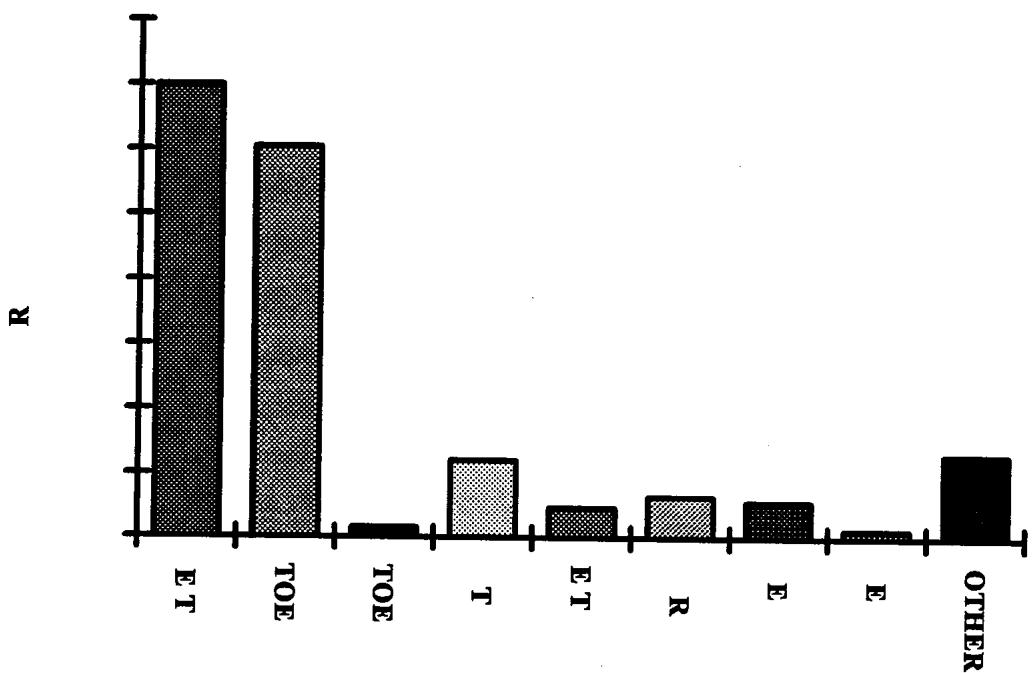
Graph 2 Usage ranking of English tests used by institutions
The second highest-ranking test is TOEFL with 9 institutions nominating it as the most used test. It is interesting to note here that the University of New South Wales nominated it as the most used test as this university has one of the highest overseas student populations in any Australian university. Again, TOEFL has a very high international profile, especially in the Asia/Pacific rim, and it would be expected that its usage in Australia was quite high. A number of institutions did express concerns with the test itself in terms of its predictive validity and these issues are addressed later in the report in section 3.9.
The ASLPR was nominated as the most used test by one institution (South Australia TAFE) but its overall ranking across all institutions is low when compared to the IELTS and TOEFL tests. The CULT test, which is recognised only in NSW and ACT, had a reasonable overall usage ranking although it is of interest to note that at the UNSW, where the test is written and delivered, it was ranked fourth after TOEFL, IELTS and UEEC. It was also interesting to note that at UNSW the CULT test is not recognised by the Faculty of Medicine. The University of Cambridge Local Examination Syndicate examinations, the CPE and CAE, while being recognised by a number of institutions in Australia do not really have a significant usage profile in Australia in terms of being used for entry into formal courses.
The third highest ranking was subsumed in the “other” category and two institutions nominated their own tests as the most highly used (TAFE Australian Capital Territory and TAFE Western Australia). Charles Sturt University nominated its ELS109 course/assessment procedure as third ranking, Edith Cowan nominated its ECU test as third ranking and “O” levels being nominated fourth ranking by the University of Newcastle.
The usage ranking of the ECT test was highest in Western Australia although it is perhaps surprising that none of the institutions in that state nominated it as the most used given that it is very much a Western Australian test. The University of Western Australia, which designed and delivers the test, nominated it as the second most used test after IELTS. Murdoch University also nominated the test as the second most used with Curtin University of Technology nominating it as the third most used test and Western Australia TAFE nominating it as fourth.
3.3 Use of University Department or ELICOS/Private Language School to Test Students for Entry into Institution.
When the initial research proposal was drawn up and the survey instrument designed, one of the crucial issues to be investigated was that of in-house testing instruments being used to assess English proficiency of those students seeking entry into formal courses. The authors of the proposal were aware of some English language tests which had been in operation for some time, being used for these purposes and there was anecdotal evidence to suggest that the usage of such tests was on the increase. The third probe in the questionnaire was thus designed to get at the issue of how many of these tests were in use, what the structure of these of tests were and finally whether any institution was planning to introduce its own test.
The responses to this question were most interesting as they showed there were quite a number of tests or in-house courses/assessment instruments being used by institutions and three universities were to planning to introduce their own. The tests could be divided into two types: stand-alone tests and in-term assessment followed by course exit testing.
3.3.1 Stand-alone Tests
BEST Test
| Field | Value |
|---|---|
| Institution where test is conducted | Bond University |
| Approximate number of students tested per year | 50 to 70 |
| Test format | 1 reading test for 1 hour, 1 writing test for 1 hour |
| Test result report format | Reading results reported in bands (0 to 9) Writing results reported in bands (0 to 9) |
| Years in use | 4 years |
This test is written and administered by the Bond University English Language Institute and looks remarkably like IELTS in format. It is used for students who apply to the University and have no recognisable English Language proficiency qualifications. The test results are used in collaboration with a recommendation from the Director of Studies at the Language Institute and then forwarded to the academic adviser who then makes a separate assessment before forwarding his/her recommendation to admissions at Bond University. The test is also used for entry into the Institute’s English for Academic Purposes course. At the present time there is only one version of the test and there are plans to assemble another.
ECT Test
| Field | Value |
|---|---|
| Institution where test is conducted | University of Western Australia |
| Approximate number of students tested per year | ≈1,000 students per year, |
| Test format | 1 listening test, 30 minutes 1 grammar and usage test, 25 minutes 1 reading test, 30 minutes 1 writing test, 95 minutes |
| Test result report format | Pass or fail |
| Years in use | 10 years |
The ECT test was developed from a grant from the Western Australian Education Department and during the research phase of the project, investigations were made into the various types of tests which could be implemented. From the research findings it was decided to concentrate on writing skills and a speaking test was excluded because it was considered too expensive and questions about reliability of this module had been raised. In Western Australia, students can also do an English as a Second Language module of the Tertiary Entrance Examination and this is accepted for entry into formal courses. The ECT test has strict eligibility requirements such as the stipulation that the student does not have English as a first language and has not lived in Australia for more than 6 years prior to taking the test.
3.3.2 In-term and Course Exit Assessment Procedures
ELS 109
| Field | Value |
|---|---|
| Institution where test is conducted | Charles Sturt University, Wagga |
| Approximate number of students tested per year | ≈ 50 students |
| Test format | 1 reading test for 3 hours 1 writing test for 2 hours Seminar presentation |
| Test result report format | A = highest grade, B = second highest, P = pass CP = provisional pass |
| Years in use | 6 years |
The ELS109 is not an assessment instrument as such but rather an English for Academic Purposes Course organised into levels starting from level 100 and finishing at the top level of 109. For a student to achieve a satisfactory ELS109 qualification, he/she has to reach the top-level course and then sit the exit test which is detailed above. During the course there is also an in-term assessment component as the students’ listening skills are assessed.
RMIT Centre for English Language Learning, Advanced Certificate Test
| Field | Value |
|---|---|
| Institution where test is conducted | RMIT - CELL |
| Approximate number of students tested per year | ≈300 with test being conducted 5 times per year |
| Test format | 1 reading test for 1 hour 1 writing test for 1 hour 1 listening test for 30 minutes 1 interview for 15 minutes + continuous assessment throughout course: oral presentation 2 writing tasks of 1,000 words each participation in mock tutorial 90% class attendance required |
| Test result report format | Pass mark is considered to be 75% or higher Writing must be 65% or higher |
| Years in use | 2 years |
This test is a very good example of the combination of in-term assessment and exit test. It is apparent there is a strong presence from the in-term assessment component and the student has to do well in this before he/she goes on to the exit test.
UEEC
| Field | Value |
|---|---|
| Institution where test is conducted | Institute of Languages, University of New South Wales |
| Approximate number of students tested per year | ≈ 150 to 200 |
| Test format | 20 week course normally (now available in 10-week mode) with in-term assessment: 2 major essays 1,500 to 2,500 words each, one at the 10 week mark, other on exit 1 reading, writing and listening for 2.5 hours Listening test is academically focused (lecture with questions) 2 seminar presentations attendance component |
| Test result report format | Grades , , , , , , D, Fail |
| Years in use | 3 years |
The Institute of Languages has a separate English for Academic Purposes unit with a special stream for entry into formal courses called the University English Entry Course. This is a 20-week course and students are tested for entry either during their EAP courses or by producing an IELTS score of 5 to 5:5. Recently, the course has been truncated to 10 weeks if the student is able to provide sufficient proof of their English Language Proficiency. The assessment procedure is a combination of in-term assessment (carried out in week 10 of the 20 week course) and an exit test. While the assessment procedure is conducted by the Institute of Languages, which also delivers the CULT test, it appears that the two tests are not linked in any way.
WELC test
| Field | Value |
|---|---|
| Institution where test is conducted | Wollongong English Language Centre, Wollongong University |
| Approximate number of students tested per year | 300 to 400 |
| Test format | Placement test for entry into EAP course then exit test from top level of course consisting of: 1 listening test consisting of lecture and note taking 1 essay portfolio of classwork put together throughout course attendance component |
| Test result report format | Grades A, B, C |
| Years in use | 6 years |
The WELC system is an EAP course with a quite extensive placement test when students enter the EAP stream and then a final exit test for those students who have successfully completed the highest level. (Students can only sit for the exit test if they have reached this top level). The placement test consists of:
- 2 cloze tests
- 1 reading test
- 1 listening test
- 3 short writing tasks
- 1 interview
The placement test is used to place students and provide an estimate of how long they need to study to reach the top level of the EAP program and thus the exit test. The results of the exit are used in combination with in-term assessment to make the final assessment decision of which grade they are to receive. Most faculties at Wollongong University require grade B for entry while the Law faculty requires grade A.
ACL EAP2
| Field | Value |
|---|---|
| Institution where test is conducted | Nepean Languages Centre, Australian Centre for Languages/ University of Western Sydney, Nepean |
| Approximate number of students tested per year | 100 to 150 |
| Test format | 1 research report 20% Mid-term assessments in listening, reading, writing, note taking and summary skills - 20% 20 minute seminar presentation - 20% 1 research essay - 20% end of term assessment - 20% |
| Test result report format | Pass/fail |
| Years in use | 6 years |
This assessment procedure was set up at the Nepean Languages Centre which is an undertaking of the Australian Centre for Languages in conjunction with the University of Western Sydney, Nepean. The students who are accepted into EAP2 must gain an overall satisfactory mark in the 5 tasks as set out above with the tasks spread throughout the 10-week course. For entry into EAP2 course the students must have a minimum of IELTS 4.5 or TOEFL 500, successful completion of EAP1 course or sit an ACL/NLC entry test and achieve a satisfactory score.
ILC EAP 4.1
| Field | Value |
|---|---|
| Institution where test is conducted | Insearch Language Centre for University of Western Sydney, Hawkesbury |
| Approximate number of students tested per year | ? |
| Test format | 2 writing tasks of 750 words (1 summary of article, 1 discursive essay) - 40% 1 speaking test (short informal presentation, 1 formal presentation) - 15% attendance and participation - 10% 1 final examination covering reading/writing/listening skills - 35% |
| Test result report format | Pass/Fail |
| Years in use | 5 years |
Successful completion of EAP 4.1 course conducted at Insearch Language Centre is accepted for entry into formal courses at the Hawkesbury campus of the University of Western Sydney. This entry stream is only very rarely used at the Hawkesbury campus and with the advent of the new stream at the Insearch Language Centre it is anticipated that the EAP 4.1 will be superseded by the recently implemented DEEP stream.
DEEP
| Field | Value |
|---|---|
| Institution where test is conducted | Insearch Language Centre |
| Approximate number of students tested per year | ? |
| Test format | |
| Test result report format | Pass/Fail |
| Years in use | In development phase |
This course, only recently launched, is designed for students preparing to enter undergraduate or postgraduate courses at UTS. The course is only conducted at the ILC and is recognised as an official English entry qualification by UTS. The course runs for a minimum of 10 weeks with the actual amount determined by a placement test. Students are expected to have a minimum IELTS score of 5.5 for entry into the program.
La Trobe University Foundation Studies - Compulsory English Subject
| Field | Value |
|---|---|
| Institution where test is conducted | La Trobe University |
| Approximate number of students tested per year | 250 to 300 per year |
| Test format | Final examination consisting of: 1 hour reading test, 3 writing tasks of 30 minutes, 35 minutes and 45 minutes - 70% 1 mid term exam - 15% In-term assessment - 15% |
| Test result report format | Pass/Fail |
| Years in use | 2 years |
The foundation studies course length is usually 34 weeks although La Trobe has recently introduced an “accelerated” course of 27 weeks and a “fast-track” course of 24 weeks. The shorter courses cover the same syllabus but in a shorter time. The English subject is compulsory.
Edith Cowan English Entry Test
| Field | Value |
|---|---|
| Institution where test is conducted | Edith Cowan Language Centre |
| Approximate number of students tested per year | less than 50 per year |
| Test format | 1 dictation cloze 1 lecture with questions and summary writing 1 reading passage 1 graph interpretation 1 set of sentence transformation 1 set of sentence/title matching exercise |
| Test result report format | Pass/Fail |
| Years in use | 8 years |
Proposed CALUSA test
| Field | Value |
|---|---|
| Institution where test is to be conducted | Centre for Applied Linguistics, University of South Australia |
| Approximate number of students tested per year | |
| Test format | in development phase |
| Test result report format | |
| Years in use |
The proliferation of new assessment instruments and pathways into formal courses poses a number of questions related to the design, use and appropriacy of the tests:
(i) Is the major reason for the growth of in-house testing instruments primarily because there is general dissatisfaction with the present range of tests such as IELTS /TOEFL / CULT etc? One of the questions in the questionnaire specifically asked the institutions whether they were satisfied with the tests being used and the overwhelming response was positive. It would appear then that the impetus for the development of these tests may not be coming from the universities themselves but rather from the Language Centres/ELICOS centres which act as feeder institutions into formal courses. This postulate cannot be tested, however, as the present survey investigated the possibility of other tests being used for direct entry and did not look into the issue of why these tests have been/are being developed. Is the imperative for development of such tests academic or financial? Such a question cannot be answered from the findings of this survey and as is often the case, research can throw up more questions than answers so further research into this matter would be useful.
(ii) A central question in the development of any English language test is how that test is designed and perhaps more importantly how it is validated. Validation of tests is a time-consuming and complex procedure if carried out correctly and a major problem with reasonably small cohort tests is that it is often difficult to locate candidates on whom to trial the test in its developmental stage. Without easy access to a reasonable sample size there is always the temptation to construct a cohort with similar characteristics to the target cohort and use this for the trialling. This issue is particularly important when validating tests for cohorts of less than 200 to 300 as it can be extraordinarily difficult to address the issue of bias in the population when it is this small. Indeed, some sources in the language-testing field have suggested that it is impossible to correctly validate a test for such a small population. A number of the tests detailed in this report are in the small cohort category so this issue is particularly germane.
(iii) Many of the tests and in-term assessment procedures detailed above rely on a subjective assessment component as may be expected in any communicative test. With subjective assessment the central questions which have to be answered are:
- How are the examiners who carry out the subjective test standardised?
- How are the examiners monitored to ensure that the inter-rater reliability and intra-rate reliability coefficients are within acceptable limits?
These thorny issues have to be addressed in subjective assessment and all too often they are not handled with the appropriate rigour, maybe as a result of time constraints or a shortage of adequate funding. Communicative tests live and die by how reliable they appear to be and it would be instructive to investigate how this issue is handled by the test developers involved in creating instruments for entry into Australian universities.
(iv) The ability of candidates to memorise tests can be remarkable and during the first two years of IELTS a number of problems arose from the shortage of “live” versions of the test available. Indeed, during these first two years there was anecdotal evidence to suggest that students were attempting to piece the test together and then sell the information. This problem has been addressed with the introduction of several new live versions available at any time and a bank of tests in the wings. With new tests and assessment procedures being developed by so many different bodies, the problem of test security is ever present and if and when new versions of these tests are developed then the issue of calibrating those new versions against previous versions needs to be dealt with. Again, because of the relatively small size of test cohorts such an exercise becomes very difficult and also expensive if it is to be reliably undertaken.
(v) With the use of in-term assessment components in some of these pathways there is always the danger of pressure being placed on the teachers to give their students a “good” mark. Unquestionably, in-term assessment has its strengths not the least of which is that it allows for on-going assessment and reduces the constraints imposed by set test dates. Problems can occur, however, when teachers are subjected to pressure by students who believe that it is quite normal to lobby those involved in the decision making process. With IELTS this issue is never a problem as there are specific regulations which preclude an examiner testing a student he/she may know or have taught.
(vi) How transportable are the test results? Anecdotal evidence would suggest that some of these test results can be surrendered to universities and colleges other than the institution in which the test was sat. However, in most cases in-house language qualifications are not surrenderable to other institutions. This means they have no currency in the wider world.
3.4 Use of English Test to Assess Non-English Speaking Background Permanent Residents
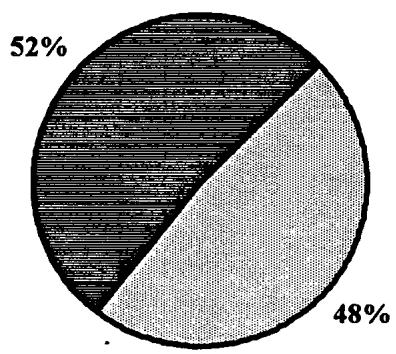
Graph 3 Proportion of institutions which use English tests to assess NESB permanent residents
Test NESB permanent residents Do not test NESB permanent residents
It was decided to include a question on the use of English tests for NESB permanent residents as reports had been received at the UTS IELTS centre that some Sydney universities were not accepting IELTS as a valid test of English for migrants. It is unclear who made this policy decision or its rationale but it was thought significant enough to warrant further investigation. The universities were therefore asked whether they used English tests for this particular group and if so, which tests were recognised.
Of those institutions saying they did use an English test the majority sighted the freely available tests such as IELTS, TOEFL, ECT and CULT. ASLPR was also nominated by two state TAFE organisations with the Western Australia TAFE nominating a special version of ASLPR used only in that state.
3.5 Approximate Overseas Student Population enrolled in Formal Courses in Universities and Colleges
The institutions were asked to estimate the overseas student population enrolled in formal programs in their particular university /college and were given categories of:
A 1 to 100 B 101 to 200 C 201 to 500 D 501 to 1,000 E 1,001 to 2,000 F 2,001 to 5,000
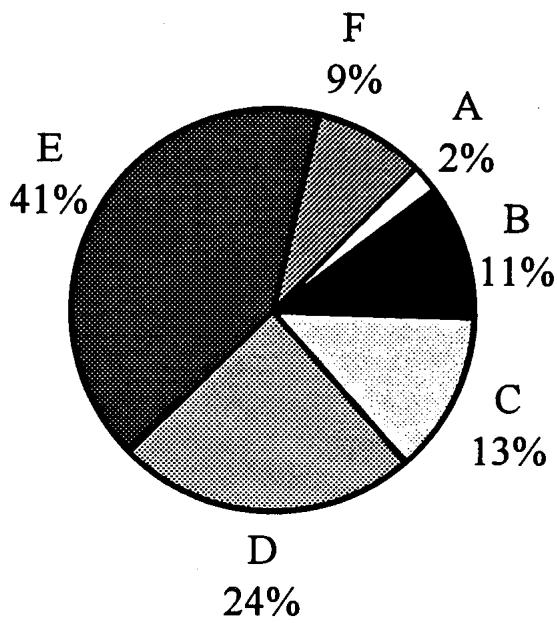
Graph 4 Approximate overseas student populations in universities and colleges
3.6 Entry Scores required for the Tests used by each Institution
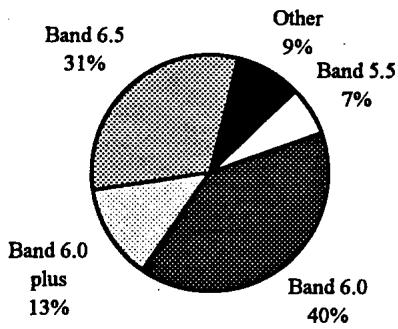
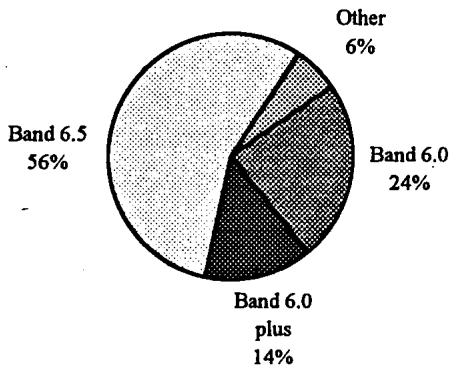
The scores required for entry into formal courses are well documented by the institutions and from state-based central enrolment organisations such as UAC in New South Wales and TISC in Western Australia. It was decided to include this question in the questionnaire to see whether the documentation that is publicly available to students matches the responses from the universities and colleges. If we refer to Appendix 5.2 which gives a detailed breakdown of the responses to this question, at both the undergraduate and postgraduate level, it would appear that the information matches, although it is interesting to note that some of the institutions had stated that the CULT test was recognised by their institutions but this was not indicated in their questionnaire responses.
IELTS scores for entry into undergraduate level
IELTS scores for entry into postgraduate level
Graph 5 IELTS scores required for entry into formal courses
The collated data in Appendix 5.2 shows that the majority of institutions indicated that a minimum overall score of 6.5 on IELTS or minimum score of 550 on TOEFL. The graphs show the Australia wide trends of how universities/colleges are using IELTS scores for entry at the undergraduate level and how universities alone are using the scores for entry into postgraduate courses.
3.7 Departments or Groups in Institutions which decide English Language Score Policy for Entry
Question 7 in the questionnaire was designed to investigate the issue of how policy on English language proficiency requirements for entry into formal courses is decided upon. The formulation and application of policy is extremely important as it sets the proficiency benchmarks by which each institution is prepared to accept overseas students and the research team thought it important to establish which bodies or institutional levels were involved in the process. In the survey, the institutions were asked to nominate any of the following choices:
- The Chancellery/The Registrar/Chief Executive Officer
- International Students Office/Department
- Individual faculties
- Others
The collated results of the feedback are shown in Graph 6.
As we can see from the graph, the largest grouping is where a combination of bodies are used which would indicate that a number of institutional levels are involved including academic boards, faculties and the international students office. It is also interesting to note that the second largest grouping is the academic boards in collaboration with the admissions committee. Some universities noted that the minimum was set by a central body and some faculties could raise these levels if they so wished. One university in particular made the following interesting comment:
Decided by academic committee on advice from International Centre - not rubber-stamped but hotly debated!
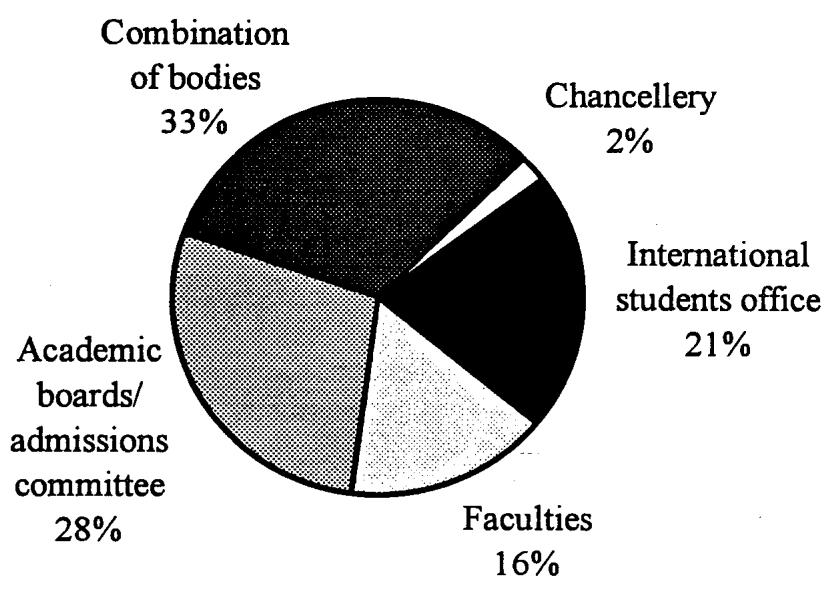
Graph 6 Departments/Groups involved when setting policy on English proficiency required for entry into courses
3.8 Who is consulted when English Language Entry Score is decided?
This question was included in the survey as a supplement to question 7 as there was the perception that institutions, when setting policy, may or may not be consulting professionals in the field of English as a Second or Other Language. To investigate whether or not this was true the institutions were asked to nominate any of the following choices:
- In consultation with English as a Second/Foreign Language professionals
- In consultation with other educational institutions
- From educational testing literature/test handbooks/test information leaflets
- Others
The results of the feedback are shown in Graph 7.
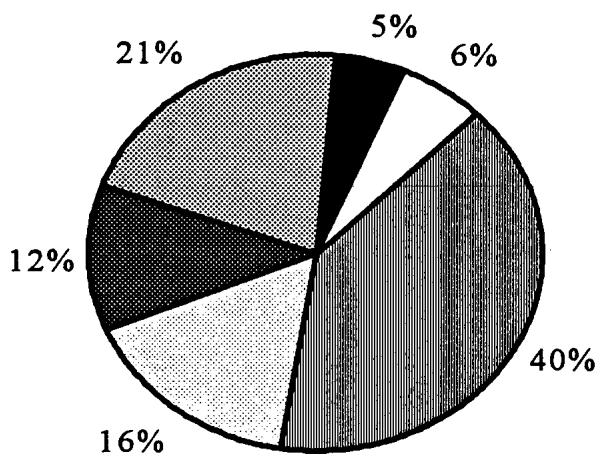
Graph 7 Who is consulted when English language entry score is decided
As we can see from the graph, the largest grouping is where all three sources are consulted when policy is set, with the second largest grouping being when ESL/EFL professionals and other institutions are involved. The issue of other institutions being involved is interesting in itself as with these policy decisions there could be a strong temptation for each institution to set the policy according to what it perceives other equivalent universities/colleges have done. The feedback from the survey, however, does not appear to support this as only 12% of institutions stated that they only consulted other institutions.
3.9 Rating of English Proficiency Tests in Terms of Usefulness
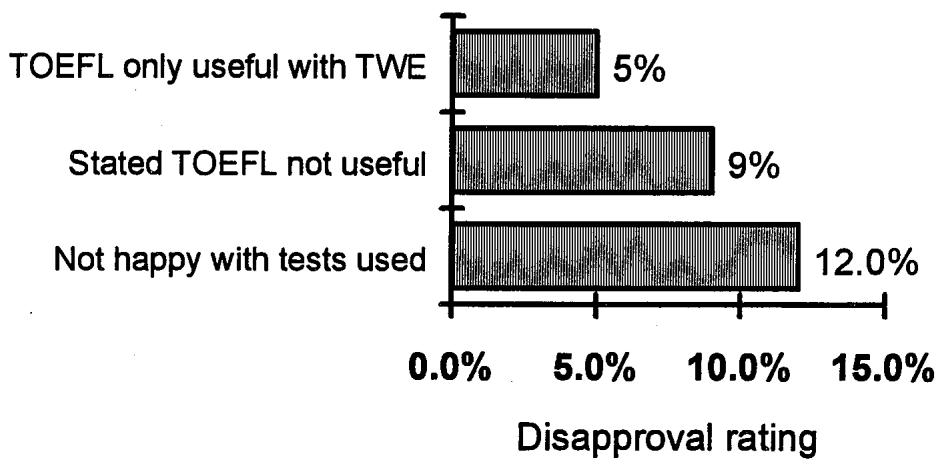
Graph 8 Approval/Disapproval ranking of English language tests used
For questions 9 and 10 in the survey, each institution was asked whether they were satisfied with the English proficiency tests being used and then to nominate a classification of useful, not useful and not know for the most commonly used tests. Care was taken in the design of these two questions not to bias the respondent towards any test or to provide an opportunity to comment negatively on any particular test.
The most interesting trend to emerge from this particular component of the survey was the significant proportion of institutions (12%) who answered “NO” to the question relating to whether they were satisfied with the tests being used. The disapproval trends are shown in Graph 8. Those institutions who stated they were not happy with tests being used were most concerned with correlations between test results and actual proficiency; in other words there were concerns with the predictive validity of some tests. A number of comments were made on this particular point:
There have been problems in the past where students have achieved the minimum score but not the required proficiency
Sometimes it is hard to believe that scores reflect real life proficiency
It was also interesting to note that those institutions who stated they were unhappy with the test being used only nominated TOEFL as the one causing concern and a number of comments were made on the perceived problems with this test:
TOEFL as an indicator had proven to be unreliable in a number of cases where students merely take it a number of times until they get the desired result
Find TOEFL unreliable as an indicator of proficiency
All tests have difficulty providing accurate assessment, TOEFL has concerns over security ie. who actually sat the test
Some TOEFL scores seem to depend on which country the test was administered - scores sometimes do not match reality
IELTS scores appear to provide useful predictor, TOEFL does not measure academic English skills at all adequately. Students with 550 may scarcely be able to communicate
High TOEFL scores don’t always give clear indication of proficiency
Some interesting comments were also made comparing IELTS and TOEFL:
There is a feeling that IELTS is a better test than TOEFL but TOEFL is more widely available
An IELTS or TOEFL test in itself is not a sole indicator of chance of success - only an indicator
3.10 How Students find out about Entry Requirements into the Universities and Colleges
The universities and colleges were asked in this question to nominate how their students find out about entry requirements for their particular institution. The choices given in the questionnaire were:
- From Institution brochure
- From Central Admissions agency (UAC, QTAC, SATAC, VTAC, TISC 3 )
- English Language Colleges
- Word of mouth
- Other
The most significant trend to emerge from the data collation was that institutions relied on a variety of means to inform any prospective students of the language requirements and all institutions stated that they relied heavily on their own institution brochure. 46% of the universities and colleges stated that students accessed the information on entry requirements though the central admission agencies, whilst 46% stated English colleges as a source of information and 50% believed that students accessed the information via word of mouth.
3.11 Minimum IELTS Module Scores required by Universities and Colleges
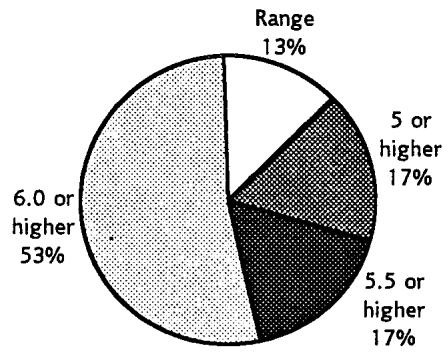
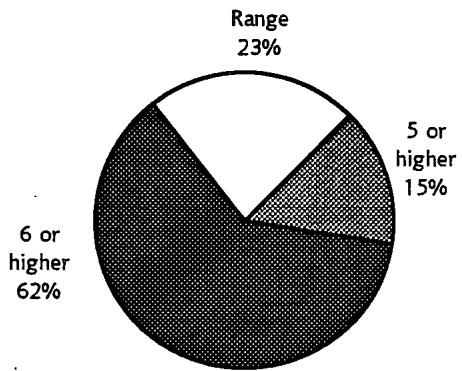
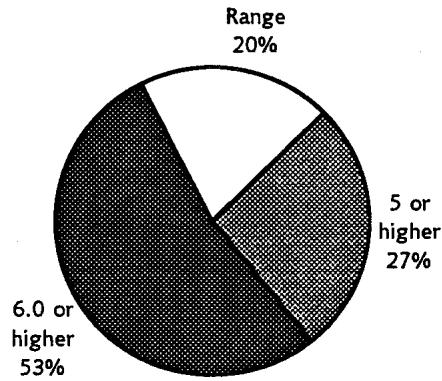
Each institution was asked whether they required a minimum score for the reading, writing, listening and speaking tests of IELTS. If the institutions stated that they did in fact require minimum scores they were then asked to nominate what these scores were.
20% of the respondents stated that they did not require minimum scores and for those institutions which did require them the graphs below detail the scores according to the four subtests.
Minimum reading scores required for entry
Minimum writing scores required for entry
Minimum speaking scores required for entry
Minimum listening scores required for entry
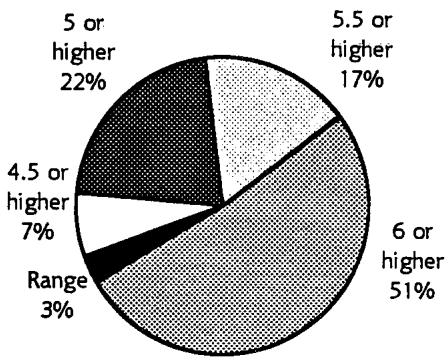
Graph 9 Minimum IELTS scores required for entry into formal courses
As can be seen from looking at the graphs above, the majority of institutions (62%) nominated a band score of 6.0 as the minimum score required and it is interesting to note that 4.5 as a minimum score on the listening subtest was nominated by some TAFE organisations.
3.12 Ranking of Tests in terms of “Value for Money”
The final question in the survey asked the institutions to rate the tests in terms of cost or “value for money” with the choices given as “expensive”, “reasonable cost” and “good value for money”.
The results of the feedback on this question are given below.
| Expensive | Reasonable cost | Good Value for money | |
|---|---|---|---|
| IELTS | 32% | 38% | 25% |
| TOEFL | - | 45% | - |
| TOEIC | - | - | - |
| CULT | - | 8% | - |
| ECT | - | - | 18% |
| ASLPR | 8% | 16% | 16% |
| CPE | 4% | 8% | - |
| CAE | - | - | - |
4.0 Survey Follow-up and Interviews with Academic Staff
A number of academic staff at a range of universities across Australia were contacted for personal comment. All had a strong opinion about the need to improve the level of English competence of overseas students generally, though many also pointed to the need to improve literacy levels among our own Australian school leavers.
Each was asked five broad questions, listed below together with the summary of the responses.
1. Do you know which tests are used at your institution?
All the academics surveyed were aware of the major English testing instruments such as IELTS and TOEFL and usually of the in-house tests specific to their institutions. Some expressed reservations about the lesser known tests. One respondent regretted that they had no real ‘say’ in which tests were used and said these decisions were taken elsewhere.
2. Do you have any strong feelings about any of the tests?
All respondents stated that they felt IELTS to be the best predictor of a student’s ability to study in English and also the test which provided the most information to the receiving institutions because of the profile of skills reported on the TRP. Several respondents suggested that more information was actually needed about what the various tests indicated or the need for the EAP departments/learning assistance centres etc, to provide assistance with student selection. When candidates are being recruited off shore, however, this becomes problematic. One respondent in Sydney suggested that there was anecdotal evidence to suggest that IELTS scores from some centres were not as reliable as from others. The RMIT respondent felt IELTS to be by far the best test and suggested that the higher the Band score on entry, the better the performance at university. They are looking at raising their IELTS and TOEFL scores to Band 7 and 600 respectively.
3. Are you happy with the level of English of overseas students in your Faculty?
The responses to this question varied depending on the country of origin of the students. Malaysian students, for instance, were seen to perform well in English while Korean students were often not. One academic in Architecture and Planning at Curtin reported that his postgraduate students had more problems than the undergraduates, perhaps because it had been falsely assumed that knowledge of the area would help. Individual cases were cited of students who had no difficulty following the program. Another academic was vociferous as to the need to increase the level of language skills of overseas students.
4. Should English support be built into the program for credit?
A number of universities insist on all students (Australian school leavers and overseas students alike), having to undertake communications courses, for credit, as part of their undergraduate degree. Curtin, for instance, insists on this but it appears that the courses are not linked to any specific discipline, which was regretted by one respondent. RMIT has an obligatory requirement known as Context Curriculum Subjects to ensure that a broad range of subjects is included in any degree, including science degrees. Support English programs are also available in most institutions but enforcing attendance without offering credit for the courses is not always possible. This then begs the question of whether giving credit is fair if one considers that students not in need of help with English are not offered subjects “on a plate” in this manner. The broader communications approach is therefore favoured by many universities.
5. Which skills pose the greatest difficulty for overseas students in your Faculty?
Writing was seen as the skill area causing the most difficulty and one academic reported that she felt the IELTS test was the test most likely to assess a candidate’s ability to express opinions on paper.
5.0 Findings and Conclusions
- The overall results of the survey and the interviews would indicate that IELTS is the preferred test and also the most commonly used.
- Of those institutions using instruments other than IELTS or accepting results from other testing bodies, reservations as to the reliability of these tests were expressed. An overwhelming number of academics cited IELTS as their preferred test and volunteered their belief that it was the better predictor of all the instruments available. One respondent particularly cited TOEFL as being a poor predictor of performance.
- By surveying all institutions and by talking to individual academics the overall profile of IELTS generally has been raised. Certainly very little resistance was met from those interviewed, both in the Admissions offices as well as teaching staff within the Faculties and the overwhelming feeling was that the area was worthy of discussion and research.