
Literacy practices in the professional workplace: Implications for the IELTS reading and writing tests
Official IELTS research report on IELTS Test - Listening and Reading; IELTS Test - Writing; Impact and Washback - Impact theory and practice; Impact and Washback - Stakeholder attitudes, published in 2015.
Abstract
The study investigated the literacy practices required of graduates in professional work across a range of occupational areas. It considered how these corresponded to the types of reading and writing required of candidates on the IELTS test - both in the Academic and General Training modules.
The project was a domain analysis study concerned broadly with issues of validity of the IELTS test in its current uses for employment purposes. Specifically, it investigated the nature of literacy practices in a range of professional areas, and sought to make comparisons with the writing and reading formats used on the Academic and General Training modules of the test. The use of the tests in these contexts includes for example, the recruitment processes of major companies and the registration policies of a number of professional associations.
As McNamara and Roever (2006) point out, testing in such domains brings with it important social responsibilities. These are ones that extend to professional organisations, whose quality of service will be a function in part of the adequacy of a candidate’s communication abilities, but also to the candidates themselves, where test outcomes may have a major bearing on their opportunities for employment, and ultimately on their sense of wellbeing in society.
Using survey, interview and text analysis methods, the study found a number of correspondences between the literacy demands in the two domains. The main differences noted related to the highly transactional nature of professional communications.
Findings from the project are used as a basis to suggest possible adaptations to the test.
Two broad options for the future directions of the test would appear to be available to developers. One of these is to continue with the current trend evident in the recently produced materials - that is to pursue the idea of making the test suitably ‘flexible’ so that it has relevance to the two types of cohort considered in the research (i.e. those entering tertiary study and those entering professional employment).
The other option - a more radical one - is to work towards developing a separate IELTS test for general professional employment purposes. Such an option would enable some of the trends evident in recent materials - as well as findings from the present study - to be taken up in a more focused and untrammelled way. Before any project of this dimension could be contemplated, clearly additional research would need to be undertaken.
1 INTRODUCTION
The IELTS test has played a significant role in the growing spread of English as an international language. This is reflected in the test’s dramatic growth in candidature levels since its creation several decades ago, with annual test sittings now numbering in excess of two million (IELTS 2011). Significantly, in the early years of IELTS, the two versions of the test - the Academic and General Training modules - were used for fairly restricted purposes, namely, as an indicator of readiness to participate in different forms of education (Davies 2008). Thus candidates intending to enter vocational and training courses typically undertook the General Training module, and those entering university completed the Academic module. In recent times, the test, in both its modules, has come to be used for a much broader range of purposes, including for migration, employment, professional registration, and various other personal reasons (IELTS 2011). These expanded uses of IELTS have become a spur for researchers to investigate new aspects of the test, such as the specific language demands of some of these new contexts (Garner, Rugea & Sedgwick 2012), or the perceptions and attitudes of new stakeholders (Knoch, May, Macqueen, Pill & Storch, in preparation; Murray, Cross & Cruickshank 2014).
The present project was concerned with investigating the IELTS writing and reading tests, and their uses in one of these new contexts, namely as a test of readiness to enter professional employment. It should be noted that while the Academic module is the recommended test for this purpose, scores on either module are accepted in many workplace contexts (IELTS 2013a). The focus of the study was on the idea of construct validity; that is to say, the extent to which the test can be said to be valid for the contexts in which it is being used (Messick 1989). By one well-known definition, a test has ‘construct validity if it ‘reflects the psychological reality of behaviour in the area being tested’ (Hamp-Lyons 1990). In the present study, we adopted a slightly different view of these matters, seeing the relevant construct not so much as a ‘psychological’ one, but more a social one, with an emphasis on the idea of ‘social practice’ rather than ‘behaviour’ (Cetina, Schatzki, & von Savigny 2005). Thus in the research, we were interested in finding out about patterns of reading and writing - literacy practices - required of graduates across a range of professional areas, and seeing in what ways, and to what extent, these could be said to correspond with the types of reading and writing required of candidates on the test.
In the sections that follow, we provide a description of the IELTS reading and writing materials. This is followed by an extended account of professional literacy practices, as conveyed to us by informants from a range of professional workplaces. The findings of these two components are then used to reflect upon the use of the writing and reading tests for workplace and professional purposes.
Validity studies such as the ones outlined in this study are a necessary part of any test development process; they would appear, however, to have particular relevance to testing in professional contexts. As McNamara and Roever (2006) point out, testing in such domains brings with it important social responsibilities. These are on es that extend to professional organisations, whose qual of service will be a function in part of the adequacy of candidate’s communication abilities, but also to the candidates themselves, where test outcomes may have a major bearing on their opportunities for employment, and ultimately on their sense of well-being in society.
2 THE IELTS WRITING AND READING TESTS
The present project was concerned with investigating the types of writing and reading skills required in professional workplaces, and how these might relate to the testing of these skills in the IELTS test. Background information is provided here about the nature of these components of the test, along with brief discussion of some sample materials.
2.1 Background information
The IELTS test battery in its current form provides assessment of the four macro-skill areas of listening, reading, writing, and speaking. This assessment occurs within two distinct modules: the Academic and General Training modules. While candidates on both modules do the same listening and speaking subtests, the two modules are distinguished by having separate sub-tests of reading and writing. The relationship between the two modules, along with the sequence in which the different sub-tests are taken, is shown in Figure 1.
The two modules have a different range of uses. Both were initially developed for educational purposes, with the Academic module designed to assess the English language proficiency of students entering higher education and the General Training module designed for students wanting to enter secondary school or nonacademic training courses. In recent times, both modules have come to be used for a broader range of purposes. For example, a significant area of expansion for the General Training module has been in the area of immigration, with immigration authorities in Australia, Canada, and New Zealand using the General Training module to establish English language proficiency (Davies 2008). An important additional context for both the Academic and General Training modules is work-related and professional domains. The use of the tests in these contexts includes for example, the recruitment processes of major companies and the registration policies of a number of professional associations (Merrifield, 2008; Read & Wette 2009). While the Academic module is the preferred module in the area of professional employment, some organisations accept both (IELTS 2013a).

Figure 1: IELTS Academic and General Training modules (IELTS 2011)
Information is provided to candidates about the nature of the writing and reading subtests for the two modules (IELTS 2014). The Academic Writing Test is a direct test of writing, requiring candidates to complete two different writing tasks in the 60 minutes allocated. In Task 1, candidates need to write a short description of information presented in the form of a table, diagram, graph etc. Task 2, which carries a heavier weighting than Task 1, is a short essay in response to a proposition or question. The Academic Reading Test is typically made up of three reading passages with accompanying questions. The skills that are tested according to the Academic Reading Test specifications include: finding main ideas, identifying the underlying concept, identifying relationships between main ideas, and drawing logical inferences (cited in Alderson 2000, p 206, IELTS 1996).
The General Training Writing and Reading Tests follow a similar format to those that make up the Academic module, with some small variation in the nature and register of writing tasks, and also in the topic and level of difficulty of source texts in the Reading Tests. The General Training Writing includes two tasks “based on topics of general interest”. In Writing Task 1, candidates are “presented with a situation and asked to write a letter requesting information, or explaining the situation”. For Task 2, candidates need “to write an essay in response to a point of view, argument or problem” (IELTS 2014). The General Training Reading Test, like its academic counterpart, is divided into three sections. The reading skills tested are similar to those in the Academic module, including reading for main ideas, understanding inferences, and following an argument.
2.2 Sample items
In this section, we present sample writing and reading materials from the Academic and General Training modules. The purpose of this presentation is to provide more detail about the broad format of each task type, and also to give an account of the type of literacy activities each entails. Samples are taken from the ‘Test take information’ shown on the official IELTS website (IELTS 2014). On the site, these samples are intended to exemplify for candidates the nature of the item-types they will encounter on the test. It is assumed they are strongly representative of the format of each.
As explained, Task 1 (Ac) typically requires candidates to “describe, summarise or explain” some visual information provided in the form of a graph, table, chart or diagram (IELTS 2014). Figure 2 is one such example. As indicated in the task rubric, the essential skills required to complete this task involve identifying “the main features” of the graphical information, and then to provide an accurate summary of it. In this case, the task for candidates is to draw comparisons between the participation rates of men and women in British higher education. The visual prompt in this particular sample is concerned with statistical data. In other Task 1 formats, the same ‘information summary’ activity is required in relation to other prompt-types: e.g. diagrams showing the stages of a process, the workings of a piece of technology, or the details of an object or event.
ACADEMIC WRITING TASK 1
You should spend about 20 minutes on this task.
The chart below shows the number of men and women in further education in Britain in three periods and whether they were studying full-time or part-time.
Summarise the information by selecting and reporting the main features, and make comparisons where relevant.
Write at least 150 words.

Figure 2: Sample Academic Writing - Task 1 (IELTS 2014)
Task 2 (Ac), as mentioned, requires candidates “to write an essay in response to a point of view, argument or problem” (IELTS 2014). The topics of these essays, it is explained, are typically “of general interest to, suitable for and easily understood by test takers entering undergraduate or postgraduate studies or seeking professional registration”. In the case of the sample shown here, the topic refers to issues of traffic congestion, requiring candidates to consider possible ways that this problem might be addressed. Other topic areas typically covered in Task 2 items include: technology and education, media, health care, government services (Moore & Morton 2007). In composing a response to Task 2 items, candidates are advised that they need to write in “an academic, semi-formal style” (IELTS 2014).

Figure 3: Sample Academic Writing - Task 2 (IELTS 2014)
The genre of the Task 1 (GT) is a letter. In the test, candidates are typically presented with a scenario, and are asked to write a letter in response to the situation. A feature of these tasks is the specification of a designated recipient of the letter (e.g. a friend, a teacher, a storeowner etc.). In responding to the letter tasks, it is explained that candidates need “to provide general factual information; express needs, wants, likes and dislikes; express opinions (views, complaints etc.)” (IELTS 2014). In the Task 1 (GT) sample shown below, candidates have to imagine themselves as a resident in a university college and to write to an ‘accommodation officer’ regarding problems with their accommodation. It is noted that many Task 1 (GT) items place candidates in customer/consumer roles of this kind, e.g. as airline traveller, purchaser of goods, bank customer etc. The function of the letter in these situations typically is for the candidate to negotiate some situation of consumer difficulty or dissatisfaction. Other scenarios are of a more personal kind, requiring the candidate to negotiate some kind of social situation, e.g. to make arrangements for a social event, or to thank a friend for an activity that has taken place etc. Depending on the situation, it is indicated that “letters should be written in either a personal or semi-formal style” (IELTS 2014).

Figure 4: Sample General Training Writing - Task 1 (IELTS 2014)
The format of Task 2 (GT) is the same in many respects to that of the Academic module. Here candidates also need to write an essay style composition in response to “a point of view, argument or problem” (IELTS 2014). In the sample shown below, the issue to be addressed is the provision of financial support to the aged. In the information to candidates, the only distinction made between the Task 2 Academic and General Training formats is that in the case of the GT essay, candidates are advised that their response can be written in a “slightly more personal style” (IELTS 2014). A cursory survey of Task 2 items in existing published and retired materials (Cambridge IELTS Series, 1996-2011) suggests that topics in the GT module are also of a slightly less academic nature, e.g. consumer preferences, benefits of travel etc. It is noted too that these topics are often framed explicitly around a putative problem (e.g. overpopulation, obesity, family breakdown) typically requiring the candidate to suggest ways in which the problems could be addressed, managed, solved etc.).

Figure 5: Sample General Training Writing - Task 2 (IELTS 2014)
2.2.5 Writing descriptors (Academic and General Training)
Accompanying the various written tasks are a set of descriptors (or criteria) used to evaluate the adequacy of responses to these tasks. Inscribed in these descriptors is an account of the specific writing qualities valued by the test. Figure 6 provides a summary of these main features (clear overview, clear purpose etc.), showing also the broad assessment criteria with which each feature is associated (task achievement etc.). It will be noted that some features apply to all tasks (e.g. organisation of ideas, vocabulary range etc.), while others are relevant to specific tasks (e.g. support of argument in Task 2), or to specific modules (e.g. appropriacy of tone in General Training, Task 1).

Figure 6: Summary of qualities of effective writing (IELTS band descriptors - public version)
2.2.6 Academic Reading
As mentioned, there are separate Academic and General Training versions of the reading test. The Reading Test (Ac) is typically comprised of three sections (or testlets), each organised around a separate reading passage. IELTS (2014) describes these passages as “authentic [texts] taken from books, journals, magazines and newspapers, and written for a non-specialist audience”. The topics of the texts are described as being of “general interest” and “appropriate to, and accessible to, test takers entering undergraduate or postgraduate courses or seeking professional registration”. Accompanying the reading passages is a range of tasks. The sample below, showing both a sample passage and task, requires candidates to indicate whether the various listed propositions in the task reflect the contents of the passage. A variety of task-types is used in the reading test: multiple choice, short answer, sentence/table/chart/diagram completion, classification and matching items. In the majority of cases, these are designed to test students’ comprehension of specific propositional content of texts - particularly at the sentence level (Moore, Morton and Price 2011).

Figure 7: Sample Academic Reading passage and task (IELTS 2014)
2.2.7 General Training Reading
The Reading Test (GT) follows the same general format as the Academic version, with a range of reading passages and similar range of question types: multiple choice, short answer, sentence/ table/chart/diagram completion, classification and matching items. The main difference between the two modules is in the nature of the reading passages used. In the GT module, they are generally shorter and less academic, with a focus on topics related to “everyday life in an English-speaking country” or “work related issues” (IELTS 2014). The sample below, concerned with consumer information, requires candidates to answer a number of short answer questions about specific details in the passage. It can be seen that the passage is directed at a specific audience - in this case, consumers who have purchased a particular product. This feature of the GT reading module - the use of “everyday life” texts directed at specific audiences - stands in contrast to the Academic version of the reading test where texts are of a more expository nature, directed at a general academic audience.

Figure 8: Sample General Training Reading passage and task (IELTS 2014)
3 RELEVANT LITERATURE
This section provides a summary of literature relevant to different aspects of the study including: construct validity, professional communication; the language needs of English as an Additional Language (EAL) professionals; and previous relevant IELTS research.
3.1 Construct validity
Construct validity, a central notion in language testing, refers to “the degree to which a test measures what it claims, or purports, to be measuring” (Brown 1996; see also Bachman & Palmer 1996; Chapelle, Enright & Jamieson 2008; Hamp-Lyons 1990; McNamara & Roever 2006). According to McNamara and Roever (2006) what is validated in ‘construct validity’ is a model or theory of target language behaviour, one based upon empirical observations of non-test behaviour in the target domain. Of interest in such processes then is gauging the extent to which a specific test or test score is able to accurately predict an individual’s ability to handle the communicative demands of the target setting.
Current approaches to construct validity in language testing, following Messick (1989), stress the idea of construct validity not as a property of a test itself or even of test scores, but in terms of a test’s uses and the way scores are interpreted (e.g. Kane 2013). This distinction is important, because it is possible that interpretations and uses of a test change over time. The corollary of this situation is that if a test is expanded to new settings, then there is a need to collect further evidence if we want to support claims based on test scores that test takers are likely to succeed in this new environment.
Multiple sources of evidence are required for such validation processes. McNamara and Roever (2006) point to two broad areas of analysis: domain analysis and domain modelling. Domain analysis, described as “the testing equivalent of needs analysis” (McNamara & Roever 2006, p 21), typically involves collecting evidence about “the nature of knowledge in [the relevant] arena, how people acquire it, and how they use it” (Mislevy, Steinberg & Almond 2003, p 180). The challenges of this process include defining the target domain, identifying tasks/activities that are representative of the domain, and then analysing these tasks/activities in meaningful ways (see also Kane 2013). Expert judgment is particularly important in determining the collection of tasks and what is involved in effectively completing these tasks. Thus to validate an English for academic purposes test, first year assignments and the views of lecturers and students about the nature of these assignments are important sources of evidence. For an English for vocational purposes test, relevant texts would be those that need to be read and produced by staff in a range of professions, with expert opinion drawn from employers/ supervisors.
Domain modelling is another dimension in the process of establishing the construct validity of a test. Here the focus is on identifying the language/communication abilities, knowledge and processes that are implicit in the tasks identified as representing the target domain, and articulating these as claims, e.g. “can follow a lecture on a topic in an academic context” or “can deal with a routine customer complaint in a professional contex (McNamara & Roever 2006, p 21). Domain modelling in language testing is thus about developing a model of the demands of the target setting, articulated in terms of theoretical understandings of language and literacy. As McNamara (1996) has pointed out, inferences about the language proficiency of test takers are valid only if the domain modelling and the construct of language competence have been modelled comprehensively and the test tasks are designed appropriately to reflect these.
Domain analysis and domain modelling are part of an ‘argument-based’ approach to language test validation (Kane 2013; Messick 1989). Such an approach acknowledges that a validity argument involves making explicit the different types of evidence that are required to support a certain use of test scores for a particular context, including, importantly, test consequences or how results are expected to be used by stakeholders (Knoch & Elder 2013). With the new and expanded uses of the IELTS General Training Test for professional domains, there is a need to find out more about the new language contexts to which test results are applied. The current study contributes to the evidence and reasoning required to establish the validity of the test for professional workplace contexts.
3.2 Professional communication and literacy
The nature of literacy practices in the professions is a growing research field in the broad area of written communication studies (Bazerman & Paradis 1991; Bawarshi & Reiff 2010; Bhatia 1993; 2010; Chanock 2003; Dias, Freedman, Medway and Paré 1999; Freedman & Adam 1996, 2000; Iedema 1997, 2003). Much of this research - which derives from a range of different literacy paradigms (rhetorical genre studies; ESP; systemic functional linguistics etc.) - has been motivated by the question of how professional discourse practices are of a different order from those in the academy. Such work has had a strong applied dimension, being concerned with the transition from university to work, and especially how graduates can be adequately prepared for the distinctive literacy demands of the workplaces they enter. Research work in this area has major relevance to the present project, given the recent changes in the use of the IELTS test; that is, a shift from it being used for mainly educational purposes to uses in post-university contexts. In this and the following section, we report briefly on research relevant to the nine professional areas focused upon in the current study, namely accounting, management, law, engineering, science, information technology, health, education, and media.
In Business English (including accounting and management), research has shifted in the last couple of decades from detailed textual analyses of individual genres, mainly the business letter (e.g. Bhatia 1993) and the business email/fax (Bargiela-Chiappini & Nickerson 1999; Louhiala-Salminen 1999) to investigations of the intertextual nature of sets of genres in specific workplace contexts (Nickerson 2005).
An example of the latter is a study by Bhatia (2010), in which he identifies how the multiple purposes of an accounting annual report are achieved through the use of both accounting discourse, including a focus on numerical data, and the promotional rhetoric of public relations discourse. In another study, Dias et al. (1999) were interested in how workplace practices at the Bank of Canada were accomplished through sets of interrelated genres, including those that were typically externally-oriented (such as the Annual Report and the Monetary Policy Report) and those that were internally-oriented (such as analytic notes and briefings). Given the dominance of English as a lingua franca in international business, it is not surprising that there are also an increasingly large number of studies with an international perspective, set for example, in the Netherlands (Nickerson 2005), Hong Kong (Chew 2005), and China (Zhang 2013). In Chew’s study, a survey of the English language needs of 16 recent graduates at four Hong Kong banks demonstrated that, while most spoken communication was in Cantonese, all written communication was in English, and generally required extensive reading of English language research reports, brokers’ reports and technical reports.
In the area of legal communication, research has explored the specific linguistic features that characterise legal texts, as well as key genres and socio-pragmatic aspects of professional legal discourse. Candlin, Bhatia & Jensen (2002) include the following linguistic features as typifying legal writing - Latinisms, nominalizations, long and complex sentences, double negatives, passive verbs, a high degree of formality and modality, and extensive use of citations and footnotes. Researchers such as Bhatia (1993; 2010) and Northcote (2009) have identified case reports and statutes as the key legal genres, and described the functions and rhetorical moves associated with these. Both these authors note the importance of looking beyond the text in interpreting legal documents. Hafiner (2013) comes to a similar conclusion, emphasising the importance of drawing on multiple sources of data to understand professional legal writing in highly specific local contexts - in his case, in Hong Kong. In Hafiner’s genre-based comparison of novice students’ legal problem texts and their professional counterpart - the barrister’s opinion written by expert lawyers - he found evidence that the novice and professional writers appealed to very different types of authority to support their legal arguments.
Written discourse in the professions of engineering and science has been found to be similarly highly situated, with literacy practices determined by the nature of the organisation, as well as by the specific role and circumstances within it (e.g. Parkinson, 2013). Ethnographic studies of scientific laboratories have provided detailed accounts of reading and writing practices in these contexts (Knorr-Cetina 1981). In a study of work-based learning in engineering workplaces, Winsor (1996) found that writing in these settings was typically shaped and constrained by the “constellation of beliefs, traditions, history, personalities and so on” operating in each company (p 21). The conclusion from this study is that writers become expert not because
“[they have] learned to write well according to criteria that stand apart from any context, but because [they have] learned to “read” local contextual demands more accurately” (p 21). Focusing more specifically on types of engineering tasks, a study of the English languag needs of engineers in a Taiwanese company (Spence & Liu 2013) found that engineers were required to read and write in English on a daily basis. Spence and Liu identified the reading tasks requiring English in order of frequency as emails, instructions, office documents, project documents, professional texts and manuals, and the written tasks requiring English as emails, memos, reports, project proposals, minutes of meetings, presentation slides and business letters.
In the health professions, the focus of research has been on two key genres - the research article and the case report (Ferguson 2013). The rhetorical moves of the medical research article were modelled by Nwogu (1997), and have been updated by Li and Ge (2009). Within the IMRD (Introduction, Method, Results, Discussion) macrostructure, Li and Ge note changes in the generic structure of the research article in the period since Nwogu’s work, with for example, some of the optional moves becoming obligatory (presenting background information and describing data analysis procedures). Similarly, the case report appears to have gone through a process of becoming gradually more impersonal and abstract in the last couple of decades, evidenced by, for example, the greater frequency of passives and complex noun phrases, and a more conventionalised structure (Taavitsaianen & Pahta 2000)
Arguably the most influential study in the field of professional literacies is Dias et al.’s (1999) collection Worlds Apart: Acting and Writing in Academic and Workplace Contexts. This was a multi-site study that compared writing in a number of university courses with corresponding workplaces in the areas of law, public administration, management, finance, social work and architecture. The study involved the collection of written texts in each domain, tracking the processes surrounding the production of these texts, interviewing key stakeholders, and the conducting of ethnographic observations of academic and workplace sites. As suggested by the book’s title, Worlds Apart, literacy practices in the professions were found to be distinctive in a variety of ways. These included the more collaborative nature of writing processes; the more complex and varied audiences that documents were typically designed for; the selective way that documents were usually read; and the highly diverse political, economic and communicative purposes of writing in professional contexts.
One of the themes to emerge from this research into various professional discourses is its context-specific nature. At the same time, as Bhatia (2008) has noted, professional communication is becoming increasingly complex and dynamic, and the boundaries between professional discourses (such as accounting and law) increasingly blurred. Another distinctive theme to emerge from these studies is the highly action-oriented nature of professional discourses. This is contrasted with the more reflective ‘knowledge-oriented’ modes of the academy (Freedman & Adam 2000). Thus, Chanock (2003), notes that while traditional types of academic texts are well-
attuned to making students aware of the ‘complexities’ of issues, such an outlook is not necessarily valued in the workplace - where rhetorical activity is oriented towards ‘swift decision-making and action’. Such a contrast was noted by Ledwell-Brown (2000) in a study of communication practices in a large pharmaceuticals company, where it was found that writing was shaped by organisational values such as teamwork and salesmanship, and that these seemed “to run counter to values cultivated during employees’ university education” (p 220).
Ledwell-Brown’s observation raises what is a contentious issue in debates about academic and professional communication - the extent to which these differences manifest as a form of ‘literacy interference’ for students as they make the transition from university to work. Dias et al. (2000) make the point that certain discourse processes (e.g. the way that data is marshalled, or arguments constructed) may well carry over relatively unproblematically from university to workplace contexts (p 12). This raises questions about the transferability of such writing skills, and also the question of how much a test, such as IELTS General Training, should be expected to mirror the precise discourse requirements of these target domains of use (Taylor 2007). This is an issue considered in some detail in our study.
3.3 The language needs of EAL professionals
A feature of workplace trends over the last decade in Australia has been a growing number of graduates from EAL backgrounds seeking to gain professional employment. These have included degree-qualified migrants arriving as part of the country’s skilled migration program, and also international students applying for permanent residency on completion of their university studies. Among other things, such developments have seen the wide scale use of language tests such as IELTS and TOEFL to enable (or to oblige) applicants to demonstrate appropriate levels of English for professional employment (Humphreys & Gribble 2013).
Despite the enhanced levels of vocational skills possessed by EAL graduates, studies increasingly attest to the difficulties experienced by these cohorts in obtaining jobs commensurate with their qualifications and skills. The conclusion drawn in many of these studies is that English language proficiency plays a key role in determining outcomes (Birrell, Hawthorne & Richardson 2006; Hawthorne 2007). These challenges can be related both to the high expectations employers have about the language skills of graduates (Blackmore, Farrell, Devlin, Arber, Gribble & Rahimi 2010-2012; Hinchcliff & Jolly 2011), and also to the particular language demands associated with specific occupations (e.g. Wette & Basturkmen 2006). Blackmore et al. (2010-2012), for example, cite a large Australian nursing recruitment agency on the need for graduate nurses to communicate effectively in stressful and emotional situations with a wide range of people, including hospital staff, other professionals and patients. Another recent study of internationally-trained teachers concluded that the language demands of classroom teaching are similar to
those of the healthcare profession, including the need for colloquial English - in the case of teaching, to conve complex ideas to students and to handle the cultural aspects of interacting with parents (Murray, Cross & Cruickshank 2014; see also Elder 1993). In the area of written communication, a recent report noted that writing confidently with an appropriate tone and style is “an ongoing challenge amongst graduates” (Consult Austral 2011). In engineering for example, writing skills are now considered to be as important as drawing skills in preparing high quality documentation for customers (Blackmore et al. 2010-2012).
Concerns about the fortunes of EAL graduates in the professional workforce have seen the introduction of a number of measures designed to improve outcomes fo these cohorts. One such measure has been the growing area of post-enrolment professional training, seen, for example, in the Australian government-funded Professional Year Program (Australian Government 2013). Such programs, designed for graduating students from EAL backgrounds, aim to develop their ‘workready’ skills and general employability. Curricula typically include classroom-based modules (“to develop effective communication skills”), and work-based modules in the form of internships (“to introduce graduates to Australian work practices”). An additional component is preparation for the IELTS test - included on programs where employment is contingent on the graduate presenting an acceptable score on IELTS (or equivalent). Such programs provide a new context for the IELTS test, where the test, increasingly used for professional purposes, is now linked to professional training programs.
3.4 Previous IELTS research
The IELTS General Training and Academic modules and their use in professional contexts have received some attention in the research literature. Merrifield (2008) investigated stakeholder attitudes towards the use of IELTS across professional contexts. In her study, the views of key staff from a range of professional associations were explored regarding the suitability of IELTS to assess eligibility for membership of those organisations, and also for professional registration Participants in the study identified a number of strengths of the test, including: its general ‘credibility’ in the international community; its standardised format and ‘reliability’; and its accessibility to candidates. One of the concerns expressed was the extent to which the test is appropriate for testing broader language skills associated with professional practice - “those required for a professional operating as a doctor, nurse, engineer, teacher or accountant” (p 9). Merrifield concluded by recommending that further validation research was required for each of the professions using IELTS (p 3).
Several studies have taken up this challenge in relation to particular professions: Read and Wette (2009) in healthcare professions; and Sawyer and Singh (2011) and Murray, Cross & Cruickshank (2014) in the teaching profession. Read and Wette (2009) investigated the attitudes of a group of overseas-trained health professionals towards the IELTS test in their experiences of meeting the English language requirements for professional registration. The study found that participants were generally favourably disposed towards the test being used for this purpose, while at the same time recognising that IELTS (and also the counterpart specific purposes language test - the Occupational English Test (OET)) had limited capacity to assess “their ability to communicate effectively in clinical settings” (p 3). Read and Wette note in relation to this response that IELTS is still designed primarily as a test for those entering educational and training contexts, and is not specifically intended “to assess the communication skills required in particular professions” (p 4). They conclude that both tests - IELTS and OET - are best thought of as one source of evidence of workplace readiness.
The use of IELTS in the teaching profession has also been the subject of research. Two studies have investigated stakeholder’s perceptions of the role of IELTS: in the selection process of international students for teacher education courses in Australia (Sawyer & Singh 2011); and for entry for overseas trained teachers into schools in Australia and New Zealand (Murray, Cross & Cruickshank 2014). While the focus of Sawyer and Singh’s study was teacher education (an academic domain), the authors were particularly concerned with the challenges for international students of the teaching practicum component (a professional domain). This study found that the student-teachers required a wide range of English language/communication skills for practicum classes beyond that needed for academic success, including familiarity with colloquial idiom in a school context and the discipline-specific discourse of particular subjects, as well as the ability to respond spontaneously in classroom interactions with students. In Murray, Cross & Cruickshank’s (2014) study, 21 school principals were interviewed about their perceptions of the IELTS test as a pathway into teaching for overseas trained teachers. The authors reported that the principals tended to have unrealistic expectations of the English language proficiency of overseas trained teachers. In addition, the participants demonstrated a lack of assessment literacy about IELTS - with some participants believing that it was a measure of pedagogical knowledge and skill, as well as of English language proficiency.
All four of these studies (Merrifield 2008; Murray, Cross & Cruickshank 2014; Read & Wette 2009; Sawyer & Singh 2011) conclude by identifying the need for further research into professional contexts, including validation research that analyses the “language skills [required in] the professions that use the test for professional registration” (Merrifield 2008, p 29). The current study takes up this research agenda in a systematic and comprehensive way.
4 THE STUDY
The study was conceived as a ‘domain analysis’, which as explained, involves collecting evidence about the nature of tasks/activities representative of a particular sphere or domain (McNamara & Roever 2006). Specifically, the research sought to gather information from a range of organisations about the literacy requirements within their workplaces and to see how these might compare with those required on the IELTS writing and reading tests. The focus of the study was no on professional literacy requirements in some general sense, but rather on the demands placed on graduates in the early stages of their employment. This was for the reason that the IELTS test is intended to assess a candidate’s “readiness to enter a domain of practice”, making no assumption that they will have acquired mastery of the specific skills needed to perform successfully in that domain (Taylor 2007). The investigation took in a wide range of professional areas including: Accounting; Education; Engineering; Information Technology; Law; Management Administration; Media; Health; and Science.
The study was guided by the following questions.
- In what systematic ways can the professional literacy requirements of newly employed graduates in a range of areas be characterised?
- What correspondences might exist between these generalised literacy requirements and those that characterise the IELTS writing and reading tests?
- How might the findings from 1) and 2) be used to inform the future design and development of the test?
4.1 Methods
Participants in the study were employers and supervisors of newly employed graduates from a range of workplaces. Three types of data were collected: survey, interview and textual. The survey, administered electronically via Opinio, was completed by employers/ supervisors from a range of professional areas (Table 1), with questions relating to the reading and writing tasks typically required of new graduates within their particular organisation. The contents of the survey were generated from a preliminary analysis of the IELTS material (Section 2), and also from the findings of previous research into the writing and reading tests (Moore & Morton 2005, 2007; Moore, Morton & Price 2011). Survey items were focused on:
the types of documents (or genre) that needed to be produced and read the purposes (or functions) of these documents the typical audiences to which documents were directed the written qualities of documents particularly valued by employers.
A copy of the survey instrument used in the study is shown in the Appendix 1. The survey was distributed to approximately 350 different organisations via email, with a total of 71 useable responses returned for subsequent analysis (20%). This response rate, while not high, was considered sufficient to provide a broad picture of practices in the target domain.
Findings from the survey were explored in greater depth in a series of follow-up interviews (see Appendix 2 for interview schedule). At the conclusion of the survey, participants were asked to volunteer for interviews. A total of 19 employers/supervisors volunteered and were interviewed, with representatives from all the professional areas covered in the study (Table 1). Interviews were for approximately an hour and probed such issues as the types, audiences and purposes of texts that graduates typically needed to read and produce, as well as the challenges graduates face in handling reading and writing demands in their professional work.
| Professional area | Survey | Interview |
|---|---|---|
| Accounting/finance | 11 | 2 |
| Information technology | 10 | 2 |
| Education | 3 | 2 |
| Engineering | 14 | 3 |
| Law | 2 | 1 |
| Management/administration | 17 | 2 |
| Health | 7 | 3 |
| Science | 6 | 3 |
| Media | 1 | 1 |
| TOTAL | 71 | 19 |
Table 1: List of professional areas (Number of survey respondents and interviewees)
Samples of workplace documents - that needed to be both read and written by new graduates - were collected as part of the interviews. These formed the basis of additional discussion with participants, following the procedure known as the ‘discourse-based interview’ (Odell, Goswami & Herrington 1983). Interviews were digitally recorded and transcribed. Interview extracts presented in this report are generally verbatim transcriptions, however, extraneous features such as false starts, fillers, hesitations and so on have been removed in the interests of readability (cf. Swales 1998).
It should be noted that in the investigation of the literacy practices in these workplace settings, no particular attention was paid to the experiences of graduates from EAL (English as an additional language) backgrounds. While it is graduates from these backgrounds that form the candidate base of the IELTS test, the focus of a ‘domain analysis’ study is necessarily on the language practices and skills required of competent users in the domain irrespective of language background.
4.2 Key analytical categories
The framing of the research and subsequent analysis was informed by two main analytical categories: genre and speech act (function)
4.2.1 Genre
The concept of genre has been broadly defined in the literature as ‘how things get done’ (Martin 1985, p 250) in a particular ‘discourse community’ (Swales 1990, p 21). In the study, the concept was used mainly to establish the types of written documents graduates needed to prepare (or contribute to) ‘to get things done in their professional roles. Two approaches to genre identification were used: one was to rely on established taxonomies generated in the field of professional communication (e.g. Employment and Social Development, Canada 2014) along with those identified in studies of workplace communications (e.g. Briguglio 2005; Kassim & Ali 2010; McMahon, & Escribano 2012). These included broad categories such as the memo, progress report, minutes, policy/procedure manuals, work plan documents. Many of these are genres of a general nature - that is to say, ones that have applicability across a range of professions. It was categories of this type that were included in the survey distributed to employers/supervisors across the professional areas.
The other approach was what might be called a nomenclatural approach - that is, identification is made on the basis of what a genre is conventionally called by users in a particular domain, e.g. in academic discourse, ‘the literature review’, ‘the research article’ etc. These categories were typically generated from the interview component of the study and were found to be specific to certain professional areas e.g. the referral letter (Health); the lesson plan (Education).
4.2.2 Speech acts and functions
Another concept used in the analysis was speech act, defined as “an utterance (spoken or written) that has a performative function in language and communication” (Searle 1969). The idea of speech acts was thought to be especially relevant to the highly transactional nature of professional communications, where communication typically occurs between parties and where the negotiation of some form of action is usually at issue. There are a number of different schemata associated with the classification of speech acts. The one that was drawn on for the study was Halliday’s (1994) account of the interpersonal metafunction. This was used mainly because of the comprehensive relationship posited in this schema between the notions of different types of transaction (‘giving’ and ‘demanding’) and different types of commodity to be transacted (‘information’ and ‘goods and services’). Drawing on these different variables provides the configuration of speech acts shown in Table 2. The categories of offer, statement, command, question are what Halliday (1994, p 69) describes “as the four primary speech functions”, a set of categories that is able to show in clear relief the underlying purposes of communication between different parties.
| EXCHANGE | GOODS AND SERVICES (action) | INFORMATION (language) |
|---|---|---|
| GIVING | Offer e.g. offering to provide a service of some kind | Statement e.g. giving information about a product |
| DEMANDING | Command e.g. requesting that a service be provided | Question e.g. asking for information about a product |
Table 2: Speech act categories used in the study
5 FINDINGS
5.1 Writing and reading in professional domains
As explained earlier, the research sought to investigate literacy practices in a range of professional workplace settings, and to consider how these related to the general contents of IELTS General Training Reading and Writing Tests. The picture developed of these practices in the professions was obtained through a number of sources: responses to an electronic survey (n=71); discussions of practices with a number of informants in interview (n=19); and samples of actual texts both read and written in workplaces, collected in the interview phase.
The first issue considered, both in the survey and the interviews, was the question of how important written communication skills and reading skills were thought to be for newly employed graduates in their professional employment. The view of respondents around this issue was clear enough - both reading and writing skills were seen as fundamental to the work of graduates, with no appreciable difference noted in the responses to the two areas (see Figures 9 and 10). Thus, in the survey 83% of participants indicated that written communication was either ‘important’ (38%) or ‘very important’ (45%); and for reading the figure was 77% (important = 30%; very important = 47%).

Figure 9: The importance of written communication in the work of newly employed graduates (all professional areas)
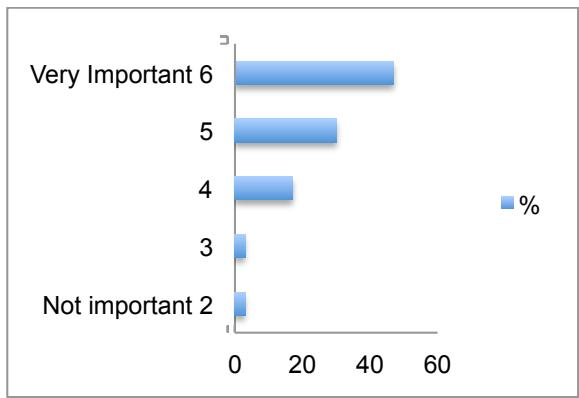
Figure 10: The importance of reading skills in the work of newly employed graduates (all professional areas)
Such views were affirmed in the interviews. On the importance of writing, comments from informants included:
“being able to write clearly and concisely is so fundamental to how successful the graduate is going to be [in the profession]” (Lawyer) “in education, good literacy skills just run right through the job” (Secondary Teacher) “[good writing] is just such a big part of the job now” (Accountant) “we need to be so precise in our writing because anything we write now has the potential to be scrutinised in some legal context in the future” (Medical Specialist).
Similar remarks were made about reading:
“having an understanding of the technical documents we work with is crucial to the job” (Engineering) “reading is essential. They [our graduates] won’t initially fully understand the documents we refer to, but we expect them to develop these skills pretty quickly” (Medical Scientist).
While participants were generally sure about the importance of these skills, some variation was noted regarding how central such skills were thought to be (i.e. the varying results for the skill being seen as ‘important’ or ‘very important’). These differences can be explained in part by a distinction between what might be termed ‘docucentric’ professions (where the product or service provided to clients/users is essentially of a textual nature), and ‘non-docucentric’ professions (where written communication may be important in the routines of the profession, but where the texts themselves do not constitute the actual core product or service delivered). Examples of the former professional areas in the study were journalism and scientific research (where the core product is respectively the news article and the research article). Examples of professions in the latter group were medical practice (where the core service is arguably treatment of patients) and engineering (where it is the provision of physical structures and products of various kinds). Variations were also noted within these two broad categories. One of our informants explained that the service/products in accountancy tend to be of a textua kind (tax returns, financial statements etc.), but the texts are often more numerical than verbal in content.
The variable importance attached to literacy skills in the different professional areas can thus be related to distinctions of this kind. While such differences are of intrinsic interest, they were not explored in any great detail in the study. This was for the reason that the research was interested in obtaining a general picture of literacy practices across the professional areas investigated, one that would allow for meaningfu comparisons to be made with a generic test such as IELTS.
It was also noted in the findings from the different professional areas that the two skill areas investigated in the study - reading and writing - were often seen by informants to be strongly related to each other. Thus, a lawyer informant, for example, discussed how in the process of preparing a letter of advice to a client (an important written genre in that profession), graduate employees would typically need to be engaged in the task of reading about relevant statutes and precedent cases. Similarly, in secondary education, the development of classroom materials would typically involve close reference to relevant curriculum documents and guidelines. This type of inter-relationship between practices is well-established in the literature. Barton (1994), for example, notes that it is rare in literacy activities for a single literacy act (e.g. the writing of a letter) to be enacted in isolation; that is, without being related in some way to other literate activities. A concept invoked to capture this idea is ‘literacy event’ (Heath 1983), which is elaborated by Barton and Hamilton (1998, p 9) as a series of observable activities mediated by text.
While the study suggested a strong interdependence between acts of writing and reading in professional work, we have elected to report findings about these two areas separately. The principal reason for this was to allow for ready comparisons to be made with the IELTS test, where the assessing of each skill occurs within separate and discrete tests. The report considers writing first.
5.2 Writing practices and attitudes
5.2.1 Types of documents
The first consideration in the study’s investigation of writing practices was to find out about the types of documents (or genres) that are typically a part of the work of graduates. In the survey, respondents were asked to indicate how frequently certain genres needed to be produced, choosing from a list of selected types. As mentioned, this list was compiled from established taxonomies of professional written communications, as well as some initial trialing work on the project. The results for this question are shown in Figure 11.
As can be seen, the documents needing to be produced most frequently were letters/emails (either sent to recipients within the organisation or to external recipients). Of these, the survey found it was more common for graduates to be engaged in correspondence within the organisation. The other document types shown in the list needed to be produced only rarely. Of these, progress reports on activities and work plan documents were found to be marginally more common than the others. It was noted, that like the ‘within-organisation’ emails/letters, these latter two genres are also internallydirected documents. This is a finding discussed in more detail in the next section.
Respondents to the survey were also invited to indicate other document types typically required of graduates in their organisations that were not included in the list shown in Figure 11. A wide array of additional genres was indicated. Some of these were of a generic nature: cover letters, staff bulletins, performance reviews, social media posts, PowerPoint presentations. Many, however, were ones that related to quite specific professional areas and practices, including the following: inspection reports, supplier requests (Engineering); engagement letters, financial statements, tax returns (Accounting); letters of advice, witness statements (Law); user manuals (Information Technology); patient notes, treatment plans, letters of referral (Health); news stories (Media); school reports, lesson plans (Education); departmental briefs (Public administration); research proposals, research reports, literature reviews (Science).
In the interviews, the nature of workplace genres was explored in some detail with informants. Of particular interest were perceptions of the extent to which document types needing to be produced tended to be of a fixed and predictable nature. A variety of experiences were reported here. Some informants spoke about written communication in their organisations being of a very standardised nature, and that as a result, a template approach could often be relied upon. An accounts manager informant, for example, mentioned that the use of templates in her organisation not only guaranteed a “consistency of style”, but was also a good way of inducting newcomers into “the style and standard that we expect of them”.

Figure 11: Document types (genres) needing to be produced frequently or very frequently by newly employed graduates (all professional areas)
Others, however, talked about the impossibility of relying on standardised written formats, stressing that communications in their professional contexts usually needed to be tailored to quite specific circumstances and audiences, as suggested in the following comments:
Lawyer: It’s not possible to standardise anything much. This is because in each case you’re dealing with an entirely different factual situation, so we have to work out how that factual situation is going to work out in the type of advice we end up preparing.
Sales operations manager, IT: There’s no sort of blanket way of communicating to someone. For example, you have to understand a business manager [who is a customer], and work out how they understand things, and then tailor your communication to their way.
On this point, it was emphasised by a number of informants that a key ability for graduates to develop was a flexibility and adaptability in the way they handled written communication norms in their work:
Environmental scientist: Many of the types of documents they [new graduates] need to produce will be quite new to them. Sometimes these will be more technical documents but other times they are writing for a more general audience. The quality we’re really looking for is for them to be able to adapt their writing.
As noted above, the email was identified as the genre needing to be produced most frequently by graduates. A few comments need to be made about this as a genre type. First of all, on one level, the email message was found to be the generic means for conducting, managing and negotiating a broad range of intra- and interorganisational activities. Some attributed the predominance of this form to the increasing shift away from the use of verbal communication in workplaces:
Academic: I’m sure it’s the same in many organisations, but we conduct just so much of our communications in written form - that is via email. I guess whereas previously you used to pick up the phone or go to see a colleague in their office, now so many of our daily transactions with colleagues are done by email.
In other instances, the email message could be seen simply as the communicative medium by which other identifiable genre types were transmitted. Thus, it was indicated by several informants that other key genres (e.g. short reports, financial statements) would often be sent in the form of an email message. Finally, some email types were found to constitute distinctive genres in their own right, ones associated with certain professional areas and often having their own distinctive structures and features. Examples of these mentioned by informants were the letter of engagement (Accounting); and letter of advice (Law). The variable aspects of the email, as seen in the above examples, provide evidence of what Bhatia (2010) has referred to as the inevitable ‘interdiscursivity’ of workplace genres, and also point to some of the inherent difficulties in seeking to classify them in clear and systematic ways.
5.2.2 Audiences
The research probed in some detail the types of audiences for which new graduates typically needed to write documents The frequency of these audience types is shown in Figure 12.
As with the findings for ‘genres’, the key finding here is that the majority of written communication handled by new graduates would be directed to recipients within the organisation.
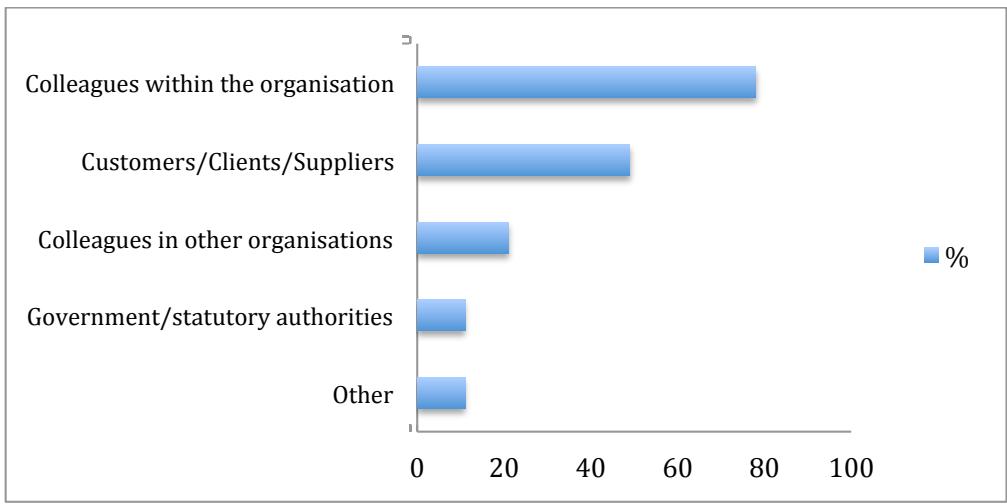
Figure 12: Audiences for whom graduate-authored documents needed to be frequently or very frequently directed (all professional areas)
This point was elaborated on by several informants in interview.
Laboratory manager: We’ve got different functional areas and they’re interrelated and something we do may need further action by another section. It might be verbal, but more often it will be by email, and so the graduate will need to write: “Can you do such and such because we’ve got this result”.
Accountant: A lot of our activity is about handling activities within the organisation, and so much of the written communication, including that of our graduates, will be directed at other members of the organisation.
Some also discussed the growing global nature of their organisations, and how the internal email has become an essential tool in the managing of activities between staff in different locations. Some stressed the importance of precision in such communication, suggesting this often constituted a particular challenge for new graduates.
Engineer: The challenge is often the appropriate use of email, in and out. Graduates often get caught. They might send something within our company to an overseas employee and not realise the repercussion of what they’ve sent. A few simple words in an email can create a huge problem overseas.
The study found the written communication required of graduates to be less frequently directed towards customers/clients (see Figure 12).
These patterns seemed to depend to some extent on the nature of the profession in question. Several of the health professionals interviewed for example, described how much communication conducted with clients in their professional routines was of a verbal, face-to-face nature, notably in the context of patient consultations. For others, however, the nature of the work unavoidably required the provision of written correspondence, for example, in the furnishing of cover letters and tax returns to clients using accountancy services or the presentation of ‘test reports’ to clients of engineering services.
A finding of some interest was the tendency for organisations to limit the contact newly employed graduates had with potential recipients outside their organisations - at least initially. On this issue, several mentioned how much of the initial work assigned to graduates tended to be forms of assistance to more experienced colleagues. Thus, the lawyer informant explained that a typical first writing task assigned to new graduates would be summarising previous cases relevant to a client file. This draft material would then be passed on to an experienced solicitor for incorporation into any documents being prepared for the client (“We don’t let a graduate give legal advice because they’re just not experienced enough to do this”). Similar processes of induction were described by the journalist informant where new graduates were typically held back from writing for the specialist external audience of a newspaper, i.e. the reading public.
Journalist: [New graduates] might come in first as what we call a “copy person” which is sort of just running basic tasks in the newsroom - not really writing anything much. And they’ll gradually start writing, sort of more minor stories, like a 50th anniversary of something. And then it might be after about six months or a little more that we get them to write more longform pieces.
Such experiences, however, were more typical of those professions where a major premium was placed on the quality of the writing (the aforementioned ‘docucentric’ professions). In other instances, graduates were given earlier license to communicate directly with clients and customers. It was noted, however, that in these instances, there was a tendency for supervisors to carefully grade the type of written tasks assigned to graduates, and also to ensure some monitoring of what was subsequently produced.
Accountant: [Typically our new graduates] begin by producing basic tasks like a simple tax return. Once they’ve demonstrated their ability to execute those basic tasks, they’re then given more challenging tasks…maybe a more complex tax return or a simple business set of accounts and other compliance documents.
Allied health specialist: Before any documentation goes out to a client or to a referrer, I’ll be in between and correcting it to some extent, going through it with them [the new graduate] one-on-one.
5.2.3 Writing purposes
Along with investigating ‘types of documents’ and ‘audiences’, the research sought to find out about the basic purposes (or functions) of written communications in professional settings. Figures 13 a-d show a list of possible writing functions, and how important each was seen to be in the written communication routines of graduates in their professional work. The various functions are classified according to the broad Hallidayan speech functions described in Table 2 (i.e. offers, commands, statements, questions).

Figure 13a: Offer

Figure 13b: Command

Figure 13c: Statement
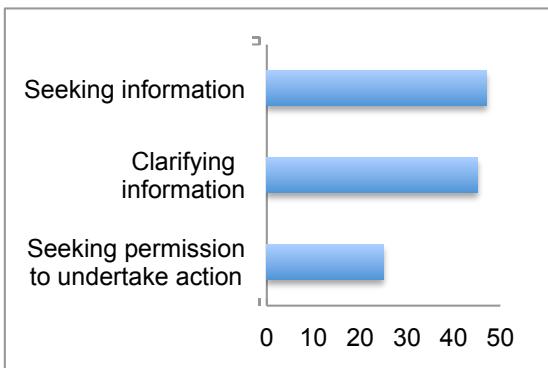
Figure 13d: Question Figures 13a-d: Writing functions considered most important in the writing of new graduates, by different speech act categories (%) (Halliday 1994)
The results shown in Figures 13 a-d can be divided roughly into three groups: more important functions (>30%); less important functions (10-30%); functions of negligible importance (<10%). In the first category were the functions: Reporting on activities completed; Seeking information; Clarifying information, Providing information; and Giving advice/recommendations. In line with Halliday’s schema (1994), it is notable that most of these functions were concerned with the exchange of information (either, ‘the giving of information’ - stating; or ‘the demanding of information’ - questioning querying). The only function related to the actual exchange (or provision) of goods and services was the least frequent in this grouping - Giving advice/ recommendations. One might conclude from these results that graduates, at least in the early phases of their tenure, are generally required to be more involved in information gathering and presentation activities in their work than the actual provision of the relevant service to clients and customers.
In the intermediate category were the functions: Seeking permission to undertake actions; Requesting actions to be performed by another party; Presenting an argument or case; and Proposing actions. One notes in these less frequent functions a greater orientation to the taking of action (i.e. the exchange of good and services). In the final category, those functions of negligible importance were: Making complaints; Making invitations; and Responding to complaints.
This area of writing functions was explored in some detail with the interview participants. In the interviews, participants were shown the results from the survey (Figures 13 a-d), and asked about how much they thought the findings accorded with their particular professional setting. They were also asked to elaborate on those functions that seemed especially pertinent to the types of communication graduates were expected to be engaged in within their organisation. Their comments are summarised below, and grouped according to the relative importance of the function, as found in the survey.
Most important functions
Reporting on activities completed: This function, the most frequently indicated function in the survey, was discussed in the interviews in relation to a range of contexts. It was seen as particularly relevant to those organisations whose operations involved research activities of some kind (e.g. engineering, medical science). The engineering informant, for example, spoke about the importance of ‘test result’ reports within his organisation, pointing out along the way the distinctive customer-focus of this style of reporting (“[A graduate] from their uni experience might say ‘We got this result’, whereas when we send this to the customer we have to say: ‘This is the result that we got, this is why we got it, and this is what it means’”). Reporting was also seen as an important ‘within-organisation’ function, especially in relation to ‘performance review’ processes, with graduates in these instances being required to provide an account of work done.
Seeking information: This function was mainly spoken about in relation to contact with customers and clients In a number of contexts, reference was made to those situations where a client seeking services from the organisation needed to be quizzed about their specific needs and circumstances. It was mentioned that in some contexts, initial information was typically obtained through verbal interactions (e.g. in medical scenarios), but in others was enacted though written communication (e.g. email inquiries about transport deliveries). It was mentioned that such activities, which involved graduates having direct contact with clients, were usually closely supervised in the early stages of their tenure.
Clarifying information: This function was discussed by several informants as one strongly related to the ‘seeking of information’. It was often seen as a follow-up activity to initial information-gathering tasks conducted with clients/customers. One of the accountant informants, for example, spoke of the frequent need in the preparation of tax returns to “send emails to clients requesting additional information or clarifying information previously provided”. Getting clarification of information was also seen as very relevant to ‘within-organisation communications, especially the need for graduates to get clarification about the details of tasks assigned to them by a supervisor.
Providing information: The providing of information was discussed in relation to two different contexts. One was when the information was being provided for an internal audience, especially as some research process to support an organisation’s activities. Examples of this were law graduates providing relevant case information to an experienced senior preparing advice to a client, or journalism graduates passing on background research for a feature story being prepared by a senior writer. The other context was when the information was prepared as a product of the organisation. Such an example was the preparation of environmental facts sheets, used as the relevant informant explained, “to inform the public about different aspects of our work and how it impacts on them”.
Giving advice/recommendations: Many informants saw this as a core activity, and in fact one upon which much professional practice was based. A number of the professional written genres discussed by informants can be seen as the formalised textual enactment of this function: e.g. treatment plans (health), school reports (education), letters of advice (law) and departmental briefs (public administration). A number commented that while this was a core function, it was one that graduates tended to be introduced to in a managed and supported way.
Less important functions
Requesting actions to be performed by another party: The function of requesting actions seemed to relate mainly to situations where a graduate needed someone within the organisation to undertake some action to support work they were doing.
The medical science informant, for example, explained how such processes worked in his organisation: “We’ve got different functional areas and they’re interrelated and something we do may need further action by another section. It might be verbal, but more often it will be by email, and so the graduate will need to write: ‘Can you do such and such because we’ve got this result’”. It was noted by several informants that such actions often needed to be handled ‘diplomatically’ by new graduates, especially in the early phases of their employment when their experience and standing within the organisation was invariably limited.
Seeking permission to undertake actions: This function was related very much to internal processes within organisations, and was seen as central to supervisorgraduate interactions. It was suggested that such exchanges were often conducted verbally, but sometimes would require official sanction though written media, for example, email.
Proposing actions: This function was seen as a core activity in many professional contexts, but was thought to have limited relevance to the work of newly employed graduates. Informants related this to the novice status and inexperience of graduates: “[A new employee] might come to me with an idea. But we find if I lend my authority to a proposed action, it will go forward, whereas if a new graduate says: ‘We need to do this’, it tends to be ignored”.
Presenting an argument or case: This was identified as a less common function with relevance to only certain professional areas. Informants tended to see the idea of an ‘argument’ or ‘case’ principally as the ‘justification’ that needed to accompany any advice given or actions proposed, especially where this involved customers/ clients. This was certainly the case with financially-based services (e.g. accounting, company law), but also with other areas. The allied health informant, for example, explained that in the preparation of a treatment plan for a client, some inbuilt justification often needed to be included to persuade the client of the expected benefits of a plan. The function was also thought to be relevant to ‘within-organisation’ processes, especially those related to any suggested changes in work practices. One informant, for example, spoke about situations where a graduate employee might have ideas for how some work routine could be done more effectively. In this instance they would be invited to “put it down in writing and say why we should be doing things differently”.
Functions of negligible importance
Responding to complaints: This function was seen to be unimportant in the work of graduates. It was suggested by several informants that any complaints from externa agencies (e.g. a client; authority) would typically be referred to a supervisor for handling.
Making complaints: This function was also seen not to be relevant to the daily communication routines of graduates. Informants suggested that it may have relevance at senior levels of organisations (especially in dealings with errant suppliers or customers), and was an activity that would be handled through quite specialist channels, including legal channels.
Making invitations: This function was also seen not to be relevant to graduates. The only context it was able be related to was workplace social activities, and was seen by informants as a more peripheral or ‘occluded’ (Swales, 1996) form of workplace communication.
In these accounts of the functions of written communication, two broad realms of interaction emerged. One was the formal and semi-formal communication conducted within organisations around the organising of work activities. For graduates, this communication typically involved interactions with supervisors and fellow workers, and included such functions as seeking clarification of work tasks, reporting on activities completed, and requesting actions to be carried out by colleagues. Such communications, which have the purpose of facilitating workplace processes (i.e. they are communicative ‘means’ rather than ‘ends’) can be seen as secondary (or ancillary) forms of written communication. The main vehicle for such communications was found to be the email message, although it also took in various internal workplace genres such as: performance review documents, work plans, and record documents.
The other type of communication identified was that directed at customers and clients which was seen as integral to the actual delivery of an organisation’s products and services. These might be regarded as the primary communications of organisations and were ones associated with the production of key industry-related genres. Such functions included seeking and clarifying information, reporting on activities and giving advice. It was noted that in some areas, engagement with such functions tended not to be initially a part of the work routines of graduates or else were closely supervised and monitored owing to a graduate’s novice status and experience in the organisation. Accordingly, the gradual managing of such written functions in a graduate’s work was seen as a key element of developing expertise (and also success) in a particular professional area.
Among informants’ discussions of communication practices within their organisations, a surprisingly consistent picture emerged of the nature and structure of these primary communications across a range of professional areas. A sample of these accounts from a range of professional areas is presented below (emphasis added). In Figure 14 below, an attempt has been made to capture the broad patterns identified in what we have called a ‘framework of professional communication practices in client/customer interactions’.
Lawyer: A large part of what we do is we get information from our clients, and then later on we provide them with advice. So as a client you come to me and say ‘We have had a claim made against us for x y and z’. And so as the lawyers, we have to get all the details about the situation. And then we’ll go off and look into it, and then we’ll come back with our advice: ‘So you told me a b c d e, here’s your liability under the Sex Discrimination Act arising from this and this section’. And then we’ll say: ‘There are such and such awards for that type of conduct and we recommend x or y’.
Sales operations manager IT: The people on our team often work hand-in-hand managing the relationship with the customer, so part of the work will be the proposing of actions. So, for example, the customer may have a budget, and they might want to prioritise those dollars from an IT support perspective. Maybe the customer has multiple contracts so we might propose to consolidate into a more manageable single contract of services. But first we need to find out about their needs, and this is where the collecting of information is important.
Allied health specialist: So an important type of document we need to produce is the treatment plan which we give to the client, and also sometimes to doctors. It’s basically a report on what we’ve found out from the client, both from our examinations and also what we’ve found out from them. So in that same document we’re proposing actions that they need to follow. But we’re also presenting an argument or case, which is the need for treatment and that’s what we need to justify.

Figure 14: A framework of professional communication practices in client/customer interactions
As shown in Figure 14, the broad activity once a client has been engaged, involves gathering relevant information in the first place. Here the basis of the client’s need for service is established along with details about specific problems/needs/issues etc. The functions most identified with this phase as shown are Seeking information and Clarifying information. In some contexts such information gathering will typically occur verbally (e.g. in medical patient consultations), but in others, it will involve written interactions (including the requesting and provision of related documents).
The next phase in the framework we have termed ‘application of professional expertise’. Here a range of processes is pursued that revolve around the application of professional expertise (knowledge, protocols, methods etc.) as a basis for responding to the particular client needs/problems/issues etc. established in the first phase.
For experienced professionals, this may involve relying mainly on extant knowledge and experience; for the novice it will invariably require research and consultative processes of some kind, including the reading of relevant texts and documents (Note: the nature of reading in professional contexts is discussed in Section 5.3).
The third phase involves the provision of the actua professional service or goods. As suggested earlier, the relevant document produced out of such processes may constitute the service itself (e.g. the delivery of a scientific report, a tax return, a letter of advice etc.) or may accompany material goods or service (e.g. the provision of a treatment plan to accompany allied health services or a user manual for a newly installed IT system). The functions most identified with this phase as shown are Reporting activities completed, Giving advice, Presenting an argument or case and Proposing actions.
In broad terms we can think of the three-part sequence shown in Figure 14 as conforming to the general ‘problem-solution’ rhetorical structure identified by Hoey (2001), where the professional service provided can be seen in some general sense as the proffering of a ‘solution’ to a ‘problem or issue’ that a client has identified or which has been identified for them. Across the professions, such problems/issues might include, for example, an illness (health); an environmental threat (science); a legal issue (law); the opportunity to improve technological processes (IT) etc.
In an additional version of the framework (see Figure 15), we have sought to represent what have been termed ‘secondary’ or ancillary functions; that is those functions and processes occurring within the organisation aimed at facilitating and advancing the primary client/customer interactions. These secondary functions - shown on the outer area of the figure - could not be represented in t he same schematic fashion as those related to customer/ client interactions. This is because communications in this area tend to be very varied, and often depend on the nature and the dynamics of the particular organisation in which they take place.

Figure 15: A framework of professional communication practices in client/customer interactions (principal secondary interactions)
5.2.4 Qualities of effective professional writing
A final area investigated in relation to writing was what participants saw as the qualities that made for good writing in their professional areas. Figure 16 reports the findings from the survey and shows the degree of importance attached to a range of different writing features. These features were generated in part from the analysis of the IELTS descriptors (Section 2.2.5), and also from some preliminary trialling work on the project.
The results show a high premium placed on the formal aspects of writing: grammatical accuracy, correct spelling and punctuation. Also considered important were certain features that related strongly to the interactive nature of written communication in the workplace; that is, documents having ‘a clear purpose’, being ‘wellorganised’, having ‘a clear layout’ and being written in ‘a language appropriate for the reader’ (including the use of ‘plain English’).
Of less importance were aspects of writing perhaps more associated with writing in academic domains, including the use of an ‘academic style’, being ‘persuasively written’, and drawing on a ‘broad vocabulary’.
These responses were pursued in some detail in the interview phase of the study. It was found to be a useful approach to explore these matters with informants around a theme of which aspects of writing graduates found most challenging (or experienced most difficulty with) in the written communication tasks assigned to them in their work. The following are the broad themes that emerged from these discussions.
Formal accuracy: Aspects of formal accuracy (grammar, spelling, punctuation etc.) were seen as important ends in themselves (“any professional just needs to be competent in these areas”), but were also discussed at some length in relation to issues of organisational credibility and reputation.
A number of informants suggested this feature was particularly relevant to any external communications: (Engineer) “In emails to clients it is important that graduates can express themselves professionally so that it reflects well on the company”; (Marketing manager) “Customer interaction whether written or verbal is critical to maintain the image of the company”. The law informant was specific about the potential risks of poorly composed documents, pointing out that clients can in fact refuse to pay if they think a document has been put together in “a haphazard or grammatically suspect way”. A number also commented on the preference in professional communications for a fairly minimalist grammatical style. Thus, one elaborated on the sort of coaching he provided to graduates in this regard: “Their [graduates’] sentences are often too long. I tell them to use short sentences. They’ll use conjunctions ‘ifs’, ‘ands’, ‘buts’ to keep a sentence going when you just want them to say it. I tell them: ‘End the sentence. Go onto the next one’”.
Tone: Many informants pointed out the challenge for graduates in getting the right tone in their correspondence, especially being able to adapt this for different types of audiences. One thought that a key challenge was properly distinguishing between “those messages directed at fellow staff and those for clients”, suggesting also that “it takes experience to know how to get an appropriate tone for different parties”. Another mentioned the challenge of getting the right pitch in “any difficult situations”, where it is sometimes necessary “to be strong and firm, but without sounding rude and abrupt” (Accountant). Informants saw this interpersonal dimension as crucial in the written communications in their professional area. It was partly anxieties about the managing of this aspect of client relations, and indeed the risk of offending relevant partie that some said lay behind any initial screening of graduates from these types of written interactions.
Purpose: Managing to convey a clear purpose in one’ written communication was also seen as a key quality i documents, and one with which graduates often had difficulty. This was explained in terms of being clea about what action was expected to ensue from a document or piece of correspondence, as suggested in the following: “In the reports we write, you need to be able to concisely identify the key points. And the customer then has to know what they do with that” (Engineer); “I often ask them to put themselves in the shoes of the client to think if they were the client reading that advice, would they know exactly what they are to do” (Accountant).
Structure: A clear and logical structuring of documents was thought to be another challenging area. It was mentioned that such structuring often needed to be developed around the nature of the advice or action being proposed, so that a document presented the relevant background and led on logically to how the recipient(s) needed to act upon the situation as outlined. A number of informants pointed out that there are often conventionalised ways in their particular field for structuring this type of information, and so part of the professional learning that graduates need to undergo is developing a feel for such conventions. The senior public servant informant, for example, described such conventions in her field thus: “It’s a certain way of writing we have here in the writing of briefs. You have to set out what the purpose of your brief is, the background of the issue, what has to be worked out, and then be very clear about your recommendations. So it involves distilling a complex issue within about two pages” (Public administrator). Also mentioned by informants was the tendency of novice employees to include irrelevant material in documents: “The graduates often don’t properly plan how they are going to write a document, so the writing will often be a bit all over the place, as well as including irrelevancies” (Research scientist).

Figure 16: Writing features considered important or very important in the writing of new graduates
Brevity: Related to issues of structure and purpose was the need to be able to write briefly and concisely. A number of informants saw this as a distinct contrast to graduates’ experience in tertiary study: “At university students are rewarded for filling 10 pages, but the commercial dictates are with writing that is concise, wellorganised, and clear” (Accountant); “With much of our writing, they need to keep it short and punchy. I’m looking for shorter sentences and paragraphs than they may be used to writing” (Environmental scientist). It was explained that the time pressures in all workplaces often mitigated against any extended and sustained reading, and thus information in documents, it was suggested, had to be constructed in the most minimal way possible. As one informant explained: “The clients just don’t read anything much, so you have to give them [what they want] in a page” (Lawyer).
De-technicalisation: Another adjustment, it was suggested, that needed to be made from graduates’ university experience was the ability to ‘de-technicalise language, and to be able to present one’s disciplinary expertise in an accessible form. It was pointed out that in written communication the intended audience - both within the organisation and outside - would typically not share the same technical or academic background, and so there was a need to constantly monitor and adjust one’s language. As several explained: “You tell them [the graduates] to just put things in plain English. Often they will try to be too technical, too official, and it just doesn’t work for the clients” (Laboratory Manager); “There are issues when they [our IT graduates] don’t articulate things in a simple language. It needs to be put in terms that our sales reps understand, and so that the sales rep can then be explaining things to the customer” (IT Sales Manager).
Comments around these different areas attest both to the importance of written communication in professional settings as well as its quite exacting demands. It was emphasised however, that commencing graduates would not normally be expected to have any developed understanding of the specific writing practices associated with their new roles. This point was strongly asserted by a number of informants.
Medical specialist: We just don’t have any expectations [about their abilities to write in our field], because we assume they wouldn’t have done it. But we typically show them what they are expected to do.
IT sales manager: Many students come with very good written skills. But it’s coming out of university into a corporate environment. They need to learn the cultural [aspects of the job] and how to engage with people. That’s more on-thejob learning.
Accountant: It is a learning experience. I don’t expect graduates to commence employment with perfect reading and written skills. It takes time and some guidance for them to develop these skills.
Engineer: In my experience it takes around two years to be confident that a new graduate can understand the nuances of technical report writing, and efficient engineering communication.
As has been explained, the response to this situation n organisations was typically to have in place processes induction and mentoring - either formal or informal - that involved graduates being progressively introduced to the writing requirements of their new professional roles, and also to the particular challenges of handling professional-client interactions.
Some comments were made in interviews specifically about the writing abilities of graduates from EAL backgrounds, that is to say, those who in any job-seeking endeavours might normally be required to provide an IELTS or other test result as part of an organisation’s recruitment processes, or as part of broader professional accreditation processes. On this point, some mentioned that as a result of the increasing global and multicultural environment their organisations operated in, efforts were increasingly being made to employ staff from diverse backgrounds, including non-Anglophone backgrounds. In a number of instances, the writing abilities of such recruits were viewed very highly: “The English of some of our bilingual students has been excellent” (Medical scientist); “We find that some of our second language graduates are exceptionally bright, and their English is often of a similar standard” (Accountant).
In general, it was suggested that while it was important for all appointees to have a high level of written proficiency, ‘the same high standards’ could not always be expected of graduates from EAL backgrounds. Some pointed out that non-Anglophone graduates could often be selected for positions primarily for reasons other than their communicative proficiency, including, for example, the level of professional or technical expertise they were able to bring to a position, or the cultural familiarity they had with particular client/customer bases of an organisation. Informants mentioned the importance generally of properly mentoring new graduates into the writing requirements and practices of the new professional roles; this, it was suggested, was especially relevant to those from second language backgrounds who, as one informant suggested, “might need a bit of extra support along the way” (Academic).
5.3 Reading: Practices and attitudes in professional domains
The first consideration in the study’s investigation of workplace reading practices was to gauge how important reading was thought to be generally in the work of newly-employed graduates. As mentioned, the quantitative results suggested the centrality of reading in much professional work with 77% of participants indicating reading either as important (30%) or very important (47%) in their particular field. This finding was strongly affirmed in interview. In their discussion of this aspect of professional work, informants made reference to a variety of text types (genres) that needed to be read on a regular basis, and the role these played in daily work routines.
Laboratory manager: The reading is extremely important. For much of their work, they [new graduates] have to read the Standard Operating Procedures, which are often incredibly badly organised. But they have to know them and be able to follow them.
IT sales manager: Reading is very important. The main communication channel is email…it’s sort of death by email. So being able to read efficiently and being able to absorb that content is really important. Much of it is internal information communicating changes in processes or policies. Being able to absorb all that is really important.
Engineer: Much of the work stems from being able to read and understand engineering specifications. Primarily we’re providing a product to a customer and the customer will give us a specification, either a design specification or a testing specification, and so we have to be really precise in our understanding of these to ensure that the part we supply is going to meet those specifications.
Public administrator: Reading is so important. Our staff are expected to read in the policy areas lengthy reports and be able to get the meaning of the report, and then to be able to pass on the relevance of these reports.
In addition to reading on the job, informants also spoke about the important role reading played in various professional development activities. In a number of instances, these activities took the form of formal programs that new staff in certain areas needed to complete as part of a profession’s registration or accreditation requirements. Such programs, it was explained, typically had a major reading component. Thus, for example, the accountant informant spoke of the “heavy reading requirements” of the Certified Practicing Accountancy (CPA) program that operated in effect like “an extension of university type studies”. The allied health specialist mentioned how it was a requirement of ongoing professional registration in his field to be enrolled in at least 20 hours of professional training per year, and this inevitably involved “a good deal of takehome reading”.
In other areas, such professional development was not mandatory, but nevertheless constituted a significant part of professional work. The secondary teacher informant, for example, talked about regular professional development sessions aimed at keeping staff abreast of the “continual policy developments and directions coming from the government”, which were usually accompanied by a fair amount of reading. In one of the accounting firms investigated, there were monthly training sessions, where new staff were introduced to certain key document types, such as engagement letters “not necessarily to write, but to be able to read and understand”.
Others spoke about more informal within-organisation efforts to keep employees in touch with relevant developments and advances in their field. In a number of instances, this involved ongoing efforts by supervisors to circulate relevant journal and magazine articles amo staff.
Laboratory manager: I’ve taken it upon myself to [pass on journal articles to my staff]. I save the articles as PDFs and put them in a library on our server and send them links. Whether they read them or not after that, I don’t know, but it is there for them to read. I assume as university graduates that they should be able to read scientific journals.
Engineer: We have an SAE, the Society of Automotive Engineers subscription, a corporate subscription. We also use a lot of internet-based publications. We share publications in the workplace. I might buy a motor magazine or Electronics Engineering, for example, bring it to the workplace and send it round to others to use it.
5.3.1 Types of documents
The study sought to find out about the types of documents (or genres) that graduates typically needed to read in their work. In the survey, respondents were asked to indicate the frequency certain genres needed to be read, choosing from a list of selected types. This list, consisting of what might be called ‘more generic document types, was compiled from established taxonomies (e.g. Employment and Social Development, Canada 2014) and also on the basis of some initial trialling work on the project. A distinction was made here between documents typically produced within organisations, and those produced externally. Separate figures are shown below for these two different areas (Figures 17 and 18).
As can be seen, among both internally and externally produced documents, the email/letter was easily the most frequently read document type. The role of email in professional work, and the differing communicative guises this can assume in workplaces, has been described in previous sections. In interview, a number of informants commented on the particular reading challenges associated with this medium.
Laboratory manager: Most of the communication is via email. A new graduate might get dozens a day. And they can be from within the department, or from external people as well. So they have to be able to understand the point that people are making, and this is not always easy.
Transport manager: It’s often a challenge dealing with customer issues, normally sent by email. It’s vital for our new staff to be able to extract the key points, and then to understand what’s required to progress things to the next stage.

Figure 17: Document types (genres) needing to be read frequently or very frequently by newly employed graduates (internally-produced documents)

Figure 18: Document types (genres) needing to be read frequently or very frequently by newly employed graduates (externally-produced documents)
Among the other ‘within-organisation’ documents investigated in the survey (Figure 17), those that graduates needed to read with some regularity were policy and procedure manuals, notes and minutes, and newsletters and bulletins. Such document types, which all relate to the facilitating of organisational processes, can be linked to the broad functions discussed earlier: instruction and regulation. Among the externally produced documents (Figure 18), in addition to emails from customers and suppliers, the other documents to have some prominence in the data/requiring the attention of graduates were legal and regulatory documents and reports, newspapers/magazines etc., and academic journals. These document types can be related to the comprehension and acquisition of different types of professional knowledge/expertise. The legal/regulatory documents, for example, relate to knowing and understanding the frameworks in which professional activity in a field is permitted/allowed to be pursued.
Some of the other document types shown in Figure 18 (reports, newspapers/magazines etc., academic journals) relate arguably to the development of professional expertise of a more general nature, especially that concerned with broad advances in knowledge and practice in one’s field.
Respondents to the survey were also invited to indicate other document types that graduates typically needed to read in their work. As with the additional types of written documents, a vast array of additional reading genres was indicated. Some of these were of a generic nature: risk assessment documents, media releases, industry news, work-in-progress reports, and product lists. Many, however, were ones that related to quite specific professional areas and practices, including the following: inspection reports, test reports (Engineering); audit reports, tax legislation (Accounting); case summaries, legislation (Law); customer support agreements,
user manuals (Information Technology); diagnostic test reports, medical histories (Health); news stories (Media); curriculum documents, assessment guidelines (Education); departmental briefs, government reports (Public administration); scientific reports, fact sheets (Science). It was mentioned by some informants that some of these documents were ones that graduates would, in time, be required to write, especially as they assumed greater expertise and standing in their professional area. Samples of these types, it was pointed out, often provide models of exemplary practice in a field, with exposure to them no doubt having a powerful role in the development of graduates’ professional literacy abilities.
5.3.2 Challenges of reading
Along with investigating the types of documents that graduates needed to read, the study also sought to find out which aspects of reading were thought by participants to be particularly challenging for graduates in their work. In general, three broad areas were identified:
properly identifying and being able to respond to client/organisational needs 2. managing information flows in the organisation 3. understanding documents of a scientific or technical nature.
Each of these is commented on below.
For many supervisors, the greatest challenges related to reading associated with a specific task or portfolio assigned to a graduate. Many emphasised the overwhelming importance of graduates being able to clearly understand the various instructions and requirements outlined to them both by clients and colleagues, and then to be able to act appropriately in response to these.
Public administrator: It’s critical that the graduates can interpret information and then act on any tasks or further communications based on what’s there in the written communication.
Others spoke about the regrettable consequences that can arise from any failure to properly interpret (or heed) instructions issued in written form:
Accountant: To understand and execute instructions from colleagues or clients is so essential. Failure to do so can sometimes have significant adverse consequences for the organisation, leading sometimes to a lot of additional work [needing to be done].
As noted, the principal genre used for the outlining and issuing of tasks was found to be the email. Other more formal genres, however, were also implicated in this function, including work schedules, specifications, manuals and standard operation procedures. While informants saw the careful reading of such documents as an essential skill, it was also acknowledged that ‘directive’ style documents were sometimes composed very poorly (“with irrelevant detail and unclear purposes”), making it difficult for tasks to be properly acted upon. This was thought to be especially the case with any documents that “do not clearly indicate required action”.
A different challenge from being able to accurately interpret messages was being able to deal with documents in an efficient manner. On this point, informants spoke about the “sheer volume” and “incessant nature” of information flows in their workplaces, and the need for staff to somehow keep on top of this - to evade “death by email”, as one put it. Other comments were:
Research scientist: The volume of information required to maintain and develop competence is high and technical. Staff are required to read and refer to protocols, reference material and scientific literature and then effectively respond to and disseminate this information.
Accountant: In a corporate environment, rightly or wrongly, you spend a lot of time reading all those messages that come though on your screen, and it’s important not only to be able to understand and interpret written communication, but also to be efficient [in your reading of it].
A key part of this efficiency, it was suggested, related to the ability to quickly ‘take on board’ various protocol documents that outlined the methods and techniques that needed to be employed in the undertaking of a professional task.
Engineer: There is a need for the new graduate to read manuals and procedures to gain a quick understanding of equipment and processes to be able to conduct their work.
For some, the need for efficiency was tied very much to the commercial imperatives underlying professional work. Several informants thought the ability to ‘quickly digest extensive written material’ was not only crucial to a graduate’s professional development, but also to their ability to contribute productively to the organisation.
A third area of challenge was the handling of documents of a more technical nature. A number of different document types were identified here. Some of these were ones emanating from within organisations, with policy and procedure documents singled out as being especially difficult: “Our policy and procedure manuals can be lengthy and difficult, and graduates are not always inclined to read the information thoroughly, or are not able to absorb the information in its entirety” (Transport Manager). Certain document types produced from outside organisations were also seen as inherently challenging, including: legal frameworks, policy documents, and scientific and technical articles.
In some instances the difficulty of these documents was traced to the technical nature of their language: “Financial and policy documents often contain terms and jargon that are outside the graduate’s expertise and that they have not picked up on yet” (Accountant).
For others, the challenges stemmed more from a lack of familiarity with the broader context in which a document might have been produced - what one described, as the “bigger picture” of the profession, and where the organisation was placed within it.
As was the case with the challenges of writing, a number of informants mentioned how they were realistic about what could be expected of new graduates in their handling of the reading demands of their work, at least in the initial stages of their employment. A number spoke of the need to often walk newcomers through key document types, pointing out also that comprehension and efficiency invariably improved as graduates became more familiar with their professional roles, and with the broader organisational and professional environment they were working in. The challenges of these processes were vividly described by one informant.
Engineer: We generally get a good level of graduate. It’s just the specific style of document that they need to get used to. For example a specification from Company X will be written as a 600-page document. That document will refer to another type of sub-document, which will refer to some corporate engineering specifications. So there’s a chain of documents that lead to each other and somewhere in that you have to find the answer to what they’re asking you to do Someone who’s been dealing with those documents for years will know straightaway: ‘Oh that’s that, so I’m going to look at this page. That’s referencing this, so I know that’ll mean such and such’ and be able to work
through that chain of understanding very quickly. So when you’re talking about a 600-page document, having the knowledge of how to use the document is not a skill that a graduate’s going to have straightaway. But they gradually get there.
5.3.3 Reading purposes
Drawing on the data collected around reading practices in these different professional areas (different types of materials graduates were expected to read in their work), five broad reading purposes were identified, namely; being able to understand (and to act upon):
- client needs
- immediate organisational needs
- internal organisational policy/processes
- external legal and regulatory policy/processes
- advances in professional knowledge/practices.
These different functional areas constitute a form of hierarchy, with some related to more immediate local concerns (e.g. understanding client needs; understanding immediate organisational needs; understanding internal organisational policy/processes) and others concerned with more global extra-organisational matters (e.g. understanding external legal and regulatory policy/processes; understanding advances in professional knowledge/practices). Figure 19 shows these different functions superimposed on the earlier Framework of Professional Communication Practices, with the inclusion of examples of specific genres related to each broad purpose. Each of these purposes is discussed briefly below.

Figure 19: Framework of professional communication practices in client/customer interactions - The place of reading
Understanding client needs: In line with the overarching aims of professional work, this purpose is arguably the most central in the reading activity of professionals. As suggested, the main genre associated with this purpose is the email message, where the nature of the service/product to be delivered is typically outlined and negotiated. This genre is notable for being a more informal and interactive means for the relaying of client needs, with the main reading challenge being able to readily comprehend precisely which types of actions need to ensue from the correspondence. As one informant (Marketing Manager) suggested, “graduates’ ability to understand customer requirements which are communicated through emails or letters is so fundamental to the operations of our business”. Other genres related to this client-focused purpose were of a more formal nature, and included specifications, letters of engagement and contracts. Such genres thus have primarily a ‘directive’ function (what needs to be done). It was suggested by a number of informants that graduates’ handling and comprehension of these document types would often be facilitated by a supervisor, at least initially.
Understanding immediate organisational needs: This function, which is related to many of the day-to-day interactions within an organisation, is concerned with managing and facilitating work processes. The chief genre associated with this function is again the email message, but also includes more formalised genres such as staff bulletins, staff meeting minutes, work plan documents etc. As with the previous category, such genres have principally a ‘directive’ function (what needs to be done).
Understanding internal organisational policy/ processes: This function relates to understanding formalised policies and processes that have been developed within organisations, and which guide and govern the work routines and activities of staff. Relevant genres include: standard operating procedures, manuals, policy documents and in-house regulations. Such document types are typically regulatory (what is required/permitted to be done) and instructional (how to do things) in nature. Speaking about the importance of such documents, one informant mentioned that: “Although training is delivered on a one-to-one basis, Work Instructions and Standard Operating Procedures are provided in written form and must be read, understood and acknowledged before work on a task can commence”.
Understanding external legal and regulatory policy/processes: This function is of a similar order to the previous one, but is concerned here with an understanding of policy and processes developed externally - for example, by government, professional bodies etc. Relevant genres in this area, which are typically regulatory in nature (what is required/permitted to be done), include industry standards, codes of conduct, laws and statutes and government policy. It was suggested that such readings relate to tasks that are often beyond the entry-level expertise of many graduates. The progressive familiarisation with such documents, however, was seen as a crucial part of a graduate’s ongoing professional development.
Understanding advances in professional knowledge/ practices: This function was concerned with being in contact with one’s broad professional area, and keeping up to date with key developments in it, including technological developments. Relevant genres includ reports, journal and magazine articles and textbook Such genres are typically expository in nature (what being done) and are often concerned with accounts of good/best practice and innovation in a field. Some informants saw exposure to this type of reading also as essential to the ongoing professional development and expertise of staff.
5.4 Writing and reading in professional domains: Summary
The main findings from our investigation into the literacy practices and skills required of graduates in professional work are summarised below.
5.4.1 Writing
The professional work of graduates was found to involve the production of a range of document types (genres). Some of these were highly specific to certain professional areas (e.g. the letter of advice in law or user manuals in IT). Of those types of a more generic nature, easily the most common was the email message - needing to be produced both for internal organisational purposes, and for contact with clients and other external agencies (p 19). Other significant written genres of this general type were: progress reports on activities; work plan documents; and information sheets/kits.
Regarding the audiences of documents, and following on from the previous finding, it was found that the majority of written communication handled by new graduates - at least in the initial stages of their employment - were directed to recipients within the organisation (p 21).
Regarding the purposes of written communication, the more common functions were found to be: Reporting on activities completed; Seeking information; Clarifying information; Providing information; and Giving advice/recommendations (p 22).
The written qualities particularly valued in professional work included a range of formal features (grammatical accuracy, correct spelling and punctuation), along with certain features that related to the highly interactive nature of professional communications (writing with ‘a clear purpose’, using ‘a clear layout’, striking the right ‘tone’, being concise, using ‘plain English’) (p 26).
Central to all written communication in the professional areas investigated was the key activity of providing professional services and products to clients. In broad terms, communications around this core activity were found to fit with a general ‘problem-solution’ rhetorical structure (p 25).
5.4.2 Reading
Reading practices were found to be directly related to many aspects of the writing that graduates needed to do in their professional work, and were tied very much to facilitating the core activity of providing goods and services to clients. Graduates needed to read a range of document types. The most common type was the email message - coming from both internal and external sources. Other ‘organisation-internal’ documents needing to be read on a regular basis were: policy and procedure manuals; notes and minutes; and newsletters and bulletins (p 30). Prominent ‘organisation-external’ documents included: legal and regulatory documents; reports; newspapers /magazines; and academic journals (pp 30-31). The main challenges of reading in professional work were found to be: properly identifying and being able to respond to client/organisational needs; managing information flows in the organisation; understanding documents of a scientific or technical nature - especially procedural and regulatory documents (p 31). A range of reading purposes were identified, with some related to more immediate client and organisational needs, and others to the operations of the profession more broadly. Five broad reading purposes were identified, namely, being able to understand (and to act upon): i) client needs; ii) immediate organisational needs; iii) internal organisational policy/processes; iv) external legal and regulatory policy/processes; and v) advances in professional knowledge/practices. These contexts were related to the broader functions of: direction (what needs to be done); regulation (what is required/permitted to be done); instruction (how something is done); and exposition (what is being done) (pp 32-33).
6 RELATING FINDINGS TO THE IELTS WRITING AND READING TESTS
In what follows, we draw on these general findings to make some observations about correspondences between the broad practices identified in the study and the different components of the IELTS test. These observations are necessarily of a provisional nature. This is for the reason that they not are based on a comprehensive and systematic analysis of task types and formats in the two modules. Such analysis, we suggest, would be a useful project to pursue in future IELTS research. In this section, brief discussion is provided about each of the following:
i) Writing task descriptors ii) Writing Task 1(Academic and General Training) iii) Writing Task 2 (Academic and General Training) iv) Reading (Academic and General Training).
A few observations are made at the end of this section about recent trends noted in the design of IELTS items.
6.1 Qualities of effective writing
The first area considered is those aspects of writing valued in the two domains - IELTS and professional practice. For IELTS, these qualities are inscribed in the band descriptors used to assess performance on the test. In the study of professional practices, these aspects were established through both the survey and in interview. The general conclusion here is that there would appear to be a good deal of overlap between the qualities valued in each domain. These include the following features that are strongly prominent in the IELTS descriptors:
relevance of ideas, information etc. clarity of purpose/ideas appropriateness of tone accuracy of formal features (grammar, spelling, punctuation) progression/structuring of information.
In the interviews and survey, many of these qualities were strongly linked to the ‘professional-client’ nature of written interactions, and the commercial context in which these occurred. Thus, matters of formal accuracy were seen as crucial among other things to ensure organisational reputation and credibility; issues of tone were often linked to the effective management of client relations; and information-related features (clarity of purpose, relevance and structuring of information) were associated with the action-oriented basis of interactions (i.e. the need to articulate in any communication what precisely needed to be done by relevant parties).
Participants, however, identified a number of other features that had no apparent coverage in the IELTS criteria. One of these was the need for brevity and concision in written communication. As pointed out by several informants, clients (and also professional colleagues) generally expect documents to be “brief and to the point”. As one explained: “The clients just don’t read anything much, so you have to give them [what they want] in a page”. It is hard, however, to know how such a feature might be accommodated in the IELTS writing tasks. In a direct writing test such as IELTS, a written sample of some notional length needs to be elicited so as to ensure that the assessment criteria can be confidently applied. Thus, one of the instructions for candidates is to achieve a designated minimum word quota regardless of the nature of the task (Task 1 = 150 words; Task 2 = 250 words), and so such a condition necessarily prevents ‘principles of economy’ from being an exigent factor in candidates’ engagement with the task.
Another quality valued by the workplace participants but not observed in the IELTS descriptors was the importance of using ‘plain English’, including where appropriate, being able to ‘de-technicalise’ specialist language from one’s professional area. Thus, informants spoke of the need for graduates to avoid being “too technical” in their writing, and also to be able to “put things in terms that [the target audience] will understand”. A number related such qualities to the adjustment graduates needed to make moving from study contexts (where they are writing principally for an academic audience), to new professional contexts
(where they are writing for a variety of audience-types, and where, in many situations, there will be limited correspondence between the level and type of technical knowledge possessed by interlocutors). Such a criterion - the ability to adapt the encoding of one’s expertise - would appear to be one that is not readily incorporated into a test such as the IELTS. This can be explained in part by the generic, non-professional-specific nature of the test, and the attendant difficulty of devising scenarios where such an adapting of specific professional knowledge and language could plausibly be required of candidates.
On another level, however, the quality that is perhaps being insisted upon by professionals in relation to these matters is the need for graduates to be generally flexible and adaptable in their written style. While it is not realistic to expect the test to assess such flexibility around a candidate’s specific professional knowledge, as we have seen, it is noted that the inclusion of two different writing formats in both modules (Task 1 and Task 2) does provide some opportunity to test flexibility in a general sense. In the Academic module, this is a difference between the more technical, empirical style of writing required in Task 1 (data description) and the more opinionative essay style required in Task 2. In the General Training module, the contrast is between the Task 2 essay and the more transactional communication required in Task 1. The assessing of the different styles and registers required in these different formats is captured arguably in various descriptors, especially around the notion of ‘appropriateness’. Such an approach may be seen by some as the best way to test such flexibility, or at least within the limits of what it is possible to assess in a generic-style test.
These observations of difference are ones of a preliminary nature only, and it would be inappropriate to rely on them as a basis for recommending any major changes to the criteria used currently on the test to assess written performance. Jacoby and McNamara (1999) point to the significant role played by criteria in the operations of any test, suggesting that “rating criteria effectively define what is being measured, and hence play a crucial role in the determination of construct validity” (p 215). Because of this ‘criteria effect’, there is no doubt that substantial additional research would need to be done around this aspect of the test before any major adaptation could be contemplated to what is such a key component of the current IELTS system.
6.2 Writing Task 1 (Academic and General Training)
As noted previously, the types of writing required on the Task 1 in the Academic and General Training are quite different. In the Academic version, candidates need to write a summary description of information that is provided in a graph, table, chart or diagram. In the General Training module, the task is to write a letter - one directed at a specific addressee, and written in response to a prescribed scenario.
Both of these writing types would appear to have some connection with patterns of written communication identified in the study. The Task 1 (Ac) format, for example, takes in one of the key writing functions identified in the study, namely the providing of information (see Table 2). This information-focus o Task 1 (Ac) ties in with several writing scenarios described in the interviews. One of these was the need o graduates to provide background ‘information’ as a subsidiary task in a larger writing activity, e.g. a law graduate providing relevant case information to an experienced senior lawyer preparing advice to a client; or a journalism graduate passing on background research for a feature story being prepared by a senior writer. Another related context was when the provision of information was an actual product of an organisation. Such an example mentioned in interview was environmental fact sheets, designed as the relevant informant explained, “to inform the public about different aspects of our work and how it impacts on them”. Aspects of Task 1 (Ac) that appear less congruent with written norms in the professions are: i) the lack of a specified audience in the design of tasks, and ii) the lack of an apparent communicative purpose for the provision of the prescribed summary material.
On the face of it, the Task 1 (GT) letter would appear to be more aligned with the types of writing required of graduates in their work. In the area of genre, this format fits very much with the predominant genre form identified in the study - the email message. Certain design features of the Task 1 (GT) format - the specification of an interactive scenario, with a designated recipient and clearly prescribed communicative purpose - also correspond with many of the exigencies of workplace writing. Additional congruent elements are certain assessment criteria used specifically for Task 1 (GT) - the management of tone, and the outlining of purpose.
We note in passing however, that the nature of the interactions often prescribed in Task 1 (GT) items may not be so consonant with those characteristics of professional work. As mentioned, many Task 1 scenarios outline consumerist-type interactions, with the candidate often required to take on the role of a customer (or potential customer) of some kind. By contrast, in professional practice, communicative roles typically operate on the other side of such interactions - that is, to be engaged in the provision of service to customers and clients. This different configuration is suggestive of quite different rhetorical activities, e.g. the solving of problems as opposed to the adducing of them. Among other things, such differences would seem to have a bearing on certain pragmatic dimensions of language use, particularly in the contrast between the highly ‘mitigated’ language required to negotiate relations in professional contexts, and a ‘balder, on the record’ style of language characteristic of customer-initiated interactions (Yule, 1996). The adaptation of Task 1 (GT) scenarios to better reflect the dynamics of professional communication may be an option worth exploring by test developers.
6.3 Writing Task 2 (Academic and General Training)
As noted, both the Task 2 Academic and Task 2 General Training prescribe an ‘essay’ composition, with just some small variation in the level of academic formality required in each (IELTS 2014). On the face of it, an essay style task has no obvious correspondence to the type of writing required of graduates in professional practice. Significantly, in the study, the essay as a genre was mentioned by no informants as a written form that needed to be produced by graduates in their work. Further to this, several informants were keen to stress some of the differences they saw between academic styles of writing and the highly action-focused communication characteristic of professional work. It was suggested, for example, that the discursive, academic style that many graduates bring from their university studies can often serve as an impediment to the delivery of clear and concise messages. The absence of a clear sense of audience in the IELTS Task 2 essay format is also a feature that lacks congruence with writing in professional settings.
While the essay genre itself may have limited applicability, there would appear to be aspects of the Task 2 format that do have some connection with writing in the professions. These connections relate to the list of ‘skills’ (or functions) that the Task 2 format is intended to test (IELTS 2014) - including, inter alia, the ability “to present and justify an opinion” and “to present a solution to a problem” (p 5). Such functions are evident in the sample Tasks 2 items shown in Section 2.2. In each of these samples, the candidate needs to propose a solution to a putative problem outlined in the prompt, i.e. traffic congestion (Task 2 Ac), and the cost of aged care (Task 2 GT). Further, in the proposing of a solution, they are called upon to justify or “give reasons for their answer”.
These functions - proposing and justifying - were both found to be relevant to writing in professional domain In relation to the first, a number of informants spoke of the need for graduates to often support (or justify) a position. Thus, for example, the allied health informant spoke about the requirement in his field of always being able to ‘justify’ a program of treatment that was being recommended - whether to the patient or to another consulting practitioner. Another context requiring acts of ‘justification’ was the situation described by the medical scientist, where a newcomer into their organisation may want to propose a change to a particular work practice, and who would then be asked to “put it down in writing and say why we should be doing things differently”
In relation to the second function - proposing solutions to problems- it was noted in the study that written acts of this kind were very common in the data, and that in fact much rhetorical activity in professional work could be understood in terms of the enactment of this function. This overarching pattern was captured in the Framework of professional communication practices in client/ customer interactions shown in Figure 14.
These correspondences in writing functions between the two domains suggest some possible directions for the development of the Task 2 format. In particular, it may be a warrantable shift to place a greater emphasis on items constructed around a ‘problem-solution justification framework (Hoey 2001). Such a configuration is set out schematically in the following sequence, along with a hypothetical sample task, illustrating this configuration (see Figure 20 below). It is noted that the topic of this task (high turnover of staff) is related to a workplace context.

Figure 20: Sample hypothetical ‘solution-justification’ task
6.4 Reading (Academic and General Training)
A key finding regarding reading practices in the professions was the intimate link noted between acts of reading and the undertaking of professional activities - whether these were related to internal organisational processes or to interactions with clients and other external agencies. Thus, as was noted, many reading activities and related genres were concerned with forms of doing: what needs to be done (e.g. staff bulletins, meeting minutes, specifications, contracts, letters of engagement); what is required to be done (e.g. codes of conduct; industry standards; laws and statutes); how to do things (policy manuals; operating procedures etc.). On this point, a number of participants in describing the challenges of workplace reading, emphasised the importance of being able to extract “the key points” from a text, and to be able to understand exactly what was required “to progress things to a next stage”.
In the IELTS Reading Test there would appear to be some coverage of reading texts and tasks of this kind. This seems to be particularly the case with the General Training version of the test, where there is an emphasis on texts related to ‘everyday’ experiences and ‘work-related’ contexts (e.g. applying for jobs, company policies, pay and conditions, workplace facilities, staff development and training) and which are directed at specific audiences and contexts (IELTS 2014). The requirement of understanding a text as a basis for the taking of subsequent action can be seen in the General Training sample shown in Figure 8. As noted, the text in this sample is a Product Recall notice. Among other things, the task requires candidates to identify what they need to do if they have consumed the product in question. Other samples of this kind noted in recent IELTS materials include tasks based around workplace training and employee codes of conduct documents (IELTS 2010).
Arguably, this action-orientation of tasks is less a feature of the Academic version of the reading test. Unlike the General Training module where a variety of text types are used - including ones with a strong situational and interactive element to them - texts used in the Academic module appear to be mainly of a expository nature - that is to say “general interest” texts taken from “books, journals, magazines and newspapers”. Related to this, the principal task for candidates in the Academic module appears to be one mainly of identifying specific propositional content in texts. Such a format is evident in the sample passage and task shown in Figure 7, where candidates need to identify the presence (or absence) of certain claims being made in the text - in this case, one focused on research into the health risks of smoking. It should be noted, however, that expository texts of this type (covering such areas as linguistic and biologica research) do appear to have a connection with at least one of the reading functions identified in the study - Understanding advances in professional knowledge/ practices (what is being done) - though it is also noted that such a function was seen to be less central to the daily activities of graduates (p 33).
The contrast between the predominant rhetorical modes observed in the Academic and General Training modules is captured in the distinction traditionally drawn in semantics between ‘epistemic’ and ‘deontic’ modality An epistemic clause (or text) as Huddleston (1982) explains has the status of a proposition (or series of propositions); it asserts whether something is the case A deontic clause (or text), on the other hand, has the character of an action: “what is at issue is not whether something is true, but whether something is going to be done” (Huddleston 1982, p 168). The differences in these rhetorical modes can be illustrated in the following sentences taken from the sample reading texts shown earlier in Figures 7 and 8.
Academic module sample: proposition-oriented clauses (epistemic)
Passive smoking, the breathings in of the side-stream smoke from the burning of tobacco between puffs or of the smoke exhaled by a smoker, also causes a serious health risk. A report published by 1992 by the US Environmental Protection Agency (EPA) emphasised the dangers of side-stream smoke.
General Training module sample: action-oriented clauses (deontic)
Fancy foods will pay a reward of $10,000- $50,000 for information which leads to the conviction of any person guilty of placing metal pieces in its products. If you have such information, please contact the Customer Relations Manager, Fancy Food Retailers, Blacktown.
In line with the action orientation of much professional work, the study found that reading practices in the professions were oriented more to texts of a deontic nature. To bring about a greater alignment of reading in the two domains, it may be that such a feature could have a stronger emphasis in the IELTS reading test, especially in the Academic version of the test.
6.5 Recent trends in the IELTS Reading and Writing Tests
The recent changes in the uses of the IELTS, i.e. its uses for professional employment and registration, have coincided with some changes in the content and focus of test materials (IELTS 2010). This has been particularly evident in the General Training Reading Test where prescribed topics now include such work-related topics as “applying for jobs, company policies, pay and conditions, workplace facilities, staff development and training” (IELTS 2014). Some changes are also detectable in the writing component of the test. Although the format and genres of these - both Academic and General Training - are unchanged, one notes in recent retired and published materials the use of topics related more to workplace/ professional contexts. For example, recent Task 1 (GT) items require candidates to respond to certain workplace scenarios such as submitting a request for leave, or indicating a start date for a new position (IELTS, 2010).
Similar adaptations are also evident in some Task 2 items with coverage of such work-related topics as retirement age and employee remuneration. These changes are arguably concerned more with the topics (or subject matter) of materials - as opposed to their rhetorical characteristics - but nevertheless suggest a clear effort to make the test more relevant to its new cohorts of users. Some general ideas for broader changes to the test are discussed in the next section.
7 DISCUSSION AND RECOMMENDATIONS
7.1 Discussion
The preceding discussion has noted both areas of convergence and divergence between the two domains - IELTS and professional practice. These patterns raise several issues regarding the future development of the test. The first is the extent to which it is appropriate to have a test that is geared towards what are in effect two distinct circumstances, i.e. entry into education and training programs, and entry into professional practice. The other issue is whether it would be feasible to adapt the test to make it strongly relevant to the professional literacy practices identified in the study. These two issues, considered in turn below, both have a bearing on the recommendations that can ultimately be made about future directions for the test.
On the first issue, our preliminary findings suggest that the current hybrid use of the test may be problematic in some ways. If as Kane (2013) argues, an essential part of a test’s validity is the extent to which the language elicited on test tasks is comparable with the language used in the relevant real-world domain, then the provisional differences we have observed in this study would seem to pose some challenges for future test development. Any such concerns, however, do need to be tempered by considerations of what a pencil and paper test of this kind can reasonably be expected to cover. Commenting on the IELTS Academic module, Taylor (2007) suggests that it is important to recognise the limits to which a test such as IELTS is able to simulate (and indeed should be expected to simulate) language use in the target situation. Thus, Taylor notes that “IELTS is designed principally to test readiness to enter [various target domains]”, and does not assume that test takers have already mastered the skills they are likely to need (original emphasis, p 482). In reference to academic study, Taylor goes on to suggest that candidates will often need to develop many of these skills more fully once they are engaged in that domain of use. The same is true, we would suggest, for candidates moving into the professional workplace.
It is significant that such a view is very much in line with those expressed by a number of informants in the study. Thus, it was suggested by some that they wished graduates to come into their organisations equipped with basic writing and reading competence (i.e. “a readiness to enter”) but that little was assumed about the familiarity they might have with the specific literacy practices characteristic of the particular work context they were entering. In response to this situation, as many
explained, organisations typically had well-developed routines to induct their graduates into the writing and reading requirements of their work. On this broad issue, it is significant that many of the basic, threshold skills that supervisors said they were looking for in graduates appeared to have coverage in the test, especially in relation to the assessment criteria used on the test’s various writing tasks, i.e. an ability to write with forma accuracy (grammar, spelling, punctuation), to convey a clear purpose in one’s writing, to organise texts logically, and to adapt one’s style and tone for specific audiences and contexts.
On this level, it may be that the test in its current form is sufficiently valid for use in professional contexts. There is, however, a dimension of the test’s use that suggests that a greater degree of alignment between the two domains may be worth pursuing - this relates to the growing area of post-enrolment professional training, seen, for example, in the Australian government-funded Professional Year Program (Australian Government 2013), as discussed in Section 3.3. Such programs, as mentioned, are designed to improve the employability of graduates, and as noted, often include an IELTS component in their curricula. The IELTS test used in this context thus, has arguably an identifiable washback effect on the design of such programs, and so it is a worthy aim in this circumstance to have the curriculum of each component (the training component and the test preparation component) as well aligned as possible. This has been an ongoing challenge in EAP contexts, and has created certain pressure on the IELTS partners to work continually to enhance the validity of the Academic module test (Moore & Morton 2007; Moore, Morton & Price 2011; Riazi & Knox 2013). It is likely that the same pressures will increasingly be felt in English for professional purposes contexts.
The second issue - one that follows on logically from the first - is whether it is feasible to develop a generic professionally-oriented test that will have relevance to a range of professional areas. The challenges of such an endeavour are immediately apparent when one considers the great diversity of literacy practices identified in the present study, and the uniqueness of many of these to specific professional fields. The question then arises whether there is any form of generic professional knowledge (and related scenarios) that will have relevance to candidates irrespective of professional area, and which could thus be drawn upon in the design of a more professionally-oriented test. It would seem that no such knowledge-type exists (Dias et al. 1999), or at least that which is concerned with the core professional activities identified in the study, i.e. the provision of professional services to clients. This is for the reason that all such services, as we have seen, are founded irredeemably upon specialised, field-related knowledge, whether this be legal, medical, technical, financial, educational etc. Therefore, it is not an option to have recourse to such expertise in the design of tasks and scenarios.
In the search for a common base for such testing, arguably the best option on offer is to rely on a kind of generic experience around some of the broad processes of professional work.
Some of these processes have been discussed in the findings, and relate to what we have referred to as ‘secondary’ or ‘ancillary’ interactions; that is to say, various formal and semi-formal communications conducted within organisations to facilitate work activities e.g. making requests to colleagues; reporting on activities completed; getting clarification from supervisors about work processes, and conditions etc.
Significantly, it is these ancillary processes that have formed the basis of some of the recent adaptations made to the test, noted in Section 6.5, including Task 1 writing items requiring candidates to negotiate certain workplace processes (requesting leave etc.), or reading passages covering such issues as “applying for jobs, company policies, pay and conditions, workplace facilities, staff development and training” (IELTS 2014).
7.2 Recommendations for test development and future research
Based on the discussion above, two broad options for the future directions of the test would appear to be available to developers. One of these would be to continue with the current trend evident in the recently produced materials - that is to pursue the idea of making the test suitably ‘flexible’ so that it has relevance to the two types of cohort considered in the research (i.e. those entering tertiary study and those entering professional employment). The credibility of such an option would seem to derive in part from the increasing blurring occurring nowadays between the worlds of study and of work, a phenomenon often discussed under the rubric of ‘lifelong learning’ (Field 2000). In the domain of tertiary study, for example, students increasingly engage in forms of employment (including professional employment), seen for instance in programs of ‘work integrated learning’ and professional internships (Orrell 2004). On the other side of the ledger, as noted in the research findings, working professionals are increasingly involved in study of some kind, particularly in relation to the professional development training that is often mandated from within many professions. In such an approach, the key to test design would be to identify major areas of rhetorical overlap between these worlds.
The other option - a more radical one - would be to work towards developing a separate IELTS test for general professional employment purposes. Such an option would enable some of the trends evident in recent materials - as well as findings from the present study - to be taken up in a more focused and untrammelled way. In addition to further enhancing the validity of the IELTS system, a dedicated professionally-oriented test would have the benefit of being a useful complement to the emerging area of professional preparation programs, as seen, for example, in the Professional Year Program (Australian Government 2013). A test designed in this way thus, is likely to ensure that any washback on such programs is a demonstrably positive one.
Before any project of this dimension could be contemplated, clearly additional research would need to be undertaken. Perhaps the most pressing need here is to investigate validity issues around the two modules in a systematic way.
The current research has only made some provisiona observations about the degree of correspondence between the literacy demands of the test and those related to professional work. A more systematic analysis of items and formats would enable more definite conclusions to be made about the overall suitability of using the test in these contexts, as well as a sense of whether one of the modules - Academic or General Training - is demonstrably more suitable for this purpose than the other. Other useful research would be to further investigate stakeholder responses to professional uses of the test, taking into account the views of graduates, employers, professional associations, and relevant education providers. A number of such projects have already been conducted (Merrifield 2008; Murray et al. 2014; Read & Wette 2009) or been recently commissioned by IELTS (e.g. Blackmore et al. 2010- 2012; Knoch et al. in preparation). The outcomes of such work can assist to establish more clearly both whether there is a need for a new dedicated test, as well as the shape such a test could feasibly take.
As indicated earlier, an increasingly important issue in higher education is how to ensure that graduates from EAL backgrounds are able to participate fully in the professional areas of their training (Hawthorne 2007; Humphreys & Gribble 2013). At issue are not only concerns about equity and the life experiences of such graduates, but also how the latent capacity of the training they have undertaken can be fully utilised in the economy and the wider society. There is no doubt that these will be continuing challenges for education, industry and government going into the future. By responding to these social circumstances in an informed, researched-based way, IELTS is well positioned to be highly integrated in such processes, and to continue to be a major contributor to outcomes in this area.
8 ACKNOWLEDGMENTS
The researchers would like to thank the following for their contribution to this project:
the Industry Based Learning (IBL) Faculty co-ordinators at Swinburne University, who assisted in trialling the questionnaire and in accessing potential respondents for the survey the professional staff who completed the survey, and especially those who were interviewed and who provided sample reading and writing documents for this project Professor Tim McNamara and Associate Professor Cathie Elder (University of Melbourne) who provided advice as members of the reference group for the project.
The researchers would also like to thank the IELTS Jointfunded Research Program (IDP:IELTS, British Council, Cambridge English Language Assessment) for its support of this project. Special thanks are due to Jenny Osborne and Bethany Marett for their behind-the-scenes assistance throughout the research.
9 REFERENCES
Alderson, JC, 2000, Assessing reading, Cambridge University Press, Cambridge
Australian Government, 2013, Professional Year Program https://www.immi.gov.au/skilled/general skilled-migration/professional-year.htm
Bachman, L & Palmer, A, 1996, Language Testing Practice: Designing and Developing Useful Language Tests, Oxford University Press, Oxford
Bargiela-Chiappini, F & Nickerson, C, 1999, Writing business: Genres, media and discourses, Longman, London
Barton, D, 1994, Literacy: An introduction to the ecology of written language, Basil Blackwell, Oxford
Barton, D & Hamilton, M, 1998, Local literacies: Reading and writing in one community, Routledge, London
Bawarshi, AS & Reiff, MJ, 2010, Genre: An introduction to history, theory, research, and pedagogy, Parlor Press, Indiana
Bazerman, C & Paradis, J, eds, 1991, Textual dynamics of the professions: Historical and contemporary studies of writing in professional communities, University of Wisconsin Press, Madison
Bhatia, VK, 1993, Analysing genre: Language use in professional settings, Routledge, New York, NY
Bhatia, VK, 2010, ‘Interdiscursivity in professional communication’, Discourse & Communication 4(1), pp 32-50
Birrell, R, Hawthorne, L & Richardson, S, 2006, Evaluation of the General Skilled Migration Categories, Department of Immigration and Multicultural Affairs, Australian Government, Canberra
Blackmore, J, Farrell, L, Devlin, M, Arber, R, Gribble, C & Rahimi, M, 2010-2012, Investigating stakeholder responses to changing skilled migration policies for Australian international graduates, Australian Research Council, Deakin University, Australia
Briguglio, C, 2005, The Use of English as a Global Language in Multinational Settings and the Implications for Business Education, The University of Western Australia
Brown, JD, 1996, Testing in language programs, Prentice Hall Regents, Upper Saddle River, NJ
Cambridge IELTS Series, 1996-2011, Examination papers from University of Cambridge ESOL examinations (Books 1-8), Cambridge University Press, Cambridge
Candlin, C, Bhatia, VK & Jensen, CH, 2002, ‘Developing legal writing materials for English second language learners: problems and perspectives’, English for Specific Purposes 21, pp 299-320
Cetina, KK, Schatzki, TR & von Savigny, E, eds, 2005, The Practice Turn in Contemporary Theory, Routledge, New York
Chanock, K, 2003, ‘Challenges of the graduate attributes movement’ in Proceedings of Fifth National Language and Academic Skills Conference, eds K Deller-Evans & P Zeegers, Flinders University, Adelaide
Chapelle, CA, Enright, MK & Jamieson, J, 2008, Building a validity argument for the test of English as a foreign language, Routledge, New York, NY
Chew, K-S, 2005, ‘An investigation of the English language skills used by new entrants in banks in Hong Kong’, English for Specific Purposes 24(4), pp 423-435
Consult Australia, 2011, The Consult Australia Skills Survey, Consult Australia, Sydney
Crystal, D, 2003, English as a global language, Cambridge University Press, Cambridge
Davies, A, 2008, ‘Assessing academic English: Testing English proficiency 1950-1989 - the IELTS solution’ in Studies in Language Testing Vol. 23, eds UCLES/ Cambridge University Press, Cambridge
Dias, P, Freedman, A, Medway, P & Paré, A, 1999, Worlds Apart: Acting and Writing in Academic and Workplace Contexts, Lawrence Erlbaum, Mahwah, NJ
Elder, C, 1993, ‘How do subject specialists construe classroom language proficiency?’, Language Testing 10, pp 235-254
Employment and Social Development, Canada, 2014, www.esdc.gc.ca/eng/jobs/les/definitions/index.shtml
Ferguson, G, 2013, ‘English for medical purposes’ in The Handbook of English for Specific Purposes, eds B Paltridge & S Starfield, Wiley-Blackwell
Field, J, 2000, Lifelong learning and the new educational order, Trentham Books, Stoke-on-Trent
Freedman, A & Adam, C, 2000, ‘Write where you are: Situating learning to write in the university and workplace settings’ in Transitions: Writing in Academic and Workplace Settings, eds P Dias & A Pare, Hampton, Creskill, NJ, pp 31-60
Freedman, A & Adam, C, 1996, ‘Learning to write professionally: Situated learning and the transition from university to professional discourses’, Journal of Business and Technical Communication 10 (4), pp 395-425
Garner, M, Rugea, S & Sedgwick, C, 2012, Investigating the language needs of international nurses: insiders perspectives, University of Roehampton, United Kingdom
Hafiner, C, 2013, ‘The discursive construction of professional expertise: Appeals to authority in barristers’ opinions’, English for Specific Purposes 32(3), pp 131-143
Halliday, MAK, 1994, An Introduction to Functional Grammar 2nd ed, Edward Arnold, London
Hamp-Lyons, L, 1990, ‘Second Language writing: assessment issues’ in Second Language Writing: Research Insights for the Classroom, ed B Kroll, Cambridge University Press, Cambridge, pp 69-87
Hawthorne, L, 2007, ‘Outcomes, Language, Employment and Further Study: A Discussion Paper’. Paper presented at the National Symposium on English Language Competence of International Students, Sydney, Australia
Heath, SB, 1983, Ways with Words: Language, Life and Work in Communities and Classrooms, Cambridge University Press, Cambridge, NY
Hinchliffe, GW & Jolly, A, 2011, ‘Graduate identity and employability’, British Educational Research Journal 37, pp 563-584
Hoey, M, 2001, Textual interaction: An introduction to written discourse analysis, Routledge, London
Huddleston, R, 1982, Introduction to the Grammar of English, Cambridge University Press, Cambridge
Humphreys, P & Gribble, C, 2013, ‘Discussion paper 3: Outcomes: English language and the transition to work or further study’ in Five years on: English language Competence of International Students, International Education Association of Australia, Australian Education International
Iedema, R, 2003, Discourses of post-bureaucratic organization (Vol. 5), John Benjamins, Amsterdam
Iedema, R, 1997, ‘The language of administration: Organizing human activity in formal institutions’ in Genre and institutions: Social processes in the workplace and school, eds F Christie & JR Martin, Continuum, New York, pp 73-100
IELTS (2014) Test-takers: Test Format, https://www.ielts.org/test\_takers\_information/what\_is ielts/test_format.aspx
IELTS, 2013a, IELTS: Information for candidates http://www.ielts.org/pdf/Information%20for%20 Candidates_2013.pdf [viewed 10/10/2013]
IELTS, 2013b, IELTS Task 1 & 2 Writing band descriptors (public version) http://www.ielts.org/PDF/UOBDs\_Writing.pdf [viewed 10/10/2013]
IELTS, 2011 Annual Review, UCLES
IELTS Official Practice Materials (2007; 2010)
Jacoby S, & McNamara, T, 1999, ‘Locating competence’, English for Specific Purposes 18(3), pp 213-241
Kane, MT, 2013, ‘Validating the interpretations and uses of test scores’, Journal of Educational Measurement 50(1), pp 1-73
Kassim, H & Ali, F, 2010, ‘English communicative events and skills needed at the workplace: Feedback from the industry’, English for Specific Purposes 29(3), pp 168-182
Knoch, U & Elder, C, 2013, ‘A framework for validating post-entry language assessments (PELAs)’, Papers in Language Testing and Assessment 2(2), pp 48-66
Knoch, U, May, L, Macqueen, S, Pill, J, & Storch, N, (in preparation), ‘Transitioning from university to the workplace: Stakeholder perceptions of academic and professional writing demands’, IELTS-funded project
Knorr-Cetina, K, 1981, The Manufacture of Knowledge: An Essay on the Constructivist Nature of Science, Pergamon Press, Oxford
Ledwell-Brown, J, 2000, ‘Organizational cultures as contexts for learning to write’, in Transitions: Writing in Academic and Workplace Settings, ed P Dias & A Pare, Hampton, Creskill, NJ, pp 199-222
Li, LJ & Ge, GC, 2009, ‘Genre analysis: Structural and linguistic evolution of the English-medium medical research article (1985-2004)’, English for Specific Purposes 28, pp. 93-104
Louhiala-Salminen, L. 1999, From Business Correspondence to Message Exchange: The Notion of Genre in Business Communication, University of Jyväskylä, Jyväskylä, Finland
Martin, JR, 1985, Factual writing: Exploring and challenging social reality, Deakin University Press, Victoria
McMahon, JP & Escribano, PD, 2012, ‘Analysing written production competence descriptors for academic and professional purposes and their calibration to the CEFR’, Ibérica Journal 23 (Spring), pp 109-130
McNamara, TF, 1996, Measuring Second Language Performance, Longman, London
McNamara, T & Roever, C, 2006, Language testing: The social dimension, Blackwell, Malden MA
Merrifield, G, 2008, ‘An impact study into the use of IELTS as an entry criterion for professional associations: Australia, NZ and USA’, IELTS Research Reports Vol 8, ed J Osborne, IELTS Australia, Canberra, pp 1-43, <www.IELTS.org>
Messick, S, 1989, ‘Validity’, in Educational Measurement, 3rd ed, ed RL Linn, American Council on Education and Macmillan, New York, NY, pp 13-103
Mislevy, R, Steinberg, L & Almond, R, 2003, ‘On the structure of educational assessments’, Measurement: Interdisciplinary Research and Perspectives Vol 1, pp 3-62
Moore, T, Morton, J & Price, S, 2011, ‘Construct validity in the IELTS Academic Reading test: A comparison of reading requirements in IELTS test items and in university study’ in IELTS Research Reports Vol 11, pp 1-89, IELTS Australia, Canberra
Moore, T & Morton, J, 2007, ‘Authenticity in the IELTS Academic module Writing Test: A comparative study of Task 2 items and university assignments’, in IELTS Collected Papers: Research in speaking and writing assessment, eds L Taylor and P Falvey, Cambridge University Press, Cambridge, pp 197-248
Moore, T & Morton, J, 2005, Dimensions of difference: Academic writing and IELTS writing, Journal of English for Academic Purposes 4(1), pp 43-66
Murray, JC, Cross, JL & Cruickshank, K, 2014, ‘Stakeholder perceptions of IELTS as a gateway to the professional workplace: The case of employers of overseas trained teachers’ in IELTS Research Reports Online Series, 1/2014, IELTS Australia, Canberra <www.IELTS.org> Nickerson, C, 2005, ‘English as a lingua franca in international business contexts’, English for Specific Purposes 25, pp 217-234 Northcote, J, 2009, ‘Teaching legal English: Contexts and cases’ in English for Specific Purposes in Theory and Practice, ed D Belcher, University of Michigan Press, Ann Arbor, MI, pp 165-185 Nwogu, K, 1997, ‘The medical research paper: Structure and functions’, English for Specific Purposes 16, pp 119-138 Odell, L, Goswami, D & Herrington, A, 1983, ‘The discourse-based interview: A procedure for exploring the tacit knowledge of writers in nonacademic settings’ in Research on writing: Principles and methods, eds P Mosenthal, L Tamor and S Walmsley, Longman, New York, pp 221-236 Orrell, J, 2004, ‘Work-integrated learning programs: Management and educational quality’ in Proceedings of the Australian Universities Quality Forum 2004, AUQA Occasional Publication, pp 1-5 Parkinson, P, 2013, ‘English for science and technology in The Handbook of English for Specific Purposes, eds B Paltridge & S Starfield, Wiley-Blackwell, Maldon, MA, pp 155-174 Read, JA, & Wette, R, 2009, ‘Achieving English proficiency for professional registration: The experience of overseas qualified health professionals in the New Zealand context’ in IELTS Research Reports, Vol 10, ed J Osborne, IELTS Australia, Canberra and British Council, London, pp 181-222 Riazi, AM & Knox, JS, 2013, ‘An investigation of the relations between test-takers’ first language and the discourse of written performance on the IELTS Academic Writing Test, Task 2’ in IELTS Research Reports, Online Series, 2/2013, IELTS Australia, Canberra, <www.IELTS.org>
Sawyer, W & Singh, M, 2011, ‘Learning to play the ‘classroom tennis’ well: IELTS and international students in teacher education’ in IELTS Research Reports Vo pp 1-54, IELTS Australia, Canberra, <www.IELTS.org>
Searle, JR, 1969, Speech acts: An essay in the philosophy of language, Vol. 626, Cambridge University Press, Cambridge
Spence, P & Liu, G-Z, 2013, ‘Engineering English and the high-tech industry: A case study of an English needs analysis of process integration engineers at a semiconductor manufacturing company in Taiwan’, English for Specific Purposes 32, pp 97-109
Swales, J, 1998, Other floors, other voices: A textography of a small university building, Lawrence Erlbaum, Mahwah, NJ
Swales, JM, 1996, ‘Occluded genres in the academy: The case of the submission letter’ in Academic writing: Intercultural and textual issues eds E Ventola & A Mauranen, John Benjamins, Amsterdam
Swales, J, 1990, Genre Analysis: English in academic and research settings, Cambridge University Press, Cambridge
Taavitsaianen, I & Pahta, P, 2000, ‘Conventions of professional writing: The medical case report in a historical perspective’, Journal of English Linguistics 28, pp 60-76
Taylor, L, 2007, ‘The impact of the joint-funded research studies on the IELTS Writing Test’ in IELTS Collected Papers: Research in speaking and writing assessment, eds L Taylor and P Falvey, Cambridge University Press, Cambridge, pp 479-492
Wette, R & Basturkmen, H, 2006, ‘The language difficulties of overseas trained doctors: Evidence from role plays’, New Zealand Studies in Applied Linguistics 12(2), pp 64-77
Winsor, DA, 1996, Writing like an engineer: A rhetorical education, Lawrence Erlbaum Associates, Mahwah, NJ
Yule, G, 1996, Pragmatics, Oxford University Press, Oxford
Zhang, Z, 2013, ‘Business English students learning to write for international business: What do international business practitioners have to say about their texts?’, English for Specific Purposes 32(3), pp 144-157
APPENDIX 1: SURVEY QUESTIONNAIRE
- What is your occupation?
[Drop down list of possible occupations].
- What is the chief activity/function of your organisation?
[Drop down list of general activities and functions. Possible responses will be vague enough to not identify the organisation].
-
Briefly explain what your role in the organisation entails.
-
How many newly employed graduates have you supervised in the last 2 years, including currently?
[Drop down box with number ranges]
- Thinking about the work of newly employed graduates, how important would you say WRITTEN communication skills are in their daily work? [Likert scale]
Can you please provide more information?
- Thinking about the work of newly employed graduates, how important would you say READING skills are in their daily work? [Likert scale]
Can you please provide more information?
READING
- The following is a list of texts typically produced within an organisation. How often do these typically need to be READ by newly employed graduates in their daily work?
- Emails/notes from co-workers [Likert scale]
- Company newsletters/bulletins [Likert scale]
- Notes/minutes from meetings [Likert scale]
- Policy/procedure manuals [Likert scale]
- Company reports [Likert scale]
- Contract/legal documents [Likert scale]
- Computer/technical manuals [Likert scale]
-
Please list and briefly describe any other internally-produced documents not shown on the list above that graduates need to READ regularly.
-
Of the document types that newly-employed graduates need to READ on any regular basis, which do they find the most difficult to handle in your experience?
-
The following is a list of texts typically produced from outside an organisation. How often do these typically need to be READ by newly employed graduates in their daily work?
- Brochures [Likert scale]
- Emails/letters from customers/suppliers [Likert scale]
- Newspapers/magazines/trade publications [Likert scale]
- Legal/regulatory documents [Likert scale]
- Tender documents [Likert scale]
- Reports [Likert scale]
- Academic journal articles [Likert scale]
- Textbooks [Likert scale]
-
Please list/describe any other externally-produced documents not shown on the list above that graduates need to READ regularly.
-
Of the document types above that newly-employed graduates need to READ on any regular basis, which do they find the most difficult to handle in your experience?
-
What READING SKILLS are required in your professional area? Indicate how important you consider each of the following SKILLS in the reading newly employed graduates need to do in their daily work.
- Read to get an overview of a text [Likert scale]
- Read for specific information [Likert scale]
- Read to summarise information for others [Likert scale]
- Read to identify strengths/weaknesses in a text (critical reading) etc. [Likert scale]
WRITING
- The following is a list of texts typically produced by employees within organisations. How often do newly employed graduates need to be involved in the WRITING of each of these texts in their daily work?
- Emails/memos/note to co-workers [Likert scale]
- Emails/letters to customers/suppliers/authorities etc. [Likert scale]
- Minutes/notes from meetings [Likert scale]
- Work plan documents [Likert scale]
- Information sheets/kits [Likert scale]
- Promotional documents [Likert scale]
- Progress reports on activities [Likert scale]
- Full reports [Likert scale]
- Policy/procedure manuals [Likert scale]
- Funding proposals [Likert scale]
- Press releases [Likert scale]
-
Please list/describe any other document types that graduates need to WRITE regularly in their daily work.
-
Of the document types that newly-employed graduates need to WRITE on any regular basis, which do they find the most difficult to handle in your experience?
-
The following are some of the main writing functions that need to be performed in professional organisations. Which of these need most to be performed by newly employed graduates? (Tick 3):
Responding to complaints Making complaints Seeking information Getting clarification of information Proposing actions Reporting on activities completed Requesting actions to be performed by another party Making invitations Presenting an argument or case Giving advice Seeking permission to undertake action Presenting information
- We are interested in knowing what you think makes a good written text. Indicate how important you consider each of the following qualities in the writing produced by newly employed graduates.
- Grammatical accuracy [Likert scale]
- Plain English [Likert scale]
- Broad vocabulary [Likert scale]
- Academic style [Likert scale]
- Coherent structure [Likert scale]
- Clear layout [Likert scale]
- Persuasively written [Likert scale]
- Language appropriate for the audience [Likert scale]
- Brevity [Likert scale]
- Correct spelling and punctuation [Likert scale]
- Conformity to company style [Likert scale]
- Well-researched [Likert scale]
- Of these different writing features, which do newly employed graduates have most difficulty handling in your experience?
- Grammatical accuracy
- Plain English
- Broad vocabulary
- Academic style
- Coherent structure
- Clear layout
- Persuasively written
- Language appropriate for the audience
- Brevity
- Correct spelling and punctuation
- Conformity to company style
- Well-researched
-
Please list and briefly describe any other qualities that are important in the writing of newly-employed graduates not listed above.
-
Please provide any other information that you think is relevant about the READING and WRITING demands required of newly employed graduates, and their abilities to meet these demands in their daily work.
POST SURVEY TEXT
Thank you for your participating in this survey. Your time and knowledge is greatly appreciated.
The project is interested in conducting follow-up interviews with any participants who would be willing to provide further information about literacy and communication issues in the workplace. It is anticipated that interviews would take no more than 1 hour, and would be able to be scheduled at the participant’s workplace or a location convenient to the participant.
If you are able to help us in this regard, please click the link below which will take you to a form where you can provide us with your contact information. The link will provide a separation between your survey responses and your contact details, ensuring your survey participation remains anonymous.
Again, thank you for time.
APPENDIX 2: INTERVIEW SCHEDULE (SEMI-STRUCTURED INTERVIEW)
INTRO
- Can you tell us a little about your position and the nature of the work you do in your organisation?
- Can you tell us a little about your experience of supervising newly employed graduates in recent times?
- The focus of the research is on the written communication skills of new employed graduates in your organisation. Before we discuss this, we were wondering if you could tell us a little about the nature of the writing you yourself need to do in your professional work.
WRITING (GENERAL)
- Turning to newly employed graduates, how important would you say written communication skills are in their daily work?
- How do you see the writing abilities of these graduates generally? What are they good at? What less so?
- Can you tell us about the types of documents (genres) newly employed graduates need to produce (e.g. reports, manuals, promotional documents)? What are some of the purposes of these documents?
Follow up: What types of ‘reports’ etc. How specific are these documents to your particular field? Who are these documents generally written for? (Audience within the organisation? Outside the organisation?).
- Do the graduates have some familiarity with these types of documents when they commence their work? If not how do they learn to write them?
Follow up: Is there any training (formal or informal) provided in the organisation regarding producing appropriate documents and texts? How well do you think graduates’ university studies prepare them for the writing demands of their work in your organisation? Which aspects of writing do they generally have most difficulty with?
- In the documents that newly employed graduates need to produce, what are you generally looking for? i.e. what are the qualities that make for a good document?
READING (GENERAL)
- Turning to reading, how important would you say reading skills are for newly employed graduates in the work they do in your organisation? 10.What types of documents (genres) do newly employed graduates need to read regularly for their work (e.g. reports, manuals, promotional documents)?
- Do you see them as effective readers generally? Why? Why not?
FOCUS ON SPECIFIC DOCUMENT(S)
I want to ask you now about some quite specific aspects of writing. For the purposes of getting some focus here, it would be good to make reference to a specific document (or documents) that has been produced recently by newly employed graduates (Are there any examples of documents that you would be able to show us?)
- Can you tell us a little about the document? How would you characterise it? Who is it written principally for? What is its chief purpose?
- How does this document fit with the professional role of the staff member who wrote it? How does it fit with the activities/goals of the organisation more generally?
- What input from others would have gone into producing the document?
- Would the writer have had guidance from you (or others) in producing it?
- What reading/researching would have been involved in producing the document?
- What are the main challenges in producing this kind of document?