
IELTS as a predictor of academic language performance, Part 2
Official IELTS research report on Impact and Washback - Predictive validity, published in 2007.
Abstract
Grant awarded Round 10, 2004
This study analyses whether the language behaviour of a sample of students in the academic context is similar to that denoted by their IELTS entry tests.
The study’s aim was to establish whether language behaviour of the students in the four case studies is similar to that produced for, and denoted by, their entry IELTS bandscore. It addresses three questions: (i) did the IELTS test results predict the students’ language behaviours in real-life academic contexts; (ii) is the students’ language adequate to meet their academic tasks; (iii) are there implications for raising or lowering IELTS entry requirements into university courses?
This exploratory study complements the previous report in this volume (Bayliss & Ingram).
The spoken and written language of four participants from the initial study recorded in their qualifying IELTS Test was compared with language produced in their first semester in a range of university programs. This provided an illustrative analysis of actual language production at both the micro level and macro level in relation to task.
The findings on language production in the four case studies demonstrated that for three participants, language production in writing is generally similar or improved, when averaging out variation across tasks. Spoken language production is generally similar, although two of the subjects demonstrated a lower level in some important aspects of the academic speaking tasks. However, issues were raised with regard to this finding when correlating student language behaviour to evaluated success in task completion. Language production at a micro level similar to that in IELTS tasks is not necessarily an indicator of overall language adequacy at a macro level or successful task completion; and different aspects of production have varying effects on the completion of specific task types. The findings lead to recommendations to institutions and, acknowledging the limitations of this study, suggestions are made for further research.
1 BACKGROUND
This study examines spoken and written language produced by four students in the IELTS Test and compares it with language produced in their first semester of study in a range of university programs. The study complements related research reported by Bayliss & Ingram, titled ‘IELTS as a predictor of academic language performance, Part 1’ (2006), which examines non-native student language behaviour in academic settings as evidenced by student self-report information, tutor evaluation of student performance and researcher observation.
In the present study, an in-depth exploration based on a systemic functional linguistic (SFL) (Halliday 1994; Martin & Rose 2003) approach to language description is carried out on students’ university entry IELTS tasks and academic language behaviour to provide an illustrative examination of actual language production in relation to task completion.
1.1 Aims
The aim of this discourse analysis is to establish whether language behaviour of the students in the four case studies is similar to that produced for, and denoted by, their entry IELTS band score. It addresses three key questions:
- Did the IELTS test results predict the sort of language behaviour that the students demonstrate in real-life academic contexts?
- Is the language produced by the participants for academic tasks adequate to meet the demands of those tasks?
- Are there implications for raising or lowering common IELTS entry requirements for entry into undergraduate or graduate courses?
1.2 Previous prediction studies
Predictive validity studies have varied in their findings on the correlation between the IELTS entry level and Grade Point Average (GPA). A number of studies have found varying levels of positive relationship between English language proficiency and university performance (Feast 2002; To 2000; Kerstjens & Nery 2000; Bellingham 1993). Others have found little or no significant positive overall correlation between IELTS scores and academic achievement (Cotton & Conrow 1998; Dooey 1999). Cotton & Conrow found that a higher (7.0+) IELTS entry level was not necessarily a guarantee of academic success, nor a lower entry score (5.5) an inevitable predictor of failure. However in their study, there was some correlation between qualifying IELTS scores and task-related difficulties in particular areas of academic activity - oral presentations, written tasks and academic reading (1998, p78). In her predictive study Elder (1993) found that subset scores may be able to indicate language-related difficulties in course writing, reading and listening tasks. Finally, a number of researchers have indicated that language assistance provided to students may be a key intervening variable in academic success (Fiocco 1992 in Cotton & Conrow 1998, p78; Kerstjens & Nery 2000).
Unlike the above studies, which have addressed the relationship of students’ IELTS entry scores and their academic achievement and difficulty, this paper uses discourse analysis to evaluate the extent to which the students’ performance in their IELTS test predicts their subsequent actual language production and behaviour in academic tasks. In this discussion, the term language production will relate to specific language features, which will be discussed in terms of their degree of accuracy or appropriacy. Language behaviour refers to how this language is used to achieve a communicative goal (academic task completion) within discipline specific contexts.
1.3 Language comparison across task types
A number of issues are raised when comparing language produced for an assessment task versus a range of authentic tasks produced for very different specific discourse communities. Researchers taking a cognitive approach to the study of tasks in a range of contexts have explored the influence of task characteristics on performance and the impact of different conditions in which tasks are completed (Skehan 2003, p5). Studies of second language students in a range of learning contexts have found that structured tasks lead to greater fluency and accuracy; familiar information leads to greater fluency and accuracy; outcomes requiring justifications lead to greater complexity; and interactive tasks produce markedly more accuracy and complexity, compared with monologic tasks which produce more fluency (Foster & Skehan 1996, 1999; Skehan & Foster 1997, 1999 in Skehan 2003). Almost all studies support the positive influence of planning on language complexity and fluency (Mehnert 1998; Ortega 1999 in Skehan 2003), although its impact on accuracy is not clear. Finally, Bygate (1996, 1999, 2001 in Skehan 2003) suggests that repeated performance in task repetition enables greater formulation and monitoring. Thus the literature on task points to clear impacts on language production in different settings with diverse task types.
This study examines how aspects of language such as complexity, accuracy and fluency in academic settings change from that produced under IELTS test conditions. While both contexts present different stresses on language production and behaviour (eg time limitation for IELTS, increased task complexity for academic tasks), they also provide conditions conducive to higher production levels. For example, IELTS writing tasks can be rehearsed and rhetorical demands are limited (Moore & Morton 1998), academic writing often elicits increased complexity with more extensive planning time, drafting and the opportunity for language support.
In their research into IELTS and academic tasks, Moore & Morton (1998) compared IELTS Task 2 Writing and university assignments based on four dimensions: genre, information source, rhetorical functions and object of enquiry. They found that the most prominent written genre in the university was the essay, and while there is some similarity between IELTS and university tasks, important differences are: 1) the use of prior knowledge in the IELTS compared with a variety of research processes for academic assignments; 2) a narrow range of rhetorical functions in the IELTS tasks compared with a diverse range in academic tasks, with very different patterns of rhetorical function between the tasks; and 3) a focus on ‘real world’ situations in the IELTS, versus the need to deal with abstraction in the university (1998, p64).
It is beyond the scope of this paper to discuss in detail how the rhetorical demands of the academic tasks analysed here compare to those of the IELTS tasks. However, based on the dimensions outlined by Moore & Morton (1998), task complexity will be defined as a combination of multiple rhetorical functions within a single task and the degree of abstraction and structuring required to adequately address task requirements, with unfamiliarity considered a factor in the difficulty experienced by learners in carrying out the task (Bygate 1999). Whether participants’ academic language behaviour was adequate for the demands of their course tasks will be considered in terms of the above discussion on task complexity and performance.
2 CONTEXT OF THE STUDY
2.1 Participants
The four subjects of this analysis were selected according to their level of proficiency, enrolment into the first semester of full-time academic study and their area of study. Two participants were from the School of Applied Language Studies at Melbourne University Private, one from the Graduate Certificate and the other from the Graduate Diploma in English as an International Language. The other two subjects were enrolled in biomedical science courses (Medicine and Physiotherapy) in the Faculty of Medicine, Dentistry and Health Sciences at The University of Melbourne. Table 1 provides a summary of participant characteristics.
| Sarah | Simon | Jun | Nosali | |
|---|---|---|---|---|
| Level | Postgrad Cert | Postgrad Dip | Undergrad | Undergrad |
| Field | Arts | Arts | Medical Science | Medical Science |
| IELTS Overall | 5 | 6.5 | 6.5 | 7.5 |
| IELTS Writing | 5 | 5 | 7 | 7 |
| Writing Self-evaluation | 6.5 | 7 | 6 | 8 |
| IELTS Speaking | 5 | 6 | 6 | 8 |
| Speaking Self-evaluation | 6 | 7 | 5 | 6 |
| Place of Test | Melbourne | Jakarta | Brisbane | Melbourne |
| Test date | Sept ‘04 | June ‘04 | Dec ‘04 | June ‘05 |
| Nationality | China | Indonesia | Korea | Botswana |
| Age | 24 | 35 | 28 | 19 |
| Gender | Female | Male | Male | Female |
| Previous L1 study | BA Design | MA Media | UG Physiotherapy | High School |
| Further study | MA Fine Art | PhD Media | N/A | Specialisation |
Table 1: Case subject characteristics
2.2 Data
Classroom interaction data were recorded and transcribed, and written texts were collected during their first semester in 2005, at the same time that surveys, interviews and observations were taking place. Most written tasks were assessed assignments and were completed outside of classroom time, with the exception of one detailed analysis of classroom notes collected immediately after a recorded observation of the session. All assessment tasks and due dates were provided at the start of the semester. No information was gathered about the amount of time taken to complete tasks. The four participants had access to different kinds of academic and language support available to all students in the two universities. It is therefore possible, and in one case certain, that outside assistance with language was provided for the completion of the written academic tasks. This is not considered problematic as the aim of this study is to examine language behaviour in context as it is experienced by both students and their tutors.
2.3 Method
Participants’ written IELTS and academic tasks and transcripts of the IELTS interview and classroom speech was coded as follows: written text was divided into paragraphs, sentences and clauses; and spoken text coded into turns made up of clauses or information units (Eggins & Slade 1997). It was analysed according to the frameworks described below, and then an evaluation made about the levels of language production and behaviour in the student’s IELTS and academic tasks. A relative score was allocated to the academic texts compared with the IELTS Task 2 Writing using the language behaviour descriptors for the Writing and Speaking macro skills (see Bayliss & Ingram 2006). For example, if the language used by participants in their academic texts was considered to be at a similar level as in their IELTS task, the academic texts were allocated (=), if lower (-) or, if higher (+).
The researcher carried out the analysis and rating process with no reference to the official IELTS rating the student had received.
Task completion was evaluated as adequate ( ), borderline (b) or inadequate (x) based on the degree to which the text overall addressed the task according the researcher’s evaluation and feedback from participants’ tutors or lecturers (data provided in Bayliss & Ingram 2006).
2.4 Language behaviour descriptors
The scale of descriptors used to express levels of language behaviour for spoken and written academic tasks is based on both global band descriptors (IELTS 2003) and sub-skills used by IELTS to determine a band score. (For a full description of this instrument and its development see Bayliss & Ingram (2006).) Based on the descriptive scale, five sets of language features were identified to observe and evaluate language use as it relates to the criteria. These were: 1) linguistic complexity, 2) lexicogrammar, 3) stance and positioning language (argumentation), 4) organisation and cohesion, and 5) accuracy.
2.5 Frameworks of analysis: a systemic functional approach
Language texts in both written and spoken modes in a range of tasks are examined in relation to the criteria used by IELTS assessors. A systemic functional perspective (Halliday 1994) provides a comprehensive set of linguistic tools for discourse analysis (Martin & Rose 2003) to describe language relating to these criteria, covering context, genre and lexicogrammar at both the micro level with the ‘building blocks’ of language (eg verb types, noun phrases), and at a macro level, looking at overall text construction in relation to task. Areas of the system relevant to the IELTS criteria include: Ideation or the representation of experience and classification; the Appraisal system for expressing and negotiating attitudes and stance; and Conjunction to express the relationships of information, types of logic and argument and cohesion.
2.5.1 Linguistic complexity and lexicogrammar
Linguistic complexity is a factor in successfully addressing the demands of both IELTS and academic tasks. It is measured here by noting the number of sentences or turns with more than two clause complexes, and through observing aspects of the Ideational system. Degrees of linguistic complexity and range in syntax and vocabulary are observed through identification of simple and complex participants (noun phrases with more than two words), the range of process types (behavioral/action, mental, relational, verbal, feeling), and types of circumstances that provide contextual information (eg time, place, manner, means, under what conditions, for what purpose) about the action or process taking place. Table 2 provides a full list of language terms, their function and examples of language.
2.5.2 Stance and positioning language (argumentation)
The resources for evaluation of phenomena, attitudinal positioning, argumentation, and therefore critical thought (Cotton & Hackett 2003) are delivered through the use of Modality (Droga & Humphrey 2003) and the SFL-based Appraisal system (Martin & Rose 2003; White 1991).
The presence of this language indicates the degree to which a speaker or writer is taking a position and is evidence of the ways views are presented (Cotton & Hackett 2003), a key aspect of IELTS Task 2 Writing and many academic tasks. The Appraisal framework includes Affect, Judgement and Appreciation, systems of language that communicate feelings about degrees of happiness, security and satisfaction (like, enjoyable, boring, annoying) and positive or negative judgements (good, bad, powerful, interesting, difficult) about people and things (Martin 1995, White). Instances of this language will be referred to here as positioning.
2.5.3 Logical organisation and cohesion
The logical organisation of information has a profound impact on the success of the communication (FitzGerald 2003), and the way it is perceived by others, particularly in academic settings where it is linked with cognitive ability (Ballard & Clanchy 1992). The ways in which information in a written or spoken text is constructed coherently and logically is observed through language expressing types of deductive logic (FitzGerald 2003, p86). Categories include addition, comparison, cause, reason, consequence, time and condition (Martin & Rose 2003). Other cohesion builders examined in this analysis are: the use of relative clauses (it, this / that), and other linguistic markers such as enumeration (the first reason) and evidence markers (for example). See Table 2 for a summary.
| Linguistic term | Function | Example of language |
|---|---|---|
| Process: Behavioural (doing) | Different types of processes (verbs) express what is happening in the world. | Styles of interview, therapists |
| Process: Mental | An agent is the doer of an action or process. A participant is a noun group (people place thing or idea) involved in a process. | studied, is prepared, to rely on |
| Process: Relational Existential | An agent is the doer of an action or process. A participant is a noun group (people place thing or idea) involved in a process. | Consider, thought, realised |
| Process: Verbal (Reporting) | A circumstance describes the context in which the process takes place | Is, are, have, had been |
| Process: Feeling / Sensing | A circumstance describes the context in which the process takes place | Asked, explain, mention |
| Agent / participant | A circumstance describes the context in which the process takes place | Want, needed, like |
| Circumstance: time location | A circumstance describes the context in which the process takes place | in the pie chart, in 1908, at school |
| Circumstance: extent manner cause means role condition matter | A circumstance describes the context in which the process takes place | Large areas, by boat, seriously, for study, as a leader, about the future |
| Modal finite | Linguistic resources used to evaluate, express views, take a stand and acknowledge others’ positions in relation to statements, questions, offers and commands. | Seem to, can, should, need, may |
| Appraisal | Linguistic resources used to evaluate, express views, take a stand and acknowledge others’ positions in relation to statements, questions, offers and commands. | Important, effectively, interested |
| Modal adjunct: probability usuality obligation, typicality intensity degree obviousness time | Linguistic resources used to evaluate, express views, take a stand and acknowledge others’ positions in relation to statements, questions, offers and commands. | Quite, very, slight, just, only, generally, of course, still, in fact |
| Deductive logic: Addition | Deductive patterns of discourse integral to rhetorical organisation of information, coherence and cohesion in academic writing. | As well, and, additionally |
| Deductive logic: Comparison | Deductive patterns of discourse integral to rhetorical organisation of information, coherence and cohesion in academic writing. | However, similarly |
| Deductive logic: Cause Reason | Deductive patterns of discourse integral to rhetorical organisation of information, coherence and cohesion in academic writing. | Because, due to |
| Deductive logic: Consequence | Deductive patterns of discourse integral to rhetorical organisation of information, coherence and cohesion in academic writing. | Thus, as a result, consequently |
| Deductive logic: Time | Deductive patterns of discourse integral to rhetorical organisation of information, coherence and cohesion in academic writing. | After, when, simultaneously |
| Condition | Deductive patterns of discourse integral to rhetorical organisation of information, coherence and cohesion in academic writing. | If, whether, could, would |
| Cohesion: relative clauses, it, this, that, organisation markers | Deductive patterns of discourse integral to rhetorical organisation of information, coherence and cohesion in academic writing. | This new subject, these benefits, Another reason first of all |
Table 2: Linguistic frameworks of analysis
2.5.4 Accuracy
Finally, a concurrent cross-sectional evaluation of errors in the language outlined above was carried out in the texts collected for each subject. Syntax, the use of vocabulary resources and effectiveness of cohesion have been assessed for both accuracy and appropriateness of use, ie for deviations from the norms of the target language (Ellis 1994, p51) of the relevant discourse community for each subject. In spoken interaction there are differences in the way language is utilised (Brazil 1995, McCarthy 1995) and therefore evaluated in terms of accuracy or appropriacy, for example, accuracy of syntax in interactive text differs markedly from that in writing, as does complexity. Thus the coding of the linguistic components of speech has taken different spoken genres (eg presentation, discussion) into account.
Types of inaccuracies include ‘overt’ errors where there is a clear deviation from form, and ‘covert’ errors, language that is well-formed but did not mean what the communicator intended it to mean (Corder 1971). Table 3 outlines the types of error identified. A clause was deemed to be unintelligible if it was either impossible to understand or the meaning was so ambiguous that it was not possible to guess probable meaning from the context. In spoken text, as well as due to errors in syntax and expression, interference from L1 pronunciation was another reason language was indecipherable.
| Description | Example | |
|---|---|---|
| Syntax error | Incorrect or inappropriate: word order, subject / verb agreement, singular / plural agreement, verb tense or form, preposition & article use, modal form, spelling, punctuation, overall sentence structure, or missing words. | Finally, Chinese variation and change can be happened as same as any other language. The number and frequency of (?) using foreign languages increased. |
| Vocabulary / expression error | Inappropriate or incorrect word use due to wrong word form, incorrect meaning, poor expression or inappropriate register. | How much weight-bearing can he kept. |
| Cohesion error | Inappropriate or incorrect cohesion and logical markers, absence of cohesion, problems with relevance, incorrect use of pronouns or other referencing devices. | For an instant, I will be examining the types of media used by government. |
| Unintelligible | Overall meaning is unclear within a clause or over a group of clauses, due to problems with structure, vocabulary use, or spoken production. |
Table 3: Error framework of analysis
A comparison of language features across texts using the above frameworks is described in each of the following case profiles. Frequency of language instances has been converted to a percent of total words to compare usage in texts of different lengths. I focus more closely on comparing IELTS Task 2 Writing with the academic tasks, since it more closely relates to language required in the observed academic work.
It should also be noted that some variation in occurrence is clearly due to different task types, but in some cases an absence or lower rate of instances does indicate poor performance. For example, a markedly low rate of positioning in an essay requiring discussion, or in a literature review, or in evaluative writing of any kind is an indication that the task may not have been addressed adequately; lower levels of complexity in some academic texts (eg essays, reports) could also indicate a problem with discipline appropriate discourse.
Adequate performance is not defined in terms of academic results since the aim of this study is solely to examine language behaviour. Completion of tasks has been evaluated according to what degree:
- the language used addresses a specific written task, topic of discussion or presentation;
- the student demonstrates the capacity to complete a task appropriately; or 3) there is evidence of communicative breakdown between peers, tutors or lecturers.
An example of written and spoken text coding is provided in Appendix 1.
3 CASE STUDIES
3.1 Sarah
Sarah was in her first semester of full-time study in an Applied Language Studies Graduate Certificate in the School of Applied Language Studies at Melbourne University Private.
3.1.1 Sarah: writing
The written text analysed in this study was produced for a subject on World English in response to the following task:
“Language is the principal means whereby we conduct our social lives. When it is used in contexts of communication, it is bound up with culture in multiple and complex ways.” (Kramsch 1998:3)
Discuss the above statement with reference to a national language with which you are familiar.
What are some of the ways in which that language is a reflection of the culture within which it is spoken? Demonstrate some of the particular features of that language, with examples of vocabulary, expressions and social linguistic practices adopted by different groups within a broader speech community of its users.
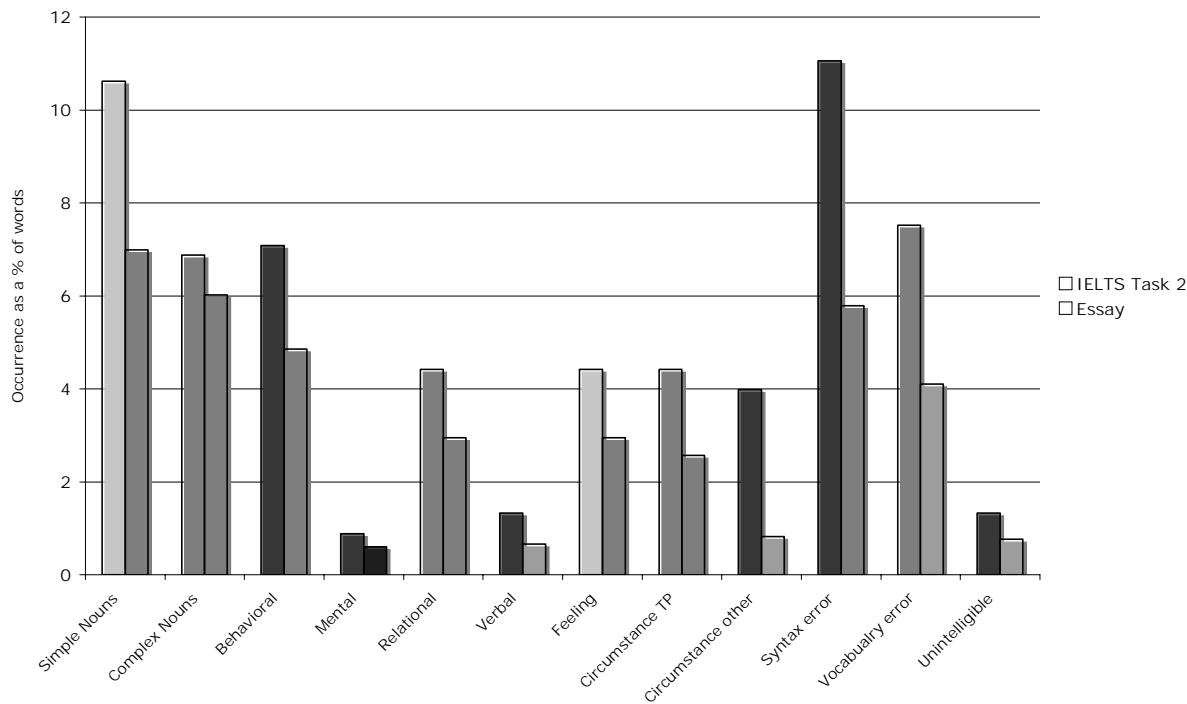
Figure 1: Sarah writing: Transitivity
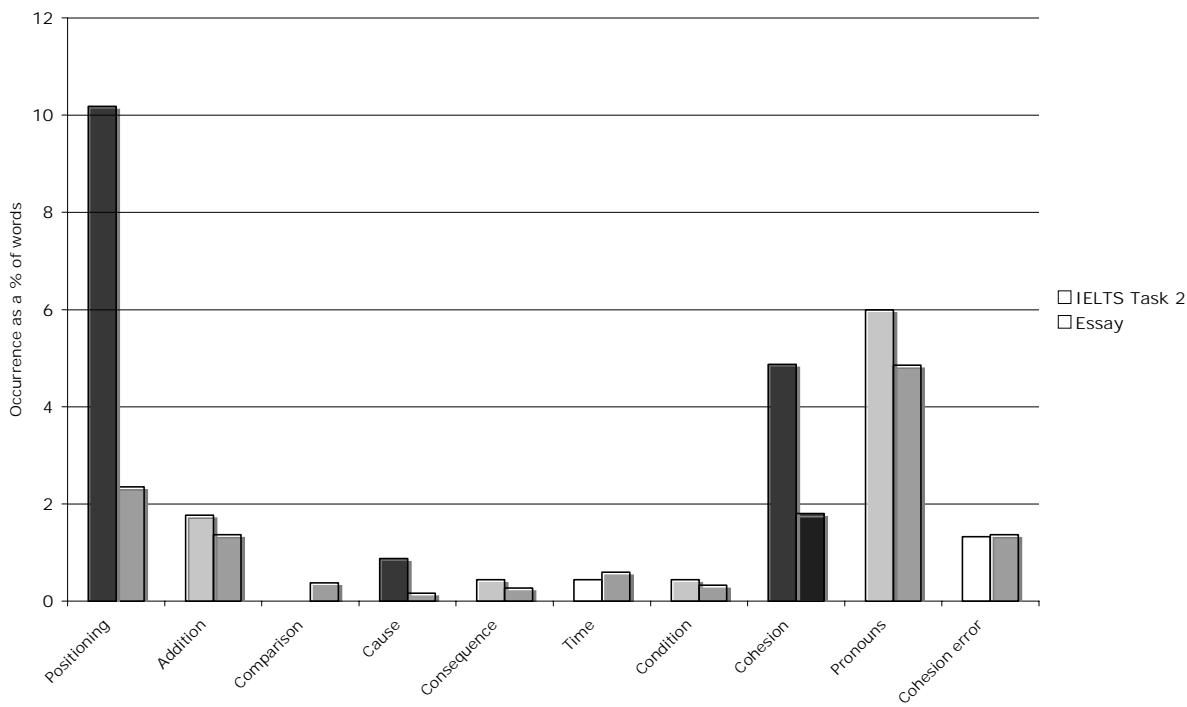
Figure 2: Sarah writing: Positioning, logic and cohesion
There is far greater linguistic complexity in the academic essay (see Table 4), however, there is a decrease in reporting verbs and language in the essay, thus an important aspect of the task - to attribute content knowledge appropriately - is not addressed. Sarah contextualises information to a greater degree in the IELTS task than in the academic paper, where there is approximately a third less information about time and place, and far less information about extent, manner, cause, means, role, or condition.
| Task 1 | Task 2 | Essay | |
|---|---|---|---|
| No. of sentences | 10 | 17 | 86 |
| Complexes > 2 clauses | 0 | 0 | 17 |
Table 4: Sarah writing - linguistic complexity: Clause complexes
Overall there appears to be significantly less use of cohesive language in the essay (Figure 2). Moreover, particular types of logic are represented by the limited use of one or two markers (eg Cause - because and because of). There is overwhelmingly more positioning language delivered in the IELTS Task 2 than in the academic essay, delivered equally through modal finites, mood adjuncts and Appraisal language.
Sarah is displaying a 45% increase in accuracy of syntax and vocabulary use in the essay task as compared to both Tasks 1 and 2 Writing in the IELTS test. There are also fewer incidents of completely unintelligible language. However, there is slightly more error in cohesion, and there are large parts of the paper where relevance of information is unclear, either due to the type of information included or problems in expressing its relationship to the task (see Figure 2).
Overall, the findings demonstrate that some areas of language in the IELTS task are more varied, particularly cohesion and positioning, but generally in the academic task there is increased complexity of word groups and clause complexes, and accuracy is greatly improved. Therefore, language behaviour in the essay is at a slightly more developed level of proficiency. However despite this, the academic task lacks some important aspects of content, positioning, organisation and cohesion, and the task fulfilment is borderline, as Sarah’s text does not adequately address the question.
3.1.2 Sarah: speaking
In one of the spoken interactions examined here, Sarah was required to collaboratively analyse and plan a writing task in class. The other interaction required her to discuss the future in a language support subject.

Legend: IELTS Interview; Discussion 1; Discussion 2
Figure 3: Sarah speaking: Transitivity
The first discussion mirrors a possible topic of the IELTS Speaking interview (predicting future world development). Compared with the IELTS interview, language is less complex or varied, although information is more contextualised, particularly in time and place. In terms of logical organisation, Sarah uses nearly half the Addition, but in all other categories shows increased use of organisational markers and cohesion language, and there is two and a half times as much positioning language as in the interview. Most interestingly, despite a slightly increased amount of inaccuracy in syntax and cohesion error, unintelligible instances of language use has dramatically decreased. Thus although there is an increased rate, the complexity or severity of error is less (Figures 3 and 4).
It can be seen in Figure 3 that in the second discussion, which requires Sarah to cope with a much more exploratory and unpredictable topic, the planning of an assignment, there is more varied and complex language, more use of other types of rhetorical organisation (comparison, cause, consequence and condition), and far more use of other cohesive strategies (Figure 4). Although there is more syntax error compared to the IELTS interview, the relative proportion of syntax to vocabulary error shows an increase in appropriate vocabulary use, with a similar level of error in cohesion across the texts
(Figure 4). However, Discussion 2 shows the greatest amount of unintelligible language, and this is partly due to grammar and vocabulary inaccuracy in longer turns, but also to a high incidence of problems with pronunciation and clear speech production in the more complex task.
In the first sample from the academic setting, spoken language behaviour is more developed than that of the IELTS interview. However the second text, although demonstrating increased complexity, falls significantly below in terms of accuracy and intelligibility. This task corresponds in difficulty more closely to the other types of academic tasks encountered by Sarah, and overall the language produced appears to be at a slightly lower level of proficiency than that spoken in the IELTS interview. In terms of task completion, she was not able to adequately address the second task within the time-frame of the class session as a large proportion of time was spent on processing the task, defining terms and concepts, and little time was spent planning writing approaches.

Legend: IELTS Interview; Discussion 1; Discussion 2
Figure 4: Sarah speaking: Positioning, logic and cohesion
3.2 Simon
Simon was in his first semester of study of a Graduate Diploma in English as an International Applied Language studies at Melbourne University Private. The texts examined are taken from two subjects related to research methods and skills.
3.2.1 Simon: writing
The first written text is a comparative review requiring Simon to demonstrate language and academic research skills in a critical integrated evaluation of two academic texts from the literature on Media Studies, the area of Simon’s planned doctoral degree. The second task is a longer literature report for a research project that required the integration and evaluation of at least six academic texts - an extension of the first task.

Legend: IELTS Task 1; IELTS task 2; Comparative; Lit Report
Figure 5: Simon writing: Transitivity
Complexity of sentences is fairly similar in the academic tasks but slightly higher in Task 2 IELTS (see Table 5). Figure 5 shows that, compared with the Task 2 text, the shorter comparative review is less complex in terms of word groups. The use of mental verbs (eg consider, know) shows an interesting pattern with behavioural verb meanings being used for mental activities (eg explore basic issues of different theoretical views, map paradigms, examine ideas). There is less verbal and reporting language in the two academic tasks, decreasing with increased task length and complexity. As in Sarah’s text, there is a striking lack of attribution in two tasks that directly call for acknowledgement and integration of sources.
Simon produces a slightly wider range of language use for the different categories of logical organisation than is demonstrated in his Task 2 writing (eg Cause - caused by, due to, driven by; Consequence - leads to, as a result of, therefore) with fewer repetition of markers. Cohesion language is slightly lower in the comparative review, but significantly higher in the literature report text. Taking logical organisation and cohesion language together, overall there is a slightly greater incidence in the IELTS Task 2 text (Figure 6). Interestingly, given the requirements of these task types, there is only slightly more positioning language in the shorter comparison, and significantly less in the longer literature report than exists in the IELTS Task 2.

Figure 6: Simon writing: Positioning, logic and cohesion
Syntax and vocabulary error is lower in the first academic task, but in the second, while inaccuracy in syntax is lower, there are increased problems with vocabulary. In both academic texts, problems with cohesion occur at nearly four times the rate of occurrence in the Task 2 Writing. The comparative review has only slightly fewer incidents of unintelligible language, but in the longer report there is almost double the amount of unintelligibility. This pattern of error in this text seems to indicate that syntax and vocabulary inaccuracy may be more serious (eg word order, incorrect terms) rather than surface (eg article use, word form), and that poor cohesion may contribute less to unintelligibility.
Simon’s texts display problematic language behaviour such as reduced inclusion of positioning in one task that directly calls for this kind of language, a marked increase in unintelligibility in the more complex academic task, and greatly increased problems with cohesion in both academic tasks. However this is balanced by: increased complexity; increased syntactic and vocabulary accuracy; greater use of cohesion language in one text; and increased range and sophistication of verb use. The written academic tasks analysed here are significantly more demanding than those of the IELTS test. Even if overall Simon’s written language behaviour may be considered more developed than that produced in his IELTS tasks, and despite seemingly adequate language behaviour (eg the linguistic ability to make comparisons with reasonable accuracy, to connect complex information, to use positioning language), his academic texts do not successfully fulfil the fundamental task requirement to integrate and evaluate reported sources.
| Task 1 | Task 2 | Review | Literature Report | |
|---|---|---|---|---|
| No. of sentences | 6 | 12 | 29 | 46 |
| Complexes > 2 clauses | 0 | 3 | 8 | 12 |
Table 5: Simon writing - linguistic complexity: Clause complexes
3.2.2 Simon: speaking
In the observed classroom situation, Simon was required to describe a research topic, rationale and plan to his Research Methods lecturer and class in a formal presentation, and to address any questions about this.
Spoken production is relatively complex with a high ratio of embedded clauses in turns, extended clause complexes in very long turns, and complex noun phrases in both texts (eg I work as a trainer an’a a young generation like me is unusual to be a trainer for civil servant to be a trainer mainly for college their age is more than fifty years old / the position head of training board of local government or head of training office). There is greater use of cohesive language, especially relative clauses and pronouns. In the presentation, although there are more problems with cohesion, syntactic and vocabulary accuracy is increased, and there are fewer instances of unintelligible language.

Figure 7: Simon speaking: Transitivity

Legend: IELTS Speaking; Presentation
Figure 8: Simon speaking: Positioning, logic and cohesion
Spoken language behaviour is overall improved as compared to the proficiency denoted by that exhibited in his IELTS tasks. Nonetheless, in this presentation Simon fails to adequately address the task and communicate his research intentions, and so does not fulfil the task requirements. This is not due to inadequate language behaviour, but to issues of content knowledge - in particular, the conventions related to the type of information necessary in describing a research project and the manner of its presentation.
3.3 Jun
Jun was in his first semester of undergraduate Physiotherapy at The University of Melbourne.
3.3.1 Jun: writing
Written texts analysed are two submitted assessment tasks, an essay and an evaluation of a native speaker peer communication with a patient. In interview Jun mentioned that he regularly accesses the university’s academic skills and language support unit (LLSU) to have his assignments checked before submission. The texts examined here were collected after assessment, and therefore had been checked for comprehensibility to some degree.
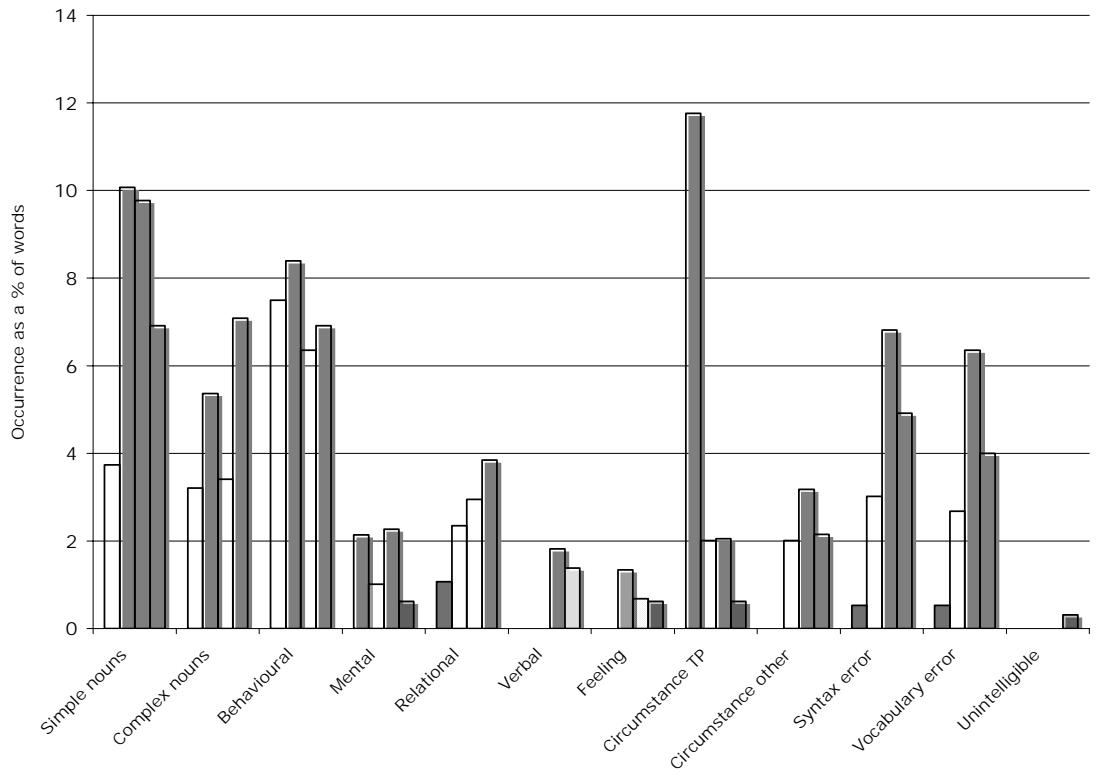
Sentence complexity is particularly high in the IELTS Task 2, where nearly of sentences consist of three or more clauses, as compared to around in the academic tasks (Table 6). The very high use of personal pronouns in the two academic tasks as compared with both IELTS tasks is illustrative of a more personal rather than academic style of writing. It is unclear whether the faculty endorsed this approach, or whether it indicates Jun’s inability to communicate attitude and stance via common academic strategies (Swales & Feak 2003).
The highest level of positioning language occurs in the IELTS Task 2 text (Figure 10) - predominantly through the use of Mood finites (can, may, should). The peer evaluation text contains a slightly lower level of positioning but within this category, there is a particularly high incidence of Appraisal language (eg communicate more effectively, avoid critical mistakes, used appropriately, make a positive relationship), with strong positive and negative Judgement on behaviour and things. This is supported by the highest rate of comparison language of all texts (Figure 10). There is successful communication of a very clear critical voice in this text that is incidental to the highly personal style of writing.
In terms of logical organisation markers, the academic texts show a wider range of use with all types present, whereas the IELTS tasks have less variety. Cohesion language is overwhelmingly higher in the IELTS Task 2; it is reduced in both academic tasks as they increase in length and complexity. The academic tasks have a far higher percent of error in syntax and vocabulary use as compared to both IELTS tasks (Figure 9), and the evaluation task also has a slightly higher level of cohesion problems (Figure 10). The essay is the only task that has any unintelligible instances of language.
Legend: IELTS Task 1; IELTS Task 2; Peer; Comm skills essay
Figure 9: Jun writing: Transitivity
| Task 1 | Task 2 | Peer Evaluation | Communication Essay | |
|---|---|---|---|---|
| No of sentences | 8 | 16 | 24 | 43 |
| Complexes > 2 clauses | 2 | 7 | 6 | 10 |
Table 6: Jun writing - linguistic complexity: Clause complexes

Legend: IELTS Task 1; IELTS Task 2; Peer; Comm skills essay
Figure 10: Jun writing: Positioning, logic and cohesion
Language behaviour in Jun’s academic writing in some important respects (syntax and vocabulary error, cohesion and academic style) is less proficient than that of the IELTS tasks, despite increased complexity and a clear critical voice in both academic texts. Overall his language production is at a somewhat lower level across the tasks despite marginally greater complexity of the written language produced. The tasks are barely adequate because of a lack of content or depth and limitation of ideas.
3.3.2 Jun: speaking
Jun was observed in a problem-based learning (PBL) tutorial and a practical (Prac) session. PBL sessions require students to: read and analyse information; list key information; identify problems; generate questions; identify learning issues related to the case; identify possible causes for problems (ie hypothesise); give rationales for hypotheses; logically decide between possible hypotheses; decide on the need for further information; report on research; and as part of the group, to map this information (create a mechanism). In the Prac class Jun watched a video on the topic (gait aids), listened to the tutor explain the different types of gait aids, and then, in a group of three, practised teaching a patient how to use a gait aid.
Legend: IELTS Speaking; PBL: broken leg; Prac: Using gait aids
Figure 11: Jun speaking: Transitivity
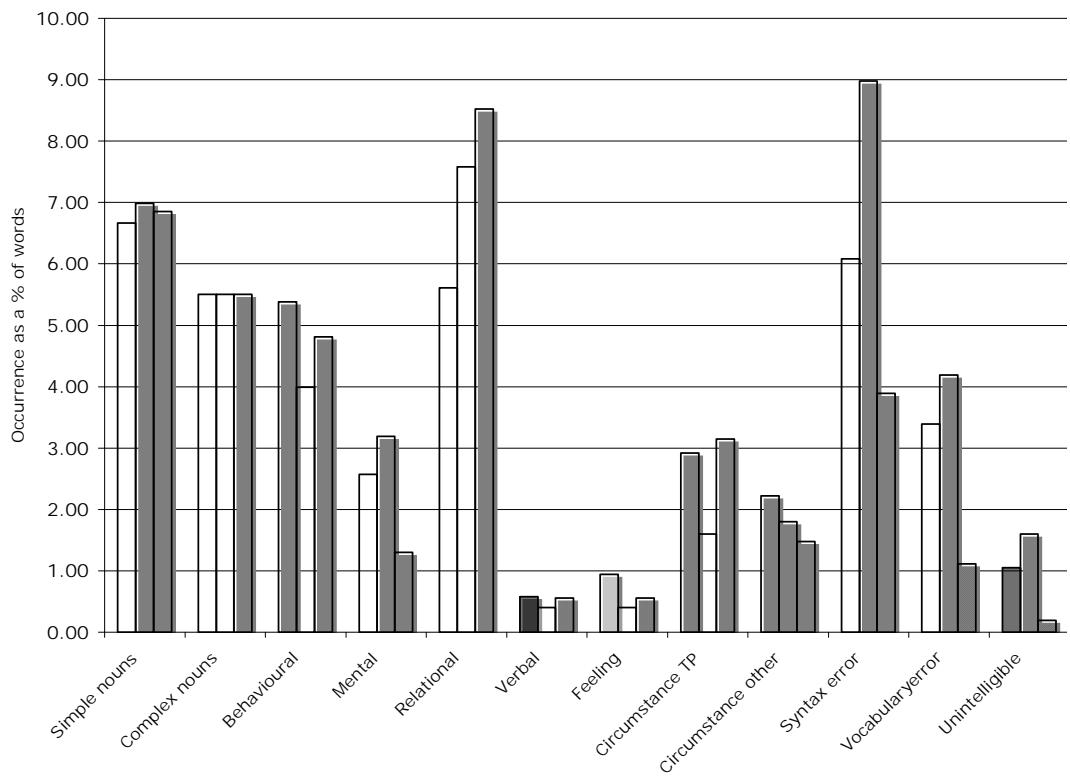
In all spoken texts, there are very few embedded clauses or complexes, and turns are short, with much repetition occurring at a far higher rate than in the IELTS interview. A typical example is:
J: Oh it’s opposite opposite opposite… no no no like this… like this like… eh yeah yeah yeh… oh oh too high!
S1: It’s okay like why is he getting taller… where’s it meant to go?… like up here J: No no no no no no S2: Yeah, it’s meant to be around there
Complexity and range of language is similar in all spoken texts (Figure 11). Incidence of positioning language is slightly higher in the PBL and Prac sessions. Cohesion is similar to the IELTS interview and the PBL session but is far higher in the Prac session (Figure 12). The range of logical organisation varies from text to text. Most notably in the PBL there is no Cause but a high incidence of Comparison and especially Consequence, which occurs at seven times the rate of occurrence in the IELTS interview and 17 times more frequently than in the Prac.
Figures 11 and 12 demonstrate conflicting patterns in the error analysis. In the Prac there is reduced error in syntax, vocabulary and instances of unintelligibility, although there are slightly more cohesion problems than in the IELTS interview. However, in the PBL session, Jun shows increased inaccuracy across all categories, with syntax error occurring at a far higher level (33%) and most notably the

Legend: IELTS Speaking; PBL: broken leg; Prac: Using gait aids
Figure 12: Jun speaking: Positioning, logic and cohesion
Jun is interrupted by peers a number of times in both academic sessions and does not manage to reassert his turn. Listeners have problems comprehending him. In the example below, this is due to inaccurate vocabulary use, but other misunderstandings are caused by Jun’s speech production. All these problems occur in the following social exchange during the prac. (The square bracket symbol - [ - denotes overlap.)
J: I am 29 if I pess (pass) this birthday he he S1: It’s birth… what? J: In th[is S2: [At his next birthday he’ll be 29 SI: When’s your birthday? J: It’s er eighth October. S1: October J: Yeah. At that time I [have S2: [Could I just… see… it looks like the right length, doesn’t it?
Overall, compared to the IELTS interview the spoken language production demonstrated by Jun is at an equal level in the Prac session, but in the PBL context there are clear differences and proficiency is lower. It is difficult to allocate a single overall rating as the differences are so marked. Ultimately there is not enough consistency at a lower level to justify the claim that language behaviour is less proficient, although it is interesting to note that Jun himself in his self-evaluation chose a descriptor of spoken language lower than that allocated by his entry IELTS band score. The language behaviour observed here does present problems for this student in carrying out vocationally oriented speaking tasks in his academic course.
3.4 Nosali
Nosali was in her first semester of Medicine at The University of Melbourne.
3.4.1 Nosali: writing
The written text is a sample of summary notes written prior to and during the PBL session, selected because creating accurate and usable notes in lectures is identified as a challenging writing task by non-native speakers (Bayliss & Ingram 2006). No other subjects in this study produced comprehensible, organised notes that fulfilled their intended function as a summary record of class content.
Linguistic complexity is greater in the PBL notes than in the IELTS tasks (see Table 7), with extremely long complexes of clauses or word groups, with appropriate ellipsis, that build into cohesive and logical units of information. For example:
| Item | Notes |
|---|---|
| Epidermis has keratinocytes | produced in stratum basale most common cell in epidermis undergo mitosis at night protein barrier retaining body tissue fluid |
There is a high incidence of simple nouns and complex nouns in the PBL writing compared with the IELTS tasks and very little pronoun use, indicating lexical load (complex medical terminology) is far higher in the notes. While the IELTS Tasks 1 and 2 demonstrate a wider range of process types, the richness of behavioural verbs in the notes (eg produces, is situated, locates, derived, stimulated, interspace) indicates a broad range and high precision in vocabulary usage.
| Task 1 | Task 2 | PBL notes | |
|---|---|---|---|
| No. of sentences | 10 | 26 | 36 |
| Complexes > 2 clauses | 1 | 7 | 15 |
Table 7: Nosali writing - linguistic complexity: Clause complexes
It is interesting that in these different text types there is a similar degree of positioning (Figure 14). In the IELTS Task 2 Writing, this is delivered through modal finites, but in her PBL notes, Nosali uses all aspects of positioning in fairly equal proportions. Understandably, range of language and methods for logical organisation and cohesion differs greatly due to the task types. However, there are relatively few instances of this in the IELTS tasks, with the exception of Comparison in Task 1, and in the PBL notes this kind of language is substituted by clear organisation in outline form and notation devices such as lines and arrows indicating relationship of information. Syntax error in the notes is 25% of that in the IELTS tasks, but is extremely low in all texts. There is no inaccuracy in vocabulary use in the notes at all and no unintelligible language in any text (Figure 13).
Nosali’s academic writing language behaviour is similar and at times more proficient than that occurring in her IELTS tasks, and she successfully completes the task.

Legend: IELTS Task 1; IELTS Task 2; PBL notes
Figure 13: Nosali writing: Transitivity

Legend: IELTS Task 1; IELTS Task 2; PBL notes
Figure 14: Nosali writing: Positioning, logic and cohesion
3.4.2 Nosali: speaking
Nosali was observed participating in a PBL session and a laboratory prac as part of the subject, ‘An Introduction to Clinical Medicine’. Spoken language from the PBL session is examined here, and PBL sessions in Medicine follow a similar structure and require similar linguistic and cognitive skills to that described for Jun.
Figure 15 illustrates that Nosali’s speaking in the IELTS test and in the academic setting has the same incidence of simple and complex noun groups, and range of verb types. In the PBL session Nosali was largely sharing and verifying accuracy of information, and did no hypothesizing. Understandably, given the differing tasks, there is less pronoun use, a greater presence of relational verbs, and far less contextualization and positioning. There is a similar level of syntax and cohesion inaccuracy in both texts (Figure 16), however it can be seen that there is no vocabulary error in the PBL session, and no unintelligible language in any text.
Overall language behaviour in the academic setting is at an equivalent level to the IELTS interview, and Nosali is addressing the required academic tasks appropriately.

Legend: IELTS Speaking; PBL Sunburn
Figure 15: Nosali speaking: Transitivity

Legend: IELTS Speaking; PBL Sunburn
Figure 16: Nosali speaking: Positioning, logic and cohesion
4.0 DISCUSSION
4.1 Language production
| Writing | Speaking | |||
|---|---|---|---|---|
| SARAH | Essay | Discuss 1 | Discuss 2 | |
| Complexity | + | - | + | |
| Transitivity | = | + | + | |
| Positioning | - | + | - | |
| Organisation | = | + | + | |
| Cohesion | - | + | + | |
| Accuracy | + | =/- | - | |
| Overall language production | = / + | = / - | ||
| Task completion | b | √ | x | |
| SIMON | Comparative review | Literature report | Presentation | |
| Complexity | = / + | + | + | |
| Transitivity | + | + | + | |
| Positioning | + | - | + | |
| Organisation | - | - | + | |
| Cohesion | = | + | ||
| Accuracy | + | - | + | |
| Overall language production | = / + | + | ||
| Task completion | b | X | X | |
| JUN | Peer evaluation | Com skills essay | PBL tutorial | Prac |
| Complexity | - | =/- | - | - |
| Transitivity | =/+ | = | = | = |
| Positioning | + | = | = | = |
| Organisation | + | + | + | - |
| Cohesion | - | - | = | + |
| Accuracy | - | - | - | + |
| Overall language production | = / - | = / - | ||
| Task completion | b | B | b /√ | x |
| NOSALI | PBL notes | PBL tutorial | ||
| Complexity | + | = | ||
| Transitivity | =/+ | = | ||
| Positioning | = | - | ||
| Organisation | = | = | ||
| Cohesion | = | + | ||
| Accuracy | + | + | ||
| Overall language production | = / + | = | ||
| Task completion | √ | √ |
Aspects of language production evaluated as at similar (=), lower (-) or higher (+) levels compared to IELTS Task 2. Task completion evaluated as adequate (√), borderline (b) or inadequate (x)
Table 8: Aspects of language production in academic tasks in relation to the IELTS and task completion
The findings on language production in the four case studies (Table 8) demonstrate that in the academic setting as compared with their qualifying IELTS test, for three students, language production in writing is generally similar or improved, when averaging out variation across tasks. Spoken language production is generally similar, however two of the case subjects demonstrate a lower level of language behaviour in some important aspects of the academic tasks observed. Nonetheless, averaged overall across skills, this analysis reveals that students are mostly using language to the levels exhibited in their IELTS test, and that an IELTS score does generally predict student language production in academic contexts.
4.2 Language behaviour and task completion: writing
Issues are raised with regard to the above finding when correlating student language behaviour to evaluated success in task completion. In three individuals, language production at a micro level similar to that in qualifying IELTS tasks is not necessarily an indicator of overall language adequacy at a macro level or successful task completion. Different aspects of production are impacted by, and have varying effects on, the completion of specific task types. In many written tasks across disciplines, rhetorical organisation, acknowledgement of sources from the field, positioning and use of field specific vocabulary play a key role in successful completion of the tasks (Bhatia 1993; Swales & Feak 2004). Accuracy in syntax and organisation / cohesion were the linguistic factors cited by lecturers as important to written task completion (Bayliss & Ingram 2006). These are found here to be variable across tasks for each student except for the student with the highest overall IELTS rating. However, as noted in Bayliss & Ingram, tutors cited a number of issues beyond language behaviour, including lack of content or depth and limitation of ideas as key factors in the unsuccessful completion of written tasks.
The students demonstrate language knowledge and production to the level denoted by their IELTS ratings, but when required to write in the ‘full context and complexity’ of their course content (Schoener 1992), the written language behaviour of these students is at times unequal to discipline specific academic demands. Factors such as rehearsal, relative predictability of tasks, familiarity with topic types and content areas, and complexity of tasks (Skehan 2003; Ellis 1994, p132) are shown to impact on proficiency of language production. Simon’s written language production is negatively influenced by the cognitive demand of his assignments, even though, with some exceptions, the capacity demonstrated in his IELTS writing is evident in the microanalysis of the academic tasks. The tasks show poor organisation and an absence of appropriate information, despite evidence of linguistic competence in the structures needed to express these ideas. It can be seen that in the comparative task below, despite errors in production, there is comparison and integration of findings and views of the two texts. In the second and more complex task, while minimally present, integrated discussion is not overall successfully addressed, as Simon reverts to a genre he has more experience with (essays), despite demonstrating a capacity for integration in the earlier task. Characteristic chunks are given below.
| Simon: comparative review | Simon: literature review |
|---|---|
| “As can be seen from Beyle, Thad, Ostiek, Donald and Lynch G. Patrick (1996), that journalists have political views associated with this background… Bennet, W. Lance states that bias could occur by many ways, such as driven by conflicting interests or electoral incentives… However, both articles emphasize that a good media-government relations should maintained by positive approach.”“This opinion support Beyle’s et al view.” | “The second cultural paradigm is intentionally searching for meaning of ‘symbolic power’ of media portrayal and access…”“Meanwhile, on the other hand, government always attempt to maintain a positive relationship with media in a good manner for some advantages.”“Besides the possibility of bias from journalists’ background, another thing should be considered is the role of media… (Purvis, 2001)” |
In Sarah’s case, key language behaviours for cohesion of information, accuracy, attribution language, positioning and task completion in the essay are weak as compared with her IELTS Task 2 text. In contrast, practice writing produced in preparation for another IELTS test (Text A), written about two months prior to the academic essay analysed here, has a well-developed level of complexity, appropriate logical organisation and far greater accuracy than much of the essay above (Text B). Illustrative chunks are shown below.
| Sarah: Text A | Sarah: Text B |
|---|---|
| “Marriage is an important process for two lovers who decide to live together, care for each other and share responsibilities. As societies come into new and modern period, more and more people claim that marriage could provide opportunities and protection for people, even though there are many factors that could cause relationship breakdown and divorce.” | “Most teachers asked us to remember vocabularies, grammars and tenses, also educated us that good way for us to learn English. We couldn’t find funs and interests to learn.”“Chinese is worth to Chinese people exploring and protecting. Keeping of cultural ideology need to be start from developing of own language” |
Lesser cognitive demand, a familiar content area, and the rehearsal factor all play a role in her more competent proficiency in Text A. Task type appears to play a key role in determining functional proficiency, proficient language production and behaviour is not the only indicator of success in cognitively demanding and/or discipline specific writing tasks.
Nosali (IELTS Writing 7 and Overall rating 7.5) is the only subject to show both consistently more developed levels of language production and highly effective language behaviour in task completion. In notes produced during one of the observed PBL sessions she organises information visually to produce a concise, functional summary, uses appropriate medical terminology, and also constructs complex sentence structures (Texts A and B below). A total of five pages of notes were produced in the two-hour session, and while these texts do not make the same kinds of demands as an extended essay, it can be seen that the language produced is clearly oriented to the demands of Nosali’s discipline and task.
| Nosali: Text A | Nosali: Text B |
|---|---|
| “* When cells in the body do not have the same genetic make up ie an mosaic, there could be a mutation, which could also be the basis for markation moles. - moles increase rapidly through adolescents - 20-40 moles Sun exposure increases number of moles Ephelides *Sun induced Freckles are associated with non-melanoma and melanoma skin cancers” |
4.3 Language behaviour and task completion: speaking
Spoken requirements faced by students differ in Arts and Biomedical settings, but regardless of discipline, where tasks require new (for the student) approaches to processing, integrating, and expressing information, or new modes of interacting with peers or in simulated or real professional settings, the demands of the spoken tasks far exceed that of the IELTS interview. In academic settings such as PBL tutorials (observed here in two biomedical contexts), the mode of study is largely oral
and a wide range of spoken communicative functions contribute to the successful completion of the PBL task: eg to share medical research and make connections between pieces of information, present and/or summarise patient case information, express hypotheses, reasoning and rationales, discuss and evaluate possible hypotheses, respond to peer or tutor requests (for information, for the application of information, for clarification) and to read out loud. The cognitive demand is high. To demonstrate participation (an evaluated component of the sessions), all students need to evaluate and integrate information ‘on-line’, and then verbally express and discuss the results of this thought. For the second language speakers observed in these settings, a need for longer processing time had an obvious impact on the amount and range of their participation, and this is clearly reflected in the quantity and type of language produced.
The results for the two students evaluated in PBL settings are quite different from one another. Nosali has a band score of IELTS 8 for Speaking and clearly produced language to the same or higher proficiency level as her IELTS interview. Her participation in the PBL process although not extensive, was similar in degree to a number of local student peers in her group, and while she was not observed providing hypotheses, she did demonstrate an ability to integrate, make connections between, and apply medical information into practical clinical situations and to introduce topics. Here is an example:
L: Where do you want to start? (Addressing the group) N: Um, I want to talk about the structure of the skin, and function.
Addressing a peer:
N: And do you want to go into what these cells are… for?
S1: Mm-hm
N: Um, the carasmacites cells are, they ceratine, which is a protein against infection and ceratine, yah… and um to change the
L: Um, do you want to tell them what the ceratine was for?
(Addressing the group and the scribe who is summarising the discussion on the board)
The second student, Jun, entered his course with an IELTS Speaking score of 6, and his language behaviour did suffer in both the PBL tutorial and the Prac classes. In the PBL sessions, Jun benefited from strong previously acquired content knowledge (an undergraduate degree in his first language), and regularly provided information to the group and raised questions. However, he produced higher levels of unintelligible language - one indication of strain. Jun’s tutors commented that, although he contributed more than some local students, his language and speech production made it difficult for even sympathetic listeners to ‘stay tuned’. As illustrated above, there are examples of peers clarifying Jun’s meaning to each other and of social interactions that have a negative impact on his academic (and future professional) performance, eg difficulty building solidarity with peers (negative language, being interrupted by peers who change topics), and his manner of instruction in the patient / practitioner interaction. In terms of successful completion of tasks, tutors also observed that in his first semester Jun was ‘coping’, but they had strong concerns about his ability to function and learn in real clinical settings, both with patients and in collegial interactions - a major future component of the course, essential to professional competence, and highly demanding of spoken language production. This type of comment was repeated about the spoken interaction of other subjects in biomedical degrees participating in this study.
It is of note that the students in PBL settings (Nosali and Jun) rated their spoken ability lower than their actual ratings, and that of observers. Nosali rated her own spoken language behaviour as two band scores below that allocated by IELTS. Based on her interview and that of her tutor, this is an indication of a lack of self-confidence, a wish to function at even a greater level, and possibly the challenge of the PBL approach to study. In fact, her tutor was quite satisfied with her performance in the tutorials. Jun rated himself one band lower. In contrast, the two students in the language/arts courses rated themselves as more competent. Further study of a larger cohort in a range of tasks would be useful to clarify whether increased task complexity consistently leads to reduced levels of confidence and an underestimation of language competence, and the effect this has on student task completion.
Examples of the impact of task complexity on the production of spoken language and interaction in arts/language subjects are provided by Simon’s research presentation text and Sarah’s task planning discussion. In Simon’s case, despite overall positive development in all aspects of spoken language production so that language production is at a higher level than in his IELTS interview, he does not adequately address the task requirements. This is largely due to inadequate and poorly organised content, as illustrated in the text below. By the end of the presentation of his research plan, he had not communicated basic information about specific research questions to be addressed or research methodology. When asked for this information by another student, he noted that this was not his main concern, and the information he did give was inadequate.
| Simon: Presentation (1) | Simon: Presentation (2): question time |
|---|---|
| S: I would like to present my research plan…about ur…mess media’s perception of beaurocracy in Indonesia… and there the basic concept of my research because… there mass media is a private organisation and the government beaurocracy is a government organisation… and… Ah these two kinds of organisation was turn in [inaudible] directions so it’s ah difficult to make them hand in hand…S: Theyr approach of the the … … government stuff is totally different ah from that to what I learned in this aria so I thinks ah… … for myself their approach ah to is commonly not so e e effecteeve because [incomprehensible] forgetting theyr po pow powerful… | Student 1: so the result will come from the previous data you choose or … some data collection in Indonesia or something? What will you do for…[inaudible]?S: for reference?S1: No no not reference… other stuff from reference… except reference, what will you do?S: ah… of course the main difficulty for me is about reference… but ah for my sample eh ah for my methodology ah I will collect the information from the senior staff of media as the data ah ah they have the desk for political sections |
Sarah and her partner spend most of the class time discussing the meaning of different concepts embedded in their task question, and show little capacity during the time allotted to analyse the question in order to plan a writing strategy. There are clear problems with production, although her non-native speaking partner seemed to have little difficulty following her meaning, but more importantly, with processing and addressing the set task. Their lecturer asks questions to guide them towards their task but little progress is made.
Sarah: Discussion 2
Sarah: Mmm… what you confuise?…because the people think we should fair and equal… if you kill one person that person should be punished by the… the law. Lots of people think this is the reason so they shoot the people who has murdered the other people. They also should be incuted (executed) by the government.
S2: Just I thought
Sarah: So you think its…you agree this or not agree?
S2: Just I thought if someone kills… like commit murder it’s that already crime
Sarah: But I think murder also… you have the reason
Thus a complex range of factors - teaching methodology and expectations (Gibson and Rusek 1992, p17 in Feast 2002), student approaches to and interpretation of assignments and tasks (Walvoord & McCarthy 1990, p21 in Zamel 1993), intellectual ability and motivation, as well as orientation to the discourse of the discipline or the professional practice being taught (Bhatia 1993: Swales 1990) - give rise to the difficulties students face, and impact on their ability to successfully navigate tasks.
In terms of recommendations for band score on entry, it is interesting to note that two students with overall proficiency ratings of 6.5 and 5, who achieved their overall rating through strength in receptive language skills (Listening, Reading), are experiencing difficulty in successfully completing more demanding academic tasks, but that this is also true for the student who received a higher Writing score (7) than his overall rating of 6.5, confirming the findings of Cotton & Conrow (1998). Therefore, the relationship between the Writing band score, the overall rating, and success in task completion is unclear from this small group of case studies. It is also interesting to observe that the three students who achieved poor levels of spoken task completion scored one or a half band lower than their overall rating, but the student who performed adequately in all observed spoken tasks scored a half band higher than her overall rating. Further research is needed to shed light on these patterns.
4.4 Limitations of the study and suggestions for future research
This study has a number of limitations. As mentioned above, it would be productive to extend the number of subjects to further explore and clarify the relationship between language ratings on entry and patterns of task completion. Also, focusing on task types by examining a wider range and where possible a larger number of similar task types. For example, presentations delivered by students across faculties and courses would allow a systematic comparison of task genres, requirements and success of completion across disciplines. Although beyond the scope of this analysis, it would also be useful to correlate this kind of study with the academic results each assessed task received. This would be valuable in identifying features of more successful texts and in identifying linguistic strategies of both successful and unsuccessful students.
To facilitate course specific recommendations for proficiency levels, further study is needed to determine: i) the effect of proficiency levels on task completion, and ii) the effect of discipline specific task types on language behaviour.
Finally, it would be useful to carry out a longitudinal study of students identified as having inadequate language behaviour and less successful task completion in their first semester of study, to evaluate effects on task completion at later stages of study.
5 CONCLUSION
This study draws on an approach to analysis of grammatical, lexical and textual features based in systemic functional grammar and genre analysis. It explores actual language production in academic settings to evaluate language behaviour in relation to task completion as compared to that produced for qualifying IELTS ratings.
Entry-level IELTS ratings do broadly predict students’ capacity for language production in academic settings. However, when examining language behaviour by these four individuals in different task types across spoken and written genres, three of these students experience difficulty in language and content with increased complexity of academic demands. Aspects of language behaviour and successful task completion do deteriorate.
It is possible that the overall level of proficiency indicated by the entry IELTS rating is not adequate for the demands faced by the students in this study, and it is of note that the one student with IELTS productive skills ratings of 7 (Writing) and 8 (Speaking) is showing the least stress and highest success at task completion of the students in the biomedical courses facing similar academic demands.
However, different proficiency levels on entry are not the only factor determining success, and it is questionable whether additional time spent achieving a higher level of proficiency would be useful without this development taking place in relation to the particular task and discourse demands of specific disciplines.
There are a number of implications for institutions:
- Rather than requiring just an overall proficiency rating, it may be appropriate for faculties to additionally specify particular proficiency levels for specific productive skills areas essential to the discipline, as is currently recommended in the IELTS handbook (IELTS 2005).
For example, a higher rating for Speaking would be appropriate in vocationally-oriented courses clearly dependent on oral communication, or increased proficiency in the Writing score for research-oriented postgraduate courses, or in language dense degrees such as education or language/arts. This is already a requirement in a few university departments.
Additional faculty-administrated targeted diagnostic testing could gauge weaknesses and plan subsequent support for either pre-course or on-going language based academic support in context. An example of this type of assessment is that conducted by Latrobe University’s Faculty of Science, where students are asked to write an essay on a science-related topic to identify a need for referral to the university’s Language and Learning Skills Unit (O’Connor 2005).
-
There is a very strong case for faculty-specific language and learning support for second language speaking students who have successfully gained entry to courses. Concurrent language orientation to discipline-specific discourse genres and task types on an ongoing basis is one way to support second language learners to higher levels of language performance for successful task completion. This can provide targeted language development that is explicitly needs based. All first language students go through a period of induction and orientation into the discourse of their discipline, often intuitively. This intuitive acquisition is a harder task for the second language learner, who however can become a more successful student with ongoing explicit instruction into this discourse and academic expectations. An administrative and academic culture that supports this learning is essential to its successful implementation.
-
This study indicates that for written tasks, students particularly require focused support in i) task analysis, ii) task oriented organisation and cohesion and iii) integration and evaluation of information and the linguistic means by which these are communicated. Support for spoken tasks needs to be context specific and simulate the demands of academic and/or professional settings.
References
- Ballard, B and Clanchy, J, 1992, Teaching Students from Overseas, Longman Cheshire, Melbourne
- Bellingham, L, 1993, ‘The relationship of language proficiency to academic success for international students’, New Zealand Journal of Education Studies, vol 30, no 2, pp 229-232
- Bhatia, Vijay K, 1993, Analyzing genre: language use in professional settings, London
- Brazil, D, 1995, A Grammar of speech, Oxford University Press, Oxford
- Bygate, M, 1996, ‘Effects of task repetition: Appraising the developing language of learners’ in A framework for task-based learning, ed J Willis, Longman, London
- Corder, SP, 1971, ‘Idiosyncratic dialects and error analysis’ International Review of Applied Linguistics, vol 5, pp 161-169
- Cotton, F and Conrow, F, 1998, ‘An investigation of the predictive validity of IELTS among a group of international students studying at the University of Tasmania’ in English Language System Research Reports, 1998, vol 1
- Cotton, F and Hackett, P, 2003, ‘Critical thinking and evaluative language use in academic writing: a comparative cross-cultural study’, paper presented at Developing Academic Literacies BALEAP Conference 2003
- Dooey, P., 1999, ‘An investigation into the predictive validity of the IELTS test as an indicator of future academic success’, paper presented at the Teaching in the Disciplines/Learning in Context, proceedings of the 8th Annual Teaching Learning Forum, University of Western Australia, pp 114-118
- Elder, C, 1993, ‘Language proficiency as a predictor of language performance in teacher education’, Melbourne Papers in Language Testing, vol 2, no 1, pp 68-87
- Eggins and Slade, D, 1997, Analyzing Casual Conversation, Cassell, London
- Ellis, R, 1994, The Study of Second Language Acquisition, Oxford University Press, Oxford
- Feast, V, 2002, ‘The impact of IELTS scores on performance at university’, International Education Journal, vol 3, no 4, pp 70-85
- Fitzgerald, H., 2003, How Different Are We? Spoken Discourse in Intercultural Communication, Multilingual Matters, Clevedon
- Kirkpatrick, A, 1993, ‘Information sequencing in modern standard Chinese’, Australian Review of Applied Linguistics, vol 16, no 2, pp 27-60
- Halliday, MAK, 1994, Introduction to Functional Grammar, second edition, Edward Arnold, London
- Martin, J and Rose, D, 2003, Working with Discourse: Meaning beyond the clause, Continuum, London
- McCarthy, M, 1998, Spoken Language and Applied Linguistics, Cambridge University Press, Cambridge
- O’Connor, E, 2005, ‘Writing, identity and ways of knowing in science’, paper presented at the 30th Congress of the Applied Linguistics Association of Australia, 25-28 September 2005, Melbourne
- Schoener, W., 1992, Were they prepared? College ESL students in mainstream classes, MATSOL Conference, Boston
- Skehan, P, 2003, ‘Task-based instruction’, Language Teaching vol 36, pp 1-14
- Swales, J and Feak, C, 2003, English in Today’s Research World, Ann Arbor, University of Michigan Press
- Swales, J., 1990, Genre Analysis: English in Academic and Research Settings, Cambridge University Press
- Walvoord, BE and McCarthy, LP, 1990, Thinking and writing in college: a naturalistic study of students in four disciplines, NCTE, Urbana, Illinois
- White, P., 1991, The Appraisal Framework, accessed June 2003 from http://grammatics.com/appraisal
- Zamel, V, 1993, ‘Questioning academic discourse college’, ESL, vol 3, no 1
APPENDIX 1: CODING SAMPLES
Simon - speaking: Research presentation
… I think ah… this is mass media [drawing on white board]… uh
they have ah … certain perceyshuns (perceptions) about … ah beaurocracy…
an’ we saw the media conduct a public discoorse (discourse) through their ah through their medium… an’ this is the media in five NGOs for their visions… an’ many more or [incomprehensible two words] an’ this is very intense ah involve in this in this course…
| T | CI | Agent/Subject | Participant | Action | Say / Report | Mental | See | Feel | Relational [be/ have] | Adjunct Circum | Modal | Position Appraise | Syntax error |
|---|---|---|---|---|---|---|---|---|---|---|---|---|---|
| 10 | 89 | I | think | ||||||||||
| 90 | This mass media | is | |||||||||||
| 91 | They | certain perceyshuns | have | about ah beaurocracy | |||||||||
| 92 | We | saw | |||||||||||
| 93 | The media | a public discoarse | conductX | through their medium | SVA | ||||||||
| 94 | This | The media | is | in five NGOs for their visionsX | |||||||||
| 95 | many more | ||||||||||||
| 96 | [incomprehensive] | ||||||||||||
| 97 | This | is | very intense | ||||||||||
| 98 | involve | in this in this course |
| T | CI | Exp/ vocabulary Error | Ellipsis Error | Cohesion Coherence | Add | Compare | Cause Reason | Consequence | Time | Condition | Conversation Marker | Unintelligible Pronunciation |
|---|---|---|---|---|---|---|---|---|---|---|---|---|
| 10 | 89 | ah | ||||||||||
| 90 | this | uh | ||||||||||
| 91 | Ah ah | P | ||||||||||
| 92 | ‘an | ah | ||||||||||
| 93 | ah | |||||||||||
| 94 | Exp | an’ | ||||||||||
| 95 | an’ | |||||||||||
| 96 | or | U | ||||||||||
| 97 | this | an’ | ah ah | |||||||||
| 98 |
Jun - writing: Communication skills essay
“Nowadays many health science students consider learning communication skills as an important training because good communication between patients and therapists provides more correct patient evaluation. One of the most effective ways of learning clinical communication skills is the self evaluation of their own interview.”
| P | S | CI | Agent/Subject | Participant | Action | Say / Report | Mental | See | Feel | Relational [be/ have] | Adjunct Circum. | Modal | Position Appraise | Syntax error |
|---|---|---|---|---|---|---|---|---|---|---|---|---|---|---|
| 1 | 1 | 1 | Many health science students | Consider | ||||||||||
| 2 | communicatio skills | learning | asX an important training X | asX (to be) | ||||||||||
| 3 | Good communication between patients and therapists | more correct patient evaluation | provides | more correct | ||||||||||
| 2 | 4 | One of the most effective ways of learning clinical communication skills | theX self evaluation of their own interview | Is | arts/pl verb form |
| P | S | CI | Expl/vocabulary error | Ellipsis error | Cohesion Coherence | Add | Compare | Cause Reason | Consequence | Time | Condition | Unintelligible |
|---|---|---|---|---|---|---|---|---|---|---|---|---|
| 1 | 1 | 1 | nowa-days | |||||||||
| 2 | MW (part of) | |||||||||||
| 3 | because | |||||||||||
| 2 | 4 |
Author biodata
Andrea Paul is a lecturer in the Centre for the Advancement of Learning & Teaching for the Faculty of Medicine and Health Sciences at Monash University, Melbourne. She provides language and communication skills support to students in the clinical years of the Bachelor of Medicine / Bachelor of Surgery degree. Her research interests include: the application of systemic functional linguistics to inform the teaching of language/communication skills in discipline specific contexts; the relationship between discourse features and their effect on social, professional and academic interaction; and the relationship between text and visual images in the construction and decoding of meaning. Andrea has worked as an ESL/EFL teacher in various countries, and in a range of institutions and programs, including a secondary immersion program in Japan and postgraduate language development university courses in Australia.