
Exploring the speaking construct in academic settings in a digital age
Official IELTS research report on IELTS Test - Speaking; Impact and Washback - Test preparation; Technology; Test delivery, published in 2023.
Abstract
This study explored language functions and skills utilised in technology-mediated academic speaking contexts, which is timely given the increasing prevalence of digitally-mediated communication in higher education settings and the recent introduction of IELTS Indicator featuring a video-call mode in the Speaking Test.
Using an embedded mixed-methods approach, the research involved:
- language function analysis of spoken communication and simultaneous written chat contributions in online taught classes and supervision meetings
- thematic analysis of students’ and lecturers’ understandings of distinctive features of online academic speaking and what constitutes successful online speaking interaction in those contexts.
We analysed a total of over 40 hours of recordings, consisting of 17 video-recorded classes from four undergraduate and postgraduate units in an Australian University, and 23 video/audio recordings of online PhD supervision meetings from a UK university. This was followed by the administration of a questionnaire and semi-structured interviews with selected participants. In order to examine the construct of online academic communication, we adapted O’Sullivan et al.’s (2002) language function checklist for our purposes.
Following the identification of language functions and skills observed in real-life online academic settings, we explored the synergy between the functions observed in online teaching and learning contexts and those elicited in the video-call IELTS Speaking Test (Nakatsuhara et al., 2021). Analyses of questionnaire and interview data helped us understand the skills perceived to be important for successful online interaction.
The report concludes with a discussion on the multimodal construct of speaking in digitally-mediated academic contexts and the ways in which the findings of this study can be useful in informing the future development of IELTS Speaking Test tasks so that they remain representative of the reality of academic speaking in the digital age.
Author biodata
Fumiyo Nakatsuhara
Fumiyo Nakatsuhara is Professor of Language Assessment at the Centre for Research in English Language Learning and Assessment (CRELLA), University of Bedfordshire, UK. Her main research interests lie in the nature of co-constructed interaction in various speaking test formats, the impact of test-taker characteristics on test performance, task design, rating scale development, and the relationship between listening and speaking skills. She has carried out a number of international testing projects, working with ministries, universities and examination boards. As the PI of the British Council’s Future of English project, Digitally-mediated EMI communication in higher education classrooms: Transforming evidence to practical resources, she is currently leading an international team involving four other institutions: Reading University UK, Reading University Malaysia, UCL, and Waseda University Japan.
Lyn May
Lyn May is an adjunct Senior Lecturer in TESOL at Queensland University of Technology (QUT). Her research interests include the assessment of L2 speaking, English for academic purposes (EAP), and learning-oriented assessment. Lyn has published widely on research projects in these areas in journals including Assessment in Education: Principles, Policy & Practice, Language Testing, and Language Assessment Quarterly.
Nahal Khabbazbashi
Nahal Khabbazbashi is Senior Lecturer in Language Assessment at the Centre for Research in English Language Learning and Assessment (CRELLA), University of Bedfordshire. Her main research interests are the assessment of speaking, the use and impact of technology in assessment, multimodal communication, and the effects of test-taker related variables on performance. Before joining CRELLA, Nahal worked as Senior Research Manager at Cambridge English.
1 INTRODUCTION
In addition to recent advances in computer technologies and increased access to high-speed internet, the COVID-19 pandemic has significantly altered the way we communicate. During pandemic lockdowns in many countries, work and spoken communication with friends and extended family were often carried out through video-conferencing applications including Skype, Zoom and WhatsApp. The impact of COVID-19 meant that online speaking became essential for professional and personal communication. In educational settings online learning became the only way to access formal education in many countries in the initial response to COVID-19 through lockdowns in 2020, during which approximately 90% of learners at all levels of education internationally were impacted by closures (UNESCO, 2020).
The recent growth in distantly delivered tuition and study programs is phenomenal. According to the Complete University Guide in the UK, “[m]ore than 270,000 undergraduate students are taking their first degrees via distance learning, together with some 108,000 postgraduate students” (Hubble & Bolton, 2021). In the Australian context, the Australian Government Department of Education Skills and Employment documented that in 2020 there were 330,100 students (20.3% of the total university cohort) studying entirely in external mode (i.e. distance mode), and a further 308,657 students (19% of the total university cohort) studying in multi-modal mode, meaning that at least one unit of study was undertaken in internal mode and at least one unit of study was taken in external mode (https://www.dese.gov.au/higher-education-statistics). Here, it should be noted that there are a variety of types and names for the technology-mediated study modes offered as an alternative to the traditional face-to-face classroom teaching, and they may be called external, online, blended, distance modes and so on.
In this surge in demand for distance-learning taught and research courses at the university level, particularly in response to the ongoing impact of COVID-19 and the pivot to online teaching and learning, recent advances in video-conferencing technology have been very beneficial in enabling students and tutors to engage in successful face-to-face communication via computers and mobile devices. This has circumvented the need for physical proximity within the same classroom while also overcoming the disadvantages of early distance learning courses where students reportedly felt isolated due to limited interaction with tutors and peers. Outside the university context, video-conferencing has also been playing a significant role in language education; for example, video-conferencing has been incorporated into large-scale national education projects such as the Plan Ceibal en Ingles program in Uruguay, which provides English lessons via video-conferencing to over 80,000 children in Uruguayan public schools (www.britishcouncil.uy).
While the use of digital technology was already a clear trend in language testing prior to the pandemic, the need for alternative, digital solutions has led to the swift development and operationalisation of at-home testing options by a number of national and international examination boards (e.g., Kremmel & Isbell, 2020), including IELTS Indicator, which has a video-conferencing speaking component, launched in April 2020. As discussed in Section 2.3 below, the video-conferencing version of the IELTS Speaking Test was extensively researched before the launch of IELTS Indicator as an alternative mode that could enhance the accessibility of the test to those who live in geographically remote or politically unstable areas where it is logistically complex to carry out the current face-to-face IELTS Speaking Test on a regular basis (e.g., Nakatsuhara et al., 2017, 2021). Research suggests the potential of the videoconferencing speaking test to embrace the speaking construct unique to online speaking communication in English for Academic Purposes (EAP) in terms of the enhanced use of negotiation of meaning (see Section 2.3).
In such contexts, the new section on online interaction introduced in the CEFR Companion Volume (Council of Europe, 2018) becomes more relevant than ever. The Companion Volume indeed acknowledges that online communication has its own unique attributes and indicates that perhaps slightly different skill sets are necessary for successful face-to-face and online speaking interactions (ibid., p.84). However, as will be detailed in Section 2.1, studies into the EAP speaking construct to date have not offered insights into the nature of speaking skills required in technology-mediated academic settings and this is where we have identified a gap in research that our study aims to address. Therefore, in order to contribute to this discussion which has direct relevance to IELTS Indicator and the future of the IELTS Speaking Test, this research investigates speaking skills required for academic degree courses delivered by digital technologies and explores the extent to which the video-conferencing-delivered mode of the IELTS Speaking Test could embrace the emerging speaking construct required in academic settings in this digital era.
2 BACKGROUND OF THE RESEARCH
This section consists of three parts. In Section 2.1, we first review the literature on EAP teaching and assessment as well as university website resources to identify the types of speaking skills and activities that are considered important in academic settings and examine the extent to which these skills and activities are represented in the IELTS Speaking Test (examples of early research into the necessary speaking skills at university level in the UK and US higher education contexts can be found in Weir (1983) and Ferris (1998), but they are outside the scope of this review here). This is followed by more recent studies on the impact of COVID-19 on the provision of both EAP and university courses, highlighting changes in assessment practices that ensued (Section 2.2). Section 2.3 then reviews research that examined the validity and feasibility of the experimental video-conferencing version of the IELTS Speaking Test.
Before engaging in the discussion of comparing the IELTS Speaking Test against an academic construct, it is worth noting that the IELTS Speaking Test was not developed to assess only academic speaking skills. From its inception in 1989, it was developed to “measure general proficiency in speaking…to interact in social, survival and training or academic contexts without focusing specifically on technical or academic features of the language” (Ingram & Wylie, 1997, p.14), and this position has been maintained in the revised IELTS Speaking Test launched in 2001. However, given that over 75% of the IELTS candidates take the Academic Module rather than the General Training Module1 , we can argue with confidence that an academic context is one of the most important contexts for which IELTS Speaking scores are often used to make inferences about university applicants’ speaking proficiency. This suggests that it is essential for the IELTS Partners to keep under constant review the extent to which the IELTS Speaking Test reflects the kinds of speaking skills and activities that are involved in academic settings, and this research aims to help ensure that the test is informed by the most up-to-date definitions of the speaking construct.
2.1 Speaking in academic settings and IELTS Speaking
Kim (2006) explored the views of 70 East Asian graduate students in the US regarding the most common oral activities in academic classrooms. For this group of predominantly arts and humanities students, whole-class discussions, asking questions during class and engaging in small-group discussions were the most frequently common activities while making oral presentations was viewed as the most important speaking skill for academic success in postgraduate courses.
- In 2019, the split between the IELTS Academic and General Training candidates was 77% and 23% respectively (https://www.ielts.org/forresearchers/test-statistics/ test-taker-performance)
In complementing the findings of Kim (2006) and several other earlier studies which were primarily informed by surveys, more recent studies have employed classroom observations to provide insights into speaking activities that actually take place in academic settings. Within the Australian higher-education context, Ingram and Bayliss (2007) identified group discussions/tutorials, oral presentations, and one-to-one meetings as the language tasks most common to the majority of disciplines and levels of study. In their analysis of transcripts from international students’ (N=28) participations in group discussions, the authors found that the participants spent the majority of the allocated time attempting to clarify and confirm with one another, often failing to complete the assigned discussion tasks in the given time.
Particularly relevant to the current research is Ducasse and Brown’s (2011) comparison of language functions observed in real-life group discussions in academic settings and those elicited in the IELTS Speaking Test. A total of seven classes across seven disciplines were observed in an Australian university and impressionistic judgments were made regarding the frequency of occurrence of different language functions using a checklist modified from O’Sullivan, Weir and Saville’s (2002) observation checklist. From the list of 16 functions, only seven were jointly observed in classrooms and in the IELTS Speaking Test sessions: providing information/opinions, supporting opinions, agreeing, modifying, asking for information/opinions, requesting elaboration and negotiating meaning. There was a noticeable absence of functions related to managing interactions such as initiating and changing topics in the IELTS Speaking Test (see also Table 1).
Table 1: Observed functions in group discussions in class and IELTS Speaking Test sessions (taken from Ducasse & Brown, 2011, p.14)
| Function type | Function | Frequency in class (1=infrequent, 5=very frequent) | Observed in IELTS Speaking Tests? |
|---|---|---|---|
| Information | Providing information, ideas or opinion | 5 | X |
| Information | Supporting own ideas or opinions | 5 | X |
| Information | Elaborating own ideas or opinion | 1 | |
| Information | Suggesting | 4 | |
| Interaction | Challenging ideas | 3 | |
| Interaction | Justifying/providing support for other | 2 | |
| Interaction | Agreeing/disagreeing | 4 | X |
| Interaction | Qualifying/modifying | 1 | X |
| Interaction | Persuading | 2 | |
| Interaction | Asking for information, ideas or opinion | 4 | X |
| Interaction | Requesting elaboration/justification | 1 | X |
| Interaction | Elaborating/modifying others’ ideas or opinion | 3 | |
| Interaction | Negotiating meaning | 5 | X |
| Interaction Management | Initiating | 1 | |
| Interaction Management | Changing topic | 1 | |
| Interaction Management | Concluding an argument/decision | 2 |
Brooks and Swain’s (2014) study of university students’ use of language in the TOEFL iBT Speaking Test compared to real-life settings both inside and outside classrooms revealed asking questions as a function that was more frequently observed in non-assessment settings. Student-initiated functions such as asking questions, asking for clarifications/ confirmation, and challenging (an argument) were also found in Kettle and May’s (2012) observations of lectures and tutorials in a first-year undergraduate business course at an Australian university. A review of assessment task guidelines did not show any explicit guidelines for oral activities although ‘active participation in discussion with peers and tutors’ was viewed positively in contributing to the successful completion of tasks.
Lastly, Nakatsuhara et al.’s (2018) review of a selection of university website resources in relation to speaking demands in academic settings revealed ‘presentations, seminar discussions, interviews (e.g., viva voce examination) and social interactions’ as the four main types of speaking activities with specific skills/functions associated with the different types of activities.
2.2 Online teaching and assessment accelerated by the pandemic
The studies reported thus far took place prior to COVID-19 lockdowns that began in 2020. The advent of the pandemic resulted in profound and sudden changes to teaching, learning, and assessment, with a pivot to online learning and assessment in all areas of formal education. Impacts on teaching, learning and assessment in EAP courses (Bruce & Stakounis, 2021), teaching and learning in university contexts (Kemp et al., 2021), and university English language entry examinations (Isbell & Kremmel, 2020; Ockey, 2021) are of relevance to the current study.
A study on teaching, learning and assessment during the initial move to online EAP classes in the UK from March to September in 2020 was undertaken by Bruce and Stakounis (2021). The enforced move to remote learning raised concerns around connectivity, student and teacher facility with digital technology, and student interaction and engagement in online learning. Despite these issues, teachers also reported that they had discovered new ways of developing and adapting materials and communicating with students in the online space and, in doing so, had enhanced their teaching skills. The impact on assessment was initially felt in terms of concerns regarding the security and reliability of tests and assessment tasks delivered online. However, as management and systems became more adept at dealing with these issues, there was a noticeable shift in some EAP providers towards more integrated assessment tasks, including speaking tasks that incorporated interactive listening, and portfolios. These new assessment tasks were seen as more meaningfully reflecting context and enabling a focus on process, thus enhancing authenticity and opportunities for feedback. While video-conferencing applications such as Teams and Zoom enabled the synchronous face-to-face assessment of speaking, internet connectivity and bandwidth posed logistical problems for students in some countries.
Student perceptions of online learning through Zoom in the Australian university context were elicited through open-ended surveys by Kemp et al. (2021). They found that approximately two-thirds of students preferred face-to-face classes, with students reporting that most of their peers were not talking or engaging during the online classes held via Zoom. Issues that were identified by students included the need for academics to understand the affordances of technology and to plan for teaching specifically through Zoom. The researchers argued that student engagement in the online learning context needed to be redefined and that it can no longer be assumed that only ‘active speaking with cameras on’ constitutes engagement. They concluded that effective communication in Zoom classes could also include the use of emojis, hand raising, and comments in the chat box, as these were ways of students engaging in the online learning space.
The closure of universities and language testing centres meant that language proficiency tests needed to be accessible through at-home versions. A review of seven at-home proficiency tests by Isbell and Kremmel (2020) focused on issues of reliability, validity, accessibility, and technology requirements. Their review pointed to the opportunity for developers of high-stakes online language tests to offer more accessibility and flexibility, including modular testing and availability through mobile devices. They argued for content validity to be at the forefront of future design, which could “potentially allow for more interactivity, multimodality, and more authentic representations of today’s communication and target language use domains” (2020, p.616).
A special issue of Language Assessment Quarterly edited by Ockey (2021) featured the experiences of several higher education institutions as they responded to COVID-19 lockdowns and in most cases had to move standardised admission tests proctored through university language centres into online at-home tests. The concerns of test security and accessibility were foregrounded, with the need for technological support for candidates as they navigated unfamiliar digital platforms also highlighted. The impetus for change generated opportunities for innovation through expanding the construct of speaking assessment to include interactional competence in the newly developed Temple University International Teaching Assistant (ITA) Test (Wagner & Krylova, 2021). The previous standardised speaking test was semi-direct and the innovation of developing a direct speaking test delivered via Zoom was designed to elicit evidence of four L2 speaking competencies: functional, sociolinguistic, discourse and linguistic. The impact on reliability, practicality and validity is currently being analysed, with the inclusion of opportunities for candidates to demonstrate features of interactional competence and the creation of more authentic speaking tasks for the ITA context emerging as strengths. As online tests move to the incorporation of video-mediated assessments that can elicit interactional competence, Muhammad & Ockey (2021) point to the need for further research to ascertain whether these online assessments are equivalent to face-to-face speaking tests or actually creating a new language ability construct (the issue of test comparability will be discussed in Section 2.3 below, in relation to the video-conferencing mode of the IELTS Speaking Test).
There are three things that are worth noting in this review of the recent literature: firstly, while there appears to be substantive overlap between the speaking skills and activities in academic settings and those in the IELTS Speaking Test, there are a number of functions, particularly those related to managing interaction, that are currently missing.
Secondly, despite the increased use of technology in higher education (Barnett, 2014; Cuesta Medina, 2018; Walker et al., 2017) in providing flexible learning opportunities in academic settings (e.g. online courses/lectures/seminars, online discussion forums, webinars, tutorials, meetings, supervisions, examinations, and vivas via video/ audioconferencing; see also Section 1 above), and particularly in response to the move online during lockdowns, none of the above studies have examined the speaking skills involved in such online interactions. As Heins et al. (2007, p.281) point out, our understanding of communication in today’s digital world needs to “accommodate the fact that the points of reference for interaction have changed”. Studies into the types of speaking activities and skills involved in academic settings not only need to take into account what takes place in the physical university setting but also in the virtual domain.
Thirdly, the review of the university websites shows that, at least at the time of writing, no explicit distinction is being made between speaking activities that take place face-to-face compared to online environments. This may perhaps reflect the ad-hoc and/or unsystematic ways in which online interactions are incorporated in academic settings. It may also hint at an underlying assumption that face-to-face and online speaking activities are interchangeable, thus circumventing the need to distinguish them. Yet, there is little empirical research in support of this assumption and in fact, in Section 2.3 we will present partial evidence for differences between face-to-face and online modes of interaction. It is therefore essential to examine more closely not only the variety of online speaking activities in academic settings but also the kinds of language functions and skills that students have to draw on to successfully complete these tasks. Linking this discussion back to IELTS, it is important to establish the extent to which the videoconferencing version of the IELTS Speaking Test represents the domain of online speaking in academic contexts.
2.3 Video-conferencing delivery mode of the IELTS Speaking Test
The potential and viability of video-conferencing technology as an alternative delivery mode of the IELTS Speaking Test were investigated in a four-phase, mixed-methods research, involving 595 test-takers and 32 examiners in total in geographically diverse areas (Nakatsuhara et al., 2016, 2017a, 2017b, 2021; Berry et al., 2018, Lee et al., 2021). The first study was conducted in London with 32 international test-takers with four examiners. The second was carried out in Shanghai with 99 Chinese test-takers from various parts of Mainland China, and 10 examiners. The third study took place across four countries in Latin America (Buenos Aires, Colombia, Mexico and Venezuela) with 89 test-takers and eight examiners. The fourth study was conducted in China and India with 375 test-takers and 10 examiners.
The project was initiated by the IELTS Partners who aimed to seek an innovative way to enhance the accessibility and fairness to as wide a constituency of candidates as possible, while maintaining benefits of the face-to-face format which allows the opportunity for reciprocal interaction between the examiner and candidate. These studies compared test scores, linguistic output (in terms of language functions elicited by test-takers), perceptions of test-takers, and examiners’ test management and rating behaviours between the face-to-face and video-conferencing mode of the IELTS Speaking Test. Training materials for test-takers and examiners to deal with the video-conferencing test were also developed, and the effectiveness of these materials, a bespoke platform to deliver the test, as well as several procedural modifications suggested during the previous phases of the project were trialled and evaluated.
These multiple data sources informed the extent to which the constructs measured in the two delivery modes are comparable and shed light on differences that should be embraced in a revised construct definition of the IELTS Speaking Test in this digital era. The scoring validity of the video-conferencing test was firmly established in terms of its comparability with the face-to-face test and its reliability in measuring test-takers spoken performances (Berry et al., 2018; Nakatsuhara et al., 2017, 2021). However, the language function analyses using O’Sullivan et al.’s (2002) function checklist in the first two studies showed that significantly more test-takers used the asking for clarification function under the video-conferencing condition. For instance, in the second study in China, nearly three times more candidates (63.3%) in Part 1 of the test (Introduction and Interview) asked one or more questions to clarify what the examiner said in the video conferencing mode than in the face-to-face mode (26.7%) (Nakatsuhara et al., 2021). Of course, the increased need for negotiation of meaning can be partly due to a result of occasional poor sound quality. However, unlike the first study in London, sound quality in the second study was considerably improved, which was also confirmed by test-takers’ and examiners’ perceptions reported after each test session.
The research team therefore concluded that the increased need for clarification requests is likely to be an attribute of the video-conferencing mode where the sound is transmitted via computer. Although it can surely be minimised to some extent with better technology, it seems to be associated with the reported difficulties in this mode for test-takers to supplement their understanding by the examiner’s subtle cues, such as gestures and voice inflection, which might be more available under the face-to-face condition. That is, while the video-conferencing test may not offer the same level of subtlety as in face-to-face communication, its communicativeness and interactiveness appear to be operationalised in the form of more explicit negotiation of meaning. The skills to signal and solve communication breakdowns and to indicate their engagement and understanding in the communication (the latter is called ‘interactive listening’, Ducasse & Brown, 2009) seem to be key to successful communication in the video-conferencing mode. As such, the authors suggested that negotiation of meaning aspects of test-taker language should be embraced as part of the test construct delivered in this mode.
However, in order to fully support the argument that these interactional features under the video-conferencing condition are in line with the nature of online communication in academic contexts, it is essential to investigate what constitutes successful videoconferencing communication undertaken in distance-learning degree courses, tutorials and research supervision meetings via video-conferencing technology. Studies that go beyond a mere comparison between the face-to-face and video-conferencing modes of the current IELTS Speaking Test would provide important insights into the construct that should be measured in the video-conferencing test. This would help us better understand the nature of EAP communication in the era of digital technology, which appears to align with what the IELTS Partners foresee in the future IELTS Speaking Test.
3 RESEARCH QUESTIONS
This research therefore addresses three research questions.
- What are the language functions and skills required for speaking in technologymediated academic environments?
- How do these functions and skills compare with those elicited under the video-conferencing condition of the IELTS Speaking Test?
- What are teachers and students’ perceptions of technology-mediated spoken communication within academic environments?
4 RESEARCH DESIGN
4.1 Research settings
This research samples two specific settings in which digital technologies are used in Australian and UK universities.
Undergraduate and Masters (Coursework) taught courses offered in external mode by an Australian university
Queensland University of Technology (QUT) is a large, well-regarded Australian university offering undergraduate and postgraduate courses and higher degrees through research across seven faculties. There were 52,717 students enrolled in QUT in 2020, of whom 8,442 were international (QUT Annual Report, 2020). Entire courses as well as individual units within courses are offered in external mode, depending on attendance requirements. In 2020, 6,932 students were enrolled in external mode for their entire course and 3,326 students enrolled in multimodal mode, meaning that some units were studied online and others were taken in classes held on campus (https://www. dese.gov.au/higher-education-statistics/resources/student-enrolments-pivot-table), with the university assuring students that “our external courses are the same as our internal courses, but their flexible attendance means that you don’t have to be on campus. You can even study some external courses from outside Australia if you’re living overseas” (https://www.qut.edu.au/study/external-and-flexible-study/external-courses). Thus, a student can take a unit or entire course in external mode, which means that all tutorials/ seminars and assessment tasks will be conducted online. In the Education faculty, where the data for this study has been collected, a typical unit would run from 9 to 13 weeks, with a student who was studying in external mode expected to access pre-recorded lectures, readings and a range of other learning resources available through the unit Blackboard site and have the opportunity to participate in online tutorials/seminars which are usually conducted using Collaborate or Zoom platforms. These online tutorials/ seminars would typically run for 1-2 hours per week and are video-recorded and uploaded to the unit Blackboard site, so that they are accessible to external students who were not able to participate and also internal students who may have not been able to attend a face-to face session. In this way, the recorded and uploaded spoken online sessions also function as learning resources for the unit.
Research degree courses offered in distance mode by a UK university
The University of Bedfordshire has a research centre specialising in language learning and assessment called CRELLA (Centre for Research in English Language Learning and Assessment) which attracts part-time students residing in different parts of the world or different regions in the UK to pursue PhD and MA by Research (MRes) studies in distance mode. While the university requires them to attend the university for six weeks per year, the remaining time is spent in off-site locations and supervision meetings are conducted via video-conferencing. At the time of this research, there were 10 students who were following this mode of study. It is also common for full-time, on-site students to have online supervision meetings from time to time, when they find it more convenient to speak online due to reasons such as childcare duties, health problems and just before pressing deadlines!
4.2 Data collection
4.2.1 Recordings from taught modules
Seventy-five (75) students from two undergraduate and two postgraduate Education units taught at QUT who had participated in video-conferenced lectures/tutorials via Zoom during the teaching semester were approached for their informed consent to access all of the recorded and uploaded Zoom/Collaborate online sessions that are housed in the Blackboard site for each unit for that semester.
This informed consent was retrospective, as the recorded online tutorials had already taken place and the students had completed the unit and results released. The reason for waiting until the results for the unit have been released at the end of the semester was to ameliorate any concern that students may feel pressured to agree to consent.
Seventeen (17) video-recorded classes were selected from the four undergraduate and postgraduate taught units (Recording ID: QUT01-QUT17). These recordings involve a total of 40 students (not all of whom participated in all sessions) and four tutors who provided their informed consent to participate in this study. The video recordings included approximately five hours of lectures/tutorials from four units: two undergraduate units and two Masters Coursework units. This enabled the incorporation of different stages of study (undergraduate units taken by 1st and 3rd year students), the involvement of more tutors (four were involved), and a wider range of topics and professional experience; students in the MTeach unit had not previously taught, while students in the MEd unit were mostly experienced teachers.
The interactional patterns included monologues by tutors, Initiation-Response Evaluation (IRE) sequences where both students and tutors initiated and responded and discussions where students responded to both the tutor and each other. Communication modes during the video-conferencing tutorials included video, audio-only (some students chose not to use video, only audio) and written comments when students used the ‘chat’ function to communicate with the tutor and each other at the same time as the oral interactions were occurring, reflecting the complexity of online academic discussions. The video-conferencing software used for all tutorials was Zoom. The length of recordings totals 1,160 minutes (19+ hours).
Table 2: Video recordings of taught classes collected
| Stage/course | Participants | Tutorial focus | Length | Chat used/records available? | |
|---|---|---|---|---|---|
| QUT01 | BEd: 1st year unit | 1 tutor - 4 students | Social constructions of childhood | 53 mins | No |
| QUT02 | BEd: 1st year unit | 1 tutor - 2 students | Gender | 46 mins | No |
| QUT03 | BEd: 1st year unit | 1 tutor - 3 students | Social class | 52 mins | No |
| QUT04 | BEd: 1st year unit | 1 tutor - 2 students | Global citizenship | 1 hour 1 min | No |
| QUT05 | BEd: 3rd year unit | 1 tutor - 4 students | Monolingualism and multilingualism | 1 hour 10 mins | No |
| QUT06 | BEd: 3rd year unit | 1 tutor - 5 students | Assessing EAL/D learners | 1 hour 30 mins | No |
| QUT07 | BEd: 3rd year unit | 1 tutor - 4 students | Cultural representations in teaching resources | 1 hour 22 mins | No |
| QUT08 | BEd: 3rd year unit | 1 tutor - 4 students | Classroom interaction | 1 hour 15 mins | No |
| QUT09 | MTeach unit | 1 tutor - 2 students | Drop-in session (Week 1-students can discuss/clarify aspects of unit with tutor) | 14 mins | No |
| QUT10 | MTeach unit | 1 tutor - 12 students | Assessing writing | 1 hour 8 mins | Yes |
| QUT11 | MTeach unit | 1 tutor - 14 students | Literacy blocks | 1 hour 58 mins | Yes |
| QUT12 | MTeach unit | 1 tutor - 15 students | Diversity and diverse learners | 1 hour 48 mins | Yes |
| QUT13 | MEd unit | 1 tutor - 12 students | Curriculum design principles | 1 hour 4 mins | Yes |
| QUT14 | MEd unit | 1 tutor - 8 students | Planning goals and objectives | 1 hour 3 mins | Yes |
| QUT15 | MEd unit | 1 tutor - 10 students | Sequencing content | 1 hour 3 mins | No |
| QUT16 | MEd unit | 1 tutor - 9 students | Materials selection and adapting coursebooks | 1 hour 4 mins | Yes |
| QUT17 | MEd unit | 1 tutor - 10 students | Assessment and evaluation | 1 hour 9 mins | Yes |
4.2.2 Recordings from research supervision meetings
In total, 23 recorded online supervision meetings at different stages of studies were collected from the PhD cohort of CRELLA, University of Bedfordshire (Recording ID: UOB01-UOB23). The recordings involve seven students and six supervisors who provided their informed consent to participate in this study. The selection was made to cover different stages of research and a wide range of supervision content and meeting topics. This did not result in the equal number of recordings from each student. However, it allowed us to observe potentially different digitally-mediated meeting environments relevant to different stages of studies.
The interactional patterns were mostly restricted to a one-on-one student-supervisor meeting, but at times two supervisors met a student, making it three-way conversation. The video-conferencing software utilised include Skype, Skype for Business and IMO, depending on the location of the students and availability of the program. Of the 23 recordings, 19 were video-recordings and four (4) were audio-recordings. The fou meetings with one student were conducted on audio only, due to the internet connection available to the particular student. The length of recordings totals 1,226 minutes (20+ hours).
Table 3: Recordings of research supervision meetings
| ID | Stage of research | Interactional pattern | Meeting content | Video or Audio | Length |
|---|---|---|---|---|---|
| UOB01 | Beginning | 1 student - 1 supervisor | Literature review/ research planning | Video | 32 mins |
| UOB02 | Beginning | 1 student - 1 supervisor | Literature review/ research planning | Video | 31 mins |
| UOB03 | Beginning | 1 student - 1 supervisor | Discussing literature review | Video | 37 mins |
| UOB04 | Beginning | 1 student - 2 supervisors | Discussing timelines and feasibility, PP1, ethics application, and practical aspects of data collection in general | Video | 29 mins |
| UOB05 | Beginning | 1 student - 2 supervisors | Discussion on submitted draft (progress update), feedback on comments and clarifications, discussions on research design and quantitative and qualitative methodologies | Video | 47 mins |
| UOB06 | Beginning | 1 student - 1 supervisor | Discussion on literature review and implications for main study, data collection procedures for pilots and main trial | Video | 53 mins |
| UOB07 | Beginning | 1 student - 2 supervisors | Progress report, discussing preliminary observations and areas of focus for thesis based on pilot data, refining data collection procedures | Video | 1 hour 28 mins |
| UOB08 | Beginning/ Middle | 1 student - 2 supervisors | Discussing data collection practicalities and sampling issues, feedback on PP1 and draft literature | Audio | 1 hour 17 mins |
| UOB09 | Beginning/ Middle | 1 student - 1 supervisor | Feedback on PP1, discussing and refining research questions and method sections | Audio | 42 mins |
| UOB10 | Beginning/ Middle | 1 student - 1 supervisor | Discussing preliminary analyses and refining instruments | Audio | 1 hour 10 mins |
| UOB11 | Beginning/ Middle | 1 student - 2 supervisors | Progress update/feedback on data collection and preliminary analyses | Audio | 1 hour 32 mins |
| UOB12 | Middle | 1 student - 1 supervisor | Progress update, discussing stats methodology with SPSS | Video | 42 mins |
| UOB13 | Middle | 1 student - 1 supervisor | Progress update, discussing qualitative analysis methodology | Video | 39 mins |
| UOB14 | Middle | 1 student - 1 supervisor | Progress update, looking at FACETS results and discussing analysis methodology | Video | 36 mins |
| UOB15 | Middle | 1 student - 1 supervisor | Progress update, working on specific methodology sections and discussing analysis methodology | Video | 25 mins |
| UOB16 | Middle | 1 student - 1 supervisor | Revising specific lit-review sections and discussing analysis methodology | Video | 1 hour 1 min |
| UOB17 | Middle | 1 student - 2 supervisors | Revising specific lit-review sections | Video | 43 mins |
| UOB18 | Middle | 1 student - 1 supervisor | Discussing specific lit-review sections | Video | 1 hour 8 mins |
| UOB19 | Middle/End | 1 student - 1 supervisor | Revising introduction and discussion chapters | Video | 1 hour |
| UOB20 | Middle/End | 1 student - 1 supervisor | Revising literature review chapter | Video | 1 hour 3 mins |
| UOB21 | End | 1 student - 1 supervisor | Discussing 2nd supervisor’s comments to finalise all chapters | Video | 1 hour 9 mins |
| UOB22 | End | 1 student - 1 supervisor | Finalising introduction and conclusions chapters before submission | Video | 36 mins |
| UOB23 | End | 1 student - 1 supervisor | Viva preparation | Video | 1 hour 26 mins |
It should be noted that the data collection from both taught and research courses involved both native and non-native speaker students, as our aim was to investigate the nature of successful online spoken communication in academic settings, regardless of L1 backgrounds. Additionally, all students accepted to study at CRELLA are required to have at least IELTS 7.0 in all four skills, and students admitted to QUT’s Education degrees are required to have at least IELTS 6.5, with no subskill less than 6.0.
4.2.3 Online survey and semi-structured interviews with students and teachers
Upon completion of one semester of undergraduate or postgraduate studies and the recording of online supervision meetings for each PhD student, students were asked to complete an online questionnaire to express their thoughts on what constitutes effective academic speaking in the technology-mediated environment, and to relate memorable episodes of either communication success or challenges experienced during their studies and meetings (see Appendix A). The questionnaire contained both closed and open-ended questions, regarding:
- demographic information
- similarities and differences between face-to-face and online speaking communication
- successful and challenging episodes of online speaking with classmates and/or teachers
- preferred mode of academic speaking communication and reasons
- use of the chat function and main purposes
- use of the screenshare function.
A total of 17 students responded to the survey (QUT: n=11, UOB: n=8), of whom 12 further participated in a semi-structured interview with one of the researchers to elaborate on their thoughts on similar questions asked in the questionnaire (QUT: n=6, UOB: n=8). Example interview questions are shown in Appendix B, but the list of the questions was modified to suit each participant’s questionnaire responses.
Eight teachers were also asked to share their experience in delivering online lectures/ tutorials and providing online research supervision, and their views on effective online communication. Of the eight teachers, three QUT teachers were interviewed online by one of the researchers following pre-scripted questions, and five UOB teachers offered written comments to those questions (Appendix C). The questions related to:
-
similarities and differences between face-to-face and online speaking communication
-
successful and challenging episodes of online speaking with classmates and/or teachers
-
what makes online academic interaction effective
-
online interaction with students for whom English is a second/additional language (only for taught-course teachers)
-
preferred mode of academic speaking communication and reasons
-
use of the chat function and main purposes
-
any improvements to suggest for enhancing online speaking interaction
-
anything else to share about experiences of online speaking communication.
All interviews are either audio- or video=recorded and transcribed.
The participants’ IDs and brief demographic information are summarised in Table 4.
Table 4: Survey/interview participants
| ID | Gender (M/F) | English (L1/L2) | Registered degree | Online learning experience | Survey | Interview | |
|---|---|---|---|---|---|---|---|
| Taught-course students | TCS01 | F | L1 | BA in Education | Yes | ||
| Taught-course students | TCS02 | M | L1 | BA in Education | Yes | ||
| Taught-course students | TCS03 | F | L1 (bilingual) | MA in Education | Yes | ||
| Taught-course students | TCS04 | unknown | L1 | BA in Education | Yes | - | |
| Taught-course students | TCS05 | F | L1 | BA in Education | Yes | - | |
| Taught-course students | TCS06 | F | L2 | MA in Education | Yes | - | |
| Taught-course students | TCS07 | F | L1 | MA in Education | Yes | ||
| Taught-course students | TCS08 | unknown | L1 | BA in Education | Yes | - | |
| Taught-course students | TCS09 | unknown | L1 | MA in Education | Yes | - | |
| Taught-course students | TCS10 | F | L1 | MA in Education | Yes | ||
| Taught-course students | TCS11 | F | L1 | MA in Education | Yes | ||
| ID | Gender (M/F) | English (L1/L2) | Uni. teaching experience | Online teaching experience | Survey | Interview | |
| Taught-course academics | TCT01 | F | L1 | 20 years | 8 years | - | √ |
| Taught-course academics | TCT02 | F | L1 | 20 years | 10 years | - | √ |
| Taught-course academics | TCT03 | F | L1 | 8 years | 7 years | - | √ |
| ID | Gender (M/F) | English (L1/L2) | Registered degree | Stage of research | Survey | Interview | |
| PGR students | PGR01 | F | L1 | PhD | Beginning | √ | √ |
| PGR students | PGR02 | M | L1 | PhD | Beginning | √ | √ |
| PGR students | PGR03 | M | L2 | PhD | Middle | √ | √ |
| PGR students | PGR04 | M | L1 | PhD | Middle | √ | √ |
| PGR students | PGR05 | F | L1 | PhD | Middle | √ | √ |
| PGR students | PGR06 | F | L1 | MA by Research | End | √ | √ |
| PGR students | PGR07 | F | L2 | PhD | End | √ | √ |
| PGR students | PGR08 | F | L1 | PhD | End | √ | √ |
| ID | Gender (M/F) | English (L1/L2) | RGR supervision experience | Online supervision experience | Survey | Interview | |
| Research supervisors | RS01 | M | L1 | 15 years | 10 years | √ | - |
| Research supervisors | RS02 | M | L1 (bilingual) | 4 years | 4 years | √ | - |
| Research supervisors | RS03 | F | L2 | 8 years | 8 years | √ | - |
| Research supervisors | RS04 | F | L2 | 6 years | 6 years | √ | - |
| Research supervisors | RS05 | F | L1 | Over 25 years | Over 15 years | √ | - |
4.3 Data analysis
4.3.1 Language function analysis
All video recordings from online classroom interaction and communication during tutorials and supervision meetings were analysed for language functions elicited from students, using a modified version of O’Sullivan et al.’s (2002) observation checklist.
Previous studies on the IELTS Speaking Test and other international examinations which applied O’Sullivan et al.’s function checklist (e.g., Brooks, 2002; Khabbazbashi, 2013; Inoue & Nakatsuhara, 2022) found that the checklist practical, user-friendly, and allowing for relatively high inter-coder reliability. Additionally, this instrument was also used by Ducasse and Brown (2011) who compared language functions elicited in face-to-face classroom interaction and the IELTS Speaking Test as well as in Nakatsuhara et al.’s (2016; 2017a; 2017b; 2021) research where candidates’ language functions in the video-conferencing delivery mode of the IELTS Speaking Test were compared with those in the standard, face-to-face mode of the test (see Sections 2.1 and 2.3).
Following the approach of O’Sullivan et al. (2002) and the above-mentioned two studies, the coding is carried out to determine whether each function was elicited by each student in one episode of classroom interaction or supervision, rather than how many instances o each function were observed. This will allow us to compare our results directly with those from Ducasse and Brown (2011) and Nakatsuhara et al.’s (2016; 2017a; 2017b; 2021) to inform RQ1 and RQ2 of the study.
Prior to the function analysis of the recordings, the three researchers of the study held a oneday workshop to modify O’Sullivan et al.’s functions checklist to suit the specific interactions of this study. This is the recommended practice of the function checklist, and we also tried to align our modifications to those made in previous studies (e.g., Brooks, 2002; Ducasse & Brown, 2011; Nakatsuhara et al., 2021). We repeatedly watched one taught-course video and one research supervision video and agreed to a provisional list of functions. It was decided to code tutor contributions and student contributions separately, and the function list was devised to be applicable to both party’s contributions. It is worth noting that at this stage, we added a new macro function category called ‘Use of Technology’, under which functions such as sharing screen and resolving a technical issue are included.
The three researchers then engaged in two rounds of individual coding followed by extensive discussions to standardise coding and to further refine the coding scheme. Each round of co-coding involved 90-minute recordings, consisting of six videos of 15 minutes each. The selection of the six video clips of 15 minutes was made to cover different interactiona patterns, different study stages, and different points of communication. As shown in Table 5, the inter-coder reliability of the first coding round among the three researchers across three videos was on average 79.5%, which was improved to 90.3% in the second round with a different set of three videos.
Table 5: Two rounds of inter-coder reliability checks
| 1st round | 2nd round | ||
|---|---|---|---|
| Video ID | Agreement rate | Video ID | Agreement rate |
| Video 1 | 79.0% | Video 7 | 89.4% |
| Video 2 | 76.0% | Video 8 | 85.6% |
| Video 3 | 85.0% | Video 9 | 90.9% |
| Video 4 | 83.0% | Video 10 | 94.7% |
| Video 5 | 78.0% | Video 11 | 87.1% |
| Video 6 | 76.0% | Video 12 | 93.9% |
| Average agreement rate | 79.5% | Average agreement rate | 90.3% |
The coding scheme was further discussed and revised after the first and second round of the co-coding exercise, and a total of 17 functions were added to O’Sullivan et al.’s list and 12 functions were modified in order to suit the discourse observed in interactions in the classrooms and research supervision meetings (see Appendix D for the full list with examples).
New functions
- Providing academic content/input (both tutors and students)
- Providing general information
- Engaging in academic content (students)
- Referring to course resources/lectures etc.
- Greeting/welcoming
- Thanking
- Qualifying OWN contribution in response to challenge
- Responding to a question
- Evaluating OTHER’s contribution/appraising Spoken contribution
- Evaluating OTHER’s contribution/appraising Written contribution
- Asking for elaboration/justification
- Asking for academic advice
- Building rapport (e.g., joking, using humour, sharing anecdotes)
- Sharing screen
- Resolving a technical issue
- Commenting on online/technical status
- Using multimedia
Modified functions
- Expressing opinions/preferences/feelings
- Elaborating/giving examples
- Describing (to include description of events/things/people)
- Suggesting/instructing/giving academic advice
- Disagreeing/challenging
- Modifying/commenting/adding to OTHER’s contribution/engaging in existing academic content
- Asking for opinions and ideas
- Conversational repair (to include only self-repair) - this also became a subcategory under Negotiating meaning
- Negotiating meaning (definitions of sub-categories slightly modified)
- Initiating new interaction/activity / Change topics
- Inviting others to talk/apply/engage in academic content / Reciprocating
- Closing a sequence/concluding an argument/making a decision
A coding sheet (see Appendix E) was also developed to be used during the actua coding sessions. The sheet offers columns to provide ticks as well as to note down timings for any interesting interactions to be transcribed later. It was decided to record the usage of functions by a tutor/supervisor and by a student separately and to describe chat activities under ‘Use of chat’. The checklist is followed by a page to denote the characteristics of the class/meeting context and notable interactional features.
In coding the spoken performances with video-recordings, the researchers took detailed notes of typical and salient ways in which each language function is observed, and transcribed relevant excerpts to exemplify and discuss selected interaction patterns and features under the online-mediated academic speaking condition.
The analysis of chat contributions was originally planned to be analysed in the identical way. However, as some of the video-conferencing programs used for research supervision meetings (at the time of the data collection) did not allow for the downloading or saving of chat comments, for those recordings only approximation of the content of written contributions was possible through speakers’ comments, for example, acknowledging receipt of a link to resources. In addition, since most of those supervision meetings were conducted on a one-on-one basis, the use of chat seemed to be very limited. Therefore, the research team decided to analyse comment box texts only for taught-course videos, all of which were recorded via Zoom and therefore text files of chat comments were downloadable. Given this limitation, it was decided that the reporting of the use of chat in this study would be limited only to taught courses, and that the analysis was to be restricted to exemplary purposes provided the small sample size of the classes that utilised the chat function (i.e., six classes in total, of which four featured students’ chat contributions only). Instead, a focus was given to the ways in which chat comments are integrated with spoken interactions and to exemplify different modes of chat interactions (e.g., between a tutor and several students, private communication, between students).
4.3.2 Analyses of questionnaire and interview data
Responses to all closed questions in the online questionnaire were summarised with descriptive statistics. The interviews were transcribed, and the interview transcripts and written responses to open-ended questions in the questionnaire were thematically analysed together. Given the small size of dataset and very narrow focus of the questionnaire and interview responses, the thematic analysis was performed by one of the researchers using simple tabulation with main themes/sub-themes and corresponding comments. The tabulated comments and themes were discussed and confirmed by the research team.
Wherever appropriate, the main and sub-themes emerged from the analysis were interpreted in light of findings from the function analysis of the output language, as well as the recent literature on EAP speaking and online communication.
As well as informing RQ3, results from the questionnaire and interview data are also used to triangulate the results of the language function to explore any similarities and differences between actual language functions and skills utilised and perceived importance of those in technology-mediated EAP contexts.
5 RESULTS AND DISCUSSION
We now report and discuss the results of the language function analysis (Section 5.1), the comparison of the language functions elicited in this study and the videoconferencing IELTS Speaking Test (Section 5.2), and the students and tutor/supervisors perceptions gathered through a questionnaire and interviews (Section 5.3).
5.1 Language functions
This section presents findings for the four broad categories of language functions oneby-one (information, interaction, managing interaction, and use of technology). For each of the four broad function categories, quantitative findings are presented first followed by actual discoursal examples to exemplify each function. While our main focus is student’s output language, we will report and discuss the language functions elicited by both students and tutors/supervisors, as it will allow us to understand the nature of online academic interactions more comprehensively.
5.1.1 Informational functions
Table 6 summarises the percentages of the informational functions used at least once by students and tutors/supervisors, respectively, in each taught class or research supervision meeting. Those percentages over 50.0% are highlighted in pink and those over 25.0% (but smaller than 50%) are highlighted in blue for ease of reading. Figure 1 visually represents the same percentage figures.
Table 6: Percentages of informational functions elicited at least once in each class/ supervision meeting
| Informational functions | Students | Tutors/supervisors | |||||
|---|---|---|---|---|---|---|---|
| Informational functions | Taught module (n=17 classes) | Research supervision (n=23 mtgs) | Taught module (n=17 classes) | Research supervision (n=23 mtgs) | |||
| 1 | Providing personal information | present | 52.9 | 52.2 | 29.4 | 39.1 | |
| 2 | Providing personal information | past | 64.7 | 39.1 | 58.8 | 47.8 | |
| 3 | Providing personal information | future | 5.9 | 39.1 | 5.9 | 17.4 | |
| 4 | Providing academic content/input (both tutors and students) | 82.4 | 87.0 | 100.0 | 100.0 | ||
| 5 | Providing general information | 52.9 | 82.6 | 58.8 | 73.9 | ||
| 6 | Expressing opinions/preferences/feelings | 88.2 | 100.0 | 94.1 | 87.0 | ||
| 7 | Elaborating/giving examples | 100.0 | 95.7 | 100.0 | 95.7 | ||
| 8 | Justifying | 47.1 | 95.7 | 47.1 | 82.6 | ||
| 9 | Comparing | 82.4 | 73.9 | 82.4 | 69.6 | ||
| 10 | Speculating | 76.5 | 95.7 | 70.6 | 100.0 | ||
| 11 | Staging | 0.0 | 30.4 | 94.1 | 56.5 | ||
| 12 | Describing | 82.4 | 95.7 | 94.1 | 78.3 | ||
| 13 | Summarising | 0.0 | 43.5 | 64.7 | 39.1 | ||
| 14 | Suggesting/instructing/giving academic advice | 29.4 | 21.7 | 100.0 | 100.0 | ||
| 15 | Referring to course resources/lectures etc. | 82.4 | 95.7 | 100.0 | 95.7 |

Figure 1: Information functions
Providing personal information: present - past - future (PI_pres, PI_past, PI_fut)
In both taught module and research student cohorts, approximately half of the students (52.9% and 52.2%, respectively) provided personal information regarding present circumstances. Some illustrative examples are provided in Excerpts 1-4. The taught module students (64.7%) seemed to have more chances to reflect upon and talk about past experiences as a response to teachers’ requests to relate new concepts to their own experience in the past (see Excerpt 1). In contrast, more students in research supervision meetings (39.1%) shared information on future plans and availability when discussing the next steps to achieve or when to meet next (see Excerpts 3 and 4). The difference, however, seems to relate to the subject content as well as the purpose of the interaction.
Excerpt 1 (QUT03: Discussions around concepts of social class and ‘capital’)
S: I grew up poor…my family wasn’t very wealthy at all, but my parents worked hard and gave us opportunities. [PI_past]…I own two houses at the age of 26, one on the Gold Coast and one in Brisbane. [PI_pres]
Excerpt 2 (QUT05: Focus on recognising the linguistic and cultural resources that EAL/D learners bring to class and reflecting on their own language learning background)
T: OK, both monolingual students, as am I, a little bit of Dutch I’ve got but not a lot. [PI_pres, ELB, EST]
Excerpt 3 (UOB13)
S: Anyway, look, as the semester goes on, obviously I’m quite busy, I have my zemi (tutorial group) and sotsugo-ronbun (graduate thesis) group as well, so that’s a new course and I’m gonna be a bit busy with, but I’m gonna keep working on this. [PI_pres, PI_fut]
Excerpt 4 (UOB14)
à S: That week is a bit busy, I have to have a chapel speech ready. [PI_fut] T: Why? [AfEJ] à S: Because we have to take in turn to do a chapel speech to make sure that students don’t go with the devil. [PI_pres, JST, RAP] T: hahaha [RAP]
Providing academic content/input (PAcad) & Providing general information (PGen)
While providing academic content/input was naturally the role of teachers (100.0% for both teacher groups; see Excerpt 5 for an example), 82.4% of the taught module classes and 87.0% of the research students used the function. Excerpt 6 shows how a research student provides insights gained in her pilot study and the definition of ‘pause’ that is key to her study. The function of providing general information was, however, elicited more by research students (82.6%) than taught module students (52.9%), but the content was similar. Both groups often referred to specific deadlines for their studies, course regulations, or computer programs they are using (see Excerpts 7-9).
Excerpt 5 (QUT02: Discussions around concepts of gender)
T: OK, yeah, and that’s actually a really interesting point and something that a lot of us don’t realise…you know…the connotations that go with each of those words and whole traditions and understandings about sex and gender, so it’s good that we can have different understandings…and the way to distinguish between the biology and the constructedness and the way to acknowledge that society can influence “those masks that we wear” as [Lecturer] put it in the lecture. So that’s a really important point and something that plays into the way we talk about gender in this unit. [PAcad, REF, EV_S, IND, EST]
Excerpt 6 (UOB18)
S: When I first did this, I was using the samples that were given to me on the X platform, and for the purpose for the pilot, I used the wiggles, em you know kind of sound waves to stop the pauses and and the definition was a large pause was over a second, I think, and a short pause was half a second…I looked at both long and short pauses initially and also I looked at filled and unfilled pauses…erm the pauses at the beginning of AS unit and filled and unfilled… [PAcad]
Excerpt 7 (UOB01)
S: I looked at my calendar, and my deadline for submitting PP1 (Progression Point 1 report) is the 17th of July. [PGen]
Excerpt 8 (UOB05)
S: I did manage to get SPSS on my laptop. [PGen]
Excerpt 9 (UOB7)
S: I didn’t put those into Google Drive. [PGen]
Expressing opinions/preferences/feelings (EOP), Elaborating/giving examples (ELAB) & Justifying (JST)
Expressing opinions/preferences/feelings and Elaborating/giving examples were the most frequently elicited informational functions in both groups of students. Eighty-eight per cent (88.2%) of the taught module students and 100.0% of the research students expressed opinions, preferences, or feelings, and 100% of the taught students and 95.7% of the research students elaborated on or gave examples with regard to their own contributions. Excerpt 10 illustrates a student expressing her view on the linguistic resources of EAL/D learners. Excerpt 11 exemplifies the use of elaborative language elicited by a student, in response to the teacher’s request for explaining key assessment documents for EAL/D learners. In Excerpt 12, a research student critically evaluated and expressed his opinion about the literature he had read, as well as expressing his preference for a data collection method. Excerpt 13 shows a research student’s elaborative argument on the problem she faced while writing up the conclusion chapter of her thesis.
By contrast, while 95.7% of the research students justified their views and choices as exemplified in Excerpts 13 and 14, the function of justifying was not as frequently observed in students in taught classes (47.1%). It was probably not always necessary to provide reasons for their opinions when many students are contributing to a class.
Excerpt 10 (QUT05)
S: I found it pretty interesting about the speech patterns [EOP]
Excerpt 11 (QUT06)
T: So, explain to me. Were they looking at the profiles of EAL/D students and comparing them to L1 standard users and seeing if they compare? [AfEJ]
à S: Yeah, they were trying to establish before the four classes because the EAL/D learners really needed help… [ELAB]
Excerpt 12 (UOB06)
S: it’s quite maddening when you read her description of some stuff [EOP, REF] …. I would much rather do it incrementally, and keep building it basically… [EOP]
Excerpt 13 (UOB22)
S: You see? I have an issue in this because I believe in it, I believe in how we judge appropriacy, the only problem is that I cannot give practical advice on this, because for example if you want to add it to assessment for example, how would you know what that person wants to achieve…do you know what I mean? [EST, EOP, ELAB, JST, OTHER]
Excerpt 14 (UOB11)
S: The reason I didn’t number them, is because the same document as PP1 so if I change them all numbers will change. [JST]
Comparing (CMP) & Speculating (SPC)
Both comparing and speculating were used very frequently by students and teachers in both modes of studies, indicating that these two functions are also vital in academic speaking. Comparing and speculating were used in 82.4% and 76.5% of the taught students and 83.9% and 95.7% of the research students, respectively. Teacher groups also used these functions equally frequently. Excerpts 15-19 shows examples only from students as the ways in which these functions were employed by teachers were very similar. Both functions often co-occurred with elaborating and justifying.
Excerpt 15 (QUT01)
S: …how we see children now is completely different from (…) [CMP]
Excerpt 16 (QUT13)
S: (comparing different activities) this is more of an interactive activity… [CMP]
Excerpt 17 (UOB21)
S: Yeah because the overall conclusions will be drawn on the literature already, part of how I got to the conclusions but I guess I can say what the tests and websites contribute might be different from what the literature says… [JST, SPC, CMP]
Excerpt 18 (UOB05)
S: I suspect that would be the obstacle there? [SPC]….they found it easier to use than Nvivo [CMP]
Excerpt 19 (UOB22)
S: I suppose you know the construct of pragmatic competence is really what my study has added to the rest in terms of sort of language ability, language part of pragmatic competence, erm more linguistic, pragmalinguistic features, which is, but this is not new, you see that’s the thing that in the past, that’s why I think it’s quite funny you know this whole assessing pragmatic competence, because in the past when they started researching this area, it was very much language features they were looking at pragmalinguistic features, that’s why a lot of my sources, when I talk about paralinguistic features are quite old actually, because that’s what they used to look at, but now it’s diverted to more looking at the the context, conversation analysis and you know all that, and not looking at language so much. So basically, I cannot say I’m doing something new. [RSPQ, SPC, EST, PAcad, ELB, JST, CMP]
Staging (STG), Summarising (SUM), & Suggesting/instructing/giving academic advice (SUG)
Unlike the above functions that we have thus far described, some informational functions were rarely observed. No students in taught modules used the staging function, which separate out or interpret the parts of an issue or talk, or the summarising function, to sum up what s/he had said so far. These functions were pertinent to class tutors (staging: 94.1%, summarising: 64.7%), who knew how the class interaction should unfold as the sole goal-oriented interactant in the group. Some example of utterances by teachers are shown in Excerpts 20-21. On the other hand, research students and supervisors did not show such a sharp contrast, as 30.4% and 43.5% of the research students employed staging and summarising (see Excerpts 25-26), while 56.5% and 39.1% of the research supervisors also used these functions respectively (see Excerpts 22-24). This suggests a more symmetric type of interaction in terms of goal-orientation and reciprocity in two-way or three-way research meetings.
However, a similar level of asymmetry was observed for the function of suggesting, instructing and giving academic advice, which was used by 100% of the class teachers and research supervisors, while the use was limited to 29.4% for the taught classes and 21.7% for the research students (see Excerpts 21, 23, 24 for teacher suggestions, and Excerpts 25-26 for student suggestions).
Excerpt 20 (QUT6)
T: So what are we actually going to be working through today? First of all, we’re going to be exploring some information about the Bandscales…(continues on to map out the session) [STG]
Excerpt 21 (QUT6)
T: Essentially what I suggest you to do is to familiarise yourself with those key documents, download them and have them ready, particularly when you’re trying to locate kids on Bandscales… [SUM, SUG, REF]
Excerpt 22 (UOB17)
T: So I’m gonna ask you in a minute how your data collection is going and based on that I don’t know whether you’d like to… [STG]
Excerpt 23 (UOB8)
T: For the PP1, you’ve got most of it there already it’s a matter of reorganising things a bit, adding a bit to the lit review, taking a bit away. Not too much (…) but for the PP1 you’re very nearly there… [SUM, SUG]
Excerpt 24 (QUT4)
T: So that’s a really interesting point and perhaps one that you might want to make a note of and draw a link between (talking about open book exam questions)…if you choose this [exam] question, that is, you might want to draw a link between this topic and data… [EOP, SUG]
Excerpt 25 (UOB02)
S: So, I didn’t send you the agenda, but I have a few things that I’d like to talk about… first of all…and a little update about finance and then…First, the impact of lockdown at… [STG, INT]
Excerpt 26 (UOB14)
S: So, alright. So just let me recap. I need to think about if I need to justify this ‘years of experience in testing’…two, I need to generate Facets results…three….four… [STG, SUM]
Excerpt 27 (UOB05)
S: If you get a chance, could you look at it and let me know what you think? [SUG]
Describing (DSC) & Referring to course resources/lectures etc (REF)
As expected, all taught classes and research meetings involved describing and referring to course researchers, drafts, readings, lectures, other sessions/meetings. Eighty-two per cent (82.4%) of the taught course students and 95.7% of the research students used each of the two functions. Teachers and supervisors also employed these functions very frequently (describing: 94.1% in taught modules, 78.3% in research supervisions; referring: 100.0% in taught modules, 95.7% in research meetings). In both teaching mode, students and teachers often described a series of events, the articles they read, graphs and images, or concepts relevant to the specific class or research in question (see Excerpts 28-30). It was also very common to refer to the literature they had reviewed (Excerpt 21, 28), the course materials that they had read or watched (Excerpt 31), students’ draft chapters or sections (Excerpt 32), and information/emails sent prior to the class/meeting (Excerpt 33).
Excerpt 28 (QUT14)
S: Before I came home from school and waited for the traffic to clear I did look up that journal you spoke about and I found a really good article from this year based in Lebanon… [DSC, REF, EOP]
Excerpt 29 (UOB16)
S: (explaining how the table is organised) If you look at the bottom right, you’ll see the slider…Go left and and up to the top, I’ve got Rater ID and….The middle column is…Column D sorry Column E [DSC, SREP]
Excerpt 30 (UOB08)
T: CA has very detailed transcription conventions, not only transcribing what they say, but in great detail (…) how they say it (…), it’s very involved. Voice goes up, voice goes down… [DSC]
Excerpt 31 (QUT03)
T: I’m making the assumption that you’ve watched the recording by [Lecturer] about social class and that you’ve read Chapter 1 by Tate about social class… [REF]
Excerpt 32 (UOB11)
T: So you have this nice example on page 46 where you’re talking about the importance of showing empathy… [REF, EV_S, EST]
Excerpt 33 (UOB04)
S: As I said in my email… [REF]
5.1.2 Interactional functions
We now move on to the second broad category of functions - interactional functions.
Table 7 summarises the percentages of the interactional functions used at least once by students and tutors/supervisors, respectively, in taught classes and research supervision meetings. Those percentages over 50.0% are highlighted in pink and those over 25.0% (but smaller than 50%) are highlighted in blue for ease of reading. Figure 2 visually represents the same percentage figures.
Table 7: Percentages of interactional functions elicited at least once in each class/meeting
| Interactional functions | Students | Tutors/supervisors | ||||
|---|---|---|---|---|---|---|
| Interactional functions | Taught module (n=17 classes) | Research supervision (n=23 mtgs) | Taught module (n=17 classes) | Research supervision (n=23 mtgs) | ||
| Interactional functions | 16 Greeting/welcoming | 47.1 | 56.5 | 88.2 | ||
| Interactional functions | 17 Thanking | 76.5 | 52.2 | 88.2 | ||
| Interactional functions | 18 Agreeing | 70.6 | 95.7 | 94.1 | ||
| Interactional functions | 19 Disagreeing/challenging | 23.5 | 26.1 | 29.4 | ||
| Interactional functions | 20 Qualifying OWN contribution IN RESPONSE TO challenge | 17.6 | 73.9 | 17.6 | ||
| Interactional functions | 21 Modifying/commenting/adding to OTHER’s contribution | 94.1 | 100.0 | 100.0 | ||
| Interactional functions | 22 Responding to a question | 94.1 | 100.0 | 94.1 | ||
| Interactional functions | 23 Evaluating/appraising OTHER’s Spoken contribution | 41.2 | 60.9 | 100.0 | ||
| Interactional functions | 24 Evaluating/appraising OTHER’s Written contribution | 5.9 | 13.0 | 35.3 | ||
| Interactional functions | 25 Asking for opinions & ideas | 41.2 | 73.9 | 94.1 | ||
| Interactional functions | 26 Asking for information | 88.2 | 69.6 | 94.1 | ||
| Interactional functions | 27 Asking for elaboration/justification | 23.5 | 30.4 | 70.6 | ||
| Interactional functions | 28 Asking for academic advice | 64.7 | 91.3 | 0.0 | ||
| Interactional functions | 29 Building rapport (e.g. joking, using humour) | 76.5 | 95.7 | 94.1 | ||
| Interactional functions | 30 Persuading | 11.8 | 13.0 | 47.1 | ||
| Interactional functions | 31 Negotiating meaning | Checking OWN understanding | 70.6 | 78.3 | ||
| Interactional functions | 32 | Check OTHER’s understanding | 17.6 | 8.7 | ||
| Interactional functions | 33 | Self-repair | 11.8 | 52.2 | ||
| Interactional functions | 34 | Indicating understanding | 100.0 | 100.0 | ||
| Interactional functions | 35 | Establishing common ground | 17.6 | 65.2 | ||
| Interactional functions | 36 | Asking for clarification (lang-related) | 5.9 | 47.8 | ||
| Interactional functions | 37 | Correcting other’s utterance (lang-related) | 0.0 | 4.3 | ||
| Interactional functions | 38 | Responding to clarification requests (lang-related) | 0.0 | 30.4 |

Figure 2: Interactional functions
Greeting/Welcoming (GRT) & Thanking (THN)
Greeting/welcoming and thanking are newly added functions to the checklist based on their frequent observations. From the taught course data, 47.1% and 76.5% of the classes involved students’ greetings and thanking to teachers and/or classmates, and 88.2% of them also involved teachers’ greetings as well as thanking. Some teachers greetings in taught modules are as extensive as Excerpt 34. Not all greetings were captured in the recording of research supervisions, as the initial and final parts of the meetings were not always recorded, as students sometime wanted to talk about personal issues with supervisors. Nevertheless, over 50% of the supervision recordings also included students’ greetings and expressions of gratitude for the meeting or for the specific suggestions that they received (see Excerpt 35).
Excerpt 34 (QUT06)
T: Welcome everyone to [Unit number], this is our third workshop for our externa students, so welcome to [name], [name] and [name], but also welcome, obviously, to anyone else who is viewing at a later time. I’m going to welcome you by saying ‘Yaama maliyaa’, which is Gamilaraay and comes from an Indigenous language in Southwest Queensland. [GRT]
Excerpt 35 (UOB16)
S: OK, right yeah, thank you I have to remember to do that. [THN]
Agreeing (AGR)
Students in both cohorts, as well as class tutors and research supervisors, expressed agreements. It seemed the agreeing function was more essential in two-way or threeway supervision meetings, and these small group meetings involved more students expressions for agreement (95.7%) than taught classes (70.6%), and a wide variety of expressions were also observed (see Excerpts 36-39).
Excerpt 36 (UOB07)
S: You’re both right and I completely agree with you. [AGR]
Excerpt 37 (UOB10)
S: Yes, I think we are all on the same page. It makes sense. [AGR]
Excerpt 38 (UOB18)
T: Due to the randomisation of delivery - that needs more explanation.
à S: Yeah, sure no problem. [AGR]
Excerpt 39 (UOB03)
T: The new set of questions, I’m not quite happy with that at the moment.
à S: Neither am I. [AGR]
Disagreeing/challenging (DIS), Qualifying own contribution in response to challenge (QUAL), & Persuading (PERS)
Disagreeing and challenging were frequently used only by research supervisors. Of the research meetings, 82.6% involved supervisors’ utterances to disagree with or to challenge students, while 23.5% of the students and 29.4% of the tutors in taught classes, and 26.1% of the research students used the function. It was however notable that all the expressions for disagreement and challenging were skilfully measured with hedges, interrogative forms, and humour, and implicatures were also often used (see Excerpts 41-42).
Excerpt 40 (UOB8)
T: I’m not quite sure why you have chosen that framework…I don’t see it being fully justified by what you’re presenting. [DIS]
Excerpt 41 (UOB3)
T: Is that a good result from your point of view? [DIS, AfO]
Excerpt 42 (UOB11)
T: We are going to agree to disagree on this. [DIS, RAP]
In addition to disagreeing/challenging, qualifying own contribution in response to challenge was also pertinent to research meetings. Of the research meetings, 73.9% and 52.2% observed this function used by students and research supervisors, respectively (see Excerpts 43-44). By contrast, only a limited number of taught classes involved that function used by students (17.6%) or class tutors (17.6%), while the ability to qualify one’s previous utterance still seems to be a very important skill in both academic settings (Excerpts 45-46).
Excerpt 43 (UOB18) T questioning the value of including a literature review on reading
T: But whether you’d like to include a reading part where your focus is speaking really is another question. [DIS] S: Alright, but I mean I mentioned it just just because I’m reporting back what they looked at and commented on it, because that’s the focus of it, I think it’s just within context that…to show that there isn’t a lot of research on research in general because that’s only come up as 6% out of everything and most of it is writing. That’s the point I’m trying to come across there. [QUAL, JST] T: Yeah, but we can do without reading, possibly. [DIS]
Excerpt 44 (UOB03)
S: I’d rather work on this on these few pages…we need to sort this out first. [DIS] T: Well, you probably won’t sort it out first, but get it in the shape you like anyway yeah. [DIS]
à S: Yeah narrow it down, yeah yeah. [QUAL]
Excerpt 45 (QUT03):
T: I know I heard something just a couple of weeks ago waiving HECS fees for students to go rural to teach, so they waived their HECS fees. [PGen] S: Isn’t that very very rural, though? Cause where we live at the moment I think it’s only a 3 on the scale of 5. [DIS, MOD]
à T: Oh, OK, yeah, it’s extra rural, like…remote, yeah [QUAL]
Excerpt 46 (QUT08):
S: I think it goes back to the list of words that we already used, the one that I had with the adjectives, nouns and verbs [EOP] T: Are they going to be looking for those, though? [DIS]
à S: Well, if they have them up on the wall they will use the words so every time they use a sentence that has some kind of bad thing that happens to the environment, they should be able to use that as a link. [QUAL]
T: OK. [AGR]
The observations of the persuading function were limited in utterances by students in both taught (11.8%) and research (13.0%) groups. The function was, however, used by class tutors (47.1%) and research supervisors (43.5%), often in conjunction with disagreeing or expressing opinions. Examples are provided in Excerpts 47-49.
Excerpt 47 (QUT05)
T: I think it’s an important point to remember as teachers of EAL/D students that Indigenous students’ language diversity is just so huge. You can’t make any assumptions, you can’t generalise or essentialise. [EOP, PERS]
Excerpt 48 (UOB06)
T: To claim that it is unobserved it’s a bit far-fetched…because essentially they know they are being video-recorded. The claim would actually not fit with the situation. [DIS, PERS]
Excerpt 49 (UOB18)
à S: (in response to the supervisor trying to convince the student to add a new chapter) OK, I don’t… I’m… I don’t 100% see how that’s gonna work [sigh]… that’s a bit frustrating to change the structure again [DIS, EOP, PERS]
Modifying/commenting/adding to other’s contribution (MOD) & Responding to a question (RSPQ)
The most prominent interactional functions observed in both academic settings were modifying/commenting/adding to other’s contribution and responding to a question. Both functions were used by students in all research supervision meetings (100.0%) and in 94.1% of the taught classes. Similarly, 100.0% of both class tutors and research supervisors used modifying. Responding to questions was also observed by over 90% of all four groups. Excerpt 50 illustrates a typical use of the responding function in taught classes, and Excerpt 51 shows very quick turn exchanges involving both functions during a supervision meeting. Further examples include Excerpts 45 and 54.
Excerpt 50 (QUT2)
S: (in response to T question on the reading) I actually didn’t realise there was a difference between sex and gender. I guess I’ve never really thought about it like that…so that sort of took me by surprise. [RESPQ, EOP]
Excerpt 51 (UOB14)
T: I don’t think you’d like to add a new variable there, but can you ask them whether the experience is more than 5 years ago or 3 years ago? [DIS, SUG] S: Why why why more than 5 or 3, what’s the rationale for that number? [AfEJ]
à T: Just a rough number haha, just because [RESPQ, JST]
à S: That’s what somebody might ask me, why 5 or why 3 [MOD]
T: but then why do you think the current experience is different from previous experience? [AfEJ]
S: They go off the rating scale, they don’t have regular training right? [RESPQ, JST]
à T: Yes but they didn’t apply that rating scale to your research, and they were trained on your scale, so if they know the principle of getting standardised, they can perhaps use the principle and use your rating scale… [DIS, MOD, PERS]
Evaluating/appraising other’s Spoken (EV_S) or Written contribution (EV_W)
Evaluating and/or appraising others’ spoken contribution tended to be observed more frequently in tutor and supervisor utterances (100.0% and 87.0%) than students in taught classes and supervision meetings (41.2% and 60.9%). This was particularly the case in taught classes, where interactions like Excerpt 52 were frequently observed. The discrepancy between the teacher and student groups was much smaller in research supervision meetings, where research students often gave evaluative comments to their supervisor’s spoken input (see Excerpts 53-55). This indicates the more balanced interactional relationships attained between research supervisors and research students.
Excerpt 52 (QUT05)
S: Frankly, I think you’d want to mix it up and do one or the other, depending on the content and what project you are working on. [EOP, SUG]
à T: That’s a really good point. There are no hard or fast rules. It is about knowing your students, knowing their capacity and being able to mix it up a bit. [EV_S, AGR]
Excerpt 53 (UOB05)
S: (in response to the supervisor’s utterance) Yes, I think it’s a very useful point. [EV_S]
Excerpt 54 (UOB14)
S: But I do like your argument of the fact that look, when this test when this experience took place is maybe less of a concern, because they are supposed to go though, they did go through a training for my test, so the relevance of the test type is more of the issue. [MOD, EV_S]
Excerpt 55 (UOB16)
S: I’m glad that you told me, because to my mind it makes sense, obviously… anyway yes fine. [EV_S]
In contrast, the only group that frequently evaluated or appraised other’s written contribution was the research supervisor group (65.2%; see Excerpts 56 and 57). The function was used only 35.3% of the class tutors in response to student chat contributions and was seldom used by taught class students (5.9%) or research students (13.0%).
Excerpt 56 (UOB19)
T: Basically, overall, this is the draft that to me, is most reader-friendly; I got your main message (…) I got your flow of argument and the aim of your thesis or of your research is clearly outlined. [EV_W, ELAB, SUM]
Excerpt 57 (UOB11)
T: So you have this nice example on page 46 where you’re talking about the importance of showing empathy. [REF, EV_W, EST]
Asking for opinions/ideas (AfO), Asking for information (AfI), Asking for elaboration/ justification (AfEJ), & Asking for academic advice (AfAD)
We coded four types of asking functions separately depending on what the participant is asking for: (i) opinions/ideas, (ii) information, (iii) elaboration/justification, and (iv) academic advice. Results showed that these four types of questions were generated by the four groups of participants to different degrees.
Opinions and ideas were asked most frequently by class tutors (94.1%) and research students (73.9%), while taught class students (41.2%) and research supervisors (39.1%) did not use this function as much. Asking for information was however consistently used by all four groups, but research supervisors (95.7%) and class tutors (94.1%) used it more than taught class students (88.2%) or research students (69.6%). The contrast of the teacher and student groups was sharper for the asking for elaboration/justification function, which was mainly used by class tutors (70.6%) and research supervisors (74.9%), and only limited use was observed in utterances by taught-class students (23.5%) and research students (30.4%). As expected, outcomes for asking for academic advice showed very different distributions: 91.3% of research students and 64.7% of taught-class students asked for academic advice, while none of the taught-class teachers and only 4.3% of research supervisors used this function. Some examples of the four types of questions are presented below. A few examples for each of the asking functions are presented in Excerpts 58-67.
(i) Asking for opinions/ideas
Excerpt 58 (QUT08)
T: Do you think that they could jointly write? Would that be beneficial? [AfO]
Excerpt 59 (QUT08)
S: So the top of the page, there is a table and then there is a comment from [2nd supervisor’s name] on the paragraph below saying ‘at what degree?’ Does she just mean R value, the correlation coefficient there? [AfO, AfAD]
(ii) Asking for information
Excerpt 60 (QUT01)
T: How’s your first week been? We’re in Week 2 now. How’s it been going? (after long pause) Anyone? (hands out to indicate ‘over to you’) [AfI]
Excerpt 61 (QUT09)
S: So I wasn’t able to make the lecture on Monday, no, Thursday. Is that going to be available? [AfI]
Excerpt 62 (QUT06)
S: I’m assuming we’re all Secondary [teachers]? [AfI]
(iii) Asking for elaboration/justification
Excerpt 63 (QUT13)
T: That’s interesting. Can you tell me a little more about your learners? What’s the context, which country, who are they and where are they going? [EV_S, AfEJ]
Excerpt 64 (QUT03)
T: [Tutor is referring to diagram of Bourdieu’s forms of capital] So, Tait’s argument is that it’s not all about economic…it’s not all about the money and how much money people have success [PAcad]
à S: Can economic be the baseline? Like, if it was a triangle would economic be the biggest because without education you can’t have or purchase social, symbolic or cultural capital? [SPC, AfEJ] T: Yeah [AGR]
S: Like, there’s no poor lords in England, for example [ELB] T: Yes, that’s a good point, that the economic is somehow the catalyst to enable you to go out and accrue other forms of capital. [MOD, EV_S]
(iv) Asking for academic advice
Excerpt 65 (QUT16)
S: Should you really be referring to your Curriculum Design Project or should you be reflecting on what you researched in your literature review? [AfAD]
Excerpt 66 (UOB13)
S: So what I’d probably do is look at that and see whether there are any contrasting themes, and who is saying that and picking those individuals for commentaries. Something like that. Does that make sense? [AfAD]
Excerpt 67 (UOB18)
S: Just excerpt in general, is it OK to to just have it italicised like that here or is there a better way to represent the sample? [AfAD]
Building rapport (RAP)
Building rapport is the new function added to this analysis, and we coded instances of jokes and use of humour that seemed to be used to facilitate rapport building between speakers. The function was used by all four parties: 76.5% of taught-class students, 95.7% of research students, 94.1% of class tutors, and 100.0% of research supervisors. One example from each group is illustrated below.
Excerpt 68 (QUT5)
T: Did you consider the historical context in making those choices that the parents made? [AfEJ]
à S: Well, I do now that you’ve mentioned it! [RSPQ, RAP]
Excerpt 69 (UOB13)
S: I’m glad that you said that. You know I haven’t done this sort of thematic analysis stuff before, so I don’t really know whether this is enough or not. When I looked at it, I thought oh you know there was something usable but I have nothing to compare with, and I looked at it, there was one or two people who haven’t really written much. Oh come on, I’ve paid you lots of money. At least you can write three sentences, instead of one? Haha [MOD, EV_S, EOP, CMP, RAP]
Excerpt 70 (QUT12)
T: Alright, we’ve got [name], who has a Pacific Islander background, and [name] is Consolidating English [level used for EAL/D learners] in Year 3, where do I need to go to find out some information about the kinds of things I need to think about in making adjustments for [name]?…Do you know where you need to go is the question…before I tell you [laughs] Where would you go first? [AfI, RAP]
Excerpt 71 (UOB8)
T: I get the impression you want to do Conversation Analysis…can you do Conversation Analysis? What I’m trying to say is that you’re using a sledgehammer to crack a nut! [DIS, AfO, RAP]
Negotiating meaning
The final group of functions of the interactional function category is negotiating meaning. We coded eight sub-functions under negotiating meaning: (i) checking own understanding (OWN), (ii) checking other’s understanding (OTHER), (iii) self-repair (SREP), (iv) indicating understanding (IND), (v) establishing common ground (EST), (vi) asking for clarification (CLA), (vii) correcting other’s utterance (CORR), and (viii) responding to clarification requests (R_CLA). We coded the last three categories only for language-related utterances, not for content-related ones.
The most notable function we observed was (iv) indicating understanding, which 100.0% of all four participant groups used. (v) Establishing common ground was also observed frequently in utterances of research supervisors (82.6%), class tutors (70.6%), and research students (65.2%), although taught-class students seldom used the function (17.6%). Both student groups (i) checked own understanding frequently (taught-class students: 70.6%, research students: 78.3%), while the use of the function was relatively limited by the teacher groups (class tutors: 35.3%, research supervisors, 34.8%). Approximately half of the research students (52.2%) and research supervisors (43.5%) (iii) repaired their own utterances. The use of (vi) clarification requests did not reach 50% by any of the four groups. The group that used this function most was research students (47.8%) followed by research supervisors (39.1%). Taught classes rarely saw instances of clarification questions (5.9% by taught class students, 0.0% by tutors). Similar patterns were observed for (viii) responding to clarification requests, with some limited use by research students (30.9%) and research supervisors (39.1%). Teachers tended to (ii) check other’s understanding more frequently (class tutors: 35.3%, research supervisors: 39.1%) than students (taught classes: 17.6%, research students: 8.7%). (vii) Correcting other’s utterance was rarely used by any groups - only 8.7% by research supervisors and 4.3% by research students.
Some examples for each negotiating meaning function are illustrated below.
(i) Checking OWN understanding
Excerpt 72 (UOB23)
S: Sorry, looping back to the reading strategies a minute, are you thinking of being able to tell if the it’s erm a useful text, was that what you were thinking of as a reading strategy? Because I think I was talking about reading strategies, just in terms of skimming, scanning, global reading… [OWN]
Excerpt 73 (QUT09)
T: So, the workshop that was on Thursday for external students, is that what you mean? [OWN]
Excerpt 74 (QUT5)
S: [following input and discussion on the concept of translanguaging and how it might be applied] I’m not 100% certain that I fully understand the point about the output, where they work together in groups to edit their own work to make sure they got the translation across to English…I suppose if they’re all operating on helping each other with just good English I can get that, but if they’re all trying to help each other translate and they’re all operating off different first languages, then I can’t see how that would be very helpful to each other [OWN, SPC, AfEJ]
(ii) Check OTHER’s understanding & (iv) Indicating understanding
Excerpt 75 (QUT6)
à S: So, what I was asking was are they more likely to be higher up on the scale when they come to Secondary school or not? [OTHER] à T: Oh, OK [IND]
Excerpt 76 (UOB18)
à T: So define idea units in the methods of analysis section, yeah? [OTHER] à S: yeah [IND] à T: Does that make sense? [OTHER]
S: Yeah [IND]
Excerpt 77 (QUT11)
T: everyone following? OK, I see nodding, I see serious faces, everyone’s focussed [laughs] Ok, good. [OTHER, IND, RAP]
(iii) Self-repair
Excerpt 78 (UOB18)
T: Maybe it’s easier to reverse, reverse? Transfer the column and line in this table. [SREP, SUG]
Excerpt 79 (UOB12)
S: I do remember talking, not talking, but I do remember having communication with Mike Linacre through email, him saying look, you’re real really looking at 50, 50 responses per individual for reliable estimates, so if I’m knocking that down to 5, ah I beg your pardon, 12 per rater, if I’m isolating grammatical accuracy… [SREP, PAcad]
Excerpt 80 (UOB19)
S: Hang on hang on, let me start that again, (…) Sorry I’m gonna get this thought straight in my head and then I will work it out [SREP]
(v) Establishing common ground
Excerpt 81 (QUT04)
T: So, hopefully by the end of this workshop we’ll have a better idea of how the ideas of global citizenship might relate to us. [EST]
Excerpt 82 (QUT02 - also shown as Excerpt 5)
T: That’s actually a really interesting point and something that a lot of us don’t realise…you know…the connotations that go with each of those words and whole traditions and understandings about sex and gender, so it’s good that we can have different understandings…and the way to distinguish between the biology and the constructedness and the way to acknowledge that society can influence “those masks that we wear” as [Lecturer name] put it in the lecture. So that’s a really important point and something that plays into the way we talk about gender in this unit. [EV_S, EST, REF, PAcad]
Excerpt 83 (UOB11)
T: So you have this nice example on page 46 where you’re talking about the importance of showing empathy. [EV_W, REF, EST]
Excerpt 84 (UOB22)
S: I don’t know if you remember but, in my literature, review I talked about appropriacy. [EST]
(vi) Asking for clarification (lang-related) & (viii) Responding to clarification requests (lang-related)
Excerpt 85 (QUT08)
T: Do you think that they could jointly write? Would that be beneficial? [AfO]
à S: They could what? Sorry? [CLA]
T: Jointly write one…like in a pair maybe [R_CLA, ELAB]
S: Oh yeah, totally, yeah [AGR, IND]
Excerpt 86 (UOB23)
S: That reminds me actually I hear you might be about to supervise my desk buddy, [name].
à T: Yeah, your your what? [CLA]
S: My desk buddy, he sits opposite me. [R_CLA]
T: Oh really? …. [MOD]
Excerpt 87 (UOB17)
à S: What do you mean by operational papers? That they rate regularly for the particular paper? [CLA] à T: Yeah [R_CLA]
Excerpt 88 (UOB13)
T: Are you analysing these comments together or are you going to separate the comments for two questions? [AfI]
à S: Oh so, you mean ah the…so what did you notice and how did that affect your rating? The the two questions… [CLA] à T: Yes, yes yes, the first one was on the comment on interaction between the candidate and examiner, and the second question was whether they affected your rating and if so how. [R_CLA]
Excerpt 89 (UOB12)
T: Can you remind me of the, uh was it uh did you have 5 or 6 categories? [AfI]
à S: uh sorry, categories for what? [CLA] à T: Analytic categories [R_CLA] S: Ah it’s five, pronunciation, fluency, lexis, grammar, interaction [ELB]
(vii) Correcting other’s utterance (lang-related)
Excerpt 90 (UOB22)
T: Which page is that, because I cannot see it clearly. [AfI]
S: two-hundred thirty-nine. [RSPQ] T: two-hundred forty-nine. [OWN]
à S: two-hundred thirty-nine. [CORR]
Excerpt 91 (UOB05)
S: Andy Fields. [OWN]
à T: Andy Field. [CORR] S: Andy Field. Ok [IND]
5.1.3. Managing interaction functions
Table 8 shows the percentages of the managing interaction functions used at least once by students and tutors/supervisors, respectively, in taught classes and research supervision meetings. Those percentages over 50.0% are highlighted in red and those over 25.0% (but smaller than 50%) are highlighted in blue. Figure 3 is a visual representation of the same percentage figures.
Table 8: Percentages of managing interaction functions elicited at least once in each class/meeting
| functions | Students | Tutors/supervisors | |||
|---|---|---|---|---|---|
| Taught module (n=17 classes) | Research supervision (n=23 mtgs) | Taught module (n=17 classes) | Research supervision (n=23 mtgs) | ||
| Managing interaction | 39 Initiating new interaction/activity/Changing topics | 11.8 | 78.3 | 94.1 | 87.0 |
| Managing interaction | 40 Inviting others to talk/engage in content / Reciprocating | 0.0 | 17.4 | 100.0 | 8.7 |
| Managing interaction | 41 Closing a sequence / Concluding an argument/decision | 0.0 | 52.2 | 94.1 | 73.9 |

Figure 3: Managing interaction functions
Initiating new interaction/activity / Changing topics (INT)
In the original checklist of O’Sullivan et al (2002), initiating and changing are treated as separate functions, but in our study, we combined the two function categories, as they both represented attempts to initiate a new interactional sequence. Unsurprisingly, the function was frequently used by class tutors (94.1%; see Excerpt 92) and research supervisors (87.0%; Excerpts 93-94). In supervision meetings, 78.3% of the research students also initiated interactions or changed topics (Excerpt 95), while the function was used by only 11.8% of the taught class students. Excerpt 96 is an example where a student usefully used a preliminary question to initiate a new topic in a taught class where the tutor is usually in charge of managing interaction.
Excerpt 92 (QUT07)
T: So the activity I’m going to get you to do now is [continues and introduces activity]… [INT]
Excerpt 93 (UOB23)
T: OK, do you want me to start or do you have like burning questions at the moment? [INT] S: Erm I’ve got 2 very quick ones I didn’t bother to put in that email.
Excerpt 94 (UOB13)
T: Shall we have a look at the spreadsheet with thematic analysis? [INT]
Excerpt 95 (UOB02)
S: So, I didn’t send you the agenda, but I have a few things that I’d like to talk about… first of all…and a little update about finance and then…. [INT, STG]
Excerpt 96 (QUT14)
S: Can I just say something first? [INT] T: Yes [AGR 18] S: Before I came home from school and waited for the traffic to clear… [DSC]
Inviting others to talk/engage in content / Reciprocating (REC)
In taught classes, the function to invite other speakers to contribute was exclusively used by tutors (100%; 0% by students), which once again indicates that the interactional patterns are usually asymmetrical with the tutor being the only goal-oriented speaker who knows when they wish students to speak up according to their teaching plans (see Excerpts 97-100). In contrast, in research supervision meetings, it seems both parties voluntarily contributed to the interaction without being prompted by others. As such, this function did not seem to be as necessary as the taught class communication. Only 8.7% and 17.4% of the research supervisors and research students used the function, respectively.
Excerpt 97 (QUT01)
T: did you have any reactions or thoughts about anything you read, anything that was interesting to you, something that you weren’t expecting, any sort of reaction to the text? [pause] Was it a new way to think for you to think of childhood as constructed or was it something you’ve been aware of? [REC, AfO]
Excerpt 98 (QUT06)
T: [following showing the short video] OK, so maybe we’ll have a bit of a chat about anything you found interesting about the Bandscales from that little clip. [REC, AfO]
Excerpt 99 (QUT10)
T: Any thoughts? Anyone want to jump in? [REC]
Excerpt 100 (QUT11)
T: OK, I’ve done lots of talking. Do you have any questions or anything at the moment? [REC]
Excerpt 101 (UOB06)
S: Anything else? [REC]
Closing a sequence / Concluding an argument/decision [CLO]
Like the topic initiation/change, the function to close a sequence was exclusively used by tutors (94.1%; see Excerpts 102-103), and no instance was observed by students (0.0%) in taught classes. In research supervision meetings, 73.9% and 52.2% of the supervisors and students used the function (Excerpts 104-105).
Excerpt 102 (QUT06)
T: In closing, our focus today was very much on language and looking at how to locate students’ writing [on the Bandscales]… [CLO, SUM]
Excerpt 103 (QUT10)
T: So, moving right along, unless anyone has any questions about the tutorial so far … [CLO]
Excerpt 104 (UOB18)
[After the supervisor offered a compromising solution]
S: OK, Phew. hahaha
T: hahaha You’re sounding much happier. That’s great. [CLO, RAP]
Excerpt 105 (UOB10)
S: OK, cool, erm yeah I think they are all the awkward questions that I had in my mind at the moment. [CLO, SUM]
5.1.4 Use of technology functions
Table 9 presents the percentages of the use of technology functions used at least once by students and tutors/supervisors, respectively, in taught classes and research supervision meetings. Those percentages over 50.0% are highlighted in pink and those over 25.0% (but smaller than 50%) are highlighted in blue. The same figures are visually represented in Figure 4. The language featured in this category is to denote the use of technology, for example by declaring to share screen or by referring to technical problems to resolve.
Table 9: Percentages of use of technology functions elicited at least once in each class/meeting
| functions | Students | Tutors/supervisors | ||||
|---|---|---|---|---|---|---|
| Taught module (n=17 classes) | Research supervision (n=23 mtgs) | Taught module (n=17 classes) | Research supervision (n=23 mtgs) | |||
| Use of technology | 42 | Sharing screen | 11.8 | 21.7 | 88.2 | 43.5 |
| Use of technology | 43 | Resolving a technical issue | 17.6 | 47.8 | 29.4 | 39.1 |
| Use of technology | 44 | Commenting on online status/technical aspects of online communication | 47.1 | 65.2 | 100.0 | 56.5 |
| Use of technology | 45 | Using multimedia | 17.6 | 13.0 | 94.1 | 30.4 |

Figure 4: Use of technology functions
Sharing screen (SCREEN)
Teachers in taught classes most frequently announced sharing screen (88.2%), followed by research supervisors (43.5%), research students (21.7%) and lastly taught-class students (11.8%). Not many variations were observed in the language used to announce screen sharing (Excerpts 106-107). However, it is interesting to see some negotiation regarding who is to share a screen (Excerpt 108), which has some similarity to a negotiation component in topic initiation as exemplified in Excerpt 93 above.
Excerpt 106 (QUT11)
T: I’m going to share my screen with the PowerPoint that goes with today… [SCREEN]
Excerpt 107 (UOB19)
T: Let me just quickly share screen… [SCREEN]
Excerpt 108 (UOB15)
T: Can I share my screen to go through amendments or is it your easier for you to share your screen and I can see your changes. [SCREEN]
Resolving a technical issue (RSV_TCH)
Supervisors (39.1%) and students (47.8%) in research supervision meetings tended to talk more about technical issues to resolve them, compared to tutors (29.4%) and students (17.6%) in taught classes. The technical problems handled include muting (Excerpt 109), screen sharing (Excerpt 110), connectivity (Excerpt 111), and a screen interface (Excerpt 112).
Excerpt 109 (QUT03)
S: Sorry, can I ask if [name] can mute her microphone? Alt-A is the shortcut key. It’s really hard to focus, it sounds like a lot of white noise. [RSV_TECH, CM_TECH]
Excerpt 110 (UOB12)
à S: How do I get, how can I show you my screen? [SCREEN, RSV_TECH] T: Share screen at the bottom of your screen. [RSV_TCH] S: ah share screen yeah, can you see that? [IND, RSV_TCH] T: Not yet. [RSPQ]
Excerpt 111 (UOB15)
à S: Can you hear me? You froze. [RSV_TCH] T: Yes yes. [RSPQ] S: Ah ok, sorry it skipped there. [CM_TCH]
Excerpt 112 (UOB19)
à S: Hang on I just need to stop a second. Umm technical question [name]. I’ve got on the screen in front of me I’ve got your screen sharing in the middle and on the right all the chats…how do I make that chat go away? Do you know? [RSV_TECH] T: It’s just if you click on your chat window will show and then press the cross. [RSV_TECH] S: Yeah I haven’t got that, I have a different interface. It’s ok. [CM_TECH]
Commenting on online status/technical aspects of online communication (CM_TCH)
This function to comment on technical aspects of online communication was especially used by the taught-class teachers (100.0%), but it was also observed in contributions by research supervisors (56.5%), research students (65.2%) and taught-class students (47.1%). Their comments referred to various technical comments, including recording (Excerpt 113), written chat comments (Excerpt 114), how to find a relevant part in a shared document (Excerpt 115), and screen settings (Excerpt 116).
Excerpt 113 (QUT01)
T: [Unit coordinator’s name] asked me to record our tutorials for other students to watch. [CM_TCH]
Excerpt 114 (QUT10)
T: Just a bit of chatting going on…which should be good. [CM_TCH]
Excerpt 115 (UOB14)
T: So if you scroll down a bit, where is it, yes yes… [CM_TCH]
Excerpt 116 (UOB03)
S: I’m just gonna fiddle with my settings so I see there is any way I can actually read them more easily. Yeah, OK I split my screen now. That’s better. [CM_TCH]
Using multimedia (MMD)
The final function under the use of technology category is reference to multimedia use. This function was most used by class tutors (94.1%) especially when they announced to show video clips (see Excerpt 117). The use by other groups was relatively limited (taught-class students: 17.6%, research supervisor: 30.4%, research students, 13.0%), but a variety of usage were observed, including a Google search (Excerpt 118), online note-taking (Excerpt 119), performing a statistical analysis while following a book (Excerpt 120), and adding a screenshot to a shared document (Excerpt 121).
Excerpt 117 (QUT10)
T: What I’d like you to do now is to watch this video of a pre-service teacher who has been working in Alice Springs… [MMD]
Excerpt 118 (UOB02)
à T: I’m just looking on on Google Scholar and it looks like it has about 500 and uh citations. [MMD]
S: Yeah Yeah [IND] T: So it seems it has been picked up in Education. [PAcad] S: Yeah, Is that the Kaplan one that you’re looking at? [AfI] T: Yes [RSPQ]
Excerpt 119 (UOB22)
S: Let me just make some notes. (writing down on a piece of paper)
à T: Shall I write that here? (referring to add to the shared document on screen) [MMD] S: Ah OK if you could do that, that’d be great. [THN]
Excerpt 120 (UOB12)
T: Can I just go and get a stats book? In the meantime, can you just try with Stepwise? [MMD] S: Yeah. [IND] T: Ah yes, OK, standard method, the standard method is now called Enter in SPSS… (reading a relevant part of the book) [MMD]
Excerpt 121 (UOB16)
T: What I’m gonna do now is to add uh a screenshot here. [MMD] S: Ah, screenshot [MMD] T: Yes, ok, you can now see how I organised the columns. [MMD]
We have so far described students and teachers’ spoken contributions in taught classes and research supervision meetings, in terms of observed language functions in four broad categories: informational, interactional, managing interaction, and use of technology functions. Additionally, we also coded written chat contributions whenever they were recorded. The chat function was mostly used by taught class students, especially when the class size was relatively large. The next section will exemplify the use of the chat in online communication during some taught classes.
5.1.5 Use of chat
Multimodal and integrated nature of online academic speaking
A striking feature of some of the online taught classes was the use of the comment box (using the chat function) to ask questions, exchange ideas and suggest resources. This involved integrated skills, where students were listening and/or speaking, reading a screen if a PowerPoint presentation or other document was being screenshared, while reading and/or writing comments and questions in the chat box. The nature of communication was multimodal, with students drawing upon multiple semiotic systems to create meaning.
Of the 17 taught-class videos analysed in this study, students in six classes (QUT4, 10, 12, 13, 15, 17) and tutors in four classes (QUT 10, 12, 15, 17) used the chat function. While we do not aim to make any generalisation from these small sample sizes, Figures 5 and 6 present how many of those six and four classes exhibited each language function at least once in students’ and tutors’ written chat contributions, respectively. The figures are colour-coded to indicate the four broad categories of language functions (i.e., informational functions = light blue, interactional functions = pink, managing interaction functions = green, use of technology functions = yellow). Due to space limitations, those functions that were not observed are not featured in the figures.
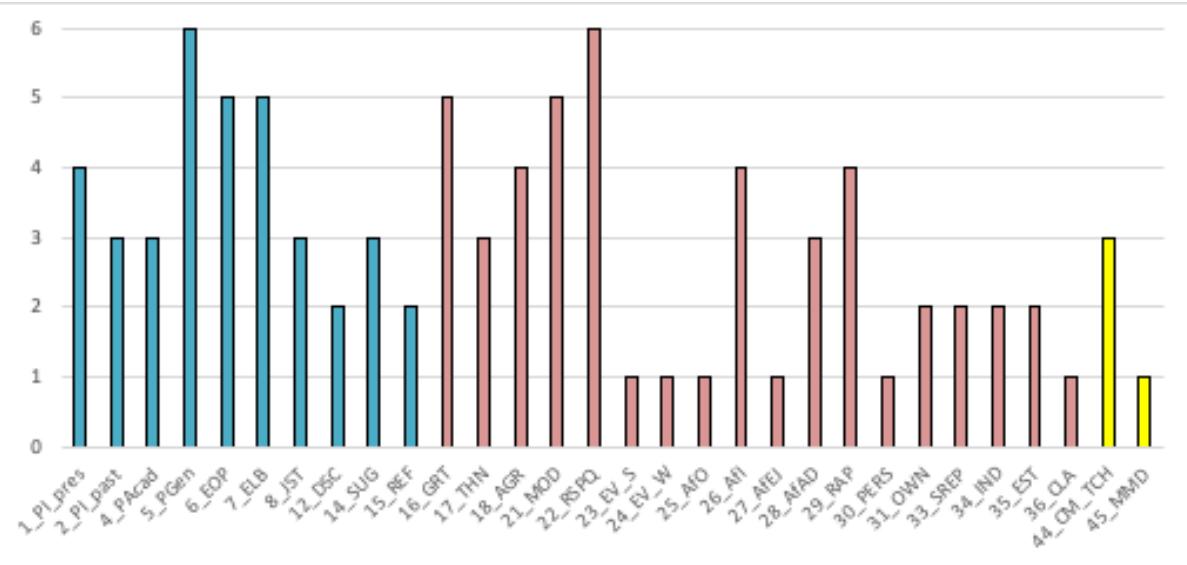
Figure 5: Frequency of language functions observed at least once in students’ chat contributions in six classes

Figure 6: Frequency of language functions observed at least once in teachers’ chat contributions in four classes
The figures show that the comment box was used by both teachers and students, but more frequently by students, for a range of functions including:
- providing personal information
- providing general information
- providing academic input
- expressing opinions
- elaborating/giving examples
- justifying
- suggesting
- greeting
- thanking
- agreeing
- modifying/commenting on other’s contributions
- responding to questions
- asking for information
- asking for academic advice
- building rapport
- commenting on technical status.
While there are many more individual functions under the first two function categories (i.e., informational and interactional functions), the colour coding indicates that informational, interactional and use of technology functions are more suited to be expressed through chat communication, while managing interaction functions are not. This is probably not surprising since the written mode of communication during taught classes is unlikely to attract all participants’ attention, which is therefore not very useful to serve the functions such as initiating new interaction/change topics, reciprocating, and closing a sequence. As expected, the chat function seemed particularly useful to share a link to resources (coded as ‘referring to resources’) and comment on technical status (e.g., pointing out that a camera is off) - which were also observed in research supervision meeting data - the use of chat seemed to go beyond those practical purposes.
The fluidity and seemingly effortless integration of the exchanges where a tutor spoke, and students listened and used chat to engage with the tutor who read the comments and then responded by speaking was noticeable. In the following exchange shown in Excerpt 122, the tutor and students discuss the readings that had been set prior to the class. The success of this interaction from the tutor’s view was indicated by her final comment “great conversation”.
Note: T indicates the tutor, who is speaking; SCHAT indicates the students, who are responding through comments in chat. Each student is identified through a number (S1 is the student who first commented). Chat contributions are in blue.
Excerpt 122 (QUT10)
T: The readings were really interesting this week…Did anyone notice anything in particular [from the readings]? [REF, REC, AfO]
S1CHAT: I liked the templates! [RSPQ, EOP, REF]
T: Ok yes, the templates, they’re really good for thinking about, you know, your future selves as educators. There’s some really great examples of templates that you could use to create your own checklist, for example. [EV_W, MOD, SUG, REF]
S2CHAT: Alignment [RSPQ, REF]
T: Yeah, the discussion around alignment, yeah that was really helpful as well.
[EV_W, AGR, MOD, REF]
S3CHAT: The assessment of writing based on the four resources model [RSPQ, REF]
T: S3, you’re in my brain! [laughs] So, the assessment of writing based on the Four Resources Model yep particularly useful, especially when it comes to thinking about your essay and justifying some of the decisions that you make around your lesson planning as well, so that’s great. [EV_W, RAP, SUG, REF, MOD]
S4CHAT: Assessment cycle [RSPQ, REF]
T: Yes, S4, the assessment cycle, and what I really like about the assessment cycle [MOD, REF]
S5CHAT: I found the visual of the assessment cycle really useful [RSPQ, MOD, EOP, REF]
T: S5, you took the words out of mouth! It’s a really nice and visual summary of the processes…So, great conversation. [EV_W, MOD, REF, EST]
Students also used chat to comment on other students’ contributions and to ask the tutor questions, as the following excerpt shows. In this exchange the tutor reads out the students’ chat contributions and then responds to them orally. This is presumably to ensure that students who are not using the chat function can follow. It creates a somewhat hybrid interaction, involving repetition of comments and questions.
Excerpt 123 (QUT12)
S2CHAT: [following up on Tutor description of pedagogy] We use that ‘role’ structure where I work [MOD]
T: Really good, so someone said ‘We use that role structure where I work’, Yep, great, and it’s really good and there are things like reciprocal reading which is really useful for that kind of reading as well, more so…it might be a bit easier to set up in earlier years, the reciprocal reading, but I’ve used it in Grade 3, 4, 5, 6 [SUG, EV_W, MOD]
S3CHAT: Just going back a step - where do the words come from for the word work activities? Do the students find the words in the text or are they provided with words? [AfI, AfEJ]
T: So, just a question here: ‘Going back a step - where do the words come from for the word work activities? Do the students find the words in the text or are they provided with words?’ So, a range of things can happen. It might come from what I just suggested then, the model text [continues on to explain and give examples] [RSPQ, SUG]
Students used chat to share links to resources and specific documents that are being discussed, as the following excerpt demonstrates.
Excerpt 124 (QUT10)
T: Alright, we’ve got Thuy, who has a Pacific Islander background, and Thuy is Consolidating English [level used for EAL/D learners] in Year 3, where do I need to go to find out some information about the kinds of things I need to think about in making adjustments for Thuy?…Do you know where you need to go is the question… before I tell you [laughs] Where would you go first? [AfI, RAP]
S1CHAT: learning progression and content descriptor docs. [RSPQ, REF]
T: Yep, great. The learning progression and content descriptors. [EV_W, REF]
S2CHAT: The EAL/D learning progression document. [RSPQ, REF, MOD]
T: The learning progression document in particular because I don’t have particular descriptions added here. OK. If there were descriptors that matched these, which there would be in a full English unit plan, then I could go ahead and look at the content descriptors. [EV_W, MOD, REF]
S3CHAT: http://docs.acara.edu.au/resources/EALD\_Learning\_Progression.pdf [REF]
Students also used chat among themselves to share ideas and links to resources. These chat exchanges take place simultaneously with the spoken exchanges in the class.
Excerpt 125 (QUT15)
S1CHAT: I have seen some year 2 classroom teachers use Class Dojo - kids like it! [SUG, EOP]
S2CHAT: https://www.classdojo.com/ [SUG]
S3CHAT: readingbear.org [MOD, SUG]
S1CHAT: I just discovered reading bear last week, S3. [MOD]
S4CHAT: storyboardthat.com is good to create pictures for language activities or short stories. Can create one new storyboard a week for free. I’ve used it a lot to add pictures to student-written stories, or as prompts for them to write their own. [SUG]
Another feature of chat used mainly by students was the ability to engage in a private discussion with another participant, most often the tutor. In the following exchange a student initiates a relatively lengthy private written exchange with the tutor where they discuss the student’s thoughts on a point made earlier by the tutor.
Excerpt 126 (QUT10)
S1CH to Tutor (Privately): Hi [tutor’s name], thinking about what you just shared, the student would need support in “writing” the text but they show their understanding with “producing” the text through verbal demonstration, and this would be the evidence we create to support/intervene for that particular student. That’s quite a tricky one, and thank you for sharing that. The “writing” is one part of what they are assessed, and should not be the entirety of the assessment of being satisfactory or not. [MOD, ELAB, JUS]
TCH to Student (Privately): Yes, I think as teachers and educators we really need to be aware of literacy skills and how they enable/disable students to communicate their learning. [MOD, AGR, EOP, RAP]
S1CH to Tutor (Privately): Agree, thanks. [AGR, THN]
The use of the chat function in online classes has changed the nature of the interaction, resulting in a complex and potentially more linguistically challenging context for students as they engage with academic content through integrated skills and multimodality.
5.2 Comparisons of the elicited functions in online EAP settings against those observed in a video-conferencing speaking test
We now turn to exploring the extent to which the functions observed in the real-life academic speaking contexts in this study were elicited in the IELTS Speaking Test delivered via video-conferencing. The comparison, however, needs to be interpreted with caution as not all functions coded under the real-life conditions were included in the coding of the testing condition (Nakatsuhara et al., 2021) or relevant to the high-stakes testing context. It is also essential to note that the data were analysed in a primarily qualitative way; as we explained in the methodology section, the coding was carried out to determine whether each function was elicited by each category of participants in one episode of classroom interaction or supervision, rather than how many instances of each function were observed within an episode. Thus, the somewhat arbitrary categorising of a function being observed over or under 50% of the time must be interpreted with caution. In this exploratory study the identification of a rich range of interactional, informational, managing interaction and use of technology features are key findings.
Table 10 visualises the comparison of the two conditions. Like the function tables in Sections 5.1-5.4, functions observed over 50.0% are highlighted in pink and those over 25.0% (but smaller than 50%) are highlighted in blue for ease of reading. Those functions that were not used in the coding of test interactions are announced as n/c. However, some n/c functions (e.g., responding) that were not coded but are definitely elicited by the test design are marked with two asterisks in the table.
Table 10: Elicitation of functions in real-life academic settings and testing condition (%)
| function | Real-life | IELTS video-conferencing test | |||||||||
|---|---|---|---|---|---|---|---|---|---|---|---|
| Taught module n=17 classes | super-vision n=23 mtgs | Part 1 | Part 2 n=30 | Part 3 | Elicited in both (>50%) | Elicited more in real-life (>50%) | Elicited more in VC test (>50%) | ||||
| Informational functions | 1 | Providing personal information | present | 52.9 | 52.2 | 100.0 | 16.7 | 10.0 | |||
| Informational functions | 2 | Providing personal information | past | 64.7 | 39.1 | 30.0 | 56.7 | 6.7 | |||
| Informational functions | 3 | Providing personal information | future | 5.9 | 39.1 | 26.7 | 30.0 | 0.0 | |||
| Informational functions | 4 | Providing academic content/input (both tutors and students) | 82.4 | 87.0 | n/c | n/c | n/c | ||||
| Informational functions | 5 | Providing general information | 52.9 | 82.6 | n/c | n/c | n/c | ||||
| Informational functions | 6 | Expressing opinions/preferences/feelings | 88.2 | 100.0 | 100.0 | 93.3 | 96.7 | ||||
| Informational functions | 7 | Elaborating/giving examples | 100.0 | 95.7 | 50.0 | 53.3 | 50.0 | ||||
| Informational functions | 8 | Justifying | 47.1 | 95.7 | 93.3 | 86.7 | 93.3 | ||||
| Informational functions | 9 | Comparing | 82.4 | 73.9 | 33.3 | 10.0 | 56.7 | ||||
| Informational functions | 10 | Speculating | 76.5 | 95.7 | 6.7 | 6.7 | 23.3 | ||||
| Informational functions | 11 | Staging | 0.0 | 30.4 | 6.7 | 0.0 | 10.0 | ||||
| Informational functions | 12 | Describing | 82.4 | 95.7 | 96.7 | 93.3 | 96.7 | ||||
| Informational functions | 13 | Summarising | 0.0 | 43.5 | 13.3 | 0.0 | 3.3 | ||||
| Informational functions | 14 | Suggesting/instructing/giving academic advice | 29.4 | 21.7 | 16.7 | 3.3 | 13.3 | ||||
| Informational functions | 15 | Referring to course resources/lectures etc. | 82.4 | 95.7 | n/c | n/c | n/c | ||||
| Interactional functions | 16 | Greeting/welcoming | 47.1 | 56.5 | n/c** | n/c | n/c | ( ) | |||
| Interactional functions | 17 | Thanking | 76.5 | 52.2 | n/c | n/c | n/c** | ( ) | |||
| Interactional functions | 18 | Agreeing | 70.6 | 95.7 | 10.0 | 0.0 | 6.7 | ||||
| Interactional functions | 19 | Disagreeing/challenging | 23.5 | 26.1 | 3.3 | 0.0 | 10.0 | ||||
| Interactional functions | 20 | Qualifying OWN contribution IN RESPONSE TO challenge | 17.6 | 73.9 | n/c | n/c | n/c | ||||
| Interactional functions | 21 | Modifying/commenting/adding to OTHER’s contribution | 94.1 | 100.0 | 3.3% | 0.0% | 16.7% | ||||
| Interactional functions | 22 | Responding to a question | 94.1 | 100.0 | n/c** | n/c** | n/c** | ( ) | |||
| Interactional functions | 23 | Evaluating OTHER’s contribution/appraising Spoken contribution | 41.2 | 60.9 | n/c | n/c | n/c | ||||
| Interactional functions | 24 | Evaluating OTHER’s contribution/appraising Written contribution | 5.9 | 13.0 | n/c | n/c | n/c | ||||
| Interactional functions | 25 | Asking for opinions & ideas | 41.2 | 73.9 | 3.3 | 0.0 | 0.0 | ||||
| Interactional functions | 26 | Asking for information | 88.2 | 69.6 | 0.0 | 0.0 | 0.0 | ||||
| Interactional functions | 27 | Asking for elaboration/justification | 23.5 | 30.4 | n/c | n/c | n/c | ||||
| Interactional functions | 28 | Asking for academic advice | 64.7 | 91.3 | n/c | n/c | n/c | ||||
| Interactional functions | 29 | Building rapport (e.g. joking, using humour) | 76.5 | 95.7 | n/c | n/c | n/c | ||||
| Interactional functions | 30 | Persuading | 11.8 | 13.0 | 0.0 | 0.0 | 0.0 | ||||
| Interactional functions | 31 | Negotiating meaning | Checking OWN understanding | 70.6 | 78.3 | 6.7 | 3.3 | 20.0 | |||
| Interactional functions | 32 | Negotiating meaning | Checking OTHER’s understanding | 17.6 | 8.7 | 0.0 | 3.3 | 0.0 | |||
| Interactional functions | 33 | Negotiating meaning | Self-repair | 11.8 | 52.2 | 6.7 | 6.7 | 3.3 | |||
| Interactional functions | 34 | Negotiating meaning | Indicating understanding | 100.0 | 100.0 | 16.7 | 10.0 | 33.3 | |||
| Interactional functions | 35 | Negotiating meaning | Establishing common ground | 17.6 | 65.2 | 3.3 | 0.0 | 0.0 | |||
| Interactional functions | 36 | Negotiating meaning | Asking for clarification (lang-related) | 5.9 | 47.8 | 63.3 | 13.3 | 56.7 | |||
| Interactional functions | 37 | Negotiating meaning | Correcting other’s utterance (lang-related) | 0.0 | 4.3 | 0.0 | 0.0 | 0.0 | |||
| Interactional functions | 38 | Negotiating meaning | Responding to clarification requests (lang-related) | 0.0 | 30.4 | 3.3 | 3.3 | 13.3 | |||
| Managing interaction | 39 | Initiating new interaction/activity/Changing topics | 11.8 | 78.3 | 3.3 (changing only) | 0.0 | 0.0 | ||||
| Managing interaction | 40 | Inviting others to talk/engage in content/reciprocating | 0.0 | 17.4 | 0.0 | 0.0 | 0.0 | ||||
| Managing interaction | 41 | Closing a sequence/concluding an argument/decision | 0.0 | 52.2 | 0.0 | 0.0 | 0.0 | ||||
| Use of technology | 42 | Sharing screen | 11.8 | 21.7 | n/c | n/c | n/c | ||||
| Use of technology | 43 | Resolving a technical issue | 17.6 | 47.8 | n/c | n/c | n/c | ||||
| Use of technology | 44 | Commenting on online status/technical aspects of online communication | 47.1 | 65.2 | n/c | n/c | n/c | ||||
| Use of technology | 45 | Using multimedia | 17.6 | 13.0 | n/c | n/c | n/c |
Notes: * n/c = not coded, ** not coded, but must have been observed
The total of 45 functions can be categorised into four categories:
- those functions elicited over 50% in both conditions
- those functions elicited over 50% only in the teaching/learning condition
- those functions elicited over 50% only in the testing condition
- those functions that were not elicited over 50% in either condition.
In classifying the 45 language functions into one of the four categories, we also colour-coded them according to the four broad types of functions. The functions newly added in this study, therefore not used in coding the IELTS Speaking Test data, are denoted within brackets.
1. Elicited ( > 50%) in both conditions:
- Providing personal info (present, past)
- Expressing opinions/preferences/feelings
- Elaborating/ Giving examples
- Justifying
- Comparing
- Describing
- (Greeting/ Welcoming)
- (Thanking)
- (Responding to a question)
It is notable that of the six functions that confirmed matching in both conditions are all informational functions, while the three interactional functions are newly added functions in this study, whose matching is therefore only speculative. Of the original function list of O’Sullivan et al. (2002), those informational functions not listed here are: speculating, staging, summarising, and suggesting. This indicates that most core informational functions are elicited in both real-life and testing conditions.
2. Elicited more ( > 50%) in the real-life condition:
- (Providing academic content/input)
- (Providing general information)
- Speculating
- (Referring to course resources/lectures etc.)
- Agreeing
- (Qualifying OWN contribution IN RESPONSE TO challenge)
- Modifying/commenting/adding to OTHER’s contribution
- (Evaluating OTHER’s contribution/appraising Spoken contribution)
- Asking for opinions & ideas
- Asking for information
- (Asking for academic advice)
- (Building rapport)
- Checking OWN understanding
- Self-repair
- Indicating understanding
- Establishing common ground
- Initiating new interaction/activity/ Changing topics
- Closing a sequence / Concluding an argument/decision
- (Commenting on online status/technical aspects of online communication)
In real-life data, we observed a number of interactional functions, such as agreeing, modifying, asking for opinions & ideas, asking for information and some functions to negotiate meaning, but these functions were not frequently observed in the testing condition. Similarly, managing interaction functions, such as initiating, changing topics and closing, seem to characterise only real-life academic communication. This suggests that online academic communication is much more interactive than the interactions elicited in the IELTS Speaking Test. This is congruent with Seedhouse’s (2018) study that described the interactional organisation of the IELTS Speaking Test as “topic-scripted Q-A adjacency pair”.
3. Elicited more ( > 50%) in the testing condition:
- Asking for clarification
The only function that was more prominently used in the testing condition is asking for clarification. This was counter-intuitive, given that online communicating usually involves a greater number of clarification requests. However, while this function was not very much observed by taught-class students, the use by research students indeed approached 50%. We can therefore consider that in two-way (or three-way) interactions where a student is supposed to understand all pieces of spoken input and to respond to all questions, this function is more necessary. As such, we could regard that clarification requests are often used in both real-life and testing conditions, if the interaction is dyadic (or in a small group).
4. Limited elicitation ( < 50%) in both condition:
- Providing personal info (future)
- Staging
- Summarising
- Suggesting/ Instructing/ Giving academic advice
- Disagreeing/ Challenging
- (Evaluating OTHER’s contribution/Appraising Written contribution)
- (Asking for elaboration/justification)
- Persuading
- Checking OTHER’s understanding
- Correcting other’s utterance
- Responding to clarification requests
- Inviting others to talk/engage in content / Reciprocating
- (Sharing screen)
- (Resolving a technical issue)
- (Using multimedia)
These functions seem to be rather peripheral in both real-life and testing conditions, although it does not necessarily mean that they are not important. The elicitation of some of these functions, such as staging, summarising, persuading, seems task-dependent, so it is understandable that they are not elicited much in the current IELTS Speaking Test.
5.3 Students and tutors/supervisors’ perceptions of online academic communication
We now move on to reporting on findings from survey and interview data gathered from students, class tutors and research supervisors.
5.3.1 Insights from taught course students
Eleven Education faculty students (five undergraduate and six postgraduate) responded to the survey. The survey functioned in order to elicit a range of opinions and also to point to issues that could be further explored with the survey participants who volunteered for a follow-up interview. Six students (two undergraduates and four postgraduates) were interviewed.
The survey and interview foci included the perceived similarities and differences between face-to-face and online academic speaking, sharing successful and challenging experiences of online academic speaking, the use of chat and experience sharing their screen, and their preference regarding the two modes of speaking.
As summarised in Table 11 below, the thematic analysis of the survey responses and interviews with taught course students generated three main themes with eight sub-themes.
Table 11: Themes emerged from taught course students’ survey responses and interviews
| Main theme | Sub-theme |
|---|---|
| Nature of online speaking | (a) Group size and interactional engagement |
| Nature of online speaking | (b) Turn-taking when contributing and asking questions |
| Nature of online speaking | (c) Non-verbal cues may be limited, especially body language |
| Nature of online speaking | (d) Importance of listening skills |
| Nature of online speaking | (e) Multimodal and integrated nature of online speaking which incorporates chat |
| Opportunities & challenges | (f) Connecting with students from different locations, convenience and flexibility |
| Opportunities & challenges | (g) Recordings of sessions are also learning resources |
| Opportunities & challenges | (h) Technology affordances and challenges |
| Overall preference | (i) Face-to-face interaction preferred |
Nature of online academic speaking
(a) Group size and interactional engagement
Students noted some similarities in online and face-to-face speaking, including being able to see other participants’ faces, take part in small group discussions where they could share thoughts and opinions.
- Ability to see faces and comment [in] real time. (TCS07) The tutor can lead discussions, offer insight, and ask and respond to questions in both environments. Students can still engage in discussions and ask questions in both. (TCS08) In breakout rooms [on Zoom] it felt similar to face-to-face tutorial small group discussions. (TCS02) Participants get to share their thoughts and opinions with their colleagues and receive instant feedback (depending on internet speed); if webcam is on then participants can see each other during the exchange. (TCS03) The similarities between speaking face-to-face and online speaking is the teaching content. (TCS06)
The extent to which similarities were noted depended on the way that online sessions were set up: in smaller sessions (fewer than 20 participants) it was more likely that participants would be encouraged/expected to use their video cameras and the tutor would use breakout rooms for discussions. In larger groups it was more likely that the session became more transmissive in orientation, with the tutor providing an extended monologue and students typically writing questions and comments in the chat box for the tutor to address, rather than speaking.
People can “opt out” by switching off their microphone and camera and just listen. It’s harder to “opt out” of a face-to-face discussion. (TCS10) Not turning on camera or mike allows a student to sit back, zip it and be passive. (TCS07)
(b) Turn-taking when contributing and asking questions & (c) Non-verbal cues may be limited, especially body language
While some overarching similarities were noted, participants pointed to many differences in the nature of online communication, with turn-taking emerging as a key difference between online and face-to-face speaking.
You need to take turns as you would in face-to-face discussions, but the way you take turns might be different. (TCS10)
In online communication students sometimes felt unsure about when they could join the discussion, ask a question or request clarification, resulting in more ‘polite’ turn-taking.
Only one person can speak at a time; any interjection would cause confusion as to who is speaking since we cannot see everyone on the big screen, hence resulting in more polite turn-taking. (TCS03) Can be hard to contribute, difficult to not cut someone off if you have a question. (TCS01) Sometimes it’s hard to know when and how to jump in to the discussion. (TCS01) Awkward and less frequent turn-taking, tendency to remain silent rather than turn-take naturally. (TCS07) It’s harder to interrupt in order to participate because you have to switch on your microphone, which requires “planning”. The facilitator needs to pause for longer to allow contributions. It’s not really a “true” discussion because realistically only one person can speak at a time. (TCS10)
Students also reported the difficulty in ‘reading body language’ when cues were limited to facial expressions, or not even that if a student did not have their camera on.
The nature of turn-taking is different. If you are face-to-face and can see the body language of a colleague, it’s OK to interrupt or interject, but on Zoom especially if in a large group, you don’t know who is going to talk, you don’t have that physical environment, access to body language, so you have to be very careful to have your turn to say something or interject because when yo interject and interrupt someone’s speech, then it becomes very confusing for everyone involved. (TCS03) Inability to feed off other paralinguistics crucial in face-to-face interaction, such as gesticulations and other body language as it may be out of shot. (TCS07) Non-verbal cues are less clear so it’s not always obvious when someone is trying to join in the discussion. (TCS10) In a full discussion you see the whole body, you can see they’ve got notes, you can see them looking down, you can see them shuffling papers, you know they are waiting to contribute something, whereas you can’t see that as easily when you can only see someone’s face. (TCS10) Hard to read body language or facial expression so if you want to interrupt and ask a question you have to voice out your intention rather than gesturing like raising your hand. (TCS03) So you’re not too sure when to come in or when to finish or you’re very conscious of the fact that you might be talking too long for some people who aren’t interested in what you have to say because you can’t get all those physical nuances of what’s happening in the conversation or the discussion. (TCS11) You can still get the non-verbal cues, but they become more important online [because] it can feel a bit as if you are talking to yourself if people don’t have cameras on. You still get the non-verbal feedback from the people who are very aware of social interaction…you’ll still get the nodding, facial expressions and things like that, which you’ll get more naturally in a face-to-face session… I’ve found I almost exaggerate those responses online. (TCS10) How can we understand how people are communicating in the absence of body language (can’t see hand movements, etc) - does this then require better understanding of facial expression? (TCS07)
An international student also commented on the role of language proficiency in asking questions:
Particularly, because of the language barrier, in Zoom session, I would not like to ask questions. (TCS06)
Students felt unsure of the pragmatics of online speaking in an academic context: the lack of face-to-face interaction and absence or limited nature of visual signals resulted in concern about exactly what constitutes polite turn-taking in online speaking.
There are times when person who is talking hasn’t got their camera on and the sound quality isn’t that good and you think ‘how do I respond to that?’, so you are kind of guessing, but you don’t want to ask them to repeat or interrupt. You don’t want to come across as being rude. (TCS02) I tend to let people talk and wait see if someone else is going to clarify what you don’t understand. It might come across on Zoom as more of a challenge if you ask another student to clarify what they have said. (TCS10) Allowing extended monologues for fear of new, unwritten rules of turn-taking. These can last aeons if not acted upon by some mediator. (TCS07) In order to take a turn you… have to be quite assertive, you have to really push in, which is fine, that doesn’t bother me, I’m quite pushy [laughs] but I think if you were less confident, you just wouldn’t participate. (TCS07) An L1 English speaker speculated that international students may experience difficulties related to cultural norms around online communication. Maybe the pragmatics of screen communication in their cultures is very different. (TCS07)
(d) Importance of listening skills
Students noted that listening demands were greater in the context of online speaking, with less opportunity to ask for clarification.
Listening demands at the beginning of the unit is greater [than FTF] because you don’t know who you’re interacting with. You haven’t had that social aspect of waiting in class or mingling in the canteen….So there’s the loss of the social interaction before you start having the discussion. With listening it’s trying to understand what people mean, because usually in a face-to-face discussion you can interject and say ‘what did you mean by such and such’? (TCS11) Listening is very important because it’s often the only way that you can understand the message, because sometimes with too many people on a Zoom session, you can’t see them directly, you can’t see their body language, so listening is very important. That’s why the interruption is very, very delicate: you can’t really interrupt when someone is talking, otherwise you disrupt other people’s listening. (TCS03) I think it’s mainly the turn-taking and the waiting that make the listening different, because if you’re not too sure what they’re talking about then you start thinking about what they are talking about and when you tune back in, you’ve got that gap. (TCS11) You have to be ultimately very in tune with what is communicated within your square. (TCS07)
(e) Multimodal and integrated nature of online speaking which incorporates chat
Another characteristic of online speaking was the multimodality and integrated nature of the communication, which included the challenge of reading and/or writing comments in the chat box while simultaneously listening and perhaps also speaking.
In a large group, the microphones are switched off and the chat box has to be used. Again, this distracts from the lecture as reading and interacting with the chat box means that I am unable to focus on the lesson at the same time. (TCS11)
- I tend to miss more, because I focus on the audio. (TCS10) When someone is asking something interesting [in chat] and you have to listen to the speaker at the same time or watch the slide show at the same time it’s really challenging. (TCS03)
If you don’t have the chat bar open, the next thing you hear is the lecturer say “Oh yes that’s a really good question” without knowing what that question was, and if you haven’t seen it in the chat, it gets really confusing. (TCS10)
The use of chat was noted by students in both positive and negative ways. Students could post a question through the chat box, but this may not always be noticed by the tutor, who was multitasking.
Difficulties with asking questions, as the tutor may not notice your question, or it disappears when others make a comment (TCS04) By the time the tutor addressed the questions from the chat, it was from something that had been talked about earlier, so this impacted on the flow. (TCS11)
Posting a question on chat could enable less confident students to participate and also enable students to post a question without disrupting the flow of the spoken interaction.
The chat function offers a good alternative to speaking if I don’t feel confident voicing a question. (TCS08) In a large group it’s good to get your question or contribution noted while someone else is speaking. Good facilitators will refer to the questions and comments as they come in. (TCS10)
One student felt that the (over)use of chat by students changed the nature of communication and learning.
When lots of students in the tute group and the questions were in chat, tutors didn’t refer to students by name, it felt like they were being talked at, and there wasn’t that interaction. I think the talking is very important, and it’s not just because I’m a teacher and we talk a lot [laughs] but it’s more because it’s important to have a conversation, a talking conversation, rather than just the chat box one. (TCS11)
Opportunities and challenges
(f) Connecting with students from different locations, convenience and flexibility
Students noted the opportunities of online classes, which included the convenience and learning opportunities of being able to connect with students in different locations and the feeling that the world is more connected and accessible.
I do think there may be more distractions when speaking in a face-to-face tutorial environment, making online sessions more effective and efficient in that regard. When time is short, I think Zoom sessions enable people to work from a suitable location of their choosing, while still enabling them to be involved and interact (unlike just watching a lecture or tutorial back later). (TCS08) A big plus is you get to see some of your peers in their different locations which makes you think about regions and global aspects and makes you feel the world is accessible and the topics relevant across borders or areas. It was so interesting as one student was in Greece explaining about working with olde people and one was in a remote part of Australia, and a few were in different parts of Brisbane which gave a good insight into the variations within institutions and contexts. (TCS09)
(g) Recordings of sessions are also learning resources
The online tutorials were recorded and thus also functioned as learning resources for students who were either not able to attend the online tutorial or wanted to revisit the session. The usefulness of being able to review the session was noted by students.
The zoom recording can pause or review the content if I encounter the difficulties. (TCS06)
You are able to re-listen and work at your own speed and go back to things you didn’t quite pick up the first time. (TCS09)
(h) Technology affordances and challenges
The affordances of technology included the ease of screen and document sharing among participants, the breakout rooms for small group discussion and the use of chat to incorporate written questions and comments.
When sharing a document during Zoom all participants can see the document clearly, and you can direct their attention to the part you want to discuss. (TCS03) [We] worked on a Padlet or Google doc in small groups in breakout rooms, tutors prepared sessions well. (TCS01) When there are a large number of participants, then the chat function is used. I also like to use this function to send a private message to other participants if needed at times. (TCS11)
Aspects of technology mentioned by students as impacting on the quality of their online academic speaking included internet speed, audio quality and students understanding of Zoom functions.
Connection issues mean points don’t come across clearly. (TCS02) Technical issues can make the experience frustrating sometimes (poor internet connection etc.). (TCS10) When people have noisy background then it affects everyone’s ability to hear and concentrate, so online etiquette such as muting your mic should be observed. (TCS03) There are a lot of different functions on Zoom to use, and the user needs to be familiar with these to adequately use Zoom efficiently. (TCS11)
Preference
(i) Face-to-face interaction preferred
Eight of the 11 students preferred face-to-face speaking to online speaking. Students who preferred face-to-face academic speaking felt more engaged and that the interactions were more spontaneous.
I find face-to-face speaking more engaging and struggle to concentrate on online speaking. (TCS05)
- I enjoy the engagement and interaction. (TCS01) Face-to-face as it is more human, and conversational interactions are much easier. However, due to distance, I need to use Zoom. (TCS11) Easier to clarify points of confusion. (TCS04)
- I like a more spontaneous and flexible communication experience. (TCS10) I’m not learning to learn with a screen, I’m learning to interact with other people and to hear their experiences, and that’s part of the disadvantage of Zoom because you’re not encouraging those experiences to be shared linguistically or otherwise if we’re going monologue - monologue. (TCS07)
In contrast, a few students who preferred online speaking mentioned convenience, the potential for global communication and the choice to engage as much (or as little) as they desired.
No need to travel to a set location. You can collaborate with people from different countries. Can stay low profile if I have a bad day. (TCS03) In general, I find online more efficient and convenient. (TCS08)
5.3.2 Insights from lecturers and tutors in taught courses
Three tutors were interviewed, all of whom were very experienced in teaching university tutorials in both online and face-to-face mode. The interview focussed on the characteristics of online speaking, the impact of online speaking for students for whom English is an additional language (EAL), opportunities and challenges, and their preferred mode of teaching.
Table 12: Themes emerged from tutors’ interviews
| Main theme | Sub-theme |
|---|---|
| Nature of online speaking | (a) Interactional engagement |
| Nature of online speaking | (b) Language more formal and more instructional language used by tutors |
| Nature of online speaking | (c) Impact of limited or no visual cues on ‘reading the room’ |
| Nature of online speaking | (d) Multimodality of communication- impact of chat |
| Nature of online speaking | (e) Increased listening load for EAL learners |
| Opportunities & challenges | (f) Small groups can work well |
| Opportunities & challenges | (g) Difficult to build rapport |
| Opportunities & challenges | (h) Need for IT training to effectively utilise technology |
| Overall preference | (i) Face-to-face interaction preferred |
Nature of online speaking
(a) Interactional engagement
Tutors found few similarities between online and face-to-face teaching, however, one tutor noted that both should be interactive and another that if groups were small and cameras were on, group work could occur in both with the use of breakout rooms through Zoom.
[Both online and face-to-face] has to be interactive so students should actually be doing the majority of the talking themselves. (TCT01) You can see everyone’s face if they choose to let you online. (TCT03) When students are in small groups in breakout mode online, similar in that tutor can visit groups. (TCT03) One tutor reflected that simply being in a face-to-face group does not guarantee a successful discussion. Sometimes they are discussing so much that it’s difficult to join, other times no one is talking, or two students are talking and no one else is: those same kinds of things happen. (TCT03)
(b) Language more formal and more instructional language used by tutors
Tutors were more aware of the differences between the two modes, with TCT01 noting that her language was more formal in the online tutorials and that she used more instructional language in setting up tasks.
I’m very conscious of organisational language and instructional language because with limited time, I need to give students a good overview at the beginning so they know what activities will happen and for what purpose and how long things are going to take. A lot of instructional language around accessing digital technology and resources and what their tasks are going to be, because students don’t have the opportunity to have that little friend conversation with ‘what are we doing now?’ (TCT01)
Knowing that the online tutorial will be recorded and then uploaded to the Blackboard site so that it can be accessed as an mp4 recording by students also made TCT01 more conscious of the language she used.
I’m more conscious about the level of formality of the language that I’m using, and I think that may be indicative of whether the Zoom is being recorded for other people to listen to, so I’m much more conscious and aware I guess of my enunciation, of my pitch and intonation, pace is maybe a little bit slower I think in Zooms and I’m probably very conscious of the metalanguage that I’m using. (TCT01)
TCT03 also reflected that the language she used in online tutorials was more formal than in face-to-face tutorials.
I feel when I’m online I almost forget to be myself…you’re trying to manage so much, I feel like I forget to bring my personality to it. I struggle to do that same kind of interpersonal work [as done in FTF tutes] online. (TCT03)
(c) Impact of limited or no visual cues on ‘reading the room’
The difficulty in ‘reading the room’ was noted by all tutors as a difference between online and face-to-face teaching. Turn-taking was also a point of difference, with limited or no visual cues through body language changing the nature of the interaction when it is online.
Being able to read the room…when you’re in a real room, if someone kind of moves or is looking at you intently, or they’re really leaning forward then they might have something to ask. (TCT03)
In a face-to-face situation people are looking around the room and they can see each other, and they can almost tell if someone is keen to put up their hand and contribute, whereas that doesn’t happen in the online experience. You can’t see anyone else unless…even if they’ve got their videos on - that static little head there in the little box - and the body language is not there to be read, so that’s a problem, and then the teacher has to be more orchestrated about how they elicit responses from particular students or groups of students, so I think that the lack of the physicality and the body language and that ability to read what’s happening in the room does impact on contributing, definitely. (TCT02)
Turn-taking is different in online tutes, relates to efficacy and how well the tutor knows how to engage students in activities. (TCT01)
To enhance participation TCT01 asks students to have their camera on, asks students direct questions and uses student names, “ensuring all students get the opportunity to talk, rather than being passive observers”.
(d) Multimodality of communication - impact of chat
Tutors noted the multimodal, integrated nature of online academic speaking and the use of the chat function by teachers and students.
Student discussions on chat can be a whole side discussion that you might not be aware of until the end of the tute. (TCT02)
It is really difficult to do [manage chat while teaching] because you’re trying to talk and/or listen and/or read, and you’re also then trying to think about the best way to respond…it would be like being in a real-life workshop and students handing you notes, right in the middle of your talking. (TCT03)
Sometimes it’s driven by me, sometimes it’s driven by the students, and you have to then manage it. You make different pedagogical decisions then, depending on how it’s operating at the time, and you are also thinking about the big picture, the overall flow of the workshop and keeping people engaged. (TCT03)
(e) Increased listening load for EAL learners
When asked about online interaction and students for whom English is an additional language (EAL), tutors felt that the whole group mode might feel intimidating and pressured, particularly in the absence of the full range of visual cues. Interactive listening becomes essential when the pace is fast, and many students are contributing to a discussion.
I think because Zooms tend to do more whole group discussion…there is a bit of a high pressure…there’s more talk going on…it’s quicker, it’s more interactive, students are interrupting one another, and that’s the beauty of Zoom, because you’ve got so many people engaging and for EAL students that could be the most challenging, because we are calling upon them, we do want them to be engaged, but also it’s quite fast paced, the quieter kind of conversationa learning that has occurred in breakout rooms is now being synthesised into bigger picture kind of ideas and sharing and collaboration, that could be more challenging. (TCT01) If other students are speaking and not using body language or they’ve got their video turned off, then the listening load is massive. And so, all of those non-verbal skills that we teach our students to rely on to make meaning are just not available to them. (TCT02)
The increased listening load was emphasised by TCT02, as this could also impact on a student for whom English was an additional language being able to participate in the subsequent discussion.
If we think about the relationship between listening and speaking, and this is obviously very pertinent to L2 learners, the load can be enormous in listening. The tutor might have a PowerPoint on the screen, but most of the unpacking of that PowerPoint is just done through the oral language of the lecturer [tutor] and so the student is listening listening listening, and if the tutor is not so skilled at really unpacking in ways to reduce the load on the listening, then when they come to speak, it can be very difficult because there hasn’t been that pedagogic scaffolding. (TCT02)
The opportunity to work to scaffold EAL learners is not available to a tutor in the same way that it would be in a face-to-face tutorial.
In a classroom, in person, those students could potentially feel more supported because I look and I take note and I make sure I speak to everyone. (TCT03)
Opportunities and challenges
(f) Small groups can work well
The most successful experiences that tutors recounted involved small groups of invested students. However, these students had met the teacher in face-to-face classes prior to doing an online tutorial.
I had a small group of highly invested students who were accustomed to the Zoom environment…they were articulate, they knew me because we’d worked together face-to-face, and now we were working together online, so there was already that rich established rapport…we just got on with the business of doing the learning and teaching. (TCT02)
For one tutor, the decision (or freedom) to not record the session also impacted positively on interaction and engagement, as did students already knowing each other and being confident with technology.
This semester I had four-hour workshops with final year BEd students who I knew well. Workshops weren’t recorded and I had awesome attendance. Because I already had a connection with majority of the students, a real person connection, students understood my sense of humour. Connection made a huge difference. Students also already knew each other, so I would make them co-host as they came into the Zoom room, which means they can choose which Breakout rooms they go to. They can share documents with each other, use al functions, including the whiteboard. Students used cameras. (TCT03)
(g) Difficult to build rapport
Tutors all commented on the challenge of establishing rapport in online tutorials:
I have better relationships and rapport with people I have met in person. This is a fundamental principle of being a professional educator. (TCT02) It can be harder to build rapport [in Zoom sessions], particularly if different people are joining each week. You have to build in I think when you are Zooming, the emotional connection, ‘How are you feeling? I had a really bad week’ and you can do that before you start the formality of the recording, to establish a sense of camaraderie. (TCT01) When you teach face-to-face and you walk into the classroom there’s a buzz in the room…there’s people talking to each other, physically in close proximity to one another, pre-Covid of course, and there’s a kind of relational element that’s embodied there in the room, and you can feel it when you walk in, especially if you know your students…its’ always a bit tentative in the first couple of weeks, but once they all know each other and you know them, but you don’t get that in a Zoom room: videos are off, everyone’s on mute and there’s no buzz (TCT02)
(h) Need for IT training to effectively utilise technology
Technology was also mentioned by tutors as a challenge, as they felt the move to online learning required more training and support to be able to understand and utilise the functionality of the Zoom platform for maximum efficiency and engagement. There is also the expectation that students can use the full functionality.
I still sometimes forget to stop share or put students in breakout rooms and can’t get back in again, this needs more training as it degrades the professionalism. (TCT01) There is an assumption that tutor knows how to use all functions (chat, breakout rooms, etc) and that students have a level of confidence, and also assumption of tutors that students have access to all of those functions and how to access them: thumbs up, turning camera off and on, etc. (TCT01)
Preference
(i) Face-to-face interaction preferred
Two of the three tutors preferred face-to-face tutorials, while the third (TCT01) commented that she “liked them equally, I can see the benefit of both”. Explaining her preference for face-to-face classes, one tutor reflected on the relational and dialogic nature of learning.
Face-to-face because for me learning is embodied, temporal, relational and dialogic and these elements are difficult to replicate or create in an online learning environment that assumes asynchronicity. I often can’t even see the bodies if they won’t turn their video on, and the students can’t own the shared learning space as their own from their bedroom; the space is virtual/intangible and ephemeral. And if they won’t speak or contribute online it can’t be dialogic. There’s only so many synchronous break-out rooms I can send them to. (TCT02)
5.3.3 Insights from postgraduate research (PGR) students
As summarised in Table 13, the thematic analysis of the survey responses and interviews with postgraduate research students generated two main themes with 11 sub-themes.
Table 13: Themes emerged from PGR students’ survey responses and interviews
| Main theme | Sub-theme |
|---|---|
| Nature of online speaking | (a) Turn-taking challenges |
| Nature of online speaking | (b) Tendency for monologues |
| Nature of online speaking | (c) Increased self-regulation |
| Nature of online speaking | (d) Relationship building more challenging |
| Nature of online speaking | (e) Need for more repetition/negotiation of meaning |
| Nature of online speaking | (f) More effective in staying on task |
| Opportunities & challenges | (g) Document sharing & editing |
| Opportunities & challenges | (h) Recordings as resources |
| Opportunities & challenges | (i) Flexibility |
| Opportunities & challenges | (j) Technological problems |
| Opportunities & challenges | (k) Learning styles |
Nature of online speaking
Respondents referred to three inter-related features of online speaking: (a) turn-taking challenges, (b) a tendency for monologues, and (c) increased self-regulations.
Two of our respondents touched on some of the differences between the two modes as well as the difficulties involved in predicting transition-relevant places (TRPs) when turn-taking in online communication, linking them to possible limitations of technology:
Online is a bit harder to judge where the TRPs are so like for example I’m talking and then [my supervisor] tries to jump in and I’m not finished and that happens because of the slight time delay (…) Just something that happens with the technical side really. (PGR02) That was the big thing that is different between online communication and f2f…the whole idea of turn-taking and maybe it’s to some degree to do with limitations of the technology. One of the things I notice anecdotally, it is more difficult to gauge the transition-relevant place, the TRP, the boundary, to know when and how to yield the turn (…) especially when the connection is not so good, it is more difficult to know when to interject or when to stop, so people tend to talk over or there is an overlap. In face-to-face you’ll be able to jump in and take over a turn much more easily and I’ll know when and I’ll stop. (PGR04) When face-to-face, you can ascertain more of the nuances of what is going on. (PGR05) There can be more awkward silences and more interruptions when communicating online. (PGR08)
Respondents also associated these challenges in turn-taking with a tendency for monologues as well as increased self-regulation:
It’s a monologue within a dialogue (…) You kind of need to be clear from the outset rather than bouncing things back and forth. (PGR02) Face-to-face seems much more fluid with more rapid turn-taking, as there isn’t much delay (…) There is more tendency to monologue or at least greater length of turn. (PGR04) The format lends itself to a monologue to avoid interrupting each other. (PGR06) What I tend to do is wait for the other person to stop talking. I wait till the end and then I ask questions and that’s why it is more like a monologue. (PGR04)
Due to the delay, or potential for it [in online chat] (…) you tend to self-regulate your interaction in case of poor connection. (PGR04) There is an element of needing to monitor what is happening a bit more closely than where you’re face-to-face. (PGR02)
Turn-taking challenges were found to be amplified as the number of participants in an online interaction increased - for example, in a supervision with both supervisors present or in group discussions with others:
[Compared to supervisions with just one supervisor], there is even more of the overlapping turns and false starts and you’re wondering who’s gonna talk next. Somebody butts in and the other person starts talking so there’s sort of more of those issues I would say. (PGR08) One-to-one is reasonably straightforward to manage but group discussion is much harder. Basically, it is less clear when people should contribute and overlapping turns is a big issue (…) and there is no etiquette for (…) how do you know who’s gonna talk next. (PGR01)
One participant discussed a specific supervision experience where the two supervisors were in the same physical location talking to him online via Skype and how that copresence affected the interaction in increasing the difficulty to predict TRPs:
There was a tendency maybe one of them [one of the two supervisors] picks up after the other stops talking and for the person who is remote, it’s hard to anticipate when that will happen or not because I’m obviously in a separate location, but they are together. There’s an element of that…worrying about overlaps and things. It’s not just the overlap between me and them but it’s the potential overlaps and latched turns that come at me between the two of them talking freely, quite co-presently, if that makes sense. (PGR02)
While some respondents observed differences between online and face-to-face interactions, others saw little or no difference and touched on the similarities between the two modes:
Overall, generally I think face-to-face versus online visual communication like this [referring to the online interview] in my opinion is very very similar for a lot of things like being able to look at somebody’s face and read the visual cues (…) and I really think that helps with conversations and things like establishing rapport. (PGR04) I think in both settings there is still the same number of overlapping turns, even with video (…) I don’t think the language use changes very much. (PGR01)
(d) Relationship building more challenging
Some of our respondents touched on the importance of relationship building with their supervisor, particularly in the first stages of the PhD and how this might be achieved more effectively when face-to-face compared to online settings:
I think it’s always easier to get to know someone and work out your what works face-to-face because Skype obviously puts a certain amount of distance in. (PGR06) It’s something about being able to look and get a vibe off somebody which maybe you can’t across the screen (…) It’s a gut feeling I can’t explain it but a gut reading when you shake someone’ s hand and look at them and talk and the subtle cues of body language when you immediately know if I’m able to work with this person or not or will they drive me off the wall. I like to do it in a room face-to-face. This is my long-winded way of saying that when seriously thinking about who they want to work with, it’s got to be somebody you can get along with. It’s a long-term professional relationship and there might be friction and you need to be in the same room. (PGR04) There is more chit chat when both parties are physically present and it’s easier to build a relationship. (PGR08)
In the early days of my studies when I did not know my supervisor so well, there used to be a lot of silences and I also used to find myself apologising a lot. (PGR08)
(e) Need for more repetition/negotiation of meaning
Issues with internet connection and audio/video quality were sometimes associated with an increase in misunderstandings and therefore a need for more repetition and negotiation of meaning in order to minimise communication breakdowns.
[In online conversations], you often have to repeat things (on both sides) as a result of issues with quality of channel. (PGR07) In online conversation, both the speakers have to be more alert to avoid any communication breakdown, as there are more chances to mishear or misunderstand a word or a phrase. (PGR03)
More repetition, however, was at times viewed as either tiring, an inconvenience, or even face threatening by respondents in their supervisor-supervisee relationship. This was specifically the case for those respondents with L1s other than English who also highlighted the need for stronger listening skills in online interactions:
Trying to go back [in an online conversation] it feels like more of an inconvenience to check comprehension and things like that. (PGR02) Sometimes I want to probe but feel that I shouldn’t due to taking too much of my interlocutor’s time. (PGR07) You also need to have stronger listening skills in online conversation. (PGR03) It didn’t happen very often but occasionally it happened when I didn’t understand something, and I think it was the quality of the recording somehow or there was a sort of gap or a silence so I asked. And then the same thing happened and then I thought no I don’t want to ask again a third time because you know everyone is busy and I don’t know it just felt a bit awkward like why are you asking? Don’t you understand? (PGR07) I feel online conversation is sometimes tiring as well as you need full focus and attention to have successful communication. There seems to be more stress on your nerves as you are more attentive to understand the message before you respond. (PGR03)
(f) More effective in staying on task
Two of the respondents touched on the effectiveness of the online environment in helping them stay on task and remain more focused:
If you are online sometimes that means you can focus a bit more on the actual tutorial rather than other distractions, as long as you aren’t checking your emails or doing something else on your device at the same time! (PGR05) Online supervisions (…) can in many ways be more efficient, as I tend to have a list of points / questions which I want to cover, and the meeting usually ends when I have done that. There is more likelihood of staying on task. (PGR08) When we met face-to-face, we always spent more time discussing things and looking at things whereas when we were online we were a bit more perfunctory and doing what was really necessary. (PGR07)
Relatedly, one of the students emphasised the importance of having an agenda or a structure to ‘minimise time that can be wasted’ (PGR01) in an online tutorial:
In an online environment it’s much easier to get side-tracked by either a technical issue or a small point that someone is making. It’s important to have an agenda (…) having a structure is very important (…) Also limit what you focus on. Have a simple agenda. Have one document or one spreadsheet. It can be more complicated if you’ve got too many things to share. It can get too cluttered. You’re better off having three 20-minute meetings for three different things rather than cramming in one hour with too many things. I think to sit and have a face-to-face meeting for an hour is not nearly as tiring. It’s more intense doing it online. There’s no downtime. Have it shorter and a bit more focused. (PGR01)
Opportunities & challenges
Findings from the surveys and interviews pointed to several opportunities and challenges presented by online supervisions.
(g) Document sharing & editing
The document sharing and editing function of platforms such as Skype and Teams was regarded positively by respondents in facilitating understanding and collaboration:
[Screen sharing] it’s a huge benefit that is akin to being in the room face-to-face with somebody and being able to go over a document together. There was an example where she [referring to supervisor] was trying to explain to me how she suggests I go about laying out a table in the results section and I hadn’t done that before, and I couldn’t really understand - is it columns or cells? And then she said let me show you. She shared the screen. And it was great. The ability to visually show things as well as verbally explain them, that’s a big benefit. I’m a visual person and work well with visual examples. (PGR04) Being able to share my screen [is really useful] to show how to access materials we were collaborating on, modelling what to do, then having her share her screen, and talk me through what she was doing. (PGR01) That was really useful with [my supervisor] showing things to me [when sharing screen]. (PGR07) Generally, I find the successful episodes [of online supervision] have revolved around us (my supervisor and I) sharing a document on screen together and we can both visually see and edit what is being discussed. (PGR04) I think the [online] format was most successful for discussing drafts of my thesis, as we could both refer to multiple documents on our own screens, and we had something very specific to look at and comment on. (PGR06)
(h) Recordings as resources
The ability to record supervisions was seen as a great advantage of online supervisions, circumventing the need for detailed notetaking and allowing more time to focus on the exchanges during the supervision:
Yes definitely I find them [recordings] useful. What’s quite good is that it stays within the chat so, for example, [my supervisor] sent me the recording of our last supervision because even though I take notes, I can be really useless at notes so if I want to double-check for sure what I understood I can just play it again and listen to it. And that’s absolutely invaluable. (PGR05) I think I did less concept checking online because I know I have a recording I can go back to. (PGR01) I did it at least once [listen to the recording] with each session partly because I was using it as a form of note-taking really but (…) it’s also very useful to watch a couple of times or listen to it because it made me reflect a bit more on what I had read and what my understanding of it was. It’s quite useful because it means you can go back and listen to the bit. (PGR02) I might fast-forward to some section and to make sure I have used everything to write a reasonable summary. I might go back in if I’m looking for specific information like a reference or a reading suggestion. Right now, I’m editing the document we were working on yesterday but once I’ve written it up I’ll listen to the recording and read my edited version at the same time to see if I want to add anything or change anything. Yesterday, as soon as we finished, I started listening to the whole thing over again (…) immediately almost straight away. It’s very beneficial because during the tutorial I have to think about what I’m saying and how I’m trying to express myself and if what I’m saying makes sense or is useful so I’m thinking a lot about my part in the conversation but when I go back is to listen properly in more detail to what [my supervisor] has said. So, I listen for a variety of reasons. (PGR01)
One participant also touched on the usefulness of the recordings as a self-evaluation tool to judge their own contributions and understandings during a supervisory meeting:
As a side point you can also just watch yourself talking and you can see whether you come across as someone who understands something or not. It’s about how convinced you are by your own understanding of something (PGR02).
(i) Flexibility
The flexibility and practicality offered by online supervisions was welcomed by the students many of whom were not locally based:
Due to my job, meeting online is much more convenient. The visual aspect of modern online chat programs gets us as close as possible to face-to-face, such that non-visual cues are for the most part observable and help to maintain a more conversational dialogue. But we still have the convenience of being able to set up chats without regard for the physical constraints. (PGR04)
- I really appreciate the convenience of online communication! (PGR07) Online mode is really helpful when you cannot have a face-to-face meeting. (PGR03) Same as all technology, just having the flexibility to do it [supervisions] from wherever you want. So especially for me so over half of my PhD I wasn’t in this country, I was in Hong Kong so at least it was possible to stay in touch, to have supervisions, to have some kind of quality chat. I think that’s obviously one of the benefits. (PGR08)
(j) Technological problems
When participants were asked about any challenging online supervisions, they most often touched on technical issues, connection problems, and audio/video quality:
Most challenges have been down to technological problems. Once we had issues getting started with audio and in fact this is the most common issue as far as I can see. (PGR02) There’s always a constant fear in online conversation that the signals may drop at any time or internet speed may slow down causing some conversation difficulties. (PGR03) I did a presentation at one of the CRELLA seminars and I couldn’t see anyone as I think my Skype wasn’t working properly. That was quite daunting, as I was clueless as to whether anyone understood what I was going on about or if they had indeed all left the room in a huff! I just couldn’t see faces so couldn’t measure whether my delivery was ok. On the other hand, there was something comforting about not being able to judge the room in some ways. (PGR05)
It is interesting to note in PGR05’s excerpt that while the technical issue (having no video) was considered daunting at first, it was also considered comforting. When asked to elaborate, PGR05 noted that not seeing people made her feel ‘less nervous because I just concentrated on what I wanted to say and the key points I wanted to convey and sticking to my slides, and I timed myself better and focused on the message rather than respond to an atmosphere in the room (…) and maybe overexplaining to kind of compensate for that.’
(k) Learning styles
Lastly, participants touched on their personal learning styles in expressing a preference for online or face-to-face supervisions. One respondent, for example, commented that the online format did not necessarily suit their particular learning style:
I’m quite visual rather than aural, and understand best by discussion in very short turns, neither of which particularly work in a video conference format. (PGR06)
While another respondent preferred online supervisions, as the recording function allowed them to think more about their contributions ‘rather than keep too much in working memory’ (PGR01).
5.3.4 Insights from research supervisors
Similar themes emerged from supervisors’ perspectives. Turn-taking was a challenge particularly in multi-party supervisions.
Table 14: Themes emerged from research supervisors’ survey responses
| Main theme | Sub-theme |
|---|---|
| Opportunities & challenges | (a) Success (or failure) of interaction down to technology |
| Opportunities & challenges | (b) Importance of digital literacy |
| Opportunities & challenges | (c) Turn-taking challenges |
| Opportunities & challenges | (d) Building rapport |
| Opportunities & challenges | (e) Flexibility of online supervision & teaching |
| Opportunities & challenges | (f) Sharing documents |
Opportunities & challenges
(a) Success (or failure) of interaction down to technology
Our supervisor participants commented on the importance of good internet connection - particularly in allowing video and screen sharing functionalities - in contributing to successful online interactions with their students while technical issues would leave both parties frustrated:
Most of the time, if the connection was smooth, then it’s ‘successful’ or at least a good overall experience. (RS02) I think what makes it [online supervision] successful is the facility to see the face on screen (although our eyes don’t exactly ‘meet’) while speaking and to share a screen where necessary (…) but we often have to turn the video off because of the limited bandwidth and in order to maximise the clarity of the shared screen. (RS03) Spending any more than 5-10 minutes resolving technical issues (sound, video, screen-sharing, recording of the video-conferencing) before we can get onto the main purpose of the meeting could be frustrating for both; as are disconnections (broadband issues). (RS02) When the video is on and when syncing of the video and audio doesn’t go very well…it’s really frustrating, especially when we’re talking important bits of the draft chapter and it’s missed, and you are left wondering from where you should re-start explaining. Or when the frozen screen will be back again while trying to restart Skype or laptop. (RS03)
The chat function of online platforms was viewed as a useful feature in solving technical issues but also in potentially dealing with listening comprehension problems:
I have only really used the chat function to deal with technical failures - such as when sound is lost. (RS01) I don’t usually use chat function in academic speaking unless there is a disruption or loss of signal. (RS04) The chat function reduces hearing/comprehension problems due to speech features, and allows more time to plan (or even edit) your response. This (…) could apply to academic interactional contexts (…) when the student and supervisor have potential difficulties comprehending each other’s speech in real time. (RS02)
Apart from technological issues, having a ‘clear goal’ for the discussion and ‘easy access to relevant documents’ (RS04) were viewed as factors contributing to successful interactions. These factors resonate with the need for a clear focus and agenda in online interactions as raised by the student participants.
(b) Importance of digital literacy
One of the supervisor participants emphasised the role of digital literacy in solving technical issues and ensuring more successful online interactions:
To me, what makes online interaction successful is partly an alignment between the two (or more) parties in their digital literacy. If both are familiar with the online platform being used or can quickly adapt and learn to resolve technical issues, that will make the overall experience better for both. (RS02) The digital literacy and adaptability that enables speedy resolution or managing of these technical issues help shape the overall experience. Variation in student background (age, culture) may mean that supervisors/instructors also need to be adaptive, patient, and have an open mind. (RS02)
(c) Turn-taking challenges
The previous section highlighted turn-taking challenges as one of the key themes emerging from the student findings. Similar observations were made by the supervisor participants regarding the difficulties involved in judging TRPs:
Turn-taking is undoubtedly more difficult because of the slight time lag. It is harder to time interruptions and to judge when to take the floor. (RS01) The lack of physical co-presence and reduction in /absence of non-verbal cues that allow us to read each other’s readiness to take a turn or finish a turn — sometimes adding the technical issue of time delay due to Internet connection — means you often end up speaking over your student just so you can start responding; or you end up waiting for a long time if the student is talkative, and by the time they have finished, you have forgotten some important point to raise - sometimes that means a piece of feedback to their thinking/argument is given in a less timely fashion, when you try and be ‘polite’ and not to interrupt, but they can’t readily read your cues wanting to speak/respond. (RS02)
It is also sometimes challenging when several people were trying to talk at the same time. (RS04)
The problem was perceived to be magnified as the number of participants in the interaction increased as captured in the following quote:
Multi-party supervisions when each participant is in a different physical location connected only through Skype were the most challenging (…) Turn-taking was, and still is (generally), a challenge, and trying to avoid speaking over each other. Most of the time I was silent, and only contributed when invited by [Director of Studies or the student], because they both had enough to say, and I didn’t want to interrupt/speak over them. (RS02)
This can also explain why supervisor participants preferred the face-to-face mode for teaching or presentations when larger number of people are present:
For one-to-one/small group supervision, online mode can work very well. For teaching/presentation [with more people], I prefer face-to-face communication. (RS04) Due to my experience (or lack thereof), I’d feel far less comfortable with synchronous online delivery of a lecture/tutorial via video-conferencing or delivering a webinar. For classes/seminars that I need to deliver, I’d say face-to-face in a heartbeat. But I don’t mind online one-to-one supervision meetings with research students. Perhaps the fact that it’s only one to two other people you’re interacting with, makes it feel more manageable. (RS02)
(d) Building rapport and providing support
The supervisor participants generally found both face-to-face and online modes of interaction useful for supervisions. Nevertheless, they expressed a preference for the face-to-face mode in earlier stages of the PhD, when students required more support or were experiencing difficult circumstances, and/or in particularly challenging stages of the PhD:
But sometimes with weaker students who need lots of support, I feel that it may be best to see them face-to-face, to build up rapport and confidence, and to get them more ‘on board’. I would also prefer face-to-face discussion when trying to see the students’ responses to my questions and suggestions (especially when I’m throwing in tough questions) or when we are discussing potential suspension or extension due to their difficult circumstances around their health or family. Note that I can do it via video-conferencing mode, but I feel that I can express and communicate my sympathy and understanding a lot better face-to-face. (RS03) I would not discuss challenging topics or communicate negative news via online communication. I would request a face-to-face meeting in these circumstances. (RS04) If you refer only to supervision, then I find online more fruitful, but I like to know the student well before switching to online mode. (RS05)
One supervisor participant found that the online mode attributed to a less formal supervisor-supervisee relationship:
The blurring of identities and physical settings (you’re the supervisor, but talking to your student on Skype, at home, wearing sweatpants and slippers), and the small talk, all makes it less formal. (RS02)
(e) Flexibility of online supervision & teaching
Similar to the student findings, the practicality and flexibility of online supervisions was viewed as a strength of the mode, particularly for part-time and distance-based students:
It is more time-effective for my students who then don’t have to spend several hours commuting between campus and home for a one-hour meeting. (RS04) Face-to-face interaction makes conversation easier and it feels more personal. However, online is convenient and generally works well. For brief catch-up meetings, or in situations where it’s difficult to meet face-to-face, online can be better. (RS01) I have done online supervision with MA/PhD students via Skype since 2011 and I’ve found it works well. All of my current students are part-time, distance-based PhD students. (RS03)
(f) Sharing documents
Sharing of documents and having a single point of reference in real time was viewed as one of the strengths of online platforms, creating effective opportunities for learning:
A positive feature has been the ability to share screens so that the student can show an example of what he/she has done, and we both see the same point in a document as we discuss it. This can be effective as both participants direct their attention to the same point. It also makes it relatively easy to find documents or online resources while engaged in the interaction. (RS01)
6 CONCLUSIONS
In this concluding section, we will summarise the main findings for each of the three research questions of the study, and discuss implications and recommendations in relation to the emerging construct of effective academic communication in online environments.
6.1 Main findings
RQ1: What are the language functions and skills required for speaking in technology-mediated academic environments?
Analysing 17 recordings of taught classes and 23 recordings of research supervision meetings, we investigated language functions and skills utilised in online academic speaking contexts. In order to scrutinise the language functions observed in our dataset, we drew on O’Sullivan et al.’s (2002) language function checklist but added 18 new functions as well as modifying 12 functions to suit the interactions in classrooms and research supervision meetings. A total of 45 language functions consisted of 15 informational functions, 13 interactional functions, 3 managing interaction functions, and 4 use of technology functions. In addition to a one-day workshop, two rounds of individual coding sessions with extended discussions helped finalise the coding scheme and standardise the three researchers of the study. The coding template was developed to capture the use of language functions by students and tutor/supervisors in their spoken and written chat contributions, respectively.
The results suggested that key informational functions used both by students and tutors/ supervisors were: providing personal information, providing academic content, providing general information, expressing opinions/ preferences/ feelings, elaborating/ giving examples, justifying, comparing, speculating, describing and referring to course resources. Additionally, class tutors and research supervisors frequently utilised staging, summarising, and suggesting/ instructing / giving academic advice. The use of these functions was very limited among taught class students, while it was not uncommon for research students to use staging and summarising, indicating that they are more proactive in co-constructing academic discourse in one-to-one or small group supervision meetings.
For interactional functions, the key functions elicited from both student groups were: thanking, agreeing, modifying/ commenting, responding to a question, asking for information, asking for academic advice, building rapport, checking own understanding, and indicating understanding. Unlike the informational functions, the degree of the elicitation of each function within the interactional function categories was less consistent between the two student groups and between the student and teacher groups. In particular, research supervisors often disagreed with/challenged students, and naturally research students often qualified own contribution in response to challenge. Evaluating/appraising other’s written contribution was often observed only in research supervisor’s utterances, while evaluating/appraising other’s spoken contribution was regularly used by class tutors and research students. Research students and class tutors frequently asked for opinions, but the use of the function by taught-class students and research supervisors was limited. Both teacher groups often asked for elaboration and justification. All but taught-class students frequently attempted to establish common ground in the interaction. Unlike our expectation for online communication, asking for clarification was not extensively observed, although the use by research students approached 50% (47.8%).
The managing interaction functions showed very different distributions from the above two function categories. They were rarely used by taught-class students, but the other three groups regularly used initiating new interaction/ changing topics and closing a sequence. The only one group that frequently used inviting others to talk/ reciprocating was the taught-class tutors. Interestingly, there was no notable difference between research students and research supervisors, suggesting their symmetrical interactional relationships in supervision meetings.
In the use of technology function category, the most frequently observed function by all four groups of participants was commenting on online status/ technical aspects. In addition, taught class tutors also commonly used the language to announce screen sharing and to refer to multimedia.
The same function list was also applied to written chat communication, with which students actively engaged in some taught classes. Given the small sample size, we did not quantify the function usage in chat. However, it was remarkable to see the smooth integration of a tutor’s spoken turns and students’ written turns. Students used chat to answer a tutor’s questions or to ask questions to a tutor. They also shared links to resources to supplement the spoken exchanges in the class. They also used chat to engage in a private conversation with the tutor. The use of the chat function in online classes clearly showed the changing nature of the classroom interaction. On one hand, we can say that the online communication is much more complex, involving integrated skills of listening, speaking, reading and writing simultaneously with the possibility of new turn-taking rules emerging to reflect this. As such, in order to be effective in online academic communication, one needs to master how to attend to and handle the multimodal nature of the interaction. On the other hand, the availability of chat also gives flexibility to those students who are not confident in speaking up in a class and feel more comfortable to ask questions and contribute to the class in the written mode.
RQ2: How do these functions and skills compare with those elicited under the video-conferencing condition of the IELTS Speaking Test?
Following the identification of language functions observed in real-life online academic settings, we explored synergy between the functions observed in online teaching and learning contexts and those elicited in the IELTS Speaking Test delivered via videoconferencing. For the functions observed in IELTS, we used findings from Nakatsuhara et al.’s (2021) experimental, video-conferencing IELTS study. Using the 50% threshold, the 45 functions were classified into four categories: (1) those elicited over 50% in both teaching and testing conditions, (2) those elicited over 50% only in the teaching condition, (3) those elicited over 50% only in the testing condition, and (4) those that were not elicited over 50% functions in either condition. The findings here need to be interpreted with caution, since application of a different threshold (e.g., 25%) will lead to different results. However, it is believed that the threshold of 50% offers a broad understanding of the language functions elicited under the two conditions.
The first category (elicited >50% in both conditions) included six informational functions: providing personal information, expressing opinions/preferences/feelings, elaborating/ giving examples, justifying, comparing, and describing. This seems to suggest that most core informational functions are elicited frequently in both online teaching and testing conditions. The second category (elicited >50% only in the teaching condition) included speculating, and a number of interactional functions such as agreeing, modifying, asking for opinions, asking for information, checking own understanding, self-repair, indicating understanding and establishing common ground, as well as two managing interaction functions - initiating and changing topics and closing a sequence. This indicates that students are required to engage in much more interactive communication in online academic teaching settings.
The only function that was elicited more than 50% in the testing condition only was asking for clarification. However, given that the use of the function by research students in supervision meetings was nearly 50% (i.e., 47.8%), we speculate that the use of clarification requests is not dissimilar in teaching and testing conditions, if the interaction is dyadic or in a very small group, where all the participants need to understand every single information to contribute to the communication.
The final category (elicited >50% in neither condition) included staging, summarising, suggesting, disagreeing, persuading, checking other’s understanding, correcting other’s utterance, responding to clarification requests and inviting others to talk. While these functions were frequently used by taught-class tutors and research supervisors, it seems that students do not have to use them in their learning contexts and these functions are rarely elicited in the testing condition either.
RQ3: What are teachers and students’ perceptions of technology-mediated spoken communication within academic environments?
Views from 11 taught-course students, three taught-course tutors, eight research students and five research supervisors were sought through a questionnaire and/ or interviews. Several overlapping themes were identified among the four participant groups. Overall, it was clear that both students and tutors/supervisors have a clear understanding of various unique features of online academic communication, what challenges it may have, and how it can work effectively.
For taught courses, group size seemed to be a significant factor to determine the degree of their interactional engagement. All four groups mentioned challenges in smooth turn-taking when visual cues are limited. In relation to the limited visual information, taught groups also noted the significance of listening skills. Taught-course students reported that they do not find it easy to interrupt and make clarification questions when others were talking, and this might be the reason why the use of asking for clarification was so limited in taught classes compared to two-way (or three-way) interactions in research supervision meetings, for which both students and supervisor noted the importance of explicit meaning negotiation to clearly understand each other.
A notable characteristic of online speaking denoted by taught-course participants was multimodality and the use of the written chat function. It was often the case that students need to use integrated skills of reading, listening and viewing visual information to engage with the input that underpins spoken interaction in order to interact effectively. Students need to process and respond to all input and engage in spoken and/or written chat output, which is highly demanding. Successful handling of integrated skills and high cognitive demands is undoubtedly key to effective online taught course interactions.
While internet connection, technical glitches and building rapport are major concerns in online communication, all four groups referred to advantages of having classes or supervision meetings online. They noted increased flexibility and accessibility to learning, and recordings of sessions serving as learning resources, and ease of document sharing and editing on screen and helping them focus on task.
6.2 Implications and recommendations
As noted in Section 2, the academic context is where IELTS Speaking scores are often used by universities to make an inference about a test-taker’s speaking proficiency. An investigation of the construct into which a test aims to tap is the most fundamental aspect of test development and validation, and this is one of the most significant areas for a test provider to keep under constant review to demonstrate commitment to all test users and stakeholders.
The identification of language functions and skills needed for online academic settings in this study will be useful in informing the future development of IELTS Speaking Test tasks so that they remain representative of the reality of academic speaking in the digital age. Through exploring the extent to which those emerging speaking construct required in online academic environments match those elicited in online IELTS Speaking Test, this study has clear implications for validation and task and rating scale design. As such, it is envisaged that the findings of this study will contribute to:
- refining the definition of the IELTS Speaking Test construct informed by the most up-to-date definition of the EAP construct
- suggesting how best the video-conferencing mode of the IELTS Speaking Test can embrace the new emerging construct
- offering empirical evidence based on which the Interlocutor Frame, test tasks, rating scales and rater training materials of the IELTS Speaking Test can be revised to reflect the refined construct of the test.
In particular, those functions we need to attend to in reviewing the current IELTS Speaking Test are those observed in real-life online academic contexts but are not elicited in the online IELTS Speaking Test. Those interactional and managing interaction functions which students need to use in their real-life academic settings can be scrutinised further to evaluate whether or not they can be included when designing a new task for the future IELTS Speaking Test. Additionally, the findings also suggest that it is worth revisiting and possibly revising the IELTS Scores Guide (IELTS, 2018, p.71) which specifies 14 language functions that are designed to be elicited by the test tasks: providing personal information, expressing a preference, providing non-personal information, comparing, expressing opinions, suggesting, explaining, conversation repair, contrasting, justifying opinions, narrating, paraphrasing, speculating, and analysing. This list contains target functions, and therefore it is of course not meant to claim that these functions are to be elicited by the majority of the test-takers. Nevertheless, this list can be refined in light of the results of this study as well as other recent IELTS studies that investigated elicited language functions (e.g., Ducasse & Brown, 2011; Khabbazbashi, 2013; Nakatsuhara et al., 2017a, 2021).
The results of the study have implications for other EAP speaking tests and EAP teaching materials by informing how learners engage in successful online interaction. In this report, we illustrated a number of example utterances for each of the language function elicited by students and tutors in taught classes and students and supervisors in research meetings. We also exemplified the use of chat by students and tutors in taught classes. It is believed those excerpts are useful in gaining a deeper understanding of the emerging construct of effective online academic interactions.
As for the use of multimodality in digital communication - in particular, the integration of spoken and chat communication, there is no single solution for the way in which the new construct should be shaped and operationalised in a test and how such tests should be scored. Nonetheless, there are two distinctive approaches to the issue. One way is to target particular skills to be utilised at specific points of the test task (e.g., After a short lecture, ‘Now, ask the lecturer a question about X using the chat function.’ After the lecturer’s brief explanation, ‘Now, unmute your mic, summarise your understanding of X and then ask the lecturer for further elaboration.’). Alternatively, the task could be less controlled by letting the candidates utilise their resources more flexibly; for example, they could opt for asking questions about X either in speaking or writing in the comment box, and they could also decide when, how and how many times to ask questions. The candidates are then requested to collate and summarise the information, while explaining the path they took to obtain the information. Naturally, the former approach allows candidates’ performances to be scored with a set of precisely defined descriptors, whereas performances on the latter task is more suited to be scored holistically in terms of task fulfilment.
Like any other test development, the purpose of the test, the stakes of the test and the context of the test use among others are key considerations when deciding the balance between the standardisation and authenticity of the test.
Such considerations on how to shape the emerging construct to suit specific testing or teaching purposes is both significant and timely given the increasing use of video-conferencing technology in university teaching contexts around the world. The information gained in this study can be used to develop professional development materials for university teachers, learning or guidance materials for students, in order to enhance the effectiveness of online teaching and learning, and to increase their confidence and satisfaction in online classes. It is expected that those materials will continue to be important to support the increasing trend of student enrolment in courses offered through distance/online modes.
References
- Barnett, R. (2014). Conditions of flexibility: Securing a more responsive higher education system. York: The Higher Education Academy. https://www.heacademy.ac.uk/system/ files/conditions_of_flexibility_securing_a_more_responsive_higher_education_system. pdf
- Berry, V., Nakatsuhara, F., Inoue, C., & Galaczi, E. (2018). Exploring the use of videoconferencing technology to deliver the IELTS Speaking Test: Phase 3 technical trial. IELTS Partnership Research Papers, 2018/1. British Council, Cambridge Assessment English and IDP: IELTS Australia. https://www.ielts.org/teaching-and-research/researchreports
- Brooks, L. (2002). Functions observed in the old IELTS Speaking Test versus those in the New Speaking Test. Cambridge: Internal UCLES Report.
- Brooks, L., & Swain, M. (2014). Contextualizing performances: Comparing performances during TOEFL iBT and real-life academic speaking activities. Language Assessment Quarterly, 11(4), 353-373. 10.1080/15434303.2014.947532
- Bruce, E., & Stakounis, H. (2021). The impact of COVID-19 on the UK EAP sector: An examination of how organisations delivering EAP were affected and responded in terms of academic delivery and operational procedures. https://www.baleap.org/wpcontent/uploads/2021/06/BALEAP-Report-Covid-and-EAP-May-2021.pdf
- Council of Europe. (2018). The Common European Framework of Reference for Languages: Learning, Teaching, Assessment Companion Volume with New Descriptors. https://rm.coe.int/cefr-companion-volume-with-new-descriptors-2018/1680787989
- Cuesta Medina, L. (2018). Blended learning: Deficits and prospects in higher education. Australasian Journal of Educational Technology, 34(1). 10.14742/ajet.3100
- Ducasse, A. M., & Brown, A. (2011). The Role of Interactive Communication in IELTS Speaking and its Relationship to Candidates’ Preparedness for Study or Training Contexts. IELTS Research Reports, Vol 12. IDP: IELTS Australia and British Council. https://www.ielts.org/-/media/research-reports/ielts-rr-volume-12-report-3.ashx
- Ferris, D. (1998). Students’ views of academic aural/oral skills: A comparative needs analysis. TESOL Quarterly, 32(2), 289-318. https://doi.org/10.2307/3587585
- Heins, B., Duensing, A., Stickler, U., & Batstone, C. (2007). Spoken interaction in online and face-to-face language tutorials. Computer Assisted Language Learning, 20(3), 279-295. https://doi.org/10.1080/09588220701489440
- Hubble, S., & Bolton, P. (2021). Mature higher education students in England. Briefing Paper. House of Common Library. https://researchbriefings.files.parliament.uk/ documents/CBP-8809/CBP-8809.pdf
- Inoue, C., & Nakatsuhara, F. (2022). Validation of a large-scale task-based test: Functional progression in dialogic speaking performance. In N. P. Sudharshana & L. Mukhopadhyay (eds.) Task-based language teaching and assessment: Contemporary reflections from across the world (pp.217-247). Springer Nature.
- IELTS (2018). IELTS Scores Guide. https://ielts.kz/wp-content/uploads/2019/01/ielts score-guide_a4_2018_web.pdf
- Ingram, D., & Bayliss, A. (2007). IELTS as a predictor of academic language performance, part 1. IELTS Research Reports, Vol 7. IELTS Australia, Canberra and British Council, London.
- Ingram, D. E., & Wylie, E. (1997). The General Models: Speaking. In C. Clapham & J. C. Alderson (Eds.), Constructing and Trialling the IELTS Test. IELTS Research Reports, Vol 3. IELTS Australia Pty Limited, Canberra.
- Isbell, D., & Kremmel, B. (2020). Test Review: Current options in at-home language proficiency tests for making high-stakes decisions. Language Testing, 37(4), 600-619. 10.1177/0265532220943483
- Khabbazbashi, N. (2013). An Investigation into the effects of topic and background knowledge of topic on second language speaking performance assessment in language proficiency interviews. Unpublished PhD dissertation, Oxford University, UK.
- Kemp, A., Dart, S., Palmer, E., Strelan, P., & Thompson, H. (2021). Student attitudes towards Zoom for learning: findings and recommendations [Symposium]. 2021 AARE Annual Conference, Melbourne, VIC, Australia, 28 November-2 December. https://www.aare.edu.au/publications/aare-conference-papers/show/14594/studentattitudes-towards-using-zoom-for-learning-findings-and-recommendations
- Kettle, M., & May, L. (2012). The ascendancy of oracy in university courses: Implications for teachers and second language users. In C. Gitsaki & R. B. Baldauf (Eds.), The Future Directions in Applied Linguistics: Local and Global Perspectives (pp.49-66). Newcastle upon Tyne: Cambridge Scholars Publishing.
- Kim, S. (2006). Academic oral communication needs of East Asian international graduate students in non-science and non-engineering fields. English for Specific Purposes, 25(4), 479-489. 10.1016/j.esp.2005.10.001
- Lee, H., Patel, M., Lynch, J., & Galaczi, E. (2021). Development of the IELTS video call speaking test: Phase 4 operational research trial and overall summary of a four-phase test development cycle. IELTS Partnership Research Papers, 2021/1. British Council, Cambridge Assessment English and IDP: IELTS Australia. https://www.ielts.org/-/media/research-reports/lee-patel-lynch-galaczi.ashx
- Muhammad, A., & Ockey, G. (2021). Upholding Language Assessment Quality during the COVID-19 Pandemic: Some Final Thoughts and Questions. Language Assessment Quarterly, 18(1), 51-55. 10.1080/15434303.2020.1867555
- Nakatsuhara, F., Inoue, C., Berry, V., & Galaczi, E. (2016). Exploring performance across two delivery modes for the same L2 speaking test: Face-to-face and video-conferencing delivery: A preliminary comparison of test-taker and examiner behaviour. IELTS Partnership Research Papers, 1. British Council, Cambridge Assessment English and IDP: IELTS Australia. https://www.ielts.org/teaching-andresearch/research-reports
- Nakatsuhara, F., Inoue, C., Berry, V., & Galaczi, E. (2017a). Exploring the use of videoconferencing technology in the assessment of spoken language: A mixed-methods study. Language Assessment Quarterly, 14(1), 1-18. 10.1080/15434303.2016.1263637
- Nakatsuhara, F., Inoue, C., Berry, V., & Galaczi, E. (2017b). Exploring performance across two delivery modes for the IELTS Speaking Test: Face-to-face and videoconferencing delivery (Phase 2). IELTS Research Reports Online Series, 2017/3, 1-74. British Council, Cambridge Assessment English and IDP: IELTS Australia. https://www. ielts.org/-/media/research-reports/ielts-research-partner-paper-3.ashx
- Nakatsuhara, F., Inoue, C., Berry, V., & Galaczi, E. (2021). Video-conferencing speaking tests: do they measure the same construct as face-to-face tests? Assessment in Education: Principles, Policy & Practice, 28(4), 369-388. 10.1080/0969594X.2021.1951163
- Nakatsuhara, F, Inoue, C., Lam, D. & Khabbazbashi. (2018). Towards new avenues for the IELTS Speaking Test: Insights from a comprehensive literature review. IELTS Research Reports Online Series, 2021/2. British Council, Cambridge Assessment English and IDP: IELTS Australia. https://www.ielts.org/-/media/research-reports/online-series-2021-2.ashx
- O’Sullivan, B., Weir, C. J., & Saville, N. (2002). Using Observation Checklists to Validate Speaking-Test Tasks. Language Testing, 19(1), 33-56. 10.1191%2F0265532202lt219oa
- Ockey, G. (2021) An Overview of COVID-19’s Impact on English Language University Admissions and Placement Tests. Language Assessment Quarterly, 18(1), 1-5. 10.1080/15434303.2020.1866576
- Queensland University of Technology. (2020). Annual Report. https://cms.qut.edu.au/_ data/assets/pdf_file/0009/1039347/2020-qut-annual-report.pdf
- Seedhouse, P. (2018). The interactional organisation of the IELTS Speaking Test. In P. Seedhouse, & F. Nakatsuhara (2018). The discourse of the IELTS Speaking Test: The institutional design of spoken interaction for language assessment (pp. 80-113). Cambridge University Press.
- UNESCO. (2020). COVID-19 Educational Disruption and Response. https://en.unesco. org/covid19/educationresponse/
- Wagner, E., & Krylova, A. (2021). Temple University’s ITA Placement Test in Times of COVID-19. Language Assessment Quarterly, 18(1), 12-16. 10.1080/15434303.2020.1862849
- Walker, R., Jenkins, M., & Voce, J. (2017). The rhetoric and reality of technology enhanced learning developments in UK higher education: reflections on recent UCISA research findings (2012-2016), Interactive Learning Environments. 10.1080/10494820.2017.1419497
- Weir, C. J. (1983). Identifying the language problems of the overseas students in tertiary education in the United Kingdom. Unpublished PhD thesis, University of London.
APPENDIX A: ONLINE QUESTIONNAIRE
All the following questions relate to tutorials, seminars and supervision meetings that you have so far experienced during your university studies. ‘Online speaking’ below refers to the use of any video-technology that you used during your tutorials, seminars and supervision meetings.
-
I am: a) an undergraduate student, b) a Master’s student, c) a PhD student. [Obligatory]
-
English is my: a) first b) second/additional language. [Obligatory]
-
When participating in tutorials/seminars, what are the main similarities and differences between speaking face-to-face and online speaking through Zoom, Collaborate or any other video-conferencing technology?
-
Can you describe one successful episode of online speaking with classmates and/or teachers?
-
Can you describe one challenging episode of online speaking with classmates and/or teachers?
-
Which mode of academic speaking (face-to-face or online) do you prefer? Face-to-face Online / No preference Why?
-
Do you regularly use the chat function of Zoom, Collaborate or any other video-conferencing technology?
Yes / No
If so, what are the main purposes of using the chat function?
- Do you regularly share documents during Zoom, Collaborate or any other video-conferencing sessions?
Yes / No
- If you are happy to take part in a short follow-up interview, please leave your name and your email address. We offer a small token of appreciation ($20 AUD iTunes voucher).
APPENDIX B: INTERVIEW QUESTIONS FOR STUDENTS
This is an indicative question list. The questions in this list may change slightly depending on the attributes of individual participants and the participants’ responses, which may require different follow-up questions to be asked.
A. In the survey, you mentioned X as the main similarities/differences between speaking face-to-face and online speaking through video-conferencing technology. Can you tell me more about the similarities and differences between these two modes of speaking? B. In the survey, you’ve described one successful episode of oral communication on an online platform during your discussions with classmates and/or teachers. Can you tell me more about what made this such a successful interaction? C. In the survey, you’ve described one challenging episode of oral communication on an online platform during your discussions with classmates and/or teachers. Can you tell me more about what made this such a challenging interaction? Were there any other challenges that you faced? D. In the survey, you responded that you preferred face-to-face or online as a mode of academic speaking and provided reasons. Can you tell me more about why you prefer this? E. In the survey, we asked you about the use of the chat function. What influences you to use the chat function instead of speaking directly? F. Is there anything else you’d like to share with us about your experiences of online speaking communication in tutorials?
APPENDIX C: INTERVIEW QUESTIONS FOR TUTORS/RESEARCH SUPERVISORS
This is an indicative question list. The questions in this list may change slightly depending on the attributes of individual participants and the participants’ responses, which may require different follow-up questions to be asked.
A. What do you think the main similarities and differences between speaking face-to-face and online speaking through video-conferencing technology? B. Can you describe successful episode(s) of oral communication on an online platform during your discussions with students? C. Can you tell me what you think makes online video-conferencing interaction effective in academic contexts? D. Can you tell me about any challenging episodes of oral communication on an online platform during your discussions with students? E. Do you think online interaction could be more or less challenging than face-to-face interaction for students for whom English is a second/additional language? F. Which is your preferred mode of academic speaking interaction: face-to-face or online? Why? G. How do you and your students normally use the chat function? Do you think it is useful? Why/Why not, in what ways? H. Do you have any improvements that you’d like to suggest for enhancing online speaking interaction in video-conferencing tutorials? I. Is there anything else you’d like to share with me about your experiences of online speaking communication?
APPENDIX D: FUNCTION DEFINITIONS
Modifications to O’Sullivan et al. (2002)
1. Informational functions
| Operation | Gloss | For example |
|---|---|---|
| Providing personal information | Give information on present circumstances? | “I’m a secondary school teacher at…”“I live…” “I work…” |
| Providing personal information | Give information on past experiences? | “I studied economics at university.”“I’ve been/ I went to… before/last week.” |
| Providing personal information | Give information on future plans? | “I hope to qualify in June.”“I’m going/ going to go/ I’ll work on … next week.” |
| Providing academic content/input (Both tutors and students) | Giving/explaining content-related information? | “The field of AI was founded on the assumption…”“There are four types of definition…” |
| Providing general information | Give non-personal information? | “The assignment is due next Friday.”“You need to make an appointment with the research graduate school.” |
| Expressing opinions/preferences/feelings | Express opinions? Expressing preference? Expressing feelings? | (Can be Positive or Negative)“I don’t like English food.”“It would be better if schools were given more funding.”“I prefer this methodology.”“I feel very excited.” |
| Elaborating/Giving examples | Elaborate on, modify, exemplify own contribution? | Can be signalled: “I mean…” Or “Maybe not that good, but…”Can be unsignalled: “They could reduce class size, or…” |
| Justifying | Express reasons for assertion s/he has made?(even as part of response) | Can be signalled: “It’s because…”Can be signalled by others: “Why…”Can be unsignalled: “It’s prettier, and cheaper…” |
| Comparing | Compare things/people/events?(even as part of response) | “I think X is more widely accepted.”“Both theories are useful, but this one would suit my case better.”“This picture shows… whereas/ while/but this one is busier/more crowded/more interesting” |
| Speculating | Speculate?(even as part of response) | “She must have been absent last week.”“You might probably find this taxonomy very useful”.“I can imagine him spending hours on preparing that.”“This might/could/should/would/ can’t be must be…” |
| Staging | Separate out or interpret the parts of an issue / talk? | “In this lecture, we’ll cover three topics. First…, and then… and we’ll finish with…”“The next question that I’d like to ask you is…”“Can we now talk about this first, and then we can come back to the issue later?” |
| Describing | Describe events / things / people?(even as part of responses) | “When she first goes to Italy, she is very innocent. Then…”“I went to buy a ticket and found that the ticket office had already closed.”“This course book has 5 chapters on…” |
| Summarising | Summarise what s/he has said? | “We have so far discussed the concept of…and we’ve agreed that…”“So you think…” “So we have decided/chosen…” |
| Suggesting/instructing/giving academic advice | Suggest a particular idea? Give academic advice? | “I suggest you read this article.” “You should read this paper.”“You need to rewrite this paragraph.” “Delete this.” “What about…”“We could (do)…” “Why don’t we (do)…” “How about (doing)?” |
| Referring to course resources/lectures etc | Referring to course resources/drafts/readings/lectures/other sessions/meetings? | “According to Weir’s socio-cognitive framework…”“If you’d like to know more about this, please read Chapter 3 of the textbook”“In the second paragraph of page 56, you say…”“In the last meeting, you said you were gonna use multiple regression…” |
2. Interactional functions
| Operation | Gloss | For example |
|---|---|---|
| Greeting/ Welcoming | Greet/welcome? | “Hello.” “Bye”“Welcome back.” |
| Thanking | Express thanks? | “Thank you.”“Thanks for sharing your ideas.” |
| Agreeing | Agree with an assertion made by another speaker? (Only explicit agreement) | “Yes, I agree.” “I think you’re right.”“Like Zack, I also think…” |
| Disagreeing/ Challenging | Disagree with what another speaker says? Challenge OTHER’s ideas/suggestions? | Can be marked: “I don’t think that’s right.” “I don’t agree with you”“I don’t really think that’s necessary for my research.”Can be unmarked: “But you can’t/don’t mean…, do you?”“Well, that depends on your point of view, but I rather think…” |
| Qualifying OWN contribution IN RESPONSE TO challenge | Qualifying or modifying own content-related contribution in response to challenge | “Well, it’s of course your decision, but this is the standard practice. It’s always good to see different factor solutions…” |
| Modifying/commenting/ adding to OTHER’s contribution/ Engaging in existing academic content | Modify arguments or comments made by other speaker? Or by the test taker in response to another speaker? | “Of course, only is he was forced to go, otherwise…”“Well, (perhaps) not for this but for that…”“The research findings don’t seem to be supported properly.”“The taxonomy is really useful for my context.” |
| Responding to a question | Respond to a question? | “Right. The differences between A and B are…”“OK, my teaching experience related to X is…” |
| Evaluating/appraising OTHER’s Spoken contribution | Evaluate/appraise other’s spoken contribution? (both positive and negative | “That’s a good point.”“Excellent!” |
| Evaluating/appraising OTHER’s Written contribution | Evaluate/appraise other’s written contribution?(both positive and negative) | “What you’ve written here is very relevant.” |
| Asking for opinions & ideas | Ask for opinions? | “What do you think?” “And you?” “Well?”“Can you share your thought on X?” |
| Asking for information | Ask for information? | “What are your hobbies/ leisure activities?”“What about you?” “Do you know…”“Have you all read this article?”“When is the assignment due?”“Am I allowed to take notes during the viva?” |
| Asking for elaboration/justification | Request elaboration/justification? | “Please could you give me some examples?”“Why do you think validity is important?” |
| Asking for academic advice | Ask for academic advice? | “What do you suggest about my qualitative methodology?”“Do you think I should combine these two chapters?” |
| Building rapport (e.g. joking, using humour, sharing anecdotes) | (Attempt to) build rapport? | “That’s what my grandma used to say!” |
| Persuading | Attempt to persuade another person? | Can be cued: “Don’t you think? “” But don’t you think that…?”Can be uncued: “Yes, but he can’t spend it all, or he won’t have enough left to eat!” |
| Negotiating meaning(as part of local co-construction of meaning) | Check OWN understanding? | “So, do I have to (describe all the photographs)?” |
| Negotiating meaning(as part of local co-construction of meaning) | Check OTHER’S understanding? | “OK?” “Is that clear?” |
| Negotiating meaning(as part of local co-construction of meaning) | Self-repair (only self-initiated self-repair) | By perceiving (possible) communication breakdown, repair own utterance: “What I wanted to say was…” |
| Negotiating meaning(as part of local co-construction of meaning) | Indicate understanding of point made by others? (only explicit one) | Can be verbal: “Yes, I know what you mean.” “OK, yes.” Can be non-verbal: head nod Can be paraverbal: mmm (with or without intonational changes) |
| Negotiating meaning(as part of local co-construction of meaning) | Establish common ground/ purpose or strategy? | “Shall we talk about all of them first before deciding?” “But we have to choose three articles to discuss.” “So, we both like Levelt’s model.” “Assuming we have all watched the video…” “We’ve all looked at the video…” “We’re all teachers…” |
| Negotiating meaning(as part of local co-construction of meaning) | Ask for clarification when an utterance is misheard or misinterpreted? | “Can you repeat that please?” “What exactly do you mean by wealthy?” “Pardon?” |
| Negotiating meaning(as part of local co-construction of meaning) | Correct an utterance made by other speaker which is perceived to be incorrect or inaccurate. | “No, we’re already decided not to take that one.” “You mean…” (usually a lexical or grammatical correction) |
| Negotiating meaning(as part of local co-construction of meaning) | Respond to requests for clarification? | Can be cued: “What I mean is…” Can be non-cued: “The blue one.” |
3. Managing Interaction
| Operation | Gloss | For example |
|---|---|---|
| Initiating new interaction/activity / Change topics | Start any interactions? Initiate a new activity? Change topics? | Right, where shall we start? Shall we…? “Yes, that would be the best, So what about the worst?” “Let me describe my progress so far.” “Can I go first?” “Now, let’s share our experience.” “Let’s move on to the next task.” |
| Inviting others to talk/apply/engage in academic content / Reciprocating | Share the responsibility for developing the interaction? | Have you ever tried to do it?” “Would anybody like to share your childhood memories of…?” “What do you think about this?” (trying to elicit speech) |
| Closing a sequence/ Concluding an argument/ making a decision | Close a sequence/ Come to a decision? | So, we have decided…” “You’re right, it’s easier that way. That will work.” “So, let’s aim at finishing these sections by next Monday.” |
4. Use of technology
| Operation | Gloss | For example |
|---|---|---|
| Sharing screen | Share screens? Talks about shared screens? | “Can I now share my screen?”“I’m now gonna share the lecture slides.”“Is the font large enough?”[Also code actual actions] |
| Resolving a technical issue | Report/attempt to resolve technical issues? | “I cannot see you.” “I know you’re there but your mic is muted”“Can I disconnect and call you again?”“Sorry, my microphone was off.”[Also code actual actions] |
| Commenting on online/technical status | Make remarks on online status/technical aspects of online communication? | “It says meeting is being recorded.”“Oh, now we’re just three of us.”“Sorry, one of my team is talking to me.” |
| Using multimedia | Show a video/website?Hold up materials? | “We now watch a short video of…”“If you Google…, you’ll see this page.”“I have a report card from Grade 7.”“This is the book I recommend.” (while holding it up) |
APPENDIX E: FUNCTION CHECKLIST
(to be used when coding)
| Tutor/ Supervisor | Class/ Student | Use of chat - T/S | Use of chat - C/S | |||
|---|---|---|---|---|---|---|
| Informational functions | 1 | Providing present | ||||
| Informational functions | 2 | personal past information | ||||
| Informational functions | 3 | personal past information | ||||
| Informational functions | 4 | Providing academic content/input (both tutors and students) | ||||
| Informational functions | 5 | Providing general information | ||||
| Informational functions | 6 | Expressing opinions/preferences/feelings | ||||
| Informational functions | 7 | Elaborating/ Giving examples | ||||
| Informational functions | 8 | Justifying | ||||
| Informational functions | 9 | Comparing | ||||
| Informational functions | 10 | Speculating | ||||
| Informational functions | 11 | Staging | ||||
| Informational functions | 12 | Describing | ||||
| Informational functions | 13 | Summarizing | ||||
| Informational functions | 14 | Suggesting/ Instructing/ Giving academic advice | ||||
| Informational functions | 15 | Referring to course resources/lectures etc. | ||||
| Interactional functions | 16 | Greeting/ Welcoming | ||||
| Interactional functions | 17 | Thanking | ||||
| Interactional functions | 18 | Agreeing | ||||
| Interactional functions | 19 | Disagreeing/ Challenging | ||||
| Interactional functions | 20 | Qualifying OWN contribution IN RESPONSE TO challenge | ||||
| Interactional functions | 21 | Modifying/commenting/adding to OTHER’s contribution | ||||
| Interactional functions | 22 | Responding to a question | ||||
| Interactional functions | 23 | Evaluating/appraising OTHER’s Spoken contribution | ||||
| Interactional functions | 24 | Evaluating/appraising OTHER’s Written contribution | ||||
| Interactional functions | 25 | Asking for opinions & ideas | ||||
| Interactional functions | 26 | Asking for information | ||||
| Interactional functions | 27 | Asking for elaboration/justification | ||||
| Interactional functions | 28 | Asking for academic advice | ||||
| Interactional functions | 29 | Building rapport (e.g. joking, using humour) | ||||
| Interactional functions | 30 | Persuading | ||||
| Interactional functions | 31 | Negotiating meaning | Checking OWN understanding | |||
| Interactional functions | 32 | Negotiating meaning | Check OTHER’s understanding | |||
| Interactional functions | 33 | Negotiating meaning | Self-repair | |||
| Interactional functions | 34 | Negotiating meaning | Indicating understanding | |||
| Interactional functions | 35 | Negotiating meaning | Establishing common ground | |||
| Interactional functions | 36 | Negotiating meaning | Asking for clarification (lang-related) | |||
| Interactional functions | 37 | Negotiating meaning | Correcting other’s utterance (lang-related) | |||
| Interactional functions | 38 | Negotiating meaning | Responding to clarification requests (lang-related) | |||
| Managing interaction | 39 | Initiating new interaction/activity/ Changing topics | ||||
| Managing interaction | 40 | Inviting others to talk/engage in content / Reciprocating | ||||
| Managing interaction | 41 | Closing a sequence / Concluding an argument/decision | ||||
| Use of technology | 42 | Sharing screen | ||||
| Use of technology | 43 | Resolving a technical issue | ||||
| Use of technology | 44 | Commenting on online status/technical aspects of online communication | ||||
| Use of technology | 45 | Using multimedia |
Description
| Field | Value |
|---|---|
| Video name / Duration: | |
| Number & description of participants/context: |
| Timing | Notable interactional features |
|---|---|